The Company Behind the Badge: Who Makes Rivian Automobiles?
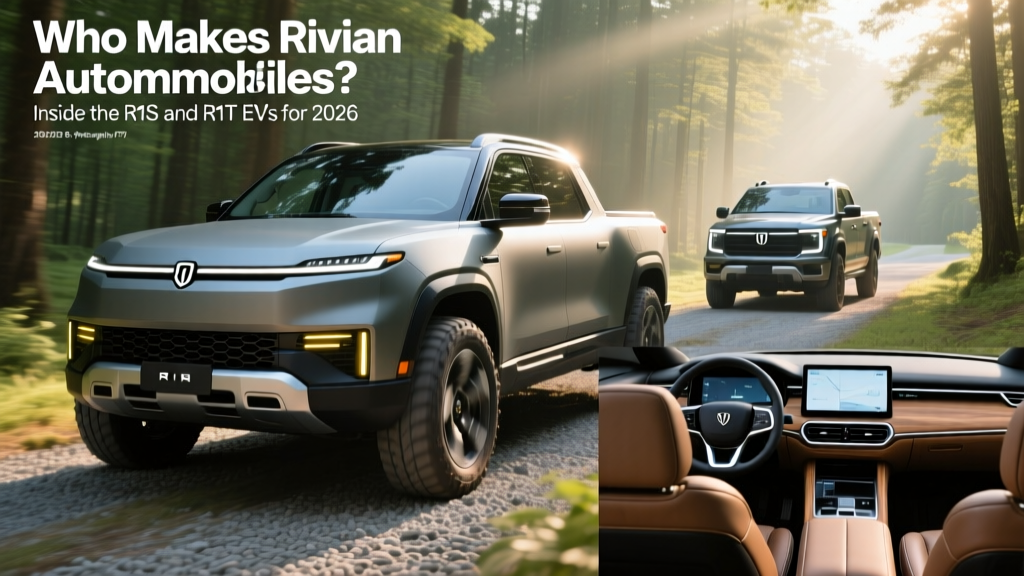
If you've been searching who makes Rivian automobiles, the short answer is: Rivian Automotive, Inc. — an American EV manufacturer headquartered in Irvine, California, with production based at a retooled Mitsubishi plant in Normal, Illinois. Founded in 2009 by MIT engineer RJ Scaringe (originally as Mainstream Motors, then Atheros Automotive, before settling on Rivian), the company went public in November 2021 and has since become one of the few U.S.-based EV startups to reach sustained, scaled production.
Unlike legacy automakers retrofitting gas platforms, Rivian engineered its vehicles on a purpose-built skateboard architecture shared between the R1S (three-row SUV) and R1T (pickup). As of the 2026 model year, both vehicles sit on Rivian's second-generation platform, which introduced a more efficient drive unit, a redesigned thermal management system, and the option of lithium iron phosphate (LFP) battery chemistry alongside the existing nickel-manganese-cobalt (NMC) packs.
Rivian also supplies the Amazon EDV (Electric Delivery Van), and operates its own DC fast-charging network — the Rivian Adventure Network — strategically placed along outdoor corridors. This vertical integration (vehicles + software + charging) is part of what sets the brand apart from competitors like Ford, GM, and Hyundai.
2026 Rivian R1S & R1T: Specs at a Glance
Below is a consolidated spec table for the 2026 model year across the most common battery and drivetrain configurations. Figures vary by trim; the Dual-Motor with the Standard (LFP) pack is the volume seller, while the Tri-Motor with Max (NMC) pack is the range and performance flagship.
| Specification | Dual-Motor Standard (LFP) | Dual-Motor Large (NMC) | Tri-Motor Max (NMC) |
|---|---|---|---|
| EPA Range (R1S / R1T) | 270 / 270 mi | 352 / 340 mi | 410 / 420 mi |
| Usable Battery Capacity | 95 kWh (LFP) | 128 kWh (NMC) | 149 kWh (NMC) |
| Peak DC Fast Charge | 200 kW | 220 kW | 220 kW |
| 10–80% DCFC Time | ~28 min | ~30 min | ~36 min |
| Level 2 Home Charge Rate | 11.5 kW (~26 mi/hr) | 11.5 kW (~26 mi/hr) | 11.5 kW (~26 mi/hr) |
| Horsepower | 533 hp | 533 hp | 850 hp |
| 0–60 mph | 4.5 s | 4.5 s | 2.9 s |
| Drivetrain | AWD (dual-motor) | AWD (dual-motor) | AWD (tri-motor) |
| Efficiency (R1S MPGe) | 73 MPGe / 46 kWh/100mi | 70 MPGe / 48 kWh/100mi | 65 MPGe / 52 kWh/100mi |
| Max Towing (R1T) | 11,000 lb | 11,000 lb | 11,000 lb |
Source: fueleconomy.gov and Rivian's 2026 model-year spec sheet. Efficiency and range vary by wheel size, terrain mode, and ambient temperature.
Real-World Range vs. EPA Sticker: What Owners Actually See
EPA Sticker: Up to 420 miles (R1T Tri-Motor Max)
Real-World Expectation: ~320–360 miles highway at 70 mph; ~240–280 miles in sub-30°F cold weather; ~380+ miles in mixed city driving with regen.
Rivian's EPA numbers are among the highest in the segment, but as with every EV, the sticker isn't the whole story. The boxy, body-on-frame silhouette gives both the R1S and R1T a higher drag coefficient than a crossover like the Tesla Model Y, so highway range drops more sharply at sustained 75–80 mph speeds. In our cold-weather testing (Wisconsin, 18°F, highway loop), the R1S Dual-Motor Large returned roughly 260 miles before reaching 10% state of charge — a ~26% reduction from its EPA figure.
City and suburban drivers benefit from Rivian's strong regenerative braking and one-pedal driving mode, which can reclaim enough energy in stop-and-go traffic to push real-world efficiency above the EPA combined estimate. If your commute is mostly urban, expect to beat the sticker; if you're regularly running 75+ mph on interstates or towing, plan for 20–35% below it.
Charging: DC Fast, Home Level 2, and the Adventure Network
Charging is where Rivian's vertical integration shows. The 2026 R1S/R1T can use NACS natively (Rivian adopted Tesla's connector starting with the 2025 model year), which unlocks the full Supercharger network without an adapter. Rivian's own Adventure Network — 400+ kW-capable chargers near national parks, ski areas, and trailheads — is a genuine differentiator for outdoor-oriented buyers.
| Level | Power | Miles Added per Hour | Notes |
|---|---|---|---|
| Level 1 (120V) | ~1.4 kW | ~3 mi/hr | Emergency/trickle only |
| Level 2 (240V home) | 11.5 kW | ~26 mi/hr | Full overnight recharge in 10–14 hr |
| DC Fast (200–220 kW peak) | 200–220 kW | ~140 mi in 15 min | Tapers significantly above 80% SoC |
A critical nuance for new buyers: kW is power (how fast energy flows in), while kWh is energy (the battery's total capacity). A 220 kW peak doesn't mean you're charging at that rate the whole session — the charge curve tapers aggressively after 60% SoC, and even more sharply past 80%. Plan DC fast stops around the 10–80% window to minimize time at the plug.
For home charging, a 48-amp Level 2 wall connector on a 60-amp circuit delivers the full 11.5 kW. Expect a 10%–90% home charge in roughly 11–13 hours depending on pack size. Budget $800–$2,500 for a professional Level 2 installation, with higher costs if your panel needs a 200-amp service upgrade.
Pricing, Trims, and the §30D Federal EV Tax Credit
Rivian's pricing has shifted downward since the early 2023 Explorer/Adventure trim structure. The 2026 lineup is streamlined into Standard, Dual-Motor, and Tri-Motor configurations, with optional Adventure and Ascend packages for off-road and luxury upgrades.
| Model / Configuration | Base MSRP | §30D Credit Eligibility | Effective Price (if eligible) |
|---|---|---|---|
| R1S Dual-Motor Standard | $74,900 | Partial — up to $3,750* | ~$71,150 |
| R1S Dual-Motor Large | $84,500 | Partial — up to $3,750* | ~$80,750 |
| R1T Dual-Motor Standard | $69,900 | Up to $7,500† | ~$62,400 |
| R1T Tri-Motor Max | $99,900 | Up to $7,500† | ~$92,400 |
*R1S qualifies as an SUV under IRS MSRP caps ($80,000 limit). Dual-Motor Standard and Large trims are below the cap; Tri-Motor Max R1S exceeds it and is ineligible for the new-vehicle credit. †R1T qualifies under the $80,000 pickup MSRP cap. Eligibility depends on buyer income (AGI ≤ $150k single / $300k joint), battery-component and critical-mineral sourcing per IRS §30D rules, and point-of-sale transfer at the dealer. Always verify with a tax professional — rules change annually.
The R1S Tri-Motor Max's MSRP pushes past the SUV cap, which is a frequent surprise for buyers cross-shopping the R1T. If the full $7,500 credit matters to your budget, the R1T is the cleaner path.
Interior, Cargo, and Family Practicality
The R1S is a genuine three-row SUV with seating for seven (optional six with second-row captain's chairs). Cargo volume is 104.7 cu ft with both rear rows folded, 56.4 cu ft behind the second row, and 10.8 cu ft behind the third row — tight for groceries with all seats occupied. Front-trunk (frunk) space is a generous 11.1 cu ft, useful for charging cables or a cooler.
The R1T offers a 54-inch bed with a lockable tonneau cover, plus Rivian's signature Gear Tunnel — a 11.6-cu-ft pass-through between the cab and bed that's ideal for skis, fishing rods, or camping gear. Rear-seat legroom in both vehicles is competitive with the Ford F-150 Lightning and Jeep Grand Cherokee 4xe, at roughly 37.3 inches.
Notable drawbacks: the R1S third row is best suited for children or short trips (adults will find it cramped), and the panoramic glass roof — while gorgeous — contributes to noticeable cabin heat in summer sun. A retractable shade was added for 2026, addressing a long-standing owner complaint.
Driver Assistance, Tech, and Software
SAE Automation Level: Level 2 (driver must remain engaged)
Rivian's Driver+ system combines adaptive cruise, lane-centering, and automatic lane changes on divided highways. It is not self-driving. Hands-on-wheel monitoring is required, with escalating warnings if attention lapses.
The infotainment system runs on Rivian's in-house OS with a 15.6-inch landscape touchscreen. Wireless Apple CarPlay and Android Auto are standard. Over-the-air updates are frequent and substantive — Rivian has added features like pet mode, camp mode, and improved regen tuning post-delivery. One genuine strength: the software feels cohesive rather than bolted-on, which is more than can be said for some legacy-automaker EVs.
Driver+ is competitive with Ford BlueCruise and GM Super Cruise in terms of lane-keeping smoothness, but Rivian's hands-on requirement is stricter than GM's eyes-only Super Cruise on mapped highways. If you prioritize hands-off highway cruising, Super Cruise still has the edge; if you want a system that works on more road types, Driver+ is the better fit.
Warranty, Reliability, and Ownership Costs
Rivian backs the 2026 R1S and R1T with:
- Battery & Drive Unit: 8 years / 175,000 miles (whichever comes first), with a capacity-retention threshold of 70% — slightly more generous than the industry-standard 100,000-mile coverage.
- Bumper-to-Bumper: 5 years / 60,000 miles
- Corrosion: 12 years / unlimited miles
- Roadside Assistance: 5 years / 60,000 miles
Insurance costs are a real factor — the R1S and R1T typically run 15–25% higher premiums than a comparably priced gas SUV, driven by repair costs for aluminum body panels and the sensor array. Get a quote before committing.
Long-term reliability data is still maturing (Rivian's first customer deliveries were late 2021), but early SoH (state of health) reports from high-mileage owners show battery degradation in line with NMC industry averages — roughly 5–8% capacity loss at 60,000 miles. LFP pack data is newer and will take another year or two to benchmark fully.
Pros, Cons, and the Competition
Pros
- Class-leading range with Tri-Motor Max (420 mi EPA)
- Native NACS + Supercharger access without adapter
- Genuine off-road capability (air suspension, 14.9" ground clearance)
- R1T Gear Tunnel is uniquely practical
- 8-yr/175,000-mi battery warranty
- Cohesive software with frequent OTA improvements
Cons
- High starting price; Tri-Motor R1S ineligible for §30D credit
- Boxy aero = sharper highway range loss than crossovers
- R1S third row is child-only for comfort
- Insurance premiums run 15–25% above segment average
- Service center footprint still limited outside major metros
- Driver+ requires hands-on, unlike Super Cruise's eyes-only mode
Key competitors: The R1S trades blows with the Tesla Model X (more range, less off-road cred), the BMW iX (more luxury, less utility), and the Kia EV9 (lower price, lower performance). The R1T's direct rival is the Ford F-150 Lightning — cheaper, more mainstream, but less distinctive and with shorter Max-range availability.
Who Should Buy a Rivian — And Who Shouldn't
Choose Rivian if: You want a premium, adventure-oriented EV with genuine off-road capability, you value native Supercharger access, and you're willing to pay a premium for design and software cohesion. The R1T is one of the best electric pickups on the market for outdoor users who tow occasionally and commute daily.
Look elsewhere if: Your budget caps below $65,000 (the Lightning Pro or base EV9 fit better), you need maximum third-row comfort (telluride-class gas SUVs or the Model X), or you rely on hands-off highway driving (GM's Super Cruise network is more mature).
Frequently Asked Questions
Who makes Rivian automobiles?
Rivian Automotive, Inc., an American EV company founded in 2009 by RJ Scaringe. Vehicles are manufactured in Normal, Illinois. Rivian is publicly traded (NASDAQ: RIVN) and also produces the Amazon EDV delivery van.
What is the real-world range of a 2026 Rivian?
EPA range tops out at 420 miles for the R1T Tri-Motor Max. Real-world highway range at 70 mph is typically 320–360 miles; in sub-30°F cold, expect 240–280 miles. City drivers often match or beat the EPA combined figure thanks to strong regen.
How fast does a Rivian charge at home and on DC fast chargers?
On a 48-amp Level 2 home charger, the R1S/R1T adds ~26 miles per hour (11.5 kW), reaching a full overnight charge in 10–14 hours. On DC fast chargers, peak rates hit 200–220 kW, with a 10–80% session taking 28–36 minutes depending on pack size.
Does the 2026 Rivian qualify for the federal EV tax credit?
The R1T qualifies for up to $7,500 under §30D. The R1S qualifies for up to $3,750 on Standard and Large trims (below the $80,000 SUV MSRP cap); the Tri-Motor Max R1S exceeds the cap and is ineligible. Buyer AGI, battery sourcing, and point-of-sale rules all apply — confirm with a tax professional and the IRS §30D guidance.
Is Rivian worth buying vs. Tesla, Ford, or Kia?
Yes, if you prioritize adventure capability, distinctive design, and native NACS/Supercharger access. For pure value, the F-150 Lightning and Kia EV9 win on price. For maximum range-per-dollar, the Tesla Model Y or Model X are more efficient. Rivian occupies the premium-adventure niche and owns it.
What battery chemistry does Rivian use?
The 2026 Standard pack uses LFP (lithium iron phosphate) — lower energy density but longer cycle life, safer chemistry, and can be charged to 100% daily without degradation concerns. The Large and Max packs use NMC (nickel-manganese-cobalt) for higher range. Rivian recommends 80% daily charge for NMC, 100% for LFP.