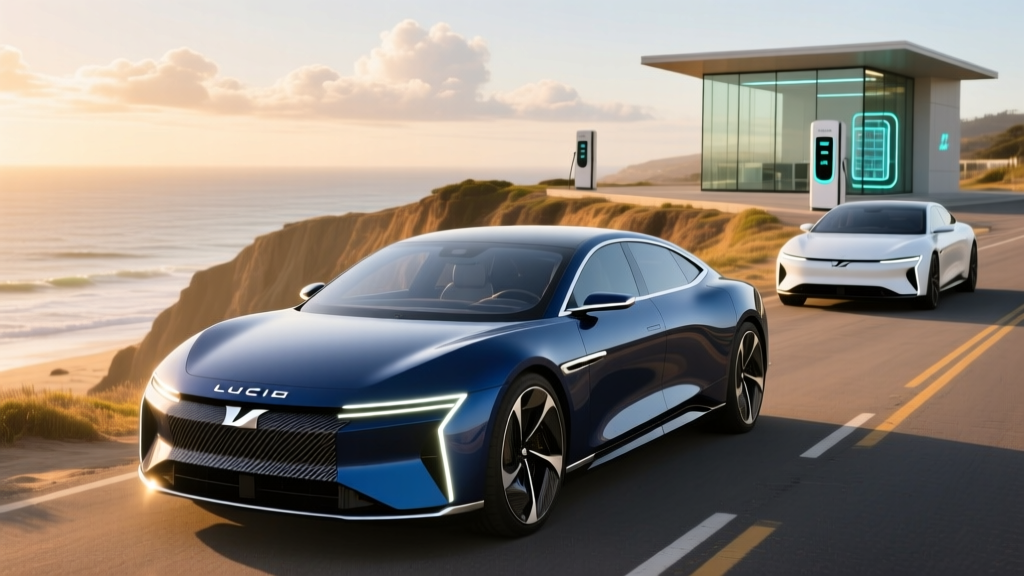
If you've seen a sleek, low-slung sedan silently passing on the highway and wondered who makes a Lucid car, the answer is Lucid Group, Inc. — an American EV manufacturer headquartered in Newark, California, with a state-of-the-art assembly plant in Casa Grande, Arizona. Founded in 2007 as Atieva (originally a battery-technology company), Lucid pivoted to full vehicle production and began delivering its first luxury sedan, the Lucid Air, in late 2021. The company is publicly traded on NASDAQ under the ticker LCID and is backed in part by Saudi Arabia's Public Investment Fund.
Unlike legacy automakers retrofitting gas-car platforms, Lucid engineered its vehicles from the ground up around proprietary miniaturized electric powertrain technology. The result is a lineup that consistently leads the industry in efficiency (miles per kWh) and EPA-verified range. For 2026, Lucid offers the Air sedan across four main trims and is preparing to launch the Gravity SUV. Here's everything buyers need to know about the company, its cars, and whether one belongs in your driveway.
Lucid Motors at a Glance: Company Profile
Lucid Group designs, manufactures, and sells luxury electric vehicles. The company's vertically integrated approach means it builds its own battery packs, electric motors, inverters, and software in-house. Key facts:
- Founded: 2007 (as Atieva); renamed Lucid Motors in 2016
- Headquarters: Newark, California
- Manufacturing: AMP-1 (Advanced Manufacturing Plant) in Casa Grande, Arizona — designed to scale to over 400,000 vehicles annually
- CEO: Marc Winterhoff (interim, as of early 2026)
- Current production vehicles: Lucid Air sedan (2022–present), Lucid Gravity SUV (2025–present)
- Key investor: Saudi Arabia's Public Investment Fund (majority stake)
- NASDAQ ticker: LCID
Lucid also supplies battery technology to other industries, including a partnership with Aston Martin for that brand's upcoming EVs, and has a deal to supply battery packs for marine applications. This diversification signals engineering depth beyond just one vehicle platform.
2026 Lucid Air: Full Model Lineup & Specifications
The Lucid Air is a full-size luxury sedan competing against the Tesla Model S, Mercedes-Benz EQS, BMW i7, and Porsche Taycan. For 2026, the lineup spans from the accessible Pure trim to the record-breaking Sapphire performance variant. Below is the complete spec breakdown.
| Spec | Air Pure | Air Touring | Air Grand Touring | Air Sapphire |
|---|---|---|---|---|
| Base MSRP | $69,900 | $77,900 | $94,900 | $249,000 |
| Drivetrain | RWD (single motor) | AWD (dual motor) | AWD (dual motor) | AWD (tri-motor) |
| Horsepower | 430 hp | 620 hp | 819 hp | 1,234 hp |
| 0–60 mph | 5.0 sec | 3.4 sec | 3.0 sec | 1.89 sec |
| EPA Range | 419 mi | 425 mi | 516 mi | 427 mi |
| Battery (usable) | 88 kWh (NMC) | 112 kWh (NMC) | 112 kWh (NMC) | 118 kWh (NMC) |
| EPA Efficiency | 146 MPGe / 23 kWh/100mi | 131 MPGe / 26 kWh/100mi | 131 MPGe / 25 kWh/100mi | 105 MPGe / 32 kWh/100mi |
| Max DC Fast Charge | 200 kW | 300 kW | 300 kW | 300 kW |
| 10–80% DC Time | ~34 min | ~20 min | ~20 min | ~22 min |
| Level 2 Home Charge | 19.2 kW (~82 mi/hr) | 19.2 kW (~82 mi/hr) | 19.2 kW (~82 mi/hr) | 19.2 kW (~82 mi/hr) |
| Cargo (trunk + frunk) | 32 cu ft total | 32 cu ft total | 32 cu ft total | 32 cu ft total |
| Rear Legroom | 41.5 in | 41.5 in | 41.5 in | 41.5 in |
All trims ride on Lucid's proprietary 900-volt electrical architecture, which enables the class-leading DC fast-charging speeds and contributes to lighter wiring harnesses (and thus lower vehicle weight). The Air uses NMC (nickel manganese cobalt) lithium-ion cells sourced primarily from Samsung SDI and LG Energy Solution, packaged in Lucid's own structural battery enclosure.
Real-World Range: What the EPA Number Doesn't Tell You
The Lucid Air Grand Touring's 516-mile EPA estimate is the highest of any production EV sold in the U.S. However, EPA range is derived from a mix of city and highway cycles with generous assumptions. Here's what to actually expect:
- City / moderate-speed driving (55–65 mph): 470–510 miles achievable in mild weather — the Air's efficiency shines at lower speeds thanks to exceptional aero (Cd 0.20)
- Highway at 75–80 mph: Expect 380–420 miles — sustained high speeds increase aerodynamic drag significantly
- Cold weather (below 32°F): Plan for 320–380 miles — NMC chemistry loses 15–25% capacity in freezing temps, even with the Air's heat pump and battery preconditioning
- Mountain / high-elevation driving: Range varies dramatically; regenerative braking on descents can partially offset uphill losses
For the Air Pure (419 mi EPA), real-world highway range typically lands between 340 and 380 miles. The Air Pure's smaller 88 kWh battery and single-motor RWD configuration make it slightly less efficient at highway speeds than the dual-motor trims but far more efficient in city driving.
The Air's efficiency is genuinely best-in-class. At roughly 23–26 kWh per 100 miles (depending on trim), it extracts more miles per kilowatt-hour than the Tesla Model S (~28 kWh/100mi), the Mercedes EQS (~31 kWh/100mi), and the BMW i7 (~33 kWh/100mi). This means lower electricity costs per mile and less time at chargers — a tangible ownership advantage you feel every week. For verified efficiency data, see the EPA's fueleconomy.gov comparison tool.
Charging Speed: Home, Public DC, and the 900V Advantage
Lucid's 900-volt architecture is one of the highest in production (most EVs use 400V; the Porsche Taycan and Hyundai Ioniq 5 use 800V). Higher voltage means the car can accept more power at lower current, reducing heat and enabling faster charging. Here's how the Air charges across all three levels:
| Charging Level | Power (kW) | Speed | Notes |
|---|---|---|---|
| Level 1 (120V household) | ~1.4 kW | ~3–4 mi/hr | Emergency/trickle only; full charge takes days |
| Level 2 (240V home, 48A) | 11.5 kW | ~50 mi/hr | Standard NEMA 14-50 or hardwired; full charge overnight |
| Level 2 (240V, 80A) | 19.2 kW | ~82 mi/hr | Requires 100A circuit; fastest home option — Lucid's Connected Home charger supports this |
| DC Fast (peak) | Up to 300 kW | ~200+ mi in 12 min | Touring/GT/Sapphire; peak rate sustained to ~50% SoC, then tapers |
| DC Fast (Pure trim) | Up to 200 kW | ~150 mi in 15 min | Smaller battery limits peak acceptance rate |
Charging curve reality check: Like all EVs, the Air does not sustain its peak 300 kW rate for the entire session. The 300 kW peak is available roughly between 10–50% State of Charge. From 50–80%, the rate tapers to approximately 150–180 kW. Above 80%, charging slows dramatically to protect battery health — expect 30–50 kW. The advertised 10–80% time of ~20 minutes assumes a 350 kW-capable CCS or NACS charger with battery preconditioning activated via navigation routing.
For home charging, most Air owners install a 60A or 100A 240V circuit. A 60A circuit (48A continuous) delivers 11.5 kW, adding roughly 50 miles of range per hour — enough to fully replenish even the 112 kWh battery overnight. If your electrical panel has capacity for a 100A circuit, the 19.2 kW option provides an exceptional ~82 miles per hour. Expect home charger installation to cost $1,200–$3,500 depending on panel upgrades and wiring distance, performed by a licensed electrician.
The Air ships with a CCS1 charge port. Lucid has announced NACS (Tesla Supercharger) adapter availability, and future model-year Airs may ship with native NACS ports as the industry transitions. Check current adapter compatibility on Lucid's official site before relying on the Supercharger network.
Performance and Driving Dynamics
Every Lucid Air delivers performance that would have been supercar territory a decade ago, but the trims serve very different purposes:
Air Pure (RWD, 430 hp): The entry point is no slouch. A 5.0-second 0–60 time beats most V6 luxury sedans, and the single-motor rear-drive layout gives the Pure a lighter, more agile feel through corners. For daily commuting and highway cruising, the Pure's power is more than adequate.
Air Touring (AWD, 620 hp): Dual-motor all-wheel drive drops the 0–60 to 3.4 seconds. The Touring adds confident all-weather traction and stronger passing performance. This is the volume trim for buyers who want luxury, range, and genuine speed without the Grand Touring price.
Air Grand Touring (AWD, 819 hp): The range champion also hits 60 mph in 3.0 seconds. Lucid's Wunderbox powertrain inverter technology enables the Grand Touring to deliver repeatable hard launches without thermal derating — a weakness of some competitors. On a twisty canyon road, the GT's adaptive air suspension and low center of gravity (battery pack under the floor) keep body roll minimal despite the sedan's 5,000+ lb curb weight.
Air Sapphire (Tri-motor AWD, 1,234 hp): Lucid's halo model. The 1.89-second 0–60 time makes it one of the quickest production cars ever built, rivaling the Rimac Nevera and Bugatti Chiron. Two motors on the rear axle enable torque vectoring, giving the Sapphire genuine track capability — not just straight-line speed. It includes carbon-ceramic brakes, unique suspension tuning, and a dedicated Sapphire drive mode. Production is limited, and the $249,000 price reflects its exclusivity.
Pricing, Trims, and Federal Tax Credit Eligibility
Lucid positions the Air as a premium luxury EV, but the Pure trim has become increasingly competitive with mid-luxury sedans once incentives are factored in. Here's the current pricing landscape for 2026:
| Trim | Base MSRP | As-Tested (typical options) | Federal §30D Credit | Effective Price |
|---|---|---|---|---|
| Air Pure | $69,900 | $72,000–$75,000 | Up to $7,500* | ~$62,400–$67,500 |
| Air Touring | $77,900 | $80,000–$85,000 | Up to $7,500* | ~$70,400–$77,500 |
| Air Grand Touring | $94,900 | $97,000–$105,000 | Up to $7,500* | ~$87,400–$97,500 |
| Air Sapphire | $249,000 | $249,000+ | Not eligible (MSRP cap) | $249,000 |
The IRS §30D credit offers up to $7,500 for qualifying new EVs, but eligibility is not automatic. As of 2026, the following rules apply:
- MSRP cap: Sedans must be priced at or below $55,000. However, the Lucid Air qualifies under the higher $80,000 cap for SUVs/pickups/vans only if classified accordingly — as a sedan, only the Air Pure may qualify depending on final MSRP with options. Buyers should verify current classification on irs.gov.
- Buyer income limits: AGI must not exceed $300,000 (joint), $225,000 (head of household), or $150,000 (single) — based on the year of delivery or the prior year, whichever is lower.
- Battery sourcing requirements: The $7,500 credit splits into two halves ($3,750 each) — one for critical minerals sourcing and one for battery component manufacturing. Lucid's battery supply chain (Samsung SDI/LG cells) has been evolving to meet North American sourcing requirements; check the DOE's qualifying vehicle list before purchasing.
- Point-of-sale transfer: Since 2024, buyers can transfer the credit to the dealer at purchase, receiving the discount upfront rather than waiting to claim it on their tax return. Lucid participates in this program.
Consult a tax professional before relying on credit eligibility. Rules change, and your individual tax situation determines whether you can use a non-refundable credit.
Interior, Technology, and Daily Livability
The Air's cabin is defined by space, glass, and screens. The sedan's 126.5-inch wheelbase — longer than a Mercedes S-Class — translates to limousine-like rear legroom (41.5 inches). The glass canopy roof floods the cabin with light and creates an airy, open feeling rare in sedans.
Infotainment: Lucid's glass cockpit display spans 34 inches in a curved 6K resolution panel floating above the dashboard. A secondary lower touchscreen handles climate, media, and vehicle settings. The system runs Lucid's custom OS — visually striking but less app-rich than Tesla's ecosystem. Wireless Apple CarPlay and Android Auto are not natively supported (a common complaint), though Lucid has been adding functionality via OTA updates. Navigation, streaming media, and a 21-speaker Surreal Sound audio system (by Dolby Atmos) are integrated.
Driver Assistance: The Air comes standard with Lucid's DreamDrive Pro ADAS suite, which includes:
- Adaptive cruise control with stop-and-go
- Lane centering assist
- Blind-spot monitoring with rear cross-traffic alert
- 360-degree surround-view camera
- Automatic emergency braking (front/rear/pedestrian)
Lucid's DreamDrive Pro is an SAE Level 2 driver-assistance system. This means the driver must remain fully engaged, keep hands on the wheel (or demonstrate attention), and supervise the vehicle at all times. It is not autonomous driving. Competing Level 2 systems include Tesla Autopilot, Ford BlueCruise, and GM Super Cruise. Lucid has not yet released a hands-free highway driving feature comparable to BlueCruise or Super Cruise, though hardware for future upgrades is included in all Air models.
Cargo: The Air offers 32 cubic feet of combined cargo space (trunk + front trunk/frunk). The trunk is wide and deep at approximately 22 cu ft, with a power-operated lid. The frunk adds roughly 10 cu ft — useful for charging cables, a gym bag, or groceries. This exceeds the Tesla Model S (26 cu ft combined) and is competitive with the Mercedes EQS (22 cu ft trunk, no frunk).
Notable drawbacks: The Air's infotainment, while beautiful, lags behind Tesla and even newer BMW/Porsche systems in responsiveness and app availability. Rear-seat visibility is compromised by the sloping roofline and thick C-pillars. Some owners report that the Air's wide footprint (78.3 inches without mirrors) makes tight parking garages challenging. And the service center network, while growing, remains far smaller than Tesla's — buyers in rural areas should check proximity to a Lucid service location or mobile service availability.
Warranty and Long-Term Ownership
Lucid backs the Air with a competitive warranty package:
- Basic vehicle warranty: 4 years / 50,000 miles
- Battery & powertrain warranty: 8 years / 100,000 miles (covers battery capacity retention above 70% of original capacity)
- Roadside assistance: 4 years / 50,000 miles
- OTA updates: Continuous over-the-air software improvements included at no cost
The 8-year/100,000-mile battery warranty is standard for the luxury EV segment (Tesla offers 8 yr/150,000 mi on the Model S). The 70% capacity retention threshold is typical — if the battery degrades below 70% of its original kWh within the warranty period, Lucid will repair or replace it. Real-world data from early 2022–2024 Air owners suggests degradation has been minimal, with most reporting 95%+ State of Health after 30,000–50,000 miles, though long-term data (100,000+ miles) is still accumulating.
Maintenance costs are low relative to gas-powered luxury sedans. There are no oil changes, spark plugs, or transmission fluid services. Expect to replace cabin air filters ($100–$200), brake fluid (every 2–3 years), and tires (the Air's weight and torque can wear tires faster than ICE cars — budget $1,500–$2,500 for a set of premium tires every 25,000–40,000 miles depending on driving style).
Insurance is a real cost factor. The Air's high repair costs (aluminum body, specialized glass roof, expensive battery pack) push premiums above the segment average. Expect annual insurance costs of $2,800–$4,500 depending on trim, driving record, and state. Get quotes before committing to a purchase.
Lucid Air vs. Key Competitors: Is It Worth Buying?
The Air doesn't exist in a vacuum. Here's how it stacks up against the luxury EV sedan competition on the metrics that matter:
| Metric | Lucid Air GT | Tesla Model S LR | Mercedes EQS 580 | BMW i7 xDrive60 |
|---|---|---|---|---|
| EPA Range | 516 mi | 402 mi | 371 mi | 318 mi |
| Efficiency (kWh/100mi) | 25 | 28 | 31 | 33 |
| Max DC Charge | 300 kW | 250 kW | 200 kW | 195 kW |
| 0–60 mph | 3.0 sec | 3.1 sec | 4.1 sec | 4.5 sec |
| Starting MSRP | $94,900 | $74,990 | $104,400 | $119,300 |
| Rear Legroom | 41.5 in | 35.4 in | 41.7 in | 42.8 in |
The Air Grand Touring wins on range and efficiency by a wide margin. No competitor comes close to 516 miles, and the Air's 25 kWh/100mi efficiency means you spend less on electricity per mile than in any rival. The 300 kW charging speed is also best-in-class among sedans (the Porsche Taycan matches it but with a much smaller battery and less range).
Where competitors win: The Tesla Model S has a vastly larger Supercharger network and more mature software/service infrastructure. The Mercedes EQS and BMW i7 offer more traditional luxury interiors with richer material quality, more physical controls, and stronger dealer networks for service. If infotainment polish and service convenience are top priorities, the German sedans have an edge. If range, efficiency, and performance-per-dollar dominate your decision, the Air is difficult to beat.
Pros
- Industry-leading EPA range (516 mi on Grand Touring)
- Best-in-class efficiency (lowest kWh/100mi)
- 300 kW DC fast charging on 900V architecture
- Massive rear legroom and cargo space for a sedan
- Sapphire variant offers hypercar performance (1.89s 0–60)
- Standard DreamDrive Pro ADAS with comprehensive sensor suite
- Arizona-built, American-manufactured vehicle
Cons
- Infotainment lacks Apple CarPlay/Android Auto
- Service center network still limited outside major metros
- Tax credit eligibility uncertain due to MSRP caps and battery sourcing rules
- Wide body (78.3 in) challenging in tight urban parking
- No hands-free Level 2+ highway driving feature yet
- Insurance premiums above segment average
- Brand is young — long-term resale value unproven vs. Porsche/Mercedes
Who Should Buy a Lucid Air?
The Lucid Air is best suited for:
- Range-priority road trippers: If you regularly drive 300+ miles between stops and want to minimize charging anxiety, the Air Grand Touring's 516-mile EPA range is unmatched. You can drive from Los Angeles to San Francisco on a single charge in moderate conditions.
- Tech-forward luxury buyers: The Air's glass canopy, curved 34-inch display, and Dolby Atmos audio create a futuristic cabin experience that traditional luxury sedans can't match.
- Performance seekers who want subtlety: The Air looks like an elegant sedan, not a track weapon — but the Grand Touring and Sapphire deliver supercar acceleration when you want it.
- Efficiency-minded EV owners: The Air's class-leading kWh/100mi means lower electricity bills and a smaller upstream carbon footprint per mile driven.
The Air is less ideal for buyers who prioritize service convenience (Tesla's network is vastly larger), those who need CarPlay/Android Auto integration, or buyers in rural areas far from a Lucid service center. If you need a third row or significant towing capacity, wait for the Lucid Gravity SUV review instead.
Frequently Asked Questions
Who makes a Lucid car and where are they built?
Lucid cars are made by Lucid Group, Inc., an American EV company headquartered in Newark, California. All Lucid Air vehicles are assembled at the company's AMP-1 manufacturing plant in Casa Grande, Arizona. Lucid was founded in 2007 and began delivering vehicles in 2021. The Saudi Arabia Public Investment Fund is the company's largest shareholder.
What is the real-world range of the Lucid Air?
The EPA-rated range spans from 419 miles (Air Pure) to 516 miles (Air Grand Touring). In real-world highway driving at 75–80 mph, expect 340–420 miles depending on trim. In freezing weather, subtract 15–25%. The Air's exceptional efficiency (23–26 kWh/100mi) means real-world range is closer to the EPA sticker than most competing EVs.
How fast does the Lucid Air charge at home and on DC fast chargers?
On a DC fast charger, the Air Touring, Grand Touring, and Sapphire can accept up to 300 kW, achieving a 10–80% charge in approximately 20 minutes with battery preconditioning. The Air Pure peaks at 200 kW (~34 min, 10–80%). At home on a 240V/48A Level 2 charger, the Air adds roughly 50 miles of range per hour; on an 80A circuit, it adds ~82 miles per hour.
Does the Lucid Air qualify for the $7,500 federal EV tax credit?
Eligibility depends on trim, final MSRP, buyer income, and battery-sourcing requirements. Under IRS §30D rules, new sedans must have an MSRP at or below $55,000 to qualify — which may disqualify most Air trims at current pricing. However, classification and sourcing rules evolve. Always check the latest qualifying vehicle list at fueleconomy.gov and consult a tax professional before purchasing. The Air Sapphire ($249,000) definitively does not qualify.
Is the Lucid Air worth buying over a Tesla Model S or Mercedes EQS?
If range, efficiency, and charging speed are your top priorities, the Air Grand Touring is objectively the best sedan in its class — 516 EPA miles and 300 kW charging have no rival. However, Tesla wins on Supercharger network access and service infrastructure, while the Mercedes EQS and BMW i7 offer more traditional luxury materials and larger dealer networks. Test-drive all three before deciding.
What is Lucid's battery warranty?
Lucid covers the Air's battery and powertrain for 8 years or 100,000 miles, whichever comes first. The warranty guarantees the battery will retain at least 70% of its original capacity during that period. The basic vehicle warranty is 4 years / 50,000 miles.
Is Lucid a reliable brand?
Lucid is a young automaker (delivering since 2021), so long-term reliability data is still limited. Early owner surveys and forums report typical startup-company issues — software bugs, panel gap inconsistencies, and occasional parts delays. However, the powertrain and battery have been largely trouble-free. Lucid's growing service network and mobile service vans are improving the ownership experience, but buyers should expect some friction compared to buying from a century-old luxury brand.