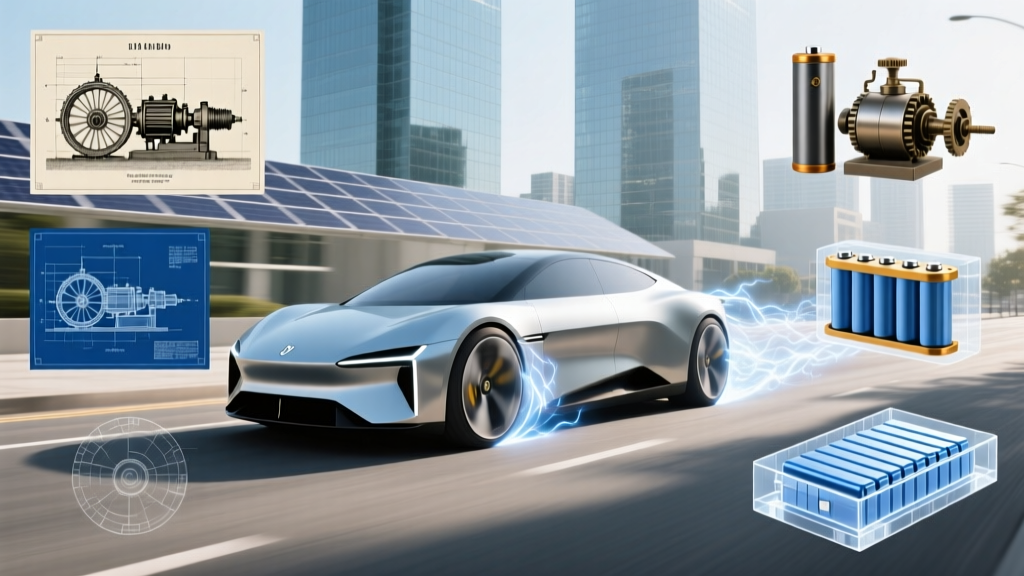
The electric motor powering your 2026 EV didn't emerge from a single genius in a garage. It's the result of nearly two centuries of iteration by multiple inventors across three continents. Understanding this history isn't academic trivia — it explains why modern EVs use either permanent-magnet synchronous motors (PMSM) or AC induction motors, why their efficiencies hit 85–97%, and why your choice of vehicle still comes down to battery chemistry, charging access, and total cost of ownership.
Quick Answer: Who Invented the Electric Motor?
Hungarian engineer Ányos Jedlik built the first rudimentary electric motor in 1828. American blacksmith Thomas Davenport patented the first practical DC electric motor in 1837. Nikola Tesla invented the AC induction motor in 1887, which became the foundation for modern industrial and EV propulsion. Today's EVs use evolved descendants of these designs — either AC induction or permanent-magnet synchronous motors.
The Inventors Who Built the Electric Motor
The electric motor's origin story has no single protagonist. Multiple inventors contributed independent breakthroughs that, combined, produced the propulsion units now found in vehicles like the Tesla Model Y, Hyundai Ioniq 5, and Ford F-150 Lightning.
Ányos Jedlik (1828): A Hungarian physicist and Benedictine monk, Jedlik constructed a small device he called an "electromagnetic self-rotor" — widely recognized as the first functioning electric motor. It demonstrated continuous rotation from electromagnetic force, though it lacked the power for practical application.
Thomas Davenport (1837): An American blacksmith from Vermont, Davenport received U.S. Patent No. 132 for the first practical DC electric motor. He used it to power a small model car on a circular track, making it arguably the first electric vehicle prototype — nearly a century before the modern EV era.
Michael Faraday (1821–1831): The English scientist demonstrated electromagnetic rotation in 1821 and discovered electromagnetic induction in 1831. While Faraday didn't build a motor per se, his laws of induction underpin every electric motor manufactured today.
Nikola Tesla (1887): Tesla's AC induction motor was the inflection point. By using alternating current and a rotating magnetic field, Tesla eliminated the need for the commutator and brushes that plagued DC motors. His design was more reliable, scalable, and efficient — and it's the direct ancestor of the AC induction motors still used in Tesla's Model S and Model X (as well as many industrial applications).
Galileo Ferraris (1885): The Italian physicist independently demonstrated a rotating magnetic field two years before Tesla's patent. While Tesla commercialized the AC motor, Ferraris contributed the theoretical foundation.
From 1887 to 2026: How Motor Tech Shapes Today's EVs
Modern EV motors are extraordinarily efficient — converting 85–97% of electrical energy into mechanical motion, compared to roughly 20–35% thermal efficiency in internal combustion engines. That efficiency gap is the core reason EVs cost less per mile to operate, and it traces directly back to the principles Tesla and Faraday established.
Today's EV market uses two dominant motor types:
| Motor Type | How It Works | Used In | Efficiency | Trade-offs |
|---|---|---|---|---|
| AC Induction (Tesla design descendant) | Rotating magnetic field induces current in rotor | Tesla Model S/X (front), older Model 3 RWD | ~90–95% | No rare-earth magnets; slightly less efficient at low speeds; excellent at high speed |
| Permanent-Magnet Synchronous (PMSM) | Rotor uses permanent magnets; stator field synchronizes | Tesla Model Y/3 (rear), Hyundai Ioniq 5, Ford F-150 Lightning, most 2026 EVs | ~93–97% | Higher efficiency, especially at low speeds; requires neodymium/dysprosium rare-earth magnets; supply-chain sensitivity |
| Externally Excited Synchronous (EESM) | Electromagnet rotor (no permanent magnets) | BMW iX, Renault Megane E-Tech, some Stellantis models | ~92–95% | Avoids rare earths; slightly more complex; competitive efficiency |
The choice of motor affects your real-world driving. PMSM motors deliver more torque at low RPM, which is why most 2026 EVs optimized for city and suburban driving use them. AC induction motors excel at sustained high-speed operation and don't require rare-earth materials — a supply-chain advantage that matters as global EV production scales.
The Real Numbers: What This History Means for Your Wallet
The motor's near-200-year evolution matters most when you look at what it costs to drive an EV versus a gas car in 2026. The motor's efficiency is the primary reason EVs win on fuel cost, even before incentives.
| Cost Factor | 2026 EV (e.g., Hyundai Ioniq 5 SEL, 318 mi EPA, 77.4 kWh battery) | Comparable Gas Car (e.g., 2026 Toyota RAV4 AWD, 30 MPG combined) | Annual Savings (EV) |
|---|---|---|---|
| Energy/Fuel Cost (15,000 mi/yr) | $580–$850 (home L2 at $0.13/kWh national avg) | $1,750 (at $3.50/gal) | $900–$1,170 |
| Energy/Fuel Cost (DCFC-heavy, $0.40/kWh) | $1,240 | $1,750 | $510 |
| Maintenance (annual avg) | $300–$500 (no oil, fewer brake replacements due to regen) | $800–$1,200 | $400–$700 |
| Insurance (annual avg) | $1,800–$2,400 (typically 10–20% higher than gas equivalents) | $1,500–$2,000 | −$300 to −$400 |
| 5-Year Total Energy + Maintenance | $4,500–$6,750 | $12,750–$14,750 | $6,000–$10,000 |
These savings assume home Level 2 charging at residential electricity rates. According to fueleconomy.gov, the Ioniq 5 achieves 114 MPGe combined — meaning it travels 114 miles on the energy equivalent of one gallon of gasoline. That efficiency is the direct result of motor design that would have seemed impossible in Davenport's era.
EV vs. Gas vs. Hybrid: The Decision Context
The electric motor's efficiency advantage doesn't automatically make an EV the right choice for every driver. The decision depends on charging access, driving patterns, climate, and budget.
| Factor | BEV (Battery Electric) | PHEV (Plug-in Hybrid) | HEV (Standard Hybrid) | Gas Car |
|---|---|---|---|---|
| Motor Efficiency | 85–97% | 85–97% (electric mode) | N/A (ICE-driven) | 20–35% |
| Real-World Range (2026 avg) | 250–350 mi EPA (200–300 mi highway) | 25–45 mi electric + 350–500 mi total | 450–600 mi | 350–500 mi |
| Home Charging Needed? | Strongly recommended (essential for daily convenience) | Recommended for EV-mode savings | No | No |
| Cold-Weather Impact | 15–30% range loss below 20°F | Reduced electric-only range; gas engine compensates | Minimal | Minimal |
| Upfront Cost (2026 avg) | $35,000–$65,000 (before incentives) | $35,000–$55,000 | $28,000–$45,000 | $25,000–$45,000 |
| Federal Tax Credit (§30D) | Up to $7,500 (subject to MSRP caps, income limits, battery sourcing — see IRS rules) | Up to $7,500 (same rules) | Not eligible | Not eligible |
| Best For | Home chargers, daily commutes under 250 mi, mild-to-moderate climates | Short electric commutes + long road trips; no reliable home charging | High-mileage drivers without charging access | Low-mileage, budget-first buyers |
Real-World Ownership: What First-Time Buyers Actually Face
Jedlik, Davenport, and Tesla solved the propulsion problem. The remaining challenges for 2026 EV buyers are infrastructure, cost, and expectations management.
Home Charging Installation: A Level 2 home charger (240V, 32–48 amps, 7.7–11.5 kW) costs $500–$1,500 for the unit plus $800–$3,000 for professional installation by a licensed electrician. If your home's electrical panel needs an upgrade from 100A to 200A service, add $1,500–$4,000. Total home charging setup: $1,300–$8,500 depending on your existing electrical infrastructure. This is the single biggest barrier for renters and condo owners.
Public Charging Reality: The U.S. public DC fast-charging network has expanded significantly, but reliability varies. Electrify America, EVgo, and ChargePoint stations average 80–90% uptime. Tesla's Supercharger network — now open to NACS-equipped non-Tesla EVs — remains the most reliable at ~95%+ uptime. If you rely exclusively on public charging, expect to pay $0.30–$0.55/kWh, reducing your cost advantage over gasoline.
Cold-Weather Range Loss: At 20°F, expect 15–30% range reduction due to battery chemistry limitations and cabin heating demands. An EV with a 318-mile EPA sticker may deliver 220–270 real-world miles in freezing conditions. Heat pumps (standard on most 2026 EVs including the Ioniq 5, Tesla Model Y, and VW ID.4) mitigate this by 5–10 percentage points compared to resistive heating.
Charging Curve Reality: Advertised peak DC fast-charge rates (e.g., "240 kW") are peak, not sustained. A typical 84 kWh battery charging at a 250 kW station will peak briefly, then taper. Expect 10–80% in 18–25 minutes for vehicles with 800V architecture (Ioniq 5, Kia EV6, Porsche Taycan) and 25–40 minutes for 400V vehicles. Above 80% SoC, charging slows dramatically to protect battery health.
Common Misconceptions About EV Motors and Ownership
| Myth | Fact |
|---|---|
| "Tesla invented the first electric motor." | Tesla invented the AC induction motor (1887), but Davenport patented a DC motor 50 years earlier. Modern EVs use both types. |
| "EV motors wear out like gas engines." | Electric motors have one moving part (the rotor) and no combustion. They routinely last 300,000+ miles with minimal maintenance. Battery degradation, not motor wear, is the longevity concern. |
| "EV batteries need replacing every 5 years." | Federal law mandates EV battery warranties of at least 8 years/100,000 miles. Real-world data from NHTSA and fleet operators shows most batteries retain 85–90% capacity at 150,000 miles. Full replacement costs $8,000–$20,000 but is rarely needed within the vehicle's life. |
| "All EVs qualify for the $7,500 tax credit." | The §30D credit has MSRP caps ($55,000 sedans, $80,000 SUVs/trucks), buyer income limits ($150K single/$300K joint), and critical-mineral/battery-component sourcing requirements. Many vehicles qualify for partial or no credit. Check current rules at irs.gov and consult a tax professional. |
| "EVs are worse for the environment because of electricity generation." | Even on coal-heavy grids, EVs produce fewer lifetime emissions than gas cars (Union of Concerned Scientists data). On grids with 50%+ renewables, the advantage is dramatic. Motor efficiency is why — 90%+ vs. 25%. |
Decision Framework: Should You Buy an EV, Hybrid, or Gas Car?
Choose a BEV (full electric) if:
- You can install a Level 2 charger at home (garage or driveway with 240V access)
- Your daily driving is under 250 miles round-trip
- You live in a mild-to-moderate climate (or can accept 20–30% winter range loss)
- You want the lowest per-mile fuel cost and minimal maintenance
- Your household income and chosen vehicle qualify for the §30D tax credit
Choose a PHEV (plug-in hybrid) if:
- Your commute is under 40 miles (covering most daily driving on electric-only mode)
- You take regular road trips beyond 300 miles and don't want to plan around chargers
- You have Level 2 access at home or work but live in an area with sparse public DCFC infrastructure
- You want EV-like daily driving with a gas-engine safety net
Choose an HEV (standard hybrid) if:
- You cannot install a home charger (apartment, street parking, condo restrictions)
- You drive 20,000+ miles per year and want fuel savings without plugging in
- You live in an extreme-cold climate where EV range loss would be consistently punishing
- Your budget is under $35,000 and you want proven, low-risk technology
Stick with a gas car if:
- You drive under 8,000 miles per year (fuel savings won't offset EV premium)
- You have no home or workplace charging access and public infrastructure in your area is unreliable
- You regularly tow heavy loads (EV towing dramatically reduces range by 40–60%)
The Motor That Made It All Possible
Ányos Jedlik's 1828 electromagnetic rotor was a laboratory curiosity. Thomas Davenport's 1837 patent proved the concept could move a vehicle. Nikola Tesla's 1887 AC induction motor made electric propulsion scalable and efficient. The permanent-magnet synchronous motors in most 2026 EVs are the latest evolution — achieving 97% efficiency, delivering instant torque, and requiring almost no maintenance over hundreds of thousands of miles.
The question "who invented the electric motor" doesn't have one answer. It has a lineage. And that lineage is the reason you can now drive 318 miles on 77.4 kWh of electricity, charge from 10–80% in 18 minutes at a 350 kW station, and spend $580 a year on fuel instead of $1,750. The inventors solved the physics. Your decision in 2026 is about infrastructure, budget, and driving patterns — not whether the technology works.
Frequently Asked Questions
Did Nikola Tesla invent the electric car?
No. Tesla invented the AC induction motor (1887), which is used in some EVs today. The first practical electric cars predate Tesla's motor — they used DC motors based on earlier designs. Tesla Motors (now Tesla, Inc.) was founded in 2003 and named in his honor, but Nikola Tesla himself never built a car.
Why do some EVs use induction motors and others use permanent-magnet motors?
AC induction motors avoid rare-earth magnets (reducing supply-chain risk and cost) and excel at high-speed efficiency. Permanent-magnet synchronous motors are more efficient at low and moderate speeds, which covers most daily driving. Many 2026 EVs use a combination: a PMSM on the rear axle for efficiency and an induction motor on the front axle for all-wheel-drive engagement without drag.
How long do EV motors last compared to gas engines?
EV motors routinely exceed 300,000 miles with essentially no maintenance beyond bearing inspection. Gas engines typically require major service or replacement between 150,000–250,000 miles. The limiting component in an EV is the battery, not the motor — and most 2026 EV batteries are warrantied for 8 years/100,000 miles with an expected useful life of 15–20 years.
What's the difference between kW and kWh in EVs?
kW (kilowatts) measures power — the rate of energy delivery, like how fast water flows from a hose. kWh (kilowatt-hours) measures energy — the total amount stored or consumed, like the total volume of water in a bucket. Your EV's battery capacity is in kWh (e.g., 77.4 kWh); its charging speed is in kW (e.g., 240 kW peak). Motor output is also in kW (e.g., 168 kW = 225 horsepower).
Are EV motors affected by cold weather?
The motor itself operates efficiently in cold weather. The range loss in cold conditions (15–30% below 20°F) comes from the battery — lithium-ion chemistry slows at low temperatures, reducing energy availability and charging speed — and from cabin heating, which draws energy from the battery. Preconditioning your EV while plugged in warms the battery and cabin using grid power, preserving range.