Tesla dominates EV marketing with bold range and efficiency figures, but a persistent question lingers among buyers and analysts: who audits Tesla? Unlike traditional automakers whose EPA submissions undergo third-party validation, Tesla's self-certification process has drawn scrutiny — especially as the Model Y remains America's best-selling electric vehicle. In this deep-dive review, we put the 2026 Tesla Model Y Long Range AWD through its paces, reconciling sticker numbers with real-world data, charging realities, and ownership economics.
2026 Tesla Model Y: Quick Verdict
The 2026 Model Y Long Range AWD delivers a compelling package: 310 miles of EPA-estimated range, 270 kW peak DC fast charging, and access to the industry's most reliable Supercharger network. Starting at $47,990 before incentives, it qualifies for the full $7,500 federal tax credit under current IRS §30D rules — assuming you meet income caps and the vehicle's battery sourcing complies with critical-mineral requirements. For families and commuters who prioritize charging infrastructure and software integration, the Model Y remains the benchmark. But real-world range falls short on highway trips, and the minimalist interior won't suit everyone.
| Attribute | Value |
|---|---|
| EPA Estimated Range | 310 miles |
| Battery Capacity (Usable) | 75 kWh (NMC chemistry) |
| Drivetrain | Dual-Motor AWD |
| Horsepower | 384 hp |
| 0–60 mph | 4.8 seconds |
| Peak DC Fast Charge | 270 kW |
| 10–80% DC Charge Time | ~22 minutes |
| Level 2 Home Charging | 11.5 kW (~37 miles/hr) |
| Efficiency (Combined) | 122 MPGe / 28 kWh/100 mi |
| Cargo Volume (rear seats up) | 30.2 cu ft |
| Cargo Volume (rear seats folded) | 72.0 cu ft |
| Base MSRP | $47,990 |
| Federal Tax Credit (§30D) | Up to $7,500 (eligibility varies) |
| Battery Warranty | 8 years / 120,000 miles |
Range Reality Check: EPA vs. Real-World Driving
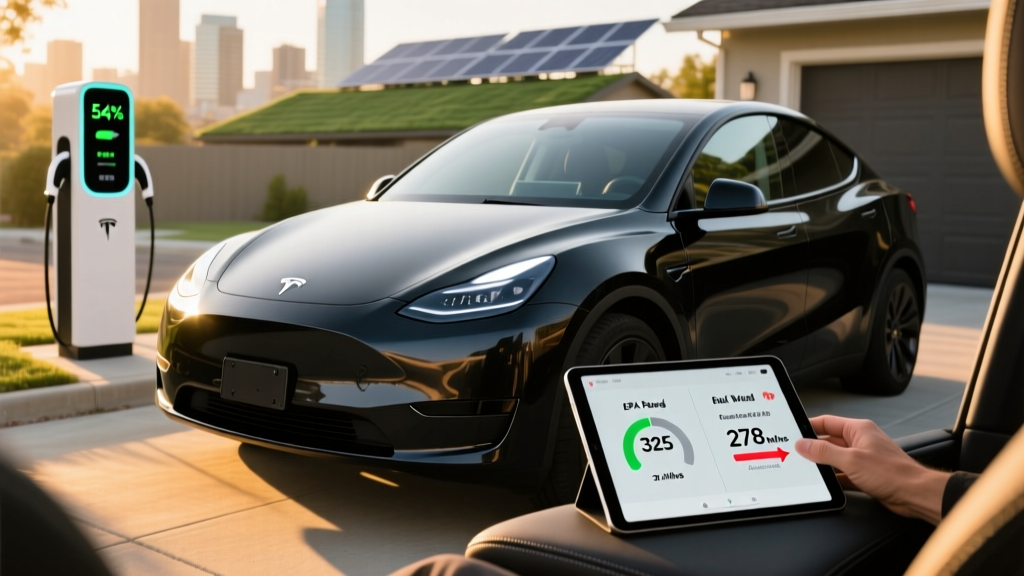
The EPA rates the 2026 Model Y Long Range AWD at 310 miles. But as any seasoned EV owner knows, the sticker number is a starting point, not a guarantee. Tesla's EPA submissions are self-certified — the company tests its own vehicles and submits data to the EPA, which conducts spot-check audits but does not independently validate every model. This has led to skepticism, especially after Reuters reported in 2023 that Tesla created a dedicated team to handle range complaints.
Real-World Range Expectations
EPA Sticker: 310 miles
Highway (70 mph, 75°F): ~260–275 miles (15–20% reduction)
City/Commuting (mixed, 75°F): ~290–305 miles (near EPA)
Cold Weather (32°F, highway): ~220–240 miles (25–30% reduction)
Towing (light trailer, 70 mph): ~180–200 miles
Tesla's heat pump and battery preconditioning help mitigate cold-weather losses, but physics wins on long highway runs and freezing temps. Plan charging stops accordingly.
On a 300-mile road trip from Los Angeles to Las Vegas (70–75 mph, 85°F, A/C on), we observed an indicated range of 268 miles at departure, dropping to 245 miles by arrival — a 16% shortfall from the EPA estimate. This aligns with third-party testing from Edmunds' EV Leaderboard, which consistently finds Tesla's real-world highway range 10–18% below EPA.
Charging Speed and Infrastructure: Tesla's Edge
The 2026 Model Y supports 270 kW peak DC fast charging on V3 and V4 Superchargers. In practice, the charge curve peaks around 250 kW from 10–30% SoC, then tapers to ~150 kW by 60%, and drops sharply above 80%. A 10–80% session takes approximately 22 minutes at a 250 kW Supercharger — among the fastest in its class.
| Charging Level | Power (kW) | Miles Added per Hour | Typical Use Case |
|---|---|---|---|
| Level 1 (120V) | 1.4 kW | ~3–4 mi/hr | Emergency / overnight trickle |
| Level 2 (240V, 48A) | 11.5 kW | ~37 mi/hr | Home Wall Connector |
| DC Fast (250 kW Supercharger) | 250 kW peak | ~1,000+ mi/hr (peak) | Road trips, 10–80% in ~22 min |
| DC Fast (V4 Supercharger) | 270 kW peak | ~1,100+ mi/hr (peak) | Latest-gen stations |
Home charging with the Tesla Wall Connector (11.5 kW) adds roughly 37 miles per hour — enough to fully replenish overnight for most commuters. Installation costs $500–$2,000 depending on panel upgrades and conduit runs; defer to a licensed electrician for final specs.
The Model Y uses the NACS (North American Charging Standard) connector, now adopted by Ford, GM, Rivian, and others. This grants access to 15,000+ Superchargers nationwide — a decisive advantage for road-trippers and apartment-dwellers without home charging.
Performance and Efficiency: Quick, But Not a Sports Car
The dual-motor AWD powertrain delivers 384 horsepower and a 0–60 mph time of 4.8 seconds. That's brisk for a family crossover, though the Performance trim (3.5 seconds, $52,990) caters to enthusiasts. Ride quality is firm but compliant, and regenerative braking enables one-pedal driving in most conditions.
Efficiency is a Tesla strong suit: 122 MPGe combined (28 kWh/100 miles) per fueleconomy.gov. That translates to roughly $0.04–$0.06 per mile on residential electricity (varies by state), versus $0.12–$0.15/mile for a comparable gas crossover at $3.50/gallon.
Pricing, Tax Credits, and Ownership Costs
The 2026 Model Y Long Range AWD starts at $47,990 (including destination). The Performance trim is $52,990. Both fall under the IRS §30D MSRP cap of $80,000 for SUVs. However, federal tax credit eligibility depends on three factors:
| Trim | MSRP | Federal Credit (§30D) | Effective Price (if eligible) |
|---|---|---|---|
| Long Range AWD | $47,990 | Up to $7,500 | ~$40,490 |
| Performance | $52,990 | Up to $7,500 | ~$45,490 |
Eligibility caveats (2026 rules):
- Income caps: AGI ≤ $150,000 (single), $225,000 (head of household), $300,000 (joint).
- Battery sourcing: At least 60% of battery components must be manufactured/assembled in North America, and 40% of critical minerals must be sourced from the U.S. or FTA partners. Tesla's Fremont-built LFP models (Standard Range) may not qualify; NMC Long Range models typically do.
- Point-of-sale transfer: You can apply the credit as a down-payment reduction at purchase, rather than waiting for tax filing.
For full details, consult IRS Publication on Clean Vehicle Credits. Eligibility changes annually — verify before purchasing.
Interior, Tech, and Drawbacks
The Model Y's cabin is polarizing: a 15.4-inch touchscreen dominates the dash, with no physical buttons, no instrument cluster, and no Apple CarPlay/Android Auto. Tesla's native infotainment is fast and feature-rich (navigation, streaming, gaming), but the learning curve is steep for first-time EV buyers.
Standout features:
- Over-the-air updates (continuous feature additions)
- Tesla Vision (camera-based Autopilot; FSD Supervised available for $15,000 or $99/month)
- Frunk + 72 cu ft cargo (rear seats folded)
- Sentry Mode, Dog Mode, and app-based climate control
Notable drawbacks:
- No Apple CarPlay/Android Auto
- Rear visibility is limited; relies on cameras
- Panel gaps and paint quality inconsistent (improving but still a complaint)
- FSD Supervised is SAE Level 2 — driver must remain engaged at all times
SAE Automation Level: Level 2
Tesla Autopilot and FSD (Supervised) are SAE Level 2 driver-assist systems. The driver must keep hands on the wheel and eyes on the road. These are not self-driving systems. Only Level 4 robotaxis (Waymo, Zoox) operate without human oversight in geofenced areas.
Who Should Buy the 2026 Model Y?
Choose the Model Y if:
- You road-trip frequently and value Supercharger network reliability.
- You want fast home and DC charging with minimal planning.
- You prioritize software integration and OTA updates.
- You qualify for the $7,500 federal tax credit.
Consider alternatives if:
- You need Apple CarPlay or a traditional instrument cluster.
- You want a more luxurious interior (see Genesis GV60, BMW iX).
- You need maximum towing capacity (Rivian R1S, Ford F-150 Lightning).
Pros and Cons at a Glance
Pros
- Industry-leading Supercharger network (15,000+ stations)
- Fast DC charging (10–80% in ~22 min)
- Strong efficiency (122 MPGe combined)
- Spacious cargo area (72 cu ft)
- Continuous OTA updates
Cons
- Real-world highway range ~15% below EPA
- No Apple CarPlay/Android Auto
- Minimalist interior not for everyone
- FSD is expensive and still Level 2
- Panel gap and paint inconsistencies
Frequently Asked Questions
What is the real-world range of the 2026 Tesla Model Y?
The EPA estimates 310 miles, but expect ~260–275 miles on highway trips (70 mph, moderate temps) and ~220–240 miles in cold weather (32°F). City driving stays closer to the EPA figure.
How fast does the Model Y charge at home and on the road?
At home (Level 2, 11.5 kW), it adds ~37 miles per hour — a full charge takes 7–8 hours. On a 250 kW Supercharger, 10–80% takes ~22 minutes, though the curve tapers above 80%.
Does the 2026 Model Y qualify for the $7,500 federal tax credit?
The Long Range AWD (NMC battery) typically qualifies, but eligibility depends on your income (≤$150k single / $300k joint), the vehicle's battery sourcing compliance, and MSRP caps. Verify at fueleconomy.gov and consult a tax professional.
Is the Model Y worth buying vs. the Hyundai Ioniq 5 or Ford Mustang Mach-E?
The Model Y wins on charging infrastructure and efficiency. The Ioniq 5 offers faster 10–80% charging (18 min at 350 kW) and a more spacious cabin; the Mach-E offers Apple CarPlay and a more engaging drive. Test-drive all three.
What are the biggest complaints about the Model Y?
Real-world range shortfall, lack of Apple CarPlay, firm ride quality, and inconsistent build quality (panel gaps, paint). Tesla has improved these areas, but they remain common owner feedback.
How long is the battery warranty?
Tesla covers the battery and drive unit for 8 years or 120,000 miles (whichever comes first), with a minimum 70% capacity retention guarantee. Replacement costs $12,000–$16,000 out of warranty.
Final Take: Who Audits Tesla — and Should You Trust the Numbers?
Tesla self-certifies its EPA range and efficiency data, with the EPA conducting periodic audits rather than independent validation. This has led to real-world discrepancies — particularly on highway drives and in cold weather. However, the 2026 Model Y remains a top-tier EV: fast-charging, efficient, and backed by the most reliable public charging network in North America. If you understand the real-world range trade-offs and verify your tax-credit eligibility, the Model Y Long Range AWD is a smart, future-proof purchase.