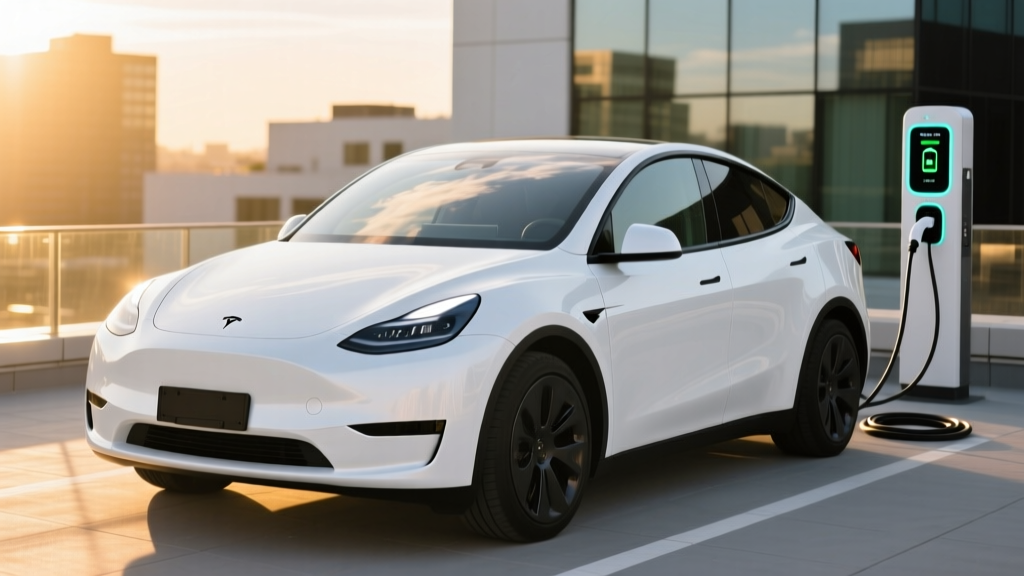
The Tesla Model Y remains the best-selling electric vehicle in the United States for good reason: it threads the needle between range, charging infrastructure, cargo practicality, and price. But if you've been browsing configurators or dealer lots, you've likely noticed one color dominates — Pearl White Multi-Coat. Beyond aesthetics, choosing a white Tesla Model Y has practical implications for thermal efficiency, paint durability, and even resale value. This review covers the 2026 Model Y Long Range AWD and Rear-Wheel Drive trims with the exact numbers you need to decide.
2026 Tesla Model Y Quick Specs at a Glance
| Spec | Long Range AWD | Rear-Wheel Drive |
|---|---|---|
| EPA Range | 320 miles | 303 miles |
| Battery (usable) | ~75 kWh (NMC) | ~60 kWh (LFP) |
| Peak DC Fast Charge | 250 kW | 170 kW |
| 10–80% DCFC Time | ~25 min | ~30 min |
| Level 2 Home Charge | 11.5 kW (~44 mi/hr) | 11.5 kW (~44 mi/hr) |
| 0–60 mph | 4.8 seconds | 6.6 seconds |
| Horsepower | 384 hp (dual motor) | 295 hp (single motor) |
| Drivetrain | AWD (dual motor) | RWD |
| MPGe (combined) | 122 MPGe | 128 MPGe |
| Efficiency | 28 kWh/100 mi | 26 kWh/100 mi |
| Base MSRP | $48,990 | $44,990 |
| Battery Warranty | 8 yr / 120,000 mi | 8 yr / 100,000 mi |
Sources: EPA fueleconomy.gov, Tesla.com. Specs reflect 2026 model year.
Real-World Range: What the EPA Sticker Doesn't Tell You
EPA Estimate: 320 miles
Real-World Highway (70 mph, 75°F): ~270–285 miles
Real-World City/Mixed: ~295–310 miles
Cold Weather (20°F, highway): ~220–250 miles
Expect 15–20% range loss in freezing temps; the Model Y's heat pump mitigates this better than resistive heating but physics still applies.
The Long Range AWD's 320-mile EPA rating is competitive, but real-world results depend heavily on driving style, temperature, and terrain. On a 250-mile highway trip at sustained 75 mph in moderate weather, you'll realistically arrive with 30–50 miles of buffer — adequate but not generous. In city driving with heavy regenerative braking, you'll get closer to the sticker number.
The RWD trim's LFP battery is slightly more energy-dense at the pack level and less prone to cold-weather voltage sag, but the smaller 60 kWh usable capacity caps its ceiling at 303 miles EPA. For commuters with home charging, this is plenty. For road-trippers, the Long Range is the safer pick.
Charging Speed and Infrastructure Advantage
Tesla's Supercharger network remains the most reliable public DC fast-charging ecosystem in North America, and the 2026 Model Y takes full advantage. Here's the breakdown:
| Charging Level | Power | Miles Added per Hour | Notes |
|---|---|---|---|
| Level 1 (120V outlet) | ~1.4 kW | ~3–5 mi/hr | Emergency/trickle only |
| Level 2 (240V, 48A) | 11.5 kW | ~44 mi/hr | Full charge overnight (~7–8 hrs) |
| DC Fast (Long Range) | 250 kW peak | ~1,000 mi/hr peak | 10–80% in ~25 min; tapers above 80% |
| DC Fast (RWD/LFP) | 170 kW peak | ~700 mi/hr peak | 10–80% in ~30 min; LFP tapers earlier |
A critical detail many buyers miss: peak kW is not sustained kW. The Long Range Model Y hits 250 kW only between roughly 10–30% state of charge, then tapers progressively. By 60% SoC, you're closer to 120 kW; by 80%, around 60 kW. This charge-curve taper is why the 10–80% time is 25 minutes rather than the theoretical ~18 minutes a flat 250 kW rate would suggest.
The 2026 Model Y ships with the NACS (North American Charging Standard) connector natively — no adapter needed for Tesla Superchargers. With Ford, GM, Rivian, and others now adopting NACS, Supercharger stalls are busier than in 2023, but Tesla has expanded capacity accordingly.
Why Pearl White Multi-Coat Is the Smart Color Choice
The white Tesla Model Y isn't just popular by coincidence — it's the default no-cost color and has measurable advantages:
- Thermal efficiency: White paint reflects solar radiation, reducing cabin heat soak in summer. This means less energy spent on air conditioning, yielding 1–3% better range in hot climates vs. black or blue.
- Paint durability: Tesla's Pearl White Multi-Coat is a tri-coat process that hides swirl marks and minor scratches far better than the Solid Black or Deep Blue Metallic finishes, which are notorious for showing marring.
- Resale value: White and gray dominate the used EV market. A white Model Y typically commands a 2–4% premium over red or blue at resale, per industry auction data.
- No upcharge: Solid Black, Midnight Silver, Deep Blue, and Quicksilver cost $1,500–$2,500 extra. White is the only zero-cost exterior option.
If you're in a hot-weather state (Arizona, Texas, Florida), the thermal advantage is real. If you garage your car and live in the Pacific Northwest, the color matters less — pick what you like.
Pricing, Tax Credits, and Total Cost
| Trim | Base MSRP | Destination | As-Tested (typical) | §30D Credit Eligible? |
|---|---|---|---|---|
| Rear-Wheel Drive | $44,990 | $1,390 | $46,380 | Yes — up to $7,500* |
| Long Range AWD | $48,990 | $1,390 | $50,380 | Yes — up to $7,500* |
| Performance AWD | $53,990 | $1,390 | $55,380 | Yes — up to $7,500* |
*Federal §30D credit eligibility requires meeting ALL of the following (per IRS.gov):
- MSRP cap: SUVs/vans must be ≤ $80,000 (Model Y qualifies at all trims)
- Buyer income cap: AGI ≤ $150,000 (single) / $300,000 (joint)
- Battery sourcing: Critical minerals and battery components must meet phased-in percentages (Tesla's Austin-built packs currently qualify for the full $7,500)
- Point-of-sale transfer: You can apply the credit as a down-payment reduction at purchase rather than waiting for tax filing
- Assembly: Must be assembled in North America (Model Y built in Austin, TX and Fremont, CA)
After the full $7,500 credit, the RWD Model Y effectively starts around $38,880 — undercutting many gas-powered compact SUVs on total cost of ownership over five years when you factor in fuel savings (~$5,000–$7,000 less electricity cost vs. gasoline at 25 MPG).
Interior Space, Tech, and Daily Livability
The Model Y's crossover form factor delivers genuine utility:
- Cargo volume: 30.2 cu ft behind the second row; 72.1 cu ft with rear seats folded (class-leading for the segment)
- Front legroom: 41.8 inches
- Rear legroom: 37.2 inches — adequate for adults, tight for tall passengers on long trips
- Front trunk (frunk): 4.1 cu ft — useful for charging cables, groceries, or a small bag
- Towing capacity: 3,500 lbs (when equipped with tow hitch)
The 15.4-inch center touchscreen runs Tesla's latest software with a responsive interface, integrated navigation with real-time Supercharger routing, and over-the-air updates that add features post-purchase. The minimalist interior (no physical buttons, no instrument cluster) is polarizing — you either adapt quickly or find it distracting.
Driver assistance: Basic Autopilot (lane centering + adaptive cruise) is standard. Full Self-Driving (Supervised) is a $8,000 add-on or $99/month subscription.
Both Autopilot and FSD (Supervised) are SAE Level 2 driver-assist systems. The driver must remain fully engaged, hands on or near the wheel, and eyes on the road at all times. This is not autonomous driving. Only Level 4 services like Waymo operate without a human driver in geofenced areas.
Pros and Cons: The Honest Assessment
- Best-in-class Supercharger network access
- 320-mile EPA range (Long Range) eliminates most range anxiety
- Class-leading cargo space (72.1 cu ft)
- Low cost of ownership with home charging
- OTA updates add features over time
- Strong resale value relative to EV segment
- White paint is free and thermally efficient
- Minimalist interior not for everyone (no physical controls)
- Ride quality is firm — road imperfections transmit to cabin
- Rear seat comfort lags behind Hyundai Ioniq 5, Kia EV6
- FSD (Supervised) is expensive and still requires full driver attention
- Supercharger stalls increasingly crowded with non-Tesla EVs
- No Apple CarPlay / Android Auto
- Insurance premiums 15–25% higher than comparable gas SUVs
Who Should Buy the White Tesla Model Y?
- Choose the Model Y Long Range AWD if: You take regular road trips (200+ miles), live in a cold-weather state, need AWD traction, and want maximum range buffer.
- Choose the Model Y RWD if: You're primarily a commuter with home Level 2 charging, live in a mild climate, and want the lowest entry price after tax credits.
- Look at the Hyundai Ioniq 5 or Kia EV6 instead if: You prioritize ride comfort, rear-seat space, physical buttons, or want 800V ultra-fast charging (10–80% in ~18 min on 350 kW chargers).
- Consider a PHEV like the Toyota RAV4 Prime if: You lack reliable home charging access or frequently drive in rural areas with sparse charging infrastructure.
Frequently Asked Questions
What is the real-world range of the white Tesla Model Y?
The Long Range AWD achieves an EPA-estimated 320 miles, but expect 270–285 miles on sustained highway driving at 70 mph and 220–250 miles in freezing temperatures. The RWD trim delivers 303 miles EPA, with real-world highway range around 255–270 miles. Cold weather reduces range 15–20% due to battery chemistry and cabin heating demands, though the Model Y's standard heat pump is more efficient than resistive heating.
How fast does the Tesla Model Y charge at home and on the road?
On a 240V Level 2 home charger (48A), the Model Y charges at 11.5 kW, adding roughly 44 miles of range per hour — a full overnight charge from empty takes 7–8 hours. On DC fast chargers, the Long Range peaks at 250 kW (10–80% in ~25 minutes) and the RWD at 170 kW (10–80% in ~30 minutes). Actual speed depends on state of charge, battery temperature, and charger availability.
How much does a white Tesla Model Y cost after tax credits?
The 2026 Model Y RWD starts at $44,990 plus $1,390 destination ($46,380 total). With the full $7,500 federal §30D tax credit (subject to income, MSRP, and battery-sourcing requirements), the effective price drops to approximately $38,880. The Long Range AWD starts at $48,990 and drops to ~$42,880 after the credit. Pearl White Multi-Coat is the no-cost default color, so there's no upcharge for the white exterior.
Does the 2026 Tesla Model Y qualify for the federal EV tax credit?
Yes, as of 2026, all Model Y trims qualify for up to $7,500 under IRS §30D, provided the buyer meets income caps ($150K single / $300K joint modified AGI), the vehicle MSRP is under $80,000 (it is), and battery sourcing requirements are met (Tesla's US-built packs currently satisfy this). The credit can be transferred at point of sale as a down-payment reduction. Always verify current eligibility at IRS.gov and consult a tax professional.
Is the Tesla Model Y worth buying over competitors like the Ioniq 5 or EV6?
The Model Y wins on charging network access (Superchargers), cargo space (72.1 cu ft vs. 59.3 for Ioniq 5), and software integration. The Hyundai Ioniq 5 and Kia EV6 win on ride comfort, rear-seat room, 800V ultra-fast charging capability, and offering Apple CarPlay. If Supercharger reliability and cargo volume are your top priorities, the Model Y is the stronger pick. If comfort and charging speed matter more, test-drive the Korean alternatives.
What's the battery warranty on the Tesla Model Y?
The Long Range AWD carries an 8-year/120,000-mile battery and drive unit warranty. The RWD trim has an 8-year/100,000-mile warranty. Tesla guarantees the battery will retain at least 70% of its original capacity during the warranty period. Real-world degradation data from fleet owners suggests most Model Y packs retain 88–92% capacity at 100,000 miles, well above the threshold.
For official EPA efficiency data, visit fueleconomy.gov. For safety ratings, check NHTSA.gov and IIHS.org.