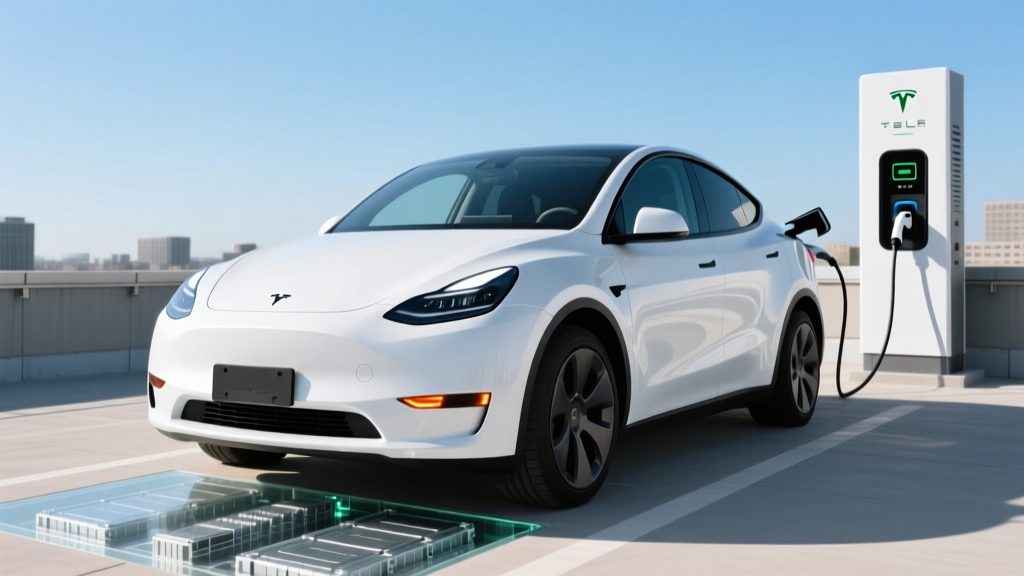
A white Tesla Model Y has become one of the most recognizable silhouettes on American roads — and for good reason. The 2026 Model Y (the refreshed "Juniper" generation introduced for the 2025 model year) brings a stiffer chassis, a quieter cabin, a rear-seat touchscreen, and revised battery management that squeezes more miles out of every kilowatt-hour. Pearl White Multi-Coat remains Tesla's most popular no-cost exterior color, and it pairs with the structural battery pack and heat-pump standard equipment to deliver one of the most efficient electric crossovers you can buy.
This review breaks down the 2026 white Tesla Model Y Long Range AWD — the volume trim — with exact EPA figures, real-world range expectations, DC fast-charge behavior, pricing after the federal §30D credit, and the ownership realities that spec sheets don't show.
2026 Tesla Model Y Long Range AWD: Core Specifications
| Spec | Value |
|---|---|
| EPA Range | 320 miles |
| Battery (usable) | ~78 kWh, NMC (2170 cells) |
| Drivetrain | Dual-motor AWD |
| Horsepower | 384 hp combined |
| 0-60 mph | 4.8 seconds |
| Top Speed | 125 mph |
| MPGe (combined) | 122 MPGe |
| Efficiency | 28 kWh / 100 mi |
| Max DC Fast Charge | 250 kW (peak) |
| 10-80% DC Charge | ~27 minutes |
| Level 2 Home Charge | 11.5 kW (~44 mi/hr) |
| Cargo (rear seats up) | 30.2 cu ft |
| Cargo (rear seats folded) | 72.1 cu ft |
| Rear Legroom | 41.6 in |
| Battery Warranty | 8 yr / 120,000 mi (≥70% retention) |
| Base MSRP | $47,990 (before destination) |
Source: fueleconomy.gov and Tesla's official 2026 spec sheet.
Real-World Range: What to Expect Beyond the EPA Sticker
The 320-mile EPA rating is impressive on paper, but any experienced EV owner knows the sticker is a blended-cycle estimate. In real-world highway driving at 70-75 mph in moderate temperatures, expect between 275 and 290 miles before you're hunting for a charger. The Model Y's 0.23 drag coefficient helps, but aerodynamic drag still dominates energy consumption above 65 mph.
Cold weather is the bigger variable. At 30°F with the cabin heated, range drops 20-30% even with the standard heat pump. Tesla's thermal management system is among the best in the industry — it recovers waste heat from the drive units and battery — but physics is physics. Preconditioning the battery while plugged in (via the Tesla app's scheduled departure feature) reclaims roughly 10-15 miles of range that would otherwise be lost to a cold pack.
For city driving with frequent regenerative-braking opportunities, 300+ miles is easily achievable. The Model Y's one-pedal driving mode (now standard with the Stop Mode setting) captures energy aggressively in stop-and-go traffic.
Charging Speed: DC Fast, Level 2, and the Supercharger Advantage
| Level | Power | Miles Added per Hour | Notes |
|---|---|---|---|
| Level 1 (120V) | 1.4 kW | ~5 mi/hr | Emergency/trickle only |
| Level 2 (240V, 48A) | 11.5 kW | ~44 mi/hr | Home Wall Connector; full charge ~8 hrs |
| DC Fast (Supercharger V3/V4) | 250 kW peak | ~1,000 mi/hr (peak) | 10-80% in ~27 min; tapers above 80% |
| DC Fast (CCS adapter, non-Tesla) | ~150-200 kW typical | Varies | Requires Tesla CCS adapter (included) |
Tesla's 250 kW peak DC fast-charge rate is not sustained across the full session. The charge curve peaks around 250 kW only between roughly 10-30% state of charge (SoC), then tapers to ~150 kW through 50%, and drops further to ~75 kW by 80%. This is normal lithium-ion behavior — the battery management system protects cell health by reducing current as voltage rises.
The practical result: a 10-80% session at a V3 or V4 Supercharger takes about 27 minutes. If you arrive at 5% SoC, you'll add roughly 200 miles in 20 minutes. For road trips, this means a 15-20 minute stop every 2.5-3 hours of driving — comparable to a gas-car rest stop.
At home, the Tesla Wall Connector on a 60A circuit delivers 11.5 kW (48A continuous). That's roughly 44 miles of range per hour of charging, meaning an overnight session (8-10 hours) fully replenishes the pack. Most owners plug in nightly and wake up to a full battery — the single biggest ownership convenience advantage over gas vehicles.
One note on the Juniper refresh: Tesla now includes a NACS-to-CCS adapter in the box, so you can access Electrify America, EVgo, and other non-Tesla DC networks. The Supercharger network remains the most reliable option, with over 6,000 V3/V4 stalls in North America.
Performance and Driving Dynamics
The 2026 Model Y Long Range AWD produces 384 combined horsepower from its dual permanent-magnet motors. The 0-60 mph sprint takes 4.8 seconds — quick enough to merge onto any highway with authority, though it's not the neck-snapping acceleration of the Performance trim (3.5 seconds, 456 hp).
The Juniper chassis revisions matter. Tesla retuned the suspension with frequency-selective dampers and added more sound deadening. The result is a noticeably quieter ride at highway speed and better absorption of sharp impacts. It's still firmer than a Hyundai Ioniq 5 or Ford Mustang Mach-E, but the gap has closed significantly.
Regenerative braking is strong and predictable. The Model Y does not offer a user-adjustable regen setting (unlike Hyundai/Kia's paddle shifters), but the default level is well-calibrated for one-pedal driving in most conditions.
Interior, Tech, and Cargo
The Juniper interior is minimalist in the extreme. A 15.4-inch center touchscreen handles everything — climate, navigation, media, vehicle settings. The 2026 refresh adds an 8-inch rear-seat touchscreen for passengers (climate, media, and entertainment), ventilated front seats as standard, and ambient lighting that replaces the previous all-black dashboard.
Cargo space measures 30.2 cubic feet behind the rear seats and 72.1 cubic feet with them folded. The front trunk (frunk) adds another 4.1 cubic feet for charging cables or a small bag. Rear legroom is generous at 41.6 inches, making this a legitimate family hauler.
Notable tech:
- Autopilot (standard): adaptive cruise + lane centering — SAE Level 2, requires hands on wheel
- Full Self-Driving (Supervised): $8,000 option — still Level 2, not autonomous
- Sentry Mode: 360° camera recording when parked
- Dog Mode / Camp Mode: climate control while parked
- Over-the-air updates: frequent feature additions
Pricing, Trims, and Federal Tax Credit Eligibility
| Trim | MSRP (incl. destination) | Est. After §30D Credit |
|---|---|---|
| Long Range RWD | $44,990 | ~$37,490* |
| Long Range AWD | $47,990 | ~$40,490* |
| Performance AWD | $52,490 | ~$44,990* |
*Assumes full $7,500 §30D credit and point-of-sale transfer. Eligibility varies.
The Pearl White Multi-Coat paint is a no-cost option on all trims, which is why the "white Tesla" is so ubiquitous. Solid Black, Deep Blue, and Quicksilver cost $1,000-$2,000 extra; Ultra Red is $2,500.
Does the 2026 Model Y Qualify for the $7,500 Federal Tax Credit?
The 2026 Tesla Model Y Long Range AWD currently qualifies for the full $7,500 federal EV tax credit under IRS §30D, and Tesla offers a point-of-sale transfer so the credit reduces your purchase price at delivery rather than waiting until tax filing. However, eligibility depends on several factors that change periodically:
- MSRP cap: SUVs/vans must be under $80,000 — Model Y qualifies at ~$48K base
- Buyer income cap: AGI ≤ $150,000 (single) / $300,000 (joint) / $225,000 (head of household)
- Battery sourcing: Critical minerals and battery components must meet phased percentage thresholds from FTA countries — Tesla's Fremont and Austin-built Model Y currently meets these
- Assembly: Must be assembled in North America — all US-market Model Ys are built in Fremont, CA or Austin, TX
- FEOC restriction: Battery components cannot be from a "foreign entity of concern" (China, Russia, etc.) after 2024; critical minerals after 2025
Rules are subject to change. Verify current eligibility at irs.gov and Tesla's website before purchasing. Consult a tax professional for personal eligibility.
Pros and Cons: The Honest Scorecard
✅ Pros
- Best-in-class Supercharger network access (6,000+ stalls in NA)
- 320 mi EPA range; 28 kWh/100mi efficiency is exceptional for an AWD SUV
- 250 kW DC fast charging; 10-80% in ~27 min
- Strong OTA update cadence adds features post-purchase
- $7,500 federal credit + point-of-sale transfer lowers effective price
- Spacious cargo area (72 cu ft folded) + frunk
- Low maintenance: no oil, spark plugs, or transmission fluid
❌ Cons
- Firm ride compared to Ioniq 5 and Mach-E
- No physical buttons — all controls via touchscreen
- FSD (Supervised) is $8,000 and still Level 2, not autonomous
- Insurance premiums run 15-30% higher than comparable gas SUVs
- Turn-signal stalk removed on Juniper — steering-wheel buttons instead
- Cold-weather range loss of 20-30% is significant in northern states
- Build quality improved but still inconsistent panel gaps on some units
2026 Model Y vs. Key Competitors
| Spec | Tesla Model Y LR AWD | Hyundai Ioniq 5 Limited AWD | Ford Mustang Mach-E Premium AWD |
|---|---|---|---|
| EPA Range | 320 mi | 290 mi | 300 mi |
| Max DC Charge | 250 kW | 350 kW (800V) | 150 kW |
| 10-80% Time | ~27 min | ~18 min | ~38 min |
| 0-60 mph | 4.8 sec | 5.1 sec | 5.0 sec |
| Base MSRP (AWD) | $47,990 | $54,600 | $48,995 |
| Charging Network | Supercharger (native) | NACS (adapter) | NACS (adapter) |
The Ioniq 5 charges faster (800V architecture), but the Model Y wins on range, efficiency, and — critically — native Supercharger access without adapters. The Mach-E is a strong value play but its 150 kW peak charge rate is a meaningful road-trip limitation.
Who Should Buy a White Tesla Model Y?
Choose the Model Y if:
- You want the lowest-risk public charging experience (Supercharger reliability)
- You road-trip regularly and value range + charge speed
- You want strong cargo capacity in an electric SUV
- You qualify for the §30D credit and want point-of-sale pricing
- You prefer OTA updates that add features over time
Look elsewhere if:
- You prioritize ride comfort over sportiness (consider Ioniq 5 or Mach-E)
- You want physical buttons and a traditional instrument cluster
- You don't have home charging access — public-only charging adds cost and friction
- You need 3-row seating (consider the Kia EV9 or Rivian R1S)
Warranty and Long-Term Ownership
Tesla covers the battery and drive units for 8 years / 120,000 miles (whichever comes first) with a minimum 70% capacity retention guarantee. The basic vehicle warranty is 4 years / 50,000 miles. Battery replacement out of warranty runs $12,000-$16,000 at a Tesla Service Center, though most packs outlast the vehicle itself — Tesla's 2025 Impact Report showed average degradation of only 12% at 150,000 miles across the fleet.
Insurance costs are a real consideration. Expect annual premiums of $1,800-$2,800 depending on your state, driving record, and coverage level — roughly 15-30% higher than a comparably priced gas SUV. Tesla Insurance is available in some states and can be competitive for clean-record drivers.
Frequently Asked Questions
Why are so many Teslas white?
Pearl White Multi-Coat is Tesla's only no-cost exterior paint option. Every other color adds $1,000-$2,500 to the MSRP. Combined with white's heat-reflective properties (marginally helpful in hot climates) and its strong resale appeal, it's the default choice for cost-conscious buyers and fleet purchasers alike.
What is the real-world range of the 2026 Model Y?
Expect 275-290 miles in moderate-temperature highway driving and 225-250 miles in freezing conditions. City driving with regenerative braking can exceed 300 miles. The EPA's 320-mile rating is a blended-cycle estimate that few drivers will match consistently on long highway trips.
How fast does the Model Y charge at home?
On a Tesla Wall Connector (240V, 48A), the Model Y charges at 11.5 kW, adding approximately 44 miles of range per hour. A full 0-100% charge takes about 8 hours. Most owners charge overnight and never visit a gas station.
Does the white Tesla Model Y qualify for the $7,500 federal tax credit in 2026?
Yes — the 2026 Model Y currently qualifies for the full $7,500 §30D credit, available as a point-of-sale transfer. However, buyer income caps ($150K single / $300K joint), the $80K SUV MSRP cap, and battery-sourcing rules all apply. Verify at irs.gov before purchasing.
Is Tesla Autopilot the same as self-driving?
No. Autopilot and the optional FSD (Supervised) are SAE Level 2 driver-assistance systems. You must keep your hands on the wheel and eyes on the road. True self-driving (Level 4) is currently only available through geofenced robotaxi services like Waymo in select cities.
Is the 2026 Model Y worth buying over competitors?
If Supercharger access, range efficiency, and OTA updates matter to you, the Model Y remains the segment benchmark. If ride comfort or faster peak charging (800V) is your priority, the Hyundai Ioniq 5 is a strong alternative. Test-drive both before deciding.