Quick Verdict: Can the GMC Sierra EV Actually Tow?
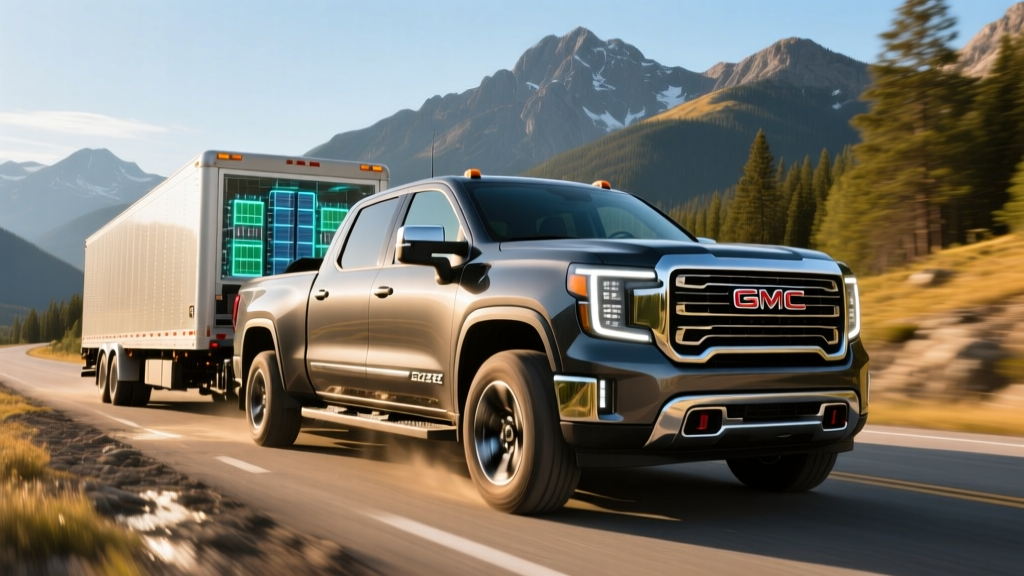
The 2026 GMC Sierra EV is General Motors' answer to the electric full-size truck segment, and its headline number is hard to ignore: a maximum tow capacity of 12,500 pounds when properly equipped on the Denali Edition 1 trim. That puts it squarely in competition with the Ford F-150 Lightning (10,000 lbs max) and ahead of the Rivian R1T (11,000 lbs), though still short of some heavy-duty gas trucks. But towing is only part of the story. With a 24-module Ultium battery pack, available four-wheel steer, and a starting price that will test the limits of federal tax credit eligibility, the Sierra EV demands a closer look at what it can — and can't — do for real truck buyers.
After spending time with the specs, the charging curves, and the real-world physics of hauling a trailer with an 8,800-pound curb-weight EV, here's the full breakdown.
GMC Sierra EV Towing and Payload Specs
The GMC Sierra EV tow capacity varies significantly by trim, and understanding the hierarchy matters before you configure your build:
| Trim | Max Tow Capacity | Max Payload | Drivetrain | Horsepower | Torque (lb-ft) |
|---|---|---|---|---|---|
| Elevation (2WT) | 10,000 lbs | 1,800 lbs | Dual-motor AWD | 510 hp | 615 |
| AT4 | 12,000 lbs | 1,600 lbs | Dual-motor AWD | 655 hp | 785 |
| Denali Edition 1 | 12,500 lbs | 1,500 lbs | Dual-motor AWD | 754 hp | 785 |
To hit the 12,500-pound max, you need the Denali Edition 1 with the available Max Tow package, which includes an integrated trailer brake controller, enhanced cooling for the rear eAxle, and a heavy-duty hitch receiver. GMC's ProGrade Trailering system includes trailer-side camera views, hitch guidance with zoom, and a trailer-angle detection overlay on the 16.8-inch center touchscreen.
⚡ Range Reality Check While Towing
EPA Estimated Range: 390 miles (Elevation), 370 miles (AT4), 340 miles (Denali Edition 1) — all on the 200+ kWh Ultium pack.
Real-World Expectation: Unloaded highway driving at 70 mph yields approximately 300–330 miles depending on temperature and terrain. When towing near max capacity, expect range to drop by 40–55%, bringing usable range to roughly 150–200 miles. This is consistent with independent testing of the F-150 Lightning and Rivian R1T under load. Cold weather (below 32°F) further reduces range by 15–25% due to battery resistance and cabin heating demands, even with the Sierra EV's standard heat pump.
Battery, Charging, and Efficiency
The Sierra EV rides on GM's BT1 electric truck platform and uses a massive Ultium battery pack with NMC (nickel manganese cobalt) chemistry across all trims. The usable capacity is approximately 200 kWh — one of the largest battery packs in any production passenger vehicle. For reference, that's roughly double the Tesla Model S and 50% larger than the F-150 Lightning Extended Range pack.
| Charging Level | Max Rate | Estimated Speed | Notes |
|---|---|---|---|
| Level 1 (120V) | 1.4 kW | ~3 miles/hr | Emergency/trickle only |
| Level 2 (240V, 48A) | 11.5 kW | ~25 miles/hr | Full charge in ~18 hours |
| Level 2 (240V, 80A) | 19.2 kW | ~42 miles/hr | Requires hardwired 100A circuit |
| DC Fast Charge | 350 kW (peak) | 10–80% in ~35 min | Sustained rate tapers above 60% SoC |
The Sierra EV supports up to 350 kW peak DC fast charging via its NACS (North American Charging Standard) port, which provides native access to the Tesla Supercharger network — a major practical advantage for truck owners who tow on road trips. However, the charge curve matters: peak rates are only sustained between approximately 10–40% State of Charge. Above 60%, the rate tapers significantly to protect the large NMC pack, and the 80–100% top-off can add another 25–30 minutes. Plan your road-trip stops accordingly.
For home charging, the onboard 19.2 kW AC charger is one of the fastest available in any EV, but it requires a dedicated 100-amp circuit and hardwired Level 2 EVSE — a panel upgrade that typically costs $1,500–$4,000 depending on your home's existing electrical service. Most buyers will opt for a 48-amp / 11.5 kW setup on a standard 60-amp circuit, which still delivers a full overnight charge.
Efficiency: The Elevation trim achieves an EPA-estimated 62 MPGe combined (approximately 54 kWh/100 miles). The Denali Edition 1 drops to roughly 56 MPGe due to larger wheels, wider tires, and the additional weight of premium equipment. For context, the F-150 Lightning Extended Range achieves 66 MPGe combined.
Performance and Drivetrain
The Sierra EV is no slouch, even at nearly 9,000 pounds curb weight. The dual-motor all-wheel-drive system provides independent front and rear eAxles with torque vectoring capability.
| Trim | 0–60 mph | Horsepower | Drivetrain |
|---|---|---|---|
| Elevation | 5.9 seconds | 510 hp | Dual-motor AWD |
| AT4 | 4.7 seconds | 655 hp | Dual-motor AWD |
| Denali Edition 1 | 4.3 seconds | 754 hp | Dual-motor AWD |
The Denali's 4.3-second 0–60 time is remarkable for a full-size truck, rivaling sports sedans from a decade ago. The instant electric torque makes highway merging and passing effortless, even with a trailer. GMC's available four-wheel steering (CrabWalk-lite) reduces the turning circle and aids low-speed maneuvering in tight job sites or trailheads — a feature borrowed from the Hummer EV platform.
Regenerative braking is adjustable via steering-wheel paddles, with a one-pedal driving mode that can bring the truck to a complete stop. When towing, regen automatically adjusts to account for trailer mass, reducing brake wear on descents.
Pricing, Trims, and Federal Tax Credit Eligibility
The Sierra EV lineup spans a wide price range, and tax credit eligibility is a critical factor for buyers:
| Trim | Base MSRP | As-Tested (typical) | §30D Credit Eligible? |
|---|---|---|---|
| Elevation (2WT) | $57,700 | $62,000–$66,000 | Yes — under $80,000 truck cap |
| AT4 | $75,100 | $80,000–$88,000 | Borderline — depends on options |
| Denali Edition 1 | $99,495 | $102,000+ | No — exceeds $80,000 MSRP cap |
Under current IRS §30D rules, the federal clean vehicle credit provides up to $7,500 for qualifying new EVs. However, trucks face an $80,000 MSRP cap, and buyers must meet adjusted gross income limits ($150,000 single / $300,000 married filing jointly). Additionally, battery component and critical mineral sourcing requirements must be satisfied, which GM has been working to localize. The Elevation trim comfortably qualifies when properly configured, while the AT4 may or may not depending on option packages. The Denali Edition 1 is categorically ineligible due to its MSRP.
The credit can now be transferred to the dealer as a point-of-sale discount, effectively reducing your purchase price at signing rather than waiting for a tax refund. Always confirm eligibility with your tax professional and verify the specific VIN on the IRS portal before purchasing.
Interior, Cargo, and Technology
The Sierra EV's interior is built around a portrait-oriented 16.8-inch infotainment touchscreen running GM's latest Google Built-in system with native Google Maps, Google Assistant, and access to the Play Store. An 11-inch digital instrument cluster and available heads-up display round out the driver's view.
Cargo and passenger dimensions:
- Bed length: 5 ft 11 in (with midgate closed); extends to 8+ ft with the MultiPro Midgate open into the cabin
- Bed volume: ~62 cu ft (midgate closed)
- Front trunk (eTrunk): ~10.7 cu ft — lockable, weather-sealed, with a 120V outlet
- Front legroom: 44.5 inches
- Rear legroom: 43.4 inches (crew cab)
- Towing-integrated features: ProGrade trailering, trailer camera views, blind-zone steering assist for trailers
The MultiPro Midgate is the Sierra EV's party trick: the rear cabin wall folds down, allowing the bed to extend into the cab for hauling items up to 10 feet long while still seating a front passenger. Combined with the lockable eTrunk (which replaces the engine bay), the Sierra EV offers cargo flexibility that neither the F-150 Lightning nor the R1T can match.
Driver assistance: The Sierra EV offers GM's Super Cruise (hands-free driving on 750,000+ miles of mapped roads) as an option on AT4 and Denali trims. This is an SAE Level 2 system — the driver must remain attentive and eyes on the road, as monitored by a driver-facing camera. Super Cruise is not self-driving and does not function on unmapped or construction-zone roads.
Warranty and Long-Term Ownership
GM backs the Sierra EV with competitive warranty coverage:
- Battery warranty: 8 years / 100,000 miles (covers defects and capacity loss below 70% of original capacity)
- Powertrain warranty: 5 years / 60,000 miles
- Bumper-to-bumper: 3 years / 36,000 miles
- Roadside assistance: 5 years / 60,000 miles
The 70% capacity retention threshold is industry-standard but worth noting: a 200 kWh pack at 70% health still provides roughly 140 kWh usable, which translates to approximately 270 miles of range on the Elevation trim. GM's Ultium packs have shown promising early degradation data from the Cadillac Lyriq and Hummer EV, with most owners reporting less than 5% loss in the first two years of ownership.
Insurance costs run higher than gas Sierra equivalents — expect premiums 20–35% above comparable ICE models, driven by the vehicle's MSRP, repair costs for the battery pack, and limited collision-repair network experience with the BT1 platform.
Sierra EV vs. the Competition
| Spec | GMC Sierra EV (Denali) | Ford F-150 Lightning (Platinum) | Rivian R1T (Tri Motor) | Tesla Cybertruck (Cyberbeast) |
|---|---|---|---|---|
| Max Tow Capacity | 12,500 lbs | 10,000 lbs | 11,000 lbs | 11,000 lbs |
| EPA Range | 340 mi | 320 mi | 352 mi | 320 mi |
| Battery (usable) | ~200 kWh (NMC) | 131 kWh (NMC) | 141 kWh (NMC) | 123 kWh (NMC) |
| Peak DC Charge | 350 kW | 150 kW | 220 kW | 250 kW |
| 0–60 mph | 4.3 sec | 4.0 sec | 3.0 sec | 2.6 sec |
| Starting MSRP | $99,495 | $96,875 | $99,900 | $99,990 |
The Sierra EV wins on tow capacity and charging speed — its 350 kW peak rate and NACS connector give it the fastest road-trip refill capability in the segment. The F-150 Lightning remains the value play with lower starting prices and broader trim availability. The R1T is the off-road and performance choice. The Cybertruck offers polarizing styling and the quickest acceleration but trails on range and practicality.
✅ Pros
- Class-leading 12,500-lb tow capacity (Denali)
- 350 kW DC fast charging — fastest in the electric truck segment
- NACS connector with native Tesla Supercharger access
- MultiPro Midgate + eTrunk offer unmatched cargo flexibility
- Super Cruise hands-free driving on mapped highways
- Massive 200 kWh battery delivers best-in-class range for towing
❌ Cons
- Denali and AT4 trims priced out of federal tax credit eligibility
- Curb weight near 9,000 lbs hurts efficiency (56–62 MPGe)
- Towing range drops 40–55% under max load — plan stops carefully
- 19.2 kW home charging requires expensive 100A panel upgrade
- Insurance premiums 20–35% higher than gas Sierra
- Limited trim availability — long wait times for AT4 and Denali
Who Should Buy the GMC Sierra EV?
Choose the Sierra EV if: You need maximum tow capacity in an electric truck, you tow within a 150–200 mile radius of home or along Supercharger-equipped corridors, and you value cargo versatility (midgate + eTrunk). The Elevation trim is the smartest buy for tax-credit-eligible fleet and commercial buyers.
Look elsewhere if: Your budget caps at $60,000 (consider the F-150 Lightning Pro or base Elevation with patience), you need a daily-driver commuter truck without towing needs (the Rivian R1T or a smaller EV is more efficient), or you live in an area with limited DC fast-charging infrastructure.
Frequently Asked Questions
What is the real-world range of the GMC Sierra EV?
The EPA rates the Elevation at 390 miles, the AT4 at 370 miles, and the Denali at 340 miles. In real-world highway driving at 70 mph, expect 300–330 miles unloaded. When towing a 5,000–8,000 lb trailer, range drops to roughly 180–230 miles. Cold weather (below freezing) further reduces range by 15–25%.
How fast does the Sierra EV charge?
On a 350 kW DC fast charger, the Sierra EV charges from 10–80% in approximately 35 minutes, though peak rates are only sustained through about 40% SoC. At home on a 48-amp Level 2 charger (11.5 kW), a full charge takes roughly 18 hours. An 80-amp hardwired Level 2 cuts that to about 10 hours.
How much does the GMC Sierra EV cost after tax credits?
The Elevation starts at $57,700 and qualifies for up to $7,500 in federal credits, bringing the effective price to approximately $50,200. The AT4 ($75,100) may or may not qualify depending on options and whether the final MSRP stays under $80,000. The Denali Edition 1 ($99,495) exceeds the truck MSRP cap and does not qualify for the §30D credit.
Does the Sierra EV qualify for the federal EV tax credit?
The Elevation trim qualifies when the final MSRP stays under the $80,000 truck cap and the buyer meets income limits ($150K single / $300K joint). Battery sourcing requirements under IRS §30D must also be met. Always verify your specific VIN on the IRS portal and consult a tax professional.
Is the Sierra EV worth buying over the F-150 Lightning?
If your priority is maximum tow capacity (12,500 vs. 10,000 lbs), faster DC charging (350 kW vs. 150 kW), and native Supercharger access, the Sierra EV has a clear edge. If you want lower pricing, broader trim availability, and a proven track record with thousands of units on the road, the F-150 Lightning remains a strong choice. Check fueleconomy.gov for official EPA efficiency comparisons.
Can I use the Sierra EV's battery to power my home or job site?
GM has announced vehicle-to-home (V2H) capability for the Sierra EV via the Ultium Home ecosystem, which requires a compatible bidirectional charger and home energy management system. The truck can also serve as a mobile power source via 120V and 240V outlets in the bed and eTrunk for job-site tools and equipment.
What is the Sierra EV's battery warranty?
GM covers the Ultium battery pack for 8 years or 100,000 miles against defects and capacity degradation below 70% of original capacity. The powertrain is covered for 5 years / 60,000 miles.