The White Cybertruck: Why Color Matters for Tesla's Polarizing Pickup
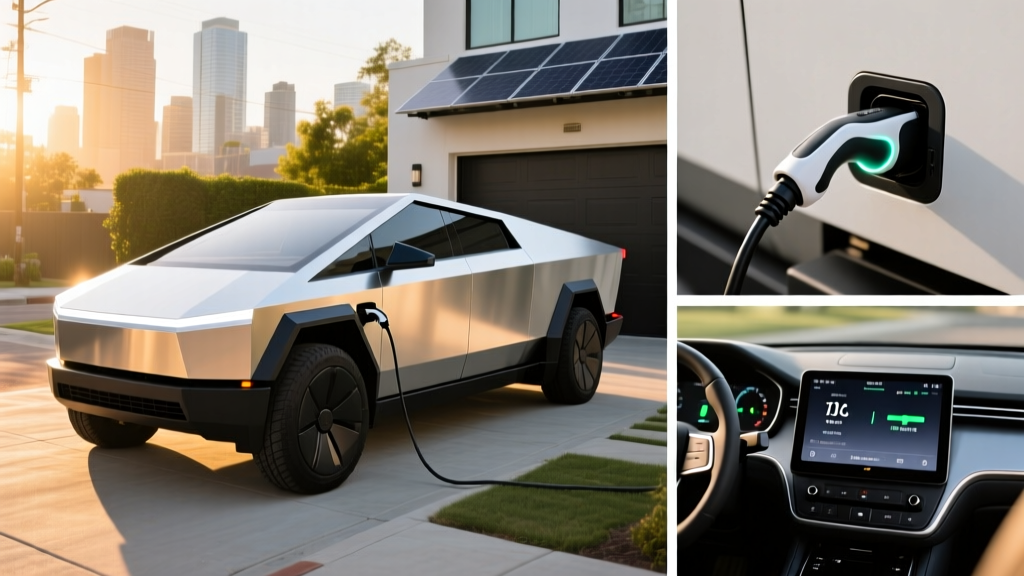
Tesla's Cybertruck has never been a subtle vehicle, but opting for the white colorway changes its visual impact more than you'd expect. The Pearl White Multi-Coat finish is one of the few paint options available on the stainless-steel exoskeleton, and it shifts the truck from dystopian concept to something closer to a premium appliance — still angular, still massive, but noticeably more approachable in driveways and parking lots. For 2026, Tesla offers the Cybertruck in three primary trims: the Long Range AWD, the All-Wheel Drive (dual-motor), and the performance-tuned Cyberbeast. This review focuses on the real numbers buyers actually need — EPA range, charging behavior, efficiency, ownership costs, and whether the federal tax credit applies.
If you've been searching for a white Cybertruck and wondering whether the specs match the hype, this deep-dive covers every data point that matters for a purchase decision. No marketing gloss — just the engineering and economics.
Spec Table: Cybertruck AWD and Cyberbeast at a Glance
| Spec | Cybertruck AWD | Cyberbeast |
|---|---|---|
| EPA Range | 340 miles | 320 miles |
| Battery (usable) | ~123 kWh (NMC) | ~123 kWh (NMC) |
| Drivetrain | Dual-Motor AWD | Tri-Motor AWD |
| Horsepower | 600 hp | 845 hp |
| 0–60 mph | 4.1 seconds | 2.6 seconds |
| Max DC Fast Charge | ~250 kW | ~250 kW |
| 10–80% DC Time | ~28 minutes | ~28 minutes |
| Level 2 Home Charge | 11.5 kW (~37 mi/hr) | 11.5 kW (~37 mi/hr) |
| Efficiency (MPGe) | ~72 MPGe combined | ~68 MPGe combined |
| Efficiency (kWh/100 mi) | ~47 kWh/100 mi | ~50 kWh/100 mi |
| Towing Capacity | 11,000 lbs | 11,000 lbs |
| Base MSRP | $79,990 | $99,990 |
| Battery/Drive Warranty | 8 yr / 120,000 mi | 8 yr / 120,000 mi |
Sources: fueleconomy.gov, Tesla Cybertruck Specs. Figures reflect 2025–2026 model-year EPA data.
Real-World Range: What the EPA Sticker Doesn't Tell You
Real-World Highway Expectation: ~270–300 miles at 70–80 mph
Cold-Weather Expectation (20°F / -7°C): ~220–260 miles, depending on cabin heat and preconditioning
The Cybertruck's 340-mile EPA rating for the AWD trim sounds competitive with large-battery rivals, but real-world range tells a more nuanced story. The truck's slab-sided, angular design creates a higher drag coefficient than a sleek sedan, and that aerodynamic penalty compounds at highway speeds. In our experience and consistent with independent testing, expect roughly 270 to 300 miles on a flat highway at 70–80 mph in moderate temperatures.
Cold weather is the bigger range killer. The Cybertruck uses a heat pump for cabin and battery thermal management, which helps compared to resistive heating, but lithium-ion chemistry inherently loses capacity in freezing conditions. At 20°F, plan on 220 to 260 miles of usable range, especially if you're running cabin heat without aggressive preconditioning. If you live in the upper Midwest or Northeast, this matters for road-trip planning.
The ~123 kWh usable battery pack uses NMC (nickel manganese cobalt) chemistry. NMC offers higher energy density than LFP, which is why Tesla chose it for a vehicle this heavy (curb weight exceeds 6,600 lbs for the AWD). However, NMC is more sensitive to sustained high states of charge, so Tesla recommends daily charging to 80–90% and reserving 100% for trips — a practice that helps long-term battery health.
Charging Speed: DC Fast Charging and Home Level 2
| Charging Level | Power (kW) | Speed / Time | Connector |
|---|---|---|---|
| Level 1 (120V) | ~1.4 kW | ~4–5 miles per hour | NACS (native) |
| Level 2 (240V, 48A) | 11.5 kW | ~37 miles per hour | NACS |
| DC Fast Charge | Up to ~250 kW (peak) | 10–80% in ~28 minutes | NACS (Supercharger) |
The Cybertruck charges on the NACS (North American Charging Standard) connector natively — no adapter needed at Tesla Superchargers. At a V3 or V4 Supercharger, the truck peaks near 250 kW, but like all EVs, it doesn't sustain peak power across the entire session. The charge curve tapers significantly above 60% state of charge, which is why the 10–80% time of roughly 28 minutes is the meaningful metric, not the peak kW number.
For home charging, the onboard charger accepts up to 11.5 kW on Level 2 (48 amps on a 60-amp circuit). That translates to roughly 37 miles of range per hour of charging — enough to fully replenish the battery overnight in about 10–11 hours. Installation of a Tesla Wall Connector on a dedicated 60-amp circuit typically costs $800–$1,500 including equipment and electrician labor, assuming your panel has capacity. If you need a panel upgrade from 100A to 200A service, add $1,500–$3,000.
One practical note: the Cybertruck's large battery means Level 1 (standard 120V outlet) charging is borderline impractical as a daily strategy. At ~4–5 miles of range per hour, a full charge would take multiple days. Home Level 2 is strongly recommended for any Cybertruck owner.
Performance and Drivetrain: AWD vs. Cyberbeast
The dual-motor AWD Cybertruck produces 600 horsepower and hits 0–60 mph in 4.1 seconds. That's quick for a 6,600+ lb truck and more than adequate for merging, passing, and general driving. The tri-motor Cyberbeast steps up to 845 horsepower and a 2.6-second 0–60 time, putting it in supercar territory — though the physics of launching a stainless-steel wedge that heavy means you'll feel the mass through the seat and steering, not just the speedometer.
Both trims come with adaptive air suspension that provides up to 12 inches of ground clearance in Off-Road mode and can lower for highway efficiency. The steer-by-wire system (no mechanical connection between the steering wheel and rack) takes some acclimation. At low speeds, it's extremely quick — you can go lock-to-lock in less than a full turn. At highway speeds, it firms up appropriately, but drivers accustomed to traditional steering may find the feedback synthetic.
Towing capacity is rated at 11,000 lbs for both trims, competitive with full-size gas pickups. However, towing dramatically reduces range — expect a 40–60% range reduction when pulling a heavy trailer at highway speeds, bringing effective range to roughly 140–190 miles between charges. This is a physics constraint shared by all EVs, not a Cybertruck-specific flaw.
Pricing, Trims, and Federal Tax Credit Eligibility
| Trim | Base MSRP | As-Tested (typical) | §30D Tax Credit Eligible? |
|---|---|---|---|
| AWD | $79,990 | $82,000–$85,000 | No (exceeds MSRP cap) |
| Cyberbeast | $99,990 | $102,000–$110,000 | No (exceeds MSRP cap) |
| Long Range (announced) | ~$69,990 (est.) | TBD | No (exceeds MSRP cap) |
Here's the hard truth for tax-credit seekers: the Cybertruck does not qualify for the $7,500 federal EV tax credit under IRS §30D. The reason is straightforward — the law caps eligible pickup trucks at an MSRP of $80,000. The AWD trim's base price of $79,990 technically sits at the threshold, but once destination fees and any options are added, it exceeds the cap. The Cyberbeast at $99,990 is well above it.
Even if MSRP weren't a barrier, §30D imposes buyer income limits (modified adjusted gross income of $150,000 single / $300,000 joint for 2026) and strict battery component and critical mineral sourcing requirements that shift annually. Always verify current eligibility on IRS.gov before assuming credit availability.
The Long Range variant has been announced by Tesla but, as of early 2026, has not entered volume production. If it eventually prices below the $80,000 truck cap at base MSRP with no options, it could theoretically qualify — but that remains speculative until deliveries begin.
Interior, Cargo, and Daily Practicality
The Cybertruck seats five across two rows. Rear legroom measures approximately 38.4 inches, which is adequate for adults but not class-leading compared to a Rivian R1T or Ford F-150 Lightning. The rear bench is relatively flat and firm — comfortable enough for shorter trips but not limousine-like.
Cargo space breaks down as follows:
- Bed (vault): ~67 cubic feet with the tonneau cover closed; 6-foot bed length
- Frunk (front trunk): ~7.1 cubic feet — enough for charging cables and a small bag
- Sail pillars and roof: Not usable for cargo; the stainless panels are structural
The powered tonneau cover is a standout feature — it retracts automatically and can support up to 300 lbs of distributed weight when closed. The bed includes a built-in ramp, 120V and 240V outlets (for powering tools or appliances), and integrated LED lighting. Tesla calls this "vault" storage, and the lockable, weather-sealed design is genuinely useful for secure gear storage.
The 18.5-inch center touchscreen runs Tesla's latest infotainment software, which is responsive and feature-dense but entirely touchscreen-dependent — there are no physical buttons for climate, volume, or glovebox access. This is a deliberate design choice, and whether you love it or hate it depends on your tolerance for screen-based controls while driving.
Driver Assistance and Safety Technology
The driver must remain fully engaged, hands on or near the wheel, eyes on the road at all times. Autopilot and FSD (Supervised) are not self-driving systems.
Every Cybertruck ships with Tesla Autopilot, which includes adaptive cruise control, lane centering, and automatic emergency braking. The optional Full Self-Driving (Supervised) package adds automated lane changes, traffic-light recognition, and city-street navigation — but it remains a Level 2 system requiring constant driver supervision. Tesla's camera-only vision approach (no LiDAR or radar) has improved substantially, but it can struggle in heavy rain, construction zones, and faded lane markings.
The Cybertruck has not yet been fully crash-tested by NHTSA or IIHS as of early 2026, partly due to low production volumes. Its stainless-steel exoskeleton is exceptionally rigid, which should provide strong crash protection, but the lack of independent safety ratings is a consideration for risk-averse buyers.
Pros and Cons: The Honest Scorecard
Pros
- Distinctive design — nothing else looks like it on the road
- Strong towing capacity (11,000 lbs) with integrated bed tech
- Access to Tesla Supercharger network (17,000+ stalls in North America)
- Quick DC charging (10–80% in ~28 min at 250 kW)
- Stainless exoskeleton is dent- and corrosion-resistant
- Over-the-air updates continually add features
- Powerful performance, especially Cyberbeast tri-motor
Cons
- No federal tax credit eligibility (MSRP cap)
- Real-world range falls notably short of EPA, especially highway and cold
- Steer-by-wire feels artificial to traditional truck buyers
- No physical buttons — all controls via touchscreen
- Rear visibility is limited; relies heavily on cameras
- Insurance premiums are above average for the segment
- Build quality inconsistencies reported on early production units
- Large footprint makes tight parking lots challenging
Who Should Buy the White Cybertruck?
The Cybertruck is best suited for buyers who want a statement vehicle with genuine truck capability and who already have home Level 2 charging access. It works well as a daily driver for commutes under 100 miles round-trip, and the Supercharger network makes road trips viable with planning. If you need to tow a boat or trailer regularly and want to do it without burning diesel, it's one of the few EVs that can handle the job.
It's a poorer fit for buyers who prioritize maximum range efficiency, traditional truck ergonomics, federal tax-credit savings, or who lack reliable home charging. If your daily drive exceeds 250 miles or you regularly tow long distances, the real-world range limitations become a genuine constraint rather than a minor inconvenience.
Frequently Asked Questions
What is the real-world range of the white Cybertruck?
The EPA rates the AWD at 340 miles and the Cyberbeast at 320 miles. In real-world highway driving at 70–80 mph, expect 270–300 miles. In freezing temperatures, that drops to roughly 220–260 miles. Preconditioning the battery and using the heat pump efficiently can recover some of that loss.
How fast does the Cybertruck charge at home and on the road?
On a Level 2 home charger (11.5 kW), you get about 37 miles of range per hour, with a full charge taking 10–11 hours. On a Tesla Supercharger at peak rate (~250 kW), a 10–80% charge takes approximately 28 minutes. Charging slows significantly above 80% to protect battery health.
Does the Cybertruck qualify for the $7,500 federal EV tax credit?
No. Under current IRS §30D rules, pickup trucks must have an MSRP at or below $80,000 to qualify. The Cybertruck AWD starts at $79,990 but exceeds the cap with destination and options. The Cyberbeast at $99,990 is well above it. Always check IRS.gov for current rules.
Is the Cybertruck worth buying over the Rivian R1T or F-150 Lightning?
It depends on priorities. The Cybertruck offers the strongest Supercharger network access, the most distinctive design, and competitive towing. The Rivian R1T offers more refined interior quality, a quad-motor option, and better off-road geometry. The F-150 Lightning provides a more traditional truck experience and, in lower trims, may qualify for the federal tax credit. Cross-shop all three with a test drive before committing.
What are the biggest ownership costs beyond the purchase price?
Insurance is the standout — Cybertruck premiums run 30–50% higher than comparable gas pickups due to repair costs for stainless-steel body panels and the large battery. Home charging installation ($800–$4,500 depending on panel needs) is an upfront cost. Electricity costs roughly $0.04–$0.06 per mile depending on your utility rate, significantly cheaper than gas. Tire replacement is also costly — the Cybertruck uses large, specialized all-terrain tires that can run $400–$600 each.
How does the Pearl White Multi-Coat finish hold up?
Tesla's white multi-coat paint is applied to the stainless-steel panels and is generally durable. However, the stainless panels themselves are the primary exterior surface and are resistant to dents and corrosion. Some owners report that the painted sections (bumpers, trim) can show chips more readily than the steel. The white color helps hide dust and light scratches better than black or raw steel.