If you've ever typed "where is the car Tesla made" into a search bar, you're not alone. Tesla operates a sprawling global manufacturing footprint, and the answer depends entirely on which model you're buying and where you live. A Model 3 purchased in California likely rolled off a different assembly line than one delivered in Berlin or Shanghai — and those origin differences can affect everything from battery chemistry to federal tax-credit eligibility.
This guide maps every active Tesla vehicle factory as of 2026, then dives into a full profile of the current Tesla Model 3 — the brand's volume-selling sedan — with the exact range, charging, pricing, and ownership numbers you need before signing a purchase agreement.
Where Tesla Vehicles Are Built: The 2026 Factory Map
Tesla manufactures vehicles at five major vehicle-assembly plants worldwide. Each factory serves specific regional markets and produces distinct model mix:
| Factory | Location | Models Produced | Primary Market |
|---|---|---|---|
| Fremont Factory | Fremont, California, USA | Model S, Model 3, Model X, Model Y | North America |
| Gigafactory Texas | Austin, Texas, USA | Model Y, Cybertruck | North America |
| Gigafactory Shanghai | Shanghai, China | Model 3, Model Y | China, Asia-Pacific, Europe (select) |
| Gigafactory Berlin-Brandenburg | Grünheide, Germany | Model Y | Europe |
| Gigafactory Mexico | Monterrey, Mexico (announced/ramping) | Next-gen platform (announced) | TBD |
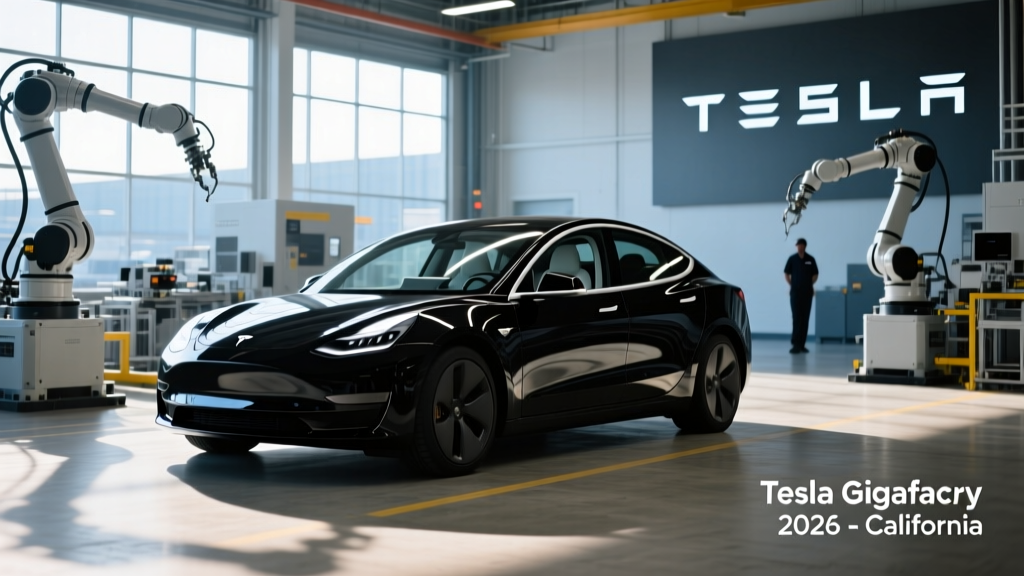
What this means for U.S. buyers: If you order a Model 3 in the United States, it was almost certainly built at the Fremont Factory in California. Model Y orders may come from either Fremont or Austin depending on configuration and delivery region. Cybertruck is exclusively an Austin product. Battery cells themselves may originate from Tesla's Nevada Gigafactory (Panasonic partnership), CATL in China (LFP cells), or other suppliers depending on the pack chemistry.
This matters for the IRS §30D federal tax credit, which imposes North American assembly and battery-sourcing requirements. Vehicles assembled outside the U.S., Canada, or Mexico are categorically ineligible — making Tesla's U.S. factories a direct advantage for credit-seeking buyers.
2026 Tesla Model 3: Quick Verdict
The refreshed Model 3 (internally dubbed "Highland" and now in its second model year post-refresh) remains the benchmark compact electric sedan. It offers class-leading efficiency, access to the Supercharger network (now with NACS-native hardware across the industry), and Tesla's software ecosystem. The trade-offs are familiar: a minimalist interior that polarizes, no traditional instrument cluster, and a reliance on the center touchscreen for nearly every vehicle function — including climate and mirror adjustments.
For 2026, the Model 3 lineup includes the Standard Range RWD, Long Range AWD, and Performance AWD trims. Pricing has stabilized, and federal tax-credit eligibility remains intact for qualifying buyers on U.S.-built configurations.
Range, Battery, and Efficiency
- Standard Range RWD: EPA 272 miles — expect ~230–245 mi on the highway at 70 mph; ~190–210 mi in sub-30°F winter conditions.
- Long Range AWD: EPA 341 miles — expect ~290–310 mi highway; ~240–265 mi in deep cold.
- Performance AWD: EPA 315 miles — expect ~265–285 mi highway; ~220–240 mi in deep cold.
Tesla's thermal management system (heat pump standard) mitigates cold-weather losses better than many competitors, but physics is physics — expect 15–25% range reduction in freezing temperatures.
| Trim | Battery (kWh usable) | Chemistry | EPA Range | MPGe (combined) | kWh/100 mi |
|---|---|---|---|---|---|
| Standard Range RWD | ~57.5 kWh | LFP (CATL) | 272 mi | 132 MPGe | 25.4 |
| Long Range AWD | ~75 kWh | NMC (Panasonic/LG) | 341 mi | 131 MPGe | 25.6 |
| Performance AWD | ~75 kWh | NMC | 315 mi | 121 MPGe | 27.7 |
LFP vs. NMC — what it means for you: The Standard Range uses a lithium iron phosphate (LFP) battery, which Tesla recommends charging to 100% regularly. LFP offers longer cycle life and lower degradation but less energy density (hence lower range). The Long Range and Performance trims use nickel-manganese-cobalt (NMC) packs, which Tesla recommends charging to 80% daily for longevity — you get more range from a larger, denser pack but should avoid routine 100% fills unless prepping for a road trip.
Charging: DC Fast, Level 2, and the Supercharger Advantage
| Charging Level | Power / Rate | Speed | Notes |
|---|---|---|---|
| Level 1 (120V household) | ~1.4 kW | ~3–4 mi/hr | Emergency/trickle only |
| Level 2 (240V home, 48A) | 11.5 kW | ~44 mi/hr | Full charge overnight (~7–8 hrs for LR) |
| DC Fast Charge (Supercharger V3/V4) | Peak 250 kW | 10–80% in ~25 min | Sustained rate tapers above 60% SoC |
| DC Fast (NACS Supercharger) | Peak 250 kW | ~170 mi in 15 min (optimal) | Native NACS port; no adapter needed |
Charging-curve reality check: The Model 3 Long Range peaks at 250 kW but only sustains that rate briefly between roughly 10–30% State of Charge. By 60% SoC, you'll see ~100–120 kW; above 80%, speeds drop sharply to protect the battery. Plan road-trip stops around the 10–80% window for maximum time efficiency — charging from 80–100% at a Supercharger can take as long as the 10–80% session.
For home charging, a Tesla Wall Connector on a 60A circuit delivers 48A (11.5 kW) to the car, adding roughly 44 miles of range per hour. Most owners with a daily commute under 60 miles round-trip will start every morning with a full battery. Budget $500–$1,500 for a professional Level 2 installation depending on your electrical panel's capacity and proximity to the parking spot.
Performance and Drivetrain
| Trim | Drivetrain | 0–60 mph | Horsepower | Top Speed |
|---|---|---|---|---|
| Standard Range RWD | Rear-Wheel Drive | 5.8 sec | ~283 hp | 125 mph |
| Long Range AWD | Dual-Motor AWD | 4.2 sec | ~384 hp | 125 mph |
| Performance AWD | Dual-Motor AWD | 2.9 sec | ~510 hp | 163 mph |
Even the base RWD Model 3 delivers instant torque and responsive acceleration that outpaces most gas-powered competitors in its price bracket. The Performance trim's 2.9-second 0–60 time puts it in supercar territory, aided by Tesla's traction-control algorithms and low center of gravity from the floor-mounted battery pack. The updated Highland suspension tuning has improved ride quality noticeably over pre-2024 models, though some drivers still note firmness over sharp pavement imperfections.
Interior, Cargo, and Technology
Passenger space: The Model 3 offers 42.2 inches of front legroom and 35.3 inches rear — adequate for adults on shorter trips but tighter than a midsize sedan. Headroom is generous thanks to the glass roof (40.3 in. front, 37.8 in. rear).
Cargo: 23 cubic feet total (trunk + frunk). The trunk opening is relatively narrow, which can make loading bulky items trickier than in a hatchback like the Model Y or Hyundai Ioniq 5.
Infotainment: A 15.4-inch center touchscreen handles everything — navigation, media, climate, vehicle settings, and even mirror adjustment. There is no separate instrument cluster; speed and navigation prompts appear in the upper-left corner of the main display. A rear 8-inch screen for passengers was added in the Highland refresh. The system is responsive and feature-rich, but the all-touch interface draws criticism from drivers who prefer physical knobs for climate and volume.
Driver assistance: Basic Autopilot (traffic-aware cruise control, lane centering) is standard. Full Self-Driving (Supervised) is a $8,000 option or $99/month subscription.
Pricing, Tax Credits, and Ownership Cost
| Trim | Base MSRP | Federal Credit (§30D) | Effective Price |
|---|---|---|---|
| Standard Range RWD | $38,990 | Up to $7,500* | ~$31,490* |
| Long Range AWD | $45,740 | Up to $7,500* | ~$38,240* |
| Performance AWD | $52,990 | Up to $7,500* | ~$45,490* |
*Critical tax-credit caveats: The IRS §30D Clean Vehicle Credit is subject to multiple eligibility gates that change frequently:
- MSRP cap: Sedans must have an MSRP at or below $55,000 — the Performance trim at $52,990 qualifies, but adding options that push the sticker above $55K may disqualify it.
- Buyer income cap: Adjusted gross income must not exceed $150,000 (single), $225,000 (head of household), or $300,000 (joint filing).
- Battery sourcing: Critical-mineral and battery-component requirements phase in annually. Tesla's U.S. assembly and diversified supply chain have kept most Model 3 configurations eligible, but always verify at fueleconomy.gov for the specific VIN before purchase.
- Point-of-sale transfer: As of 2024, you can transfer the credit to the dealer at purchase, reducing your out-of-pocket cost immediately rather than waiting for tax filing.
Warranty: Tesla covers the Model 3 with a 4-year/50,000-mile limited vehicle warranty and an 8-year/100,000-mile battery and drive unit warranty (8-year/120,000-mile for Long Range and Performance). The battery warranty guarantees at least 70% capacity retention over the coverage period.
Pros, Cons, and Who Should Buy
Pros
- Class-leading efficiency (25–28 kWh/100 mi)
- Access to Tesla Supercharger network — most reliable DC fast-charging infrastructure in North America
- Strong federal tax-credit eligibility on U.S.-built units
- LFP battery on Standard Range allows routine 100% charging
- Over-the-air updates continuously add features
- Excellent safety ratings (NHTSA 5-Star overall)
Cons
- All-touchscreen interface frustrates some drivers
- Rear seat legroom tighter than midsize competitors
- No head-up display or traditional instrument cluster
- FSD (Supervised) costs extra and is not truly autonomous
- Insurance premiums tend to run higher than segment average
- Turn-signal stalk removed in Highland refresh — uses steering-wheel buttons
- Commuters: Ideal. Efficiency, home-charging convenience, and low running costs make it a standout daily driver.
- Tech-forward buyers: If you want the most connected, software-rich EV experience, Tesla still leads.
- Road trippers: Supercharger network access removes most charging-anxiety on interstate travel.
- Families needing rear space: Consider the Model Y or a midsize competitor — the Model 3's rear seat is snug for taller teens and car-seat installations.
- Towing: Not recommended. The Model 3 is not rated for towing in the U.S.
Frequently Asked Questions
Where is the Tesla Model 3 made for U.S. buyers?
U.S.-market Model 3 vehicles are assembled at the Tesla Fremont Factory in Fremont, California. Battery cells may come from multiple suppliers, including CATL (LFP) and Panasonic/LG (NMC), depending on the trim and production batch.
What is the real-world range of the 2026 Tesla Model 3?
The EPA rates the Long Range AWD at 341 miles, but real-world highway driving at 70 mph typically yields 290–310 miles. In freezing temperatures, expect 240–265 miles. The Standard Range RWD delivers roughly 230–245 highway miles in mild conditions.
How fast does the Model 3 charge at home and on the road?
At home on a Level 2 (240V, 48A) Tesla Wall Connector, the Model 3 adds about 44 miles of range per hour. On a V3/V4 Supercharger, it peaks at 250 kW and charges from 10–80% in approximately 25 minutes, though sustained rates taper significantly above 60% State of Charge.
Does the 2026 Tesla Model 3 qualify for the $7,500 federal tax credit?
Most Model 3 configurations assembled in Fremont qualify for up to $7,500 under IRS §30D, provided the buyer meets income caps ($150K single / $300K joint) and the vehicle MSRP stays at or below $55,000 (sedan cap). Always verify eligibility for your specific VIN at fueleconomy.gov before purchasing.
Is the Model 3 worth buying over competitors like the Hyundai Ioniq 6 or BMW i4?
The Model 3 wins on Supercharger network access, software ecosystem, and efficiency. The Ioniq 6 offers a more traditional interior with physical controls and competitive range. The BMW i4 provides a premium cabin but at a higher price point. If Supercharger reliability and OTA updates matter to you, the Model 3 remains the default choice in its segment.
Where are other Tesla models manufactured?
Model Y is built in Fremont (CA), Austin (TX), Shanghai, and Berlin. Cybertruck is made exclusively in Austin. Model S and Model X are Fremont-only. The announced Gigafactory Mexico (Monterrey) is expected to produce next-generation vehicles, though production timing remains unconfirmed as of early 2026.