Where Is Rivian Headquartered — And Why It Matters for Buyers
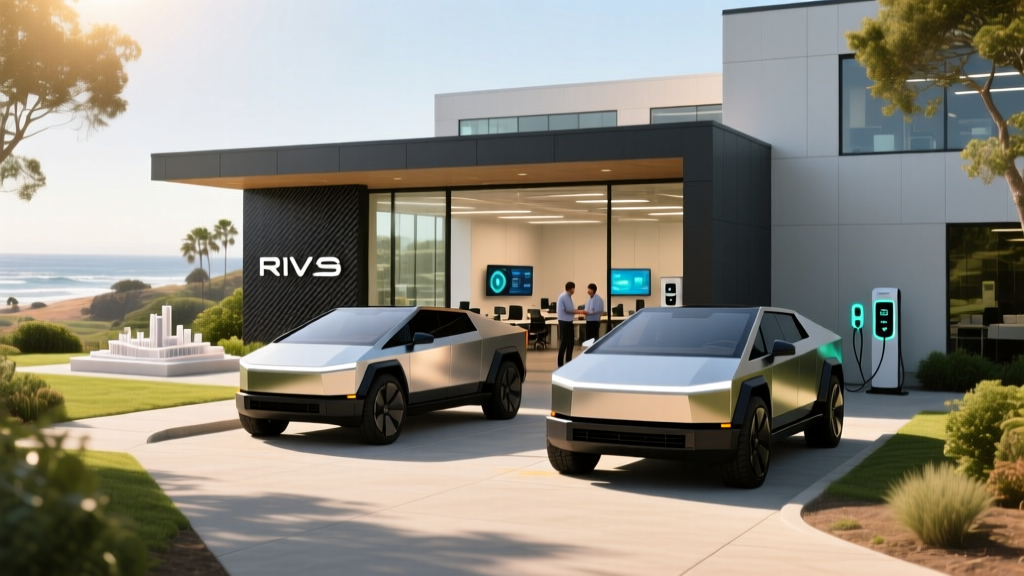
Rivian Automotive is headquartered at 15760 Laguna Canyon Road, Irvine, California 92618. The company moved into this roughly 250,000-square-foot campus in Orange County in 2022, consolidating engineering, software, design, and executive teams under one roof. While Rivian's manufacturing plant sits in Normal, Illinois, Irvine serves as the brain trust — the place where the R1T pickup, R1S SUV, and the forthcoming R2 platform are engineered, updated over-the-air, and validated before they ever reach a driveway.
For shoppers, the Irvine address is more than a corporate trivia answer. It signals a Silicon-Valley-adjacent approach to EV development: heavy investment in software-defined vehicles, continuous OTA updates, and a vertically integrated battery and drive-unit strategy. Let's pair that origin story with the data buyers actually need — EPA range, real-world charging curves, battery chemistry, and post-credit pricing — for Rivian's current 2026 lineup.
Rivian's Current Lineup at a Glance: R1T and R1S
The 2026 Rivian lineup centers on two vehicles built on the same skateboard platform: the R1T (four-door electric pickup) and the R1S (three-row electric SUV). Both share battery packs, drive units, and most software, but diverge on cargo layout, seating, and price. The second-generation architecture introduced for the 2025 model year carries forward, with dual-motor, performance dual-motor, and tri-motor configurations.
| Spec | R1T Dual-Motor | R1S Tri-Motor |
|---|---|---|
| EPA range | ~342 mi (Max Pack) | ~330 mi (Max Pack) |
| Battery (usable) | 149 kWh (Max, NMC) | 149 kWh (Max, NMC) |
| Peak DC fast charge | 220 kW | 220 kW |
| 10–80% DCFC time | ~42 min | ~42 min |
| Level 2 home charge | 11.5 kW (~25 mi/hr) | 11.5 kW (~25 mi/hr) |
| 0–60 mph | 4.5 sec | 2.9 sec (Tri) |
| Horsepower | 533 hp | 850 hp |
| Drivetrain | Dual-motor AWD | Tri-motor AWD |
| MPGe (combined) | ~73 MPGe | ~70 MPGe |
| kWh/100 mi | ~46 | ~48 |
| Battery warranty | 8 yr / 175,000 mi | 8 yr / 175,000 mi |
| Base MSRP (2026) | ~$69,900 | ~$99,000 |
Real-World Range: What the EPA Sticker Doesn't Tell You
EPA (Max Pack): up to 342 mi (R1T) / 330 mi (R1S)
Real-world highway (70 mph, 72°F): expect ~270–295 mi
Cold weather (30°F, highway): expect ~220–250 mi
Rivian's large trucks push significant frontal area and curb weight (over 7,000 lbs for the R1T), so efficiency suffers at sustained highway speeds. The 149 kWh Max Pack absorbs that penalty better than the 106 kWh Standard pack, but aerodynamics is physics — not marketing. Owners consistently report highway energy consumption between 45 and 52 kWh/100 mi depending on speed and terrain.
Cold-weather losses of 20–30% are typical for any NMC pack without preconditioning. Rivian's heat pump helps, but preconditioning via the app before DC fast charging is essential to hit peak 220 kW charge rates below freezing. For the Standard pack (106 kWh), plan on ~210–230 mi real-world highway in mild weather.
Charging Speed: DC Fast, Level 2, and the Curve
| Level | Power | Miles per hour | Notes |
|---|---|---|---|
| Level 1 (120V) | ~1.4 kW | ~3 mi/hr | Emergency/trickle only |
| Level 2 (240V, 48A) | 11.5 kW | ~25 mi/hr | Overnight full charge |
| DC fast (peak) | 220 kW | ~650 mi/hr (peak) | 10–80% in ~42 min |
The charge curve is where Rivian's 220 kW peak can mislead. Like most NMC packs, sustained rate drops sharply above 60% state of charge (SoC). Expect ~180–210 kW between 10–40%, tapering to ~80 kW by 70%, and ~40 kW above 85%. On a road trip, short 15–20 minute stops between 10–60% SoC are faster than a single long stop to 90%.
At home, the 11.5 kW onboard charger is competitive. A full Standard pack recharge takes ~9 hours; the Max Pack takes ~13 hours. Most owners installing a home Level 2 charger will need a 60A circuit and a NEMA 14-50 outlet or hardwired wall connector — budget $800–$2,200 installed depending on panel proximity.
Pricing, Trims, and the Federal Tax Credit Reality
| Trim | MSRP (2026) | §30D credit eligible? | Effective price* |
|---|---|---|---|
| R1T Dual-Motor Standard | $69,900 | Varies | As low as $62,400 |
| R1T Dual-Motor Max | $83,900 | Varies | As low as $76,400 |
| R1S Dual-Motor Standard | $74,900 | Varies | As low as $67,400 |
| R1S Tri-Motor Max | $99,000 | No (MSRP cap) | $99,000 |
*Effective price assumes full $7,500 point-of-sale transfer under IRS §30D. Actual eligibility hinges on three filters:
- MSRP cap: $80,000 for pickups/vans/SUVs. Tri-Motor Max trims exceed this.
- Buyer income cap: AGI ≤ $150k single / $300k joint.
- Battery sourcing: Critical minerals and battery components must meet phased-in thresholds that tighten yearly. Rivian's Samsung SDI cells have historically met requirements for qualifying trims, but confirm VIN eligibility at fueleconomy.gov before signing.
The credit is now available as a point-of-sale transfer, so buyers don't need to wait until tax filing. Always verify the specific VIN — sourcing rules change mid-year.
Interior, Cargo, and Family Practicality
The R1T seats five with 41.3 inches of front legroom and 38.6 inches in the rear. The 4.5-foot bed holds ~29 cu ft, and the front trunk ("frunk") adds 11 cu ft — lockable and drainable, ideal for tailgating or muddy gear. The gear tunnel (optional on some trims) is a signature Rivian feature: a pass-through behind the rear seats for skis, camping equipment, or long items.
The R1S seats up to seven across three rows, with ~105 cu ft of total cargo volume behind the front seats. Third-row space is genuinely usable for adults on short trips — rare in the segment. Both vehicles use a minimalist interior with a 15.6-inch center touchscreen, 12.3-inch driver cluster, and physical volume/drive-mode knobs.
Driver Assistance, Software, and the SAE Level Reality
SAE Level 2 driver assistance — Rivian's Driver+ combines adaptive cruise and lane centering. The driver must remain engaged with hands on the wheel. This is not self-driving. Only Level 4 robotaxis (Waymo, Zoox) operate without a human driver.
Rivian's infotainment is fully in-house, with OTA updates adding features quarterly. Recent updates have improved route planning, battery preconditioning logic, and camp-mode climate. The Rivian app is widely considered one of the best in the industry — reliable remote preconditioning, SoC monitoring, and scheduled charging.
Standout tech includes the gear tunnel, built-in air compressor, camp kitchen accessory, and quad-motor tank turns (on the Tri/Quad trims). Drawbacks: no Apple CarPlay/Android Auto (Rivian insists on its native stack), and the large touchscreen requires some menu diving for climate and mirror adjustments.
Is a Rivian Worth Buying vs. Key Competitors?
Pros
- Class-leading Max Pack range for a pickup/SUV
- Strong build quality and thoughtful adventure features
- Excellent OTA software and app experience
- 8-year/175,000-mile battery warranty
- Genuine off-road capability with air suspension
Cons
- Highway efficiency lags sleeker EVs (46–52 kWh/100 mi)
- No Apple CarPlay or Android Auto
- DC fast charging peaks at 220 kW — slower than Hyundai/Kia's 800V systems
- Tri-Motor trims exceed §30D MSRP cap
- Service center footprint still expanding
Versus the Ford F-150 Lightning, Rivian wins on range and refinement but costs more and tows less (max ~11,000 lbs vs Lightning's 10,000 lbs — close, but Ford has a larger service network). Against the Tesla Cybertruck, Rivian offers a more conventional interior, better visibility, and stronger real-world build quality, though Cybertruck's 48V architecture and steer-by-wire appeal to early adopters. For family hauling, the R1S competes directly with the Kia EV9, which is cheaper and offers CarPlay but gives up ~50 miles of range.
Who Should Buy a Rivian — And Who Shouldn't
Best for: Active households, outdoor enthusiasts, and buyers who want a premium adventure vehicle with genuine off-road chops and long range. The R1S suits three-row families who road-trip; the R1T suits truck buyers who never want to visit a gas station.
Think twice if: You need maximum towing, the lowest possible cost per mile, or CarPlay integration. Budget-focused buyers should also watch the forthcoming R2 (announced, not yet on sale), which targets a ~$45,000 starting price.
Frequently Asked Questions
Where is Rivian headquartered?
Rivian Automotive's global headquarters is at 15760 Laguna Canyon Road, Irvine, California 92618. Engineering, design, software, and executive functions are based there.
Where are Rivian vehicles manufactured?
All R1T and R1S vehicles are built at Rivian's manufacturing plant in Normal, Illinois — a former Mitsubishi factory Rivian acquired in 2017.
Does Rivian qualify for the federal EV tax credit?
Eligibility varies by trim. Dual-Motor trims under the $80,000 MSRP cap may qualify for the full $7,500 under IRS §30D, subject to buyer income limits and battery-sourcing rules. Tri-Motor Max trims exceed the MSRP cap and do not qualify.
What battery chemistry does Rivian use?
Rivian's current Max and Large packs use NMC (nickel-manganese-cobalt) cells supplied primarily by Samsung SDI. The Standard pack also uses NMC with a smaller capacity (106 kWh usable).
How long does the Rivian battery last?
Rivian warrants the battery for 8 years or 175,000 miles, whichever comes first, against defects and capacity loss below a defined threshold. Real-world degradation data is still accumulating, but NMC packs typically retain 85–90% capacity after 100,000 miles with proper charging habits (avoid sustained 100% SoC).
Is Rivian's Driver+ self-driving?
No. Driver+ is an SAE Level 2 system requiring continuous driver engagement. It combines adaptive cruise control with lane centering but does not replace the driver.
Sources: EPA fueleconomy.gov, IRS §30D Clean Vehicle Credit, Rivian Automotive.