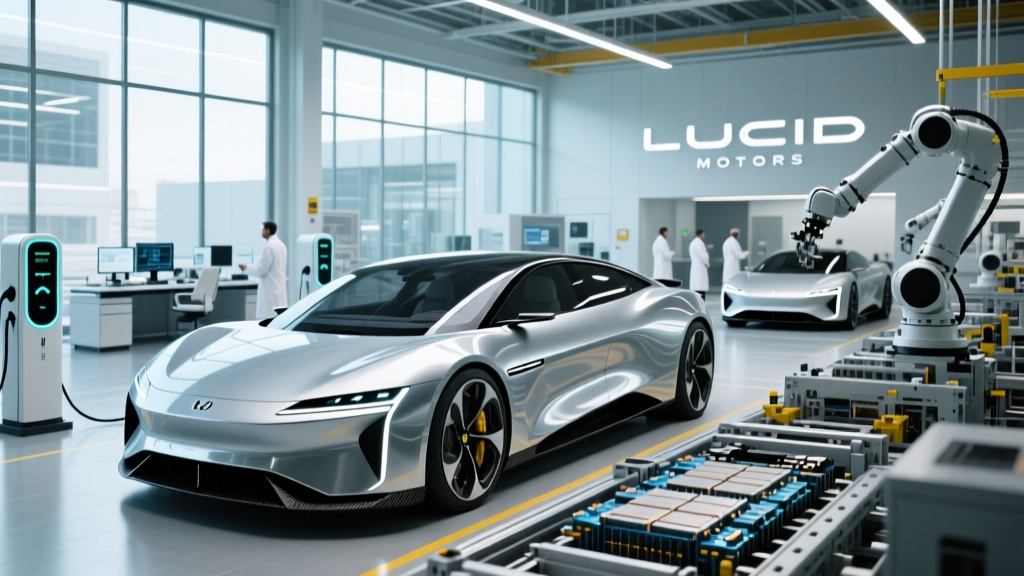
If you have been searching where is Lucid HQ, the answer takes you to the heart of Silicon Valley's hardware corridor: 3000 North First Street, Newark, California 94560. This 12-acre campus serves as both the corporate headquarters and the site of AMP-1 (Advanced Manufacturing Plant 1), the factory where every Lucid Air sedan is built for the global market. Lucid also operates a second production facility — AMP-2 — in King Abdullah Economic City (KAEC), Saudi Arabia, which handles vehicles for the Middle East and North Africa region.
But the real question for EV buyers isn't just where Lucid makes its cars — it's whether those cars are worth your money. Below, we pair a closer look at Lucid's manufacturing footprint with a full data-driven review of the 2026 Lucid Air lineup, including the Air Pure, Air Touring, Air Grand Touring, and the 1,200+ hp Air Sapphire. We also cover the upcoming Lucid Gravity SUV where relevant.
Lucid's Manufacturing Footprint: Newark, California and Beyond
Lucid Motors (originally founded as Atieva in 2007) chose Newark, California, strategically. The location sits roughly 40 miles south of San Francisco, giving the company access to Bay Area engineering talent while occupying a facility originally built for a Chrysler assembly operation. AMP-1 is a vertically integrated plant: Lucid designs and manufactures its own electric motors, battery packs, and power electronics in-house — a rarity among EV startups.
Key facts about Lucid's headquarters and production:
- Corporate HQ: 3000 North First Street, Newark, CA 94560
- AMP-1 Factory: Same Newark campus; produces the Lucid Air sedan
- AMP-2 Factory: KAEC, Saudi Arabia; began operations in 2023, primarily serves MENA markets
- Future Gravity production: Expected at AMP-1 (Newark) for North American deliveries
- Studio and service network: Lucid operates direct-to-consumer studios across major US metros, with service centers and mobile service vans
Lucid's Newark HQ also houses its R&D labs, where the company develops the compact drive units that give the Air its class-leading interior space. The facility is not generally open for public tours, though Lucid occasionally hosts media and reservation-holder events.
2026 Lucid Air: The Full Lineup at a Glance
The 2026 Lucid Air carries forward the lineup introduced for 2025 with minor software and packaging updates. The Air remains one of the most efficient luxury EVs on the market, thanks to Lucid's proprietary miniaturized drive units and a 900-volt+ electrical architecture that enables exceptionally fast charging.
| Trim | EPA Range | Battery (usable kWh) | Horsepower | 0–60 mph | Drivetrain | Base MSRP |
|---|---|---|---|---|---|---|
| Air Pure | 419 mi | 88 kWh (NMC) | 430 hp | 5.0 sec | RWD (single motor) | $69,900 |
| Air Touring | 425 mi | 112 kWh (NMC) | 620 hp | 3.4 sec | AWD (dual motor) | $87,400 |
| Air Grand Touring | 516 mi | 112 kWh (NMC) | 819 hp | 3.0 sec | AWD (dual motor) | $125,600 |
| Air Sapphire | 427 mi | 118 kWh (NMC) | 1,234 hp | 1.89 sec | AWD (tri-motor) | $249,000 |
All trims use NMC (nickel manganese cobalt) lithium-ion battery chemistry. Lucid has not adopted LFP (lithium iron phosphate) for the Air, prioritizing the higher energy density that NMC provides — a necessity for fitting 112+ kWh into a sedan footprint without sacrificing cargo room.
Real-World Range: What to Actually Expect
EPA sticker: Up to 516 miles (Grand Touring) / 419 miles (Pure)
Real-world highway (70 mph, 72°F): Expect roughly 370–410 miles for the Grand Touring and 320–350 miles for the Pure. Lucid's EPA numbers are among the most optimistic-to-real-world ratios in the industry because the Air's low drag coefficient (Cd 0.197) and efficient powertrain minimize losses at moderate speeds — but highway-speed aerodynamic drag still bites.
Cold weather (below 32°F): Plan for a 20–30% range reduction depending on cabin heating demand. The Air does include a heat pump, which mitigates losses compared to resistive heating, but sub-freezing battery chemistry still limits regenerative braking and increases consumption.
Efficiency: The Grand Touring achieves an EPA-rated 146 MPGe combined (roughly 23 kWh/100 mi), making it one of the most efficient large luxury sedans available.
Charging Speed: 900V Architecture in Practice
Lucid's 900-volt+ electrical architecture is one of the highest in production, enabling DC fast-charge rates that rival or exceed the Porsche Taycan and Hyundai Ioniq 5. Here is what charging actually looks like across the lineup:
| Charge Type | Pure (88 kWh) | Touring / Grand Touring (112 kWh) | Sapphire (118 kWh) |
|---|---|---|---|
| Peak DC fast charge | ~200 kW | ~300 kW | ~300 kW |
| 10–80% DCFC time | ~28 min | ~20 min | ~22 min |
| Level 2 home (19.2 kW onboard) | ~5.5 hours | ~6.5 hours | ~7 hours |
| Miles added per hour (L2, 19.2 kW) | ~80 mi/hr | ~72 mi/hr | ~68 mi/hr |
| Level 1 (120V, 1.4 kW) | ~4 mi/hr | ~4 mi/hr | ~4 mi/hr |
Charging-curve reality check: The Touring and Grand Touring peak at roughly 300 kW, but that rate is only sustained between approximately 10–40% state of charge. Above 60%, the curve tapers significantly — expect 80–120 kW through the 60–80% window. This is typical behavior for NMC packs at high charge rates, but it means your actual charging session on a road trip will average closer to 180–200 kW sustained, not the 300 kW peak.
Connector note: For 2026, Lucid has transitioned to the NACS (North American Charging Standard) port on new-production vehicles, granting native access to Tesla Supercharger stations. Earlier model-year Airs equipped with CCS1 can use a NACS adapter (included by Lucid for existing owners). Always confirm your specific build's connector before planning long-distance trips.
For home charging, the Air's 19.2 kW onboard charger is among the most powerful available. This requires a 100-amp dedicated circuit and a hardwired Level 2 station capable of 80 amps continuous output. Most homes will need a panel upgrade or sub-panel installation to support this — budget $1,500–$4,000 for electrical work depending on your existing service. If your home only supports a standard 48-amp / 11.5 kW circuit, plan for roughly 9–11 hours for a full charge on the larger battery packs.
Performance and Driving Dynamics
The Lucid Air lineup spans from comfortable grand-tourer to hypercar-rivaling performance machine:
- Air Pure (RWD, 430 hp): Adequate for daily driving with a 5.0-second 0–60 time. The single rear motor delivers smooth, linear acceleration. Ride quality is compliant, and the low center of gravity keeps body roll minimal in corners.
- Air Touring (AWD, 620 hp): A genuine sport sedan competitor to the BMW i5 and Mercedes EQE. The 3.4-second 0–60 time is quick without being overwhelming, and dual-motor torque vectoring adds cornering confidence.
- Air Grand Touring (AWD, 819 hp): Supercar acceleration (3.0 seconds) wrapped in a luxury sedan. This is the sweet spot for buyers who want maximum range AND performance.
- Air Sapphire (AWD, 1,234 hp): A 1.89-second 0–60 time makes this one of the fastest production cars ever built. It competes directly with the Tesla Model S Plaid and Rimac Nevera in straight-line performance, while offering a usable back seat and trunk. Track-capable with carbon-ceramic brakes and a dedicated Sapphire drive mode.
All trims feature adaptive air suspension (standard on Touring and above, optional on Pure), regenerative braking with adjustable intensity, and a low seating position that emphasizes the Air's sports-sedan character. Steering is precise but light — Lucid prioritizes GT comfort over the heavy, communicative feel of a Porsche Taycan.
Interior Space, Tech, and Daily Livability
The Air's miniaturized drive units free up significant interior volume compared to competitors. Key dimensions:
- Rear legroom: 41.3 inches (class-leading — more than the Mercedes S-Class)
- Front headroom: 39.0 inches
- Cargo (trunk + frunk): 32.0 cu ft combined (22.0 trunk + 10.0 frunk)
- Seating: 5 passengers standard
Infotainment: A 34-inch curved glass cockpit display spans the driver's instrument cluster and central infotainment. The system runs Lucid's proprietary software — responsive and visually clean, but with a smaller third-party app ecosystem than Tesla or Android Automotive. Wireless Apple CarPlay and Android Auto are supported. A lower touchscreen handles climate and secondary controls.
Driver assistance: Lucid's DreamDrive Pro system provides adaptive cruise control, lane-centering, automatic emergency braking, and blind-spot monitoring. This is an SAE Level 2 driver-assist system — meaning you must keep your hands on the wheel and eyes on the road at all times. It does not offer hands-free highway driving like GM's Super Cruise or Ford's BlueCruise. Lucid has signaled plans for more advanced driver-assist features via over-the-air updates, but as of 2026, DreamDrive Pro remains a conventional Level 2 suite.
Driver-Assist Limitation Notice
Lucid DreamDrive Pro is an SAE Level 2 system. It is not autonomous or "self-driving." The driver must remain fully engaged, monitor the road, and be prepared to take over immediately. Hands-off or eyes-off operation is not supported and is unsafe.
Notable drawbacks:
- No hands-free driving mode (competitors like BMW i7 and Mercedes EQS offer more advanced Level 2+ features)
- Rear visibility is limited by the sloping roofline — a rear camera is essential
- Service center network is still growing — owners in rural areas may rely on mobile service or long-distance towing
- Infotainment ecosystem is less mature than Tesla's, with fewer built-in streaming and gaming apps
Pricing, Tax Credits, and Ownership Economics
Here is what the 2026 Lucid Air lineup costs before and after potential federal incentives:
| Trim | Base MSRP | As-Tested (typical options) | §30D Credit Eligible? | Effective Price (if eligible) |
|---|---|---|---|---|
| Air Pure | $69,900 | $72,000–$75,000 | Potentially — see rules below | From ~$62,400 |
| Air Touring | $87,400 | $90,000–$95,000 | No — exceeds MSRP cap | $87,400+ |
| Air Grand Touring | $125,600 | $130,000–$140,000 | No — exceeds MSRP cap | $125,600+ |
| Air Sapphire | $249,000 | $250,000+ | No — exceeds MSRP cap | $249,000+ |
Federal §30D tax credit rules (2026): Under current IRS rules, the new clean vehicle credit provides up to $7,500, but eligibility depends on several conditions:
- MSRP cap: Sedans must have a base MSRP at or below $55,000 (vans, SUVs, and trucks have a $80,000 cap). This eliminates the Touring, Grand Touring, and Sapphire immediately.
- Air Pure at $69,900 MSRP: Exceeds the $55,000 sedan cap. As currently classified, the Air Pure does not qualify for the §30D new-vehicle credit.
- Buyer income limits: Modified adjusted gross income must not exceed $150,000 (single), $225,000 (head of household), or $300,000 (joint filing).
- Battery sourcing: Critical minerals and battery component requirements phase in more strictly each year. Lucid's battery supply chain involves materials from multiple global sources — check the latest fueleconomy.gov listings for current eligibility.
- Point-of-sale transfer: If eligible, the credit can be transferred to the dealer at purchase, reducing your out-of-pocket cost immediately.
Bottom line on incentives: As of 2026, no Lucid Air trim qualifies for the federal §30D new-vehicle credit due to MSRP cap constraints. Always verify current rules at irs.gov before purchasing, as classification changes (e.g., if a future Air variant is classified as an SUV) could alter eligibility.
Warranty coverage:
- Basic vehicle: 4 years / 50,000 miles
- Battery and powertrain: 8 years / 100,000 miles (covers defects and capacity loss below 70% state of health)
- Roadside assistance: 4 years / 50,000 miles
How Does the Lucid Air Compare?
Pros
- Class-leading EPA range (up to 516 mi on Grand Touring)
- Exceptional efficiency — 146 MPGe combined on GT
- Massive rear-seat legroom (41.3 in) and generous cargo volume
- 900V architecture enables ~300 kW peak DC charging
- 19.2 kW onboard charger for fast home Level 2 fills
- Air Sapphire is one of the fastest production cars ever made
- Quiet, refined ride quality with air suspension
Cons
- No trim qualifies for the $7,500 federal tax credit (MSRP cap)
- DreamDrive Pro is basic Level 2 — no hands-free highway mode
- Service center network still limited outside major metros
- Infotainment ecosystem less robust than Tesla or Android Automotive
- High starting price; Touring and above approach six figures
- Rear visibility compromised by fastback roofline
- Brand awareness and resale value still unproven vs. Tesla, Mercedes
Key competitors:
- Tesla Model S: Lower starting price, Supercharger network, hands-free-capable Autopilot (with FSD Supervised), but aging interior and lower EPA range than the Air Grand Touring.
- BMW i7: More luxurious interior, hands-free Level 2 highway assist, but significantly lower range (~318 mi EPA) and higher pricing.
- Mercedes-Benz EQS: Comparable luxury, but range falls short (~390 mi EPA on 450+), and real-world efficiency trails the Air.
- Porsche Taycan: Superior driving dynamics and charging curve consistency, but far less range and rear-seat space.
Who Is the Lucid Air For?
Decision Framework
Choose the Air Pure if: You want maximum range per dollar in a luxury sedan, commute long distances, and don't need AWD or extreme acceleration. Best for: daily commuters, efficiency-focused buyers.
Choose the Air Touring if: You want AWD, strong acceleration, and a well-equipped luxury package without stepping to Grand Touring pricing. Best for: all-weather commuters who want sport-sedan performance.
Choose the Air Grand Touring if: Range and performance are both priorities, and budget allows. This is the flagship experience. Best for: road-trippers, tech executives, luxury sedan buyers who want 500+ miles of range.
Choose the Air Sapphire if: You want hypercar performance with a usable back seat and trunk, and price is secondary. Best for: collectors, track enthusiasts, status-driven buyers.
Look elsewhere if: You need hands-free highway driving (consider BMW i7 or GM Super Cruise vehicles), you're on a tight budget, or you live far from a Lucid service center.
Frequently Asked Questions
Where is Lucid HQ located?
Lucid Motors is headquartered at 3000 North First Street, Newark, California 94560. This campus also houses AMP-1, the primary manufacturing facility for the Lucid Air.
What is the real-world range of the Lucid Air?
The EPA rates the Air Grand Touring at 516 miles and the Air Pure at 419 miles. In real-world highway driving at 70 mph, expect roughly 370–410 miles (Grand Touring) and 320–350 miles (Pure). Cold weather below freezing can reduce range by 20–30%.
How fast does the Lucid Air charge?
The Touring and Grand Touring peak at approximately 300 kW on a DC fast charger, achieving a 10–80% charge in about 20 minutes. The Pure peaks around 200 kW (10–80% in ~28 minutes). At home on a 19.2 kW Level 2 charger, a full charge takes 5.5–7 hours depending on battery size.
Does the Lucid Air qualify for the federal EV tax credit?
As of 2026, no Lucid Air trim qualifies for the §30D federal new-vehicle tax credit. All trims exceed the $55,000 MSRP cap for sedans. Always check the latest eligibility at irs.gov before purchasing.
Is the Lucid Air worth buying vs. competitors?
The Air leads the luxury EV sedan segment in range and efficiency. If those are your top priorities and budget allows, it is arguably the best choice. However, if hands-free driving tech, brand cachet, or lower pricing matter more, the Tesla Model S, BMW i7, or Mercedes EQS may be better fits.
What are the biggest pros and cons of the Lucid Air?
Pros: class-leading range (up to 516 mi EPA), exceptional efficiency, spacious interior, fast 900V charging, and the Sapphire's record-breaking performance. Cons: no federal tax credit eligibility, limited service network, basic Level 2 driver-assist, and high pricing across the lineup.
Where is the Lucid Gravity SUV made?
The Lucid Gravity, the company's first SUV, is expected to be produced at AMP-1 in Newark, California, for North American deliveries. Check Lucid's official site for the latest production and delivery updates.