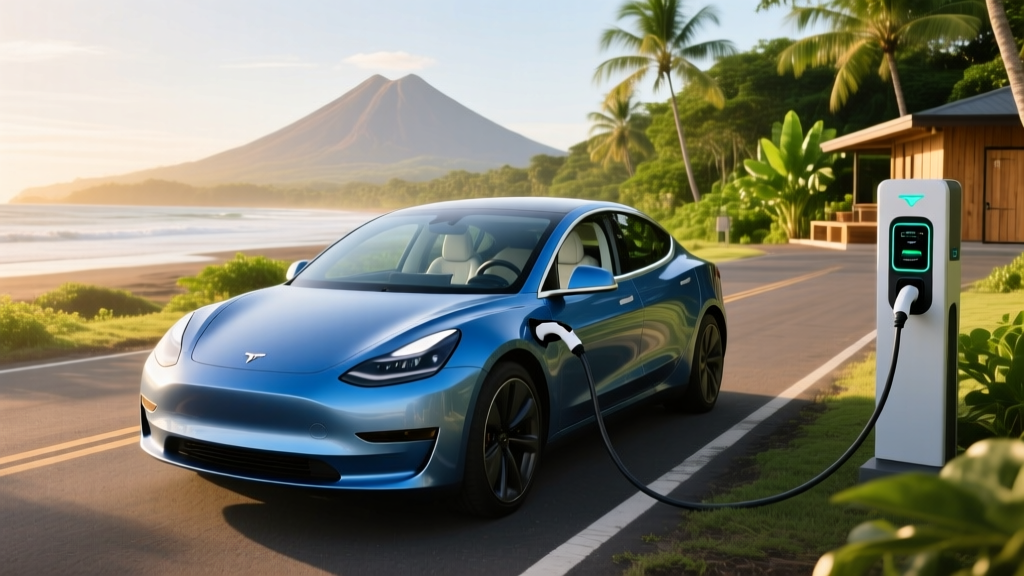
Americans researching electric vehicles online occasionally stumble into a surprising search trend: "EV Costa Rica." It's not a mistake. The Central American nation has become one of the most EV-friendly countries in the Western Hemisphere, with a grid powered roughly 98% by renewable energy, aggressive tax exemptions on electric car imports, and a growing charging corridor along the Pan-American Highway. For U.S. shoppers, it raises two questions: What can we learn from Costa Rica's EV ecosystem, and how does the real cost of owning an EV in the United States stack up in 2026?
This guide breaks down the five-year total cost of ownership (TCO) for a mainstream American EV, maps the current IRS §30D federal tax credit landscape, compares per-mile fuel and maintenance costs against a gas baseline, and addresses the uncomfortable truths about insurance premiums and depreciation that many EV cheerleaders gloss over. We'll use the 2026 Hyundai Ioniq 5 SEL (one of the best-selling U.S. EVs) as our benchmark, with a 2026 Toyota Camry LE as the gas-car comparison.
The 5-Year Total Cost of Ownership: Real Numbers
Total cost of ownership is the single most important metric for an EV purchase decision, and it's where most marketing materials fall short. Below is a realistic 5-year / 75,000-mile TCO breakdown for a 2026 Hyundai Ioniq 5 SEL (RWD, 77.4 kWh usable NMC battery, EPA 303 miles range, $46,700 MSRP before incentives) versus a 2026 Toyota Camry LE (2.5L I-4, EPA 32 MPG combined, ~$29,500 MSRP).
| Category | 2026 Ioniq 5 SEL (EV) | 2026 Camry LE (Gas) |
|---|---|---|
| Purchase Price (MSRP) | $46,700 | $29,500 |
| Federal Tax Credit (§30D) | -$7,500 (if eligible) | $0 |
| Effective Purchase | $39,200 | $29,500 |
| Fuel / Electricity (75k mi) | $5,625 | $9,375 |
| Maintenance (5 years) | $1,800 | $4,200 |
| Insurance (5 years) | $11,250 | $8,250 |
| Depreciation (est.) | $21,500 | $11,800 |
| Total 5-Year Cost | $79,375 | $63,125 |
| Cost Per Mile | $1.06 | $0.84 |
The honest takeaway: Even with the full $7,500 federal credit and significant fuel/maintenance savings, the Ioniq 5 still costs roughly $16,250 more over five years than the Camry — largely driven by higher upfront cost, steeper depreciation, and pricier insurance. The EV math flips in your favor only if you drive significantly more than 15,000 miles per year, have cheap home electricity, live in a state with additional rebates, or prioritize the performance and tech advantages that don't show up on a spreadsheet.
Federal Tax Credit in 2026: §30D Rules You Must Know
The IRS §30D Clean Vehicle Credit remains the centerpiece of U.S. EV incentives in 2026, but it is anything but simple. The credit tops out at $7,500, split between two sourcing requirements — and qualifying vehicles have shrunk considerably since the rules tightened in 2024.
§30D Eligibility Checklist (2026 Model Year)
- Credit Amount: Up to $7,500 ($3,750 for critical minerals + $3,750 for battery components)
- MSRP Caps: Vans, SUVs, and pickups ≤ $80,000; sedans and other body styles ≤ $55,000
- Buyer Income Caps (Modified AGI): Married filing jointly ≤ $300,000; Head of household ≤ $225,000; Single/other ≤ $150,000
- Battery Sourcing: Critical minerals and battery components must meet escalating domestic/Fta-partner sourcing thresholds that tighten annually through 2030
- Final Assembly: Vehicle must be assembled in North America (VIN check required)
- FEOC Restriction: Vehicles with battery components or critical minerals from a "foreign entity of concern" (primarily China, Russia, Iran, North Korea) are disqualified — this rule has removed several previously eligible models
- Point-of-Sale Transfer: Since 2024, buyers can transfer the credit to the dealer at purchase, reducing the sale price directly rather than waiting for a tax refund
- One Credit Per Vehicle, Per Taxpayer: You cannot claim §30D more than once every 3 years per VIN
For our Ioniq 5 SEL example, the $46,700 MSRP clears the $55,000 sedan/SUV cap (classified as an SUV), and Hyundai's Savannah, Georgia assembly plant satisfies North American final assembly. However, the battery sourcing rules are the make-or-break factor, and they shift annually. Always verify current eligibility on fueleconomy.gov before signing a purchase agreement — a model that qualified in January may not qualify by June.
Important: This is not tax advice. Consult a qualified tax professional to confirm your personal eligibility based on income, filing status, and the vehicle's current sourcing compliance.
State, Local, and Utility Incentives: The Patchwork Map
Beyond federal credits, dozens of states, municipalities, and investor-owned utilities stack additional incentives on top. These vary dramatically by ZIP code and change frequently, so treat the following as directional examples rather than guarantees:
- Colorado: Up to $5,000 state tax credit for new EVs (stacks with §30D)
- California (CVRP): Up to $7,000 for income-qualified buyers, though funding is cyclical
- New York: Drive Clean Rebate up to $2,000 (point-of-sale)
- Utility rebates: Many IOUs (PG&E, Xcel, Dominion) offer $500–$1,500 for home Level 2 charger installation or off-peak charging credits
- HOV lane access: States like California, Colorado, and Virginia grant solo-carpool access to qualifying EVs — a non-monetary perk worth thousands in time savings
Always check your state energy office, local air district, and utility's EV program page for current offerings.
This patchwork is where Costa Rica's approach looks enviable by comparison: a single national policy that exempts EVs from import duties, the selective consumption tax, and the annual circulation tax for the first several years of ownership. U.S. buyers must navigate 50 different state regimes plus hundreds of utility programs — a complexity that slows adoption even when total incentives are generous.
Charging vs. Gas: The Per-Mile Math That Matters
The "EVs are cheaper to fuel" claim is broadly true — but the size of your savings depends almost entirely on where and when you charge. Here's the math at 2026 rates:
| Scenario | Rate | Cost Per Mile | 75k Mile Total |
|---|---|---|---|
| Home charging (national avg. $0.16/kWh, 3.5 mi/kWh efficiency) | $0.16/kWh | $0.046 | $3,450 |
| Public DC fast charging (avg. $0.48/kWh) | $0.48/kWh | $0.137 | $10,275 |
| Gas car (32 MPG combined, $3.50/gallon) | $3.50/gal | $0.109 | $8,175 |
| Gas car (32 MPG combined, $4.25/gallon — CA/West Coast) | $4.25/gal | $0.133 | $9,975 |
The takeaway is stark: if you charge primarily at home on a utility rate around $0.16/kWh, you'll spend roughly $3,450 on electricity over 75,000 miles — a savings of about $4,700 versus a gas car at national average prices. But if you rely heavily on public DC fast chargers (common for apartment dwellers and road-trippers), your fuel cost actually exceeds a gas car. This is why home Level 2 charging access is the single biggest financial variable in EV ownership.
Costa Rica's advantage here is structural: with electricity prices around $0.20–$0.25/kWh and a grid that is nearly 100% renewable (hydro, geothermal, wind), an EV charged at home is genuinely a zero-upstream-emissions proposition — something only a handful of U.S. regions (Pacific Northwest, parts of New England) can match.
Maintenance Savings: Where EVs Actually Win
Maintenance is the cleanest win in the EV ownership equation. Battery-electric vehicles eliminate oil changes, spark plugs, timing belts, fuel filters, and most of the consumables that accumulate on a gas-car service invoice. Regenerative braking significantly extends pad and rotor life — many EV owners report original brake pads at 80,000+ miles.
| Service Item | EV (Ioniq 5) | Gas (Camry) |
|---|---|---|
| Oil Changes (synthetic, ~7,500 mi interval) | $0 | $750 |
| Brake Pads & Rotors | $200 (rear only, regen-saved fronts) | $900 |
| Cabin Air Filter | $150 | $150 |
| Coolant / Fluids | $150 | $350 |
| Tires (EVs wear tires ~15-20% faster due to weight/torque) | $1,100 | $900 |
| Miscellaneous (wipers, 12V battery, inspections) | $200 | $400 |
| Total | $1,800 | $3,450 |
Net maintenance savings: roughly $1,650 over five years, or about $330/year. Meaningful, but not transformative — and partially offset by faster tire wear on heavier, torque-rich EVs. Hyundai's 5-year/60,000-mile basic warranty and 10-year/100,000-mile powertrain/battery warranty also provide long-tail peace of mind that most mainstream gas-car warranties do not match.
Insurance: The Uncomfortable EV Premium
Here's where the EV ownership story gets less cheerful. Insurance premiums for electric vehicles are, on average, 15–30% higher than equivalent gas cars, and the gap has persisted even as EV market share has grown. The reasons are structural, not temporary:
- Higher repair costs: EV battery packs are expensive to diagnose and replace after even minor collisions; many insurers total vehicles that would be repairable if gas-powered.
- Specialized labor: High-voltage system repair requires certified technicians, and the pool is still limited.
- Parts availability: EV-specific body panels, structural battery enclosures, and drive units have longer lead times and fewer aftermarket alternatives.
- Vehicle price: The higher MSRP of most EVs directly increases comprehensive and collision premiums.
For our Ioniq 5 example, expect average annual premiums around $2,250 versus $1,650 for the Camry — a $600/year or $3,000/5-year gap. Some insurers (Tesla Insurance, Progressive, Geico) have started offering EV-specific policies with usage-based discounts, and premiums are slowly normalizing, but as of 2026, insurance remains a material line-item disadvantage.
Depreciation: The Largest Hidden Cost
Depreciation is the single largest cost in any vehicle ownership cycle, and for EVs it has been a rough story since 2022. After Tesla's aggressive price cuts in 2023–2024 cratered used EV values across the market, and as newer, longer-range models continually reset buyer expectations, early-adopter EVs have depreciated faster than comparable gas cars.
Industry data from Kelley Blue Book and iSeeCars shows that the average 3-year-old EV retains roughly 50–55% of its original MSRP, versus 60–65% for a comparable gas car. Applied to our example:
- Ioniq 5 SEL ($46,700 MSRP, ~$39,200 after credit): Estimated 5-year residual value of ~$17,700, representing ~$21,500 in depreciation from the effective purchase price.
- Camry LE ($29,500 MSRP): Estimated 5-year residual value of ~$17,700, representing ~$11,800 in depreciation.
That's nearly a $10,000 depreciation gap, and it's the main reason the 5-year TCO favors the gas car despite the EV's fuel and maintenance wins. Depreciation is improving as the used-EV market matures and battery longevity data accumulates, but buyers should enter an EV purchase knowing that resale value remains a weaker proposition than a proven gas-car segment leader.
One mitigating factor: the federal used-EV tax credit (§25E) allows qualified buyers of pre-owned EVs to claim up to $4,000 (or 30% of the sale price, whichever is lower) — which supports used-EV demand and may help stabilize future residuals. This credit has its own income caps and vehicle price limits (≤ $25,000 sale price) detailed on IRS.gov.
The Costa Rica Lesson: What U.S. Buyers Can Learn
The "EV Costa Rica" phenomenon isn't about Americans moving south to buy cars — it's about a country that removed friction. Costa Rica's unified national policy (import tax exemption, circulation tax holiday, renewable grid, charging corridor investment) gives buyers a clear, predictable financial picture. The U.S. system, by contrast, requires buyers to stack federal credits, state rebates, utility programs, and HOV perks into a bespoke package that varies by ZIP code and changes annually.
If you're a U.S. buyer evaluating an EV in 2026, here's a practical decision framework:
- Buy EV if: You have home Level 2 charging access, drive 15,000+ miles/year, qualify for §30D (and ideally state credits), plan to keep the car 7+ years (depreciation hurts less over longer horizons), and value the driving experience.
- Wait or choose PHEV if: You rely on street or apartment charging, drive under 10,000 miles/year, don't qualify for credits due to income or vehicle sourcing, or plan to trade in within 3 years.
- Choose gas if: Upfront budget is the primary constraint, you tow frequently (EV range collapses under load), or you live in a charging-desert region with extreme cold.
Frequently Asked Questions
How much does it really cost to own an EV over 5 years?
For a mainstream 2026 EV like the Hyundai Ioniq 5 SEL, expect a 5-year / 75,000-mile total cost around $79,000 including purchase (after federal credit), electricity, maintenance, insurance, and depreciation. That's roughly $16,000 more than an equivalent gas sedan, driven primarily by higher depreciation and insurance — even after $5,000+ in fuel and maintenance savings. High-mileage drivers and those with cheap home electricity narrow the gap substantially.
Do I qualify for the $7,500 federal EV tax credit?
Possibly — but it depends on three factors: (1) your modified AGI must be under $150,000 (single) / $225,000 (head of household) / $300,000 (joint); (2) the vehicle's MSRP must be under $55,000 for sedans or $80,000 for SUVs/trucks/vans; and (3) the battery's critical minerals and components must meet 2026 domestic/Fta-partner sourcing thresholds, which have disqualified several models. Always verify eligibility on fueleconomy.gov and with a tax professional before purchasing.
How much do I save on fuel and maintenance with an EV?
With home charging at the national average rate ($0.16/kWh) and a typical efficiency of 3.5 miles/kWh, expect to spend about $0.046/mile on electricity versus $0.109/mile on gas at 32 MPG and $3.50/gallon. Over 75,000 miles, that's roughly $4,700 in fuel savings. Maintenance savings add another ~$1,650 (no oil changes, reduced brake wear). Combined savings: approximately $6,350 over 5 years — significant, but not enough to offset the EV's higher purchase price, insurance, and depreciation alone.
Are EVs more expensive to insure?
Yes, typically 15–30% more than equivalent gas cars. In our Ioniq 5 vs. Camry example, that translates to roughly $600/year or $3,000 over five years. Higher repair costs, specialized labor requirements, expensive battery replacement after collisions, and higher MSRP values all contribute. Shop quotes from multiple carriers — some now offer EV-specific policies — and consider usage-based programs.
How well do EVs hold their value compared to gas cars?
Not as well, as of 2026. The average 3-year-old EV retains roughly 50–55% of MSRP versus 60–65% for a comparable gas car, and the gap widens over 5 years. Rapid technology improvements, Tesla-driven price volatility, and battery-health uncertainty all pressure used values. Plan to hold your EV 7+ years to amortize depreciation, or lease to transfer residual risk to the lessor. The §25E used-EV credit (up to $4,000) helps support demand in the secondary market.
Why do people search "EV Costa Rica"?
Costa Rica has become a global EV-policy case study: nearly 100% renewable electricity, import tax exemptions for electric vehicles, a multi-year circulation tax holiday, and a growing fast-charging corridor connecting San José to both coasts. For U.S. buyers, it's a useful comparison point — demonstrating what unified national EV policy looks like versus the fragmented U.S. incentive landscape. Some American EV owners also relocate or spend extended time in Costa Rica, where low electricity costs and favorable tax treatment make EV ownership particularly economical.