If you've been researching American-built electric trucks and SUVs, you've probably typed "where are Rivians made" into a search bar. The short answer: every Rivian R1T pickup and R1S SUV rolls off a production line in Normal, Illinois — at a sprawling former-Mitsubishi plant that Rivian retooled into one of the most vertically integrated EV factories in North America. But knowing where your EV is built is only the beginning. This guide pairs that manufacturing deep-dive with everything a 2026 buyer actually needs: real-world range, DC fast-charging curves, tax-credit math, and a head-to-head verdict against the Tesla Cybertruck, Ford F-150 Lightning, and Hyundai Ioniq 5.
Rivian's Manufacturing Home: Normal, Illinois
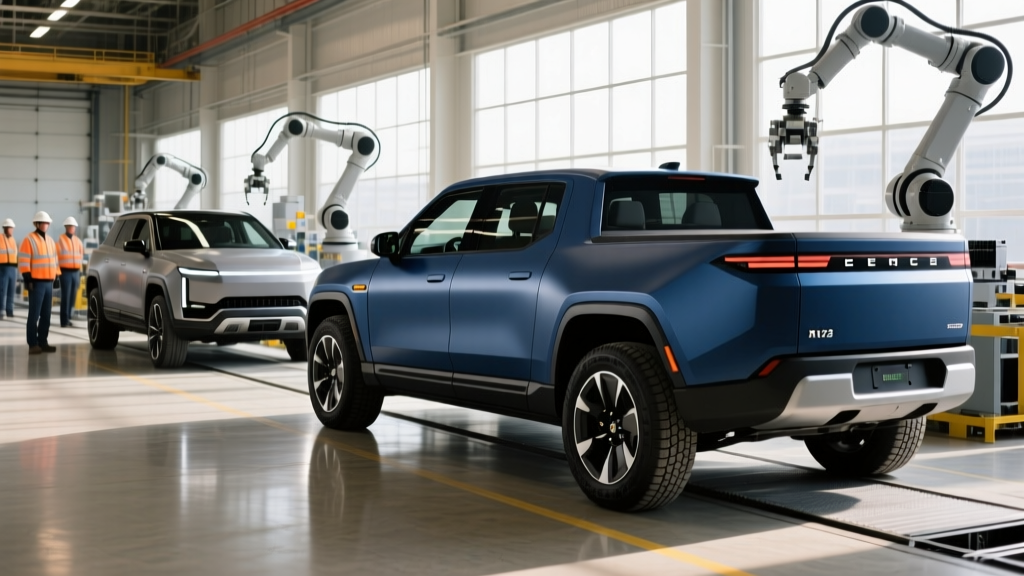
Rivian's sole production facility occupies a 3.3-million-square-foot complex in Normal, Illinois — roughly 130 miles southwest of Chicago. Originally built by Mitsubishi Motors in the 1980s, Rivian acquired the plant in 2017 and spent over $2 billion converting it for electric-vehicle production. The first R1T rolled off the line in September 2021.
As of 2026, the Normal facility handles stamping, body-in-white, paint, battery-pack assembly, drivetrain integration, and final vehicle assembly all under one roof. Rivian also builds its commercial EDV (Electric Delivery Van) for Amazon at this site, though a second plant in Stanton, Georgia — announced for commercial-van production — continues to move toward operational status.
Why does the factory location matter to a buyer? Two reasons:
- Supply-chain transparency: Rivian assembles its battery packs in-house at Normal, giving the company tighter control over cell sourcing and pack-level quality than automakers that outsource pack assembly.
- Tax-credit implications: The IRS §30D federal credit requires North American final assembly. Every R1T and R1S qualifies on the assembly-origin requirement, though other criteria (MSRP caps, income limits, critical-mineral sourcing) still apply — more on that below.
2026 Rivian R1T and R1S: Specs at a Glance
Both the R1T (truck) and R1S (three-row SUV) share Rivian's second-generation "Gen 2" skateboard platform, which introduced a self-developed dual-motor drive unit, a simplified wiring architecture, and the option of LFP (lithium iron phosphate) battery chemistry on the Standard pack. Here are the key numbers for the 2026 model year:
| Spec | R1T Dual-Motor (Standard) | R1T Dual-Motor (Max) | R1S Dual-Motor (Standard) | R1S Dual-Motor (Max) |
|---|---|---|---|---|
| EPA Range | 270 mi | 420 mi | 260 mi | 410 mi |
| Battery (usable) | ~92 kWh (LFP) | ~141 kWh (NMC) | ~92 kWh (LFP) | ~141 kWh (NMC) |
| Horsepower | 533 hp | 533 hp | 533 hp | 533 hp |
| 0–60 mph | 4.5 sec | 4.5 sec | 4.6 sec | 4.6 sec |
| Drivetrain | AWD (dual-motor) | AWD (dual-motor) | AWD (dual-motor) | AWD (dual-motor) |
| Max Tow Capacity | 11,000 lb | 11,000 lb | 7,700 lb | 7,700 lb |
| MPGe (combined) | 73 MPGe | 70 MPGe | 74 MPGe | 71 MPGe |
| Base MSRP | $69,900 | $83,900 | $75,900 | $89,900 |
Sources: EPA fueleconomy.gov, Rivian R1T specs, Rivian R1S specs.
Real-World Range: What the EPA Sticker Doesn't Tell You
On the sticker, the R1T Dual-Motor Max Pack delivers 420 miles. In mixed real-world driving (70–75 mph highway, 65°F, no cargo), expect ~340–370 miles. Load the bed with 1,000 lb of gear and push 80 mph through mountain passes, and that drops to roughly 280–310 miles. In sustained sub-freezing temperatures (20°F and below), plan for a 25–35% range reduction, landing you around 270–315 miles on the Max Pack.
Why the gap? The EPA test cycle includes low-speed urban segments that favor EVs with strong regenerative braking. Sustained highway speeds above 70 mph increase aerodynamic drag exponentially — and the R1T, at over 7,000 lb with the frontal area of a full-size truck, is no exception. The Max Pack's 141 kWh NMC battery provides a large energy buffer, but physics still applies.
The Standard Pack's LFP chemistry offers a different trade-off: lower total energy (~92 kWh usable) but superior longevity. LFP cells tolerate daily 100% charging without the degradation penalties that NMC cells face above 80% State of Charge. If your commute is under 120 miles round-trip and you charge at home nightly, the Standard Pack's 270-mile EPA rating (roughly 210–230 real-world highway miles) may be plenty — and the battery will likely outlast the vehicle.
Charging Speed: DC Fast, Level 2, and the Curve That Matters
Charging speed is where Rivian's Gen 2 platform made significant gains over the original 2022–2023 models. Here's what you can expect at the plug:
| Charging Level | Power / Rate | R1T Max Pack (141 kWh) | R1T Standard (92 kWh) |
|---|---|---|---|
| Level 1 (120V household) | ~1.4 kW | ~3 mi/hr | ~3 mi/hr |
| Level 2 (240V, 48A home charger) | 11.5 kW | ~25 mi/hr | ~25 mi/hr |
| DC Fast Charge (peak) | Up to 220 kW | 10–80% in ~34 min | 10–80% in ~25 min |
A few critical nuances that spec sheets gloss over:
- The charge curve tapers hard above 80%. The R1T Max Pack peaks near 220 kW between roughly 15–40% State of Charge, then progressively steps down. From 80–100%, charging slows to under 40 kW. On a road trip, plan your stops around 10–80% intervals — charging to 100% at a DC fast station adds 25+ minutes for the last 20% of the battery.
- Preconditioning matters. Navigate to a charger using the Rivian infotainment system and the truck will warm the battery to optimal charging temperature before you arrive. Skip preconditioning (especially in cold weather) and your peak charge rate may drop by 30–50%.
- NACS connector standard. All 2026 Rivians ship with the Tesla-style NACS charge port, granting native access to Tesla Supercharger stalls (now open to non-Tesla EVs) without an adapter. CCS1 adapters are available for Electrify America and other legacy networks.
Pricing, Trims, and Federal Tax Credit Eligibility
Rivian simplified its 2026 lineup into three main configurations per model: Standard (Dual-Motor, LFP), Max (Dual-Motor, NMC), and the performance-oriented Tri-Motor (available on select trims). Here's the pricing landscape and how the federal tax credit factors in:
| Model / Config | Base MSRP | As-Tested (typical) | §30D Credit Eligible? | Effective Price (est.) |
|---|---|---|---|---|
| R1T Standard (Dual-Motor) | $69,900 | $74,500 | Yes — up to $7,500* | ~$62,400–$67,000 |
| R1T Max (Dual-Motor) | $83,900 | $89,000 | Yes — up to $7,500* | ~$76,400–$81,500 |
| R1S Standard (Dual-Motor) | $75,900 | $81,000 | Yes — up to $7,500* | ~$68,400–$73,500 |
| R1S Max (Dual-Motor) | $89,900 | $95,500 | Yes — up to $7,500* | ~$82,400–$88,000 |
*IRS §30D eligibility requirements (2026 rules):
- MSRP cap: Trucks/vans/SUVs must have an MSRP at or below $80,000. The R1T Standard qualifies; the R1T Max at $83,900 MSRP exceeds the cap and does not qualify. The R1S Standard qualifies at $75,900; the R1S Max at $89,900 does not.
- Buyer income cap: Modified AGI must not exceed $150,000 (single), $225,000 (head of household), or $300,000 (joint filing).
- Battery sourcing: A percentage of critical minerals and battery components must be sourced from the U.S. or free-trade-agreement countries. Rivian has worked to increase domestic and FTA-partner sourcing, but the exact credit amount ($3,750 for minerals + $3,750 for components) depends on the specific build's supply chain. Always verify current eligibility at IRS.gov before purchasing.
- Point-of-sale transfer: Eligible buyers can transfer the credit to the dealer at purchase, reducing the upfront cost rather than waiting for a tax refund.
Interior, Cargo, and Technology
The R1T and R1S share Rivian's minimalist, adventure-oriented interior. Key dimensions and features:
- R1T bed: 4.5 feet long (54 inches) with the midgate closed; extends to over 6.5 feet with the midgate open. The lockable Gear Tunnel (R1T exclusive) adds 11.6 cu ft of secure, weather-sealed storage behind the cab.
- R1S cargo: 105.8 cu ft maximum (second and third rows folded), with 46.7 cu ft behind the second row. Third-row legroom is 30.4 inches — usable for children or short trips, tight for adults on long drives.
- Front trunk (frunk): 11.1 cu ft on both models — enough for a full grocery run or two carry-on bags, with a drain plug for use as a cooler.
- Infotainment: 15.6-inch center touchscreen running Rivian's in-house OS. Wireless Apple CarPlay and Android Auto are not supported — Rivian's native system handles navigation, media, and vehicle settings. The interface is responsive but the lack of phone projection frustrates some buyers.
- Driver assistance: Rivian's Driver+ system provides adaptive cruise control, lane-centering, and automatic lane changes on divided highways. This is a Level 2 SAE system — the driver must remain attentive and keep hands on the wheel at all times. It is not autonomous driving.
Rivian's Driver+ is an SAE Level 2 driver-assistance system. It can steer, accelerate, and brake under specific conditions, but the human driver is fully responsible for monitoring the road and intervening instantly. Do not confuse this with Level 4 robotaxi services like Waymo, which operate without a human driver in geofenced areas.
Warranty and Long-Term Ownership
Rivian's warranty coverage is competitive with the EV truck segment:
- Battery pack: 8 years / 175,000 miles (whichever comes first), with a capacity-retention threshold of 70%. If the battery drops below 70% of original capacity within the warranty window, Rivian will repair or replace it.
- Drivetrain (motors, gearbox, inverter): 8 years / 175,000 miles.
- Bumper-to-bumper: 5 years / 60,000 miles.
- Corrosion perforation: 5 years / unlimited miles.
The 175,000-mile battery warranty exceeds the federal minimum (8 years / 100,000 miles) and signals confidence in both the NMC Max Pack and the LFP Standard Pack. LFP chemistry in particular is known for sustaining over 80% capacity after 2,000+ full charge cycles — potentially outlasting the vehicle's useful life.
Rivian R1T vs. the Competition
| Attribute | Rivian R1T (Max) | Tesla Cybertruck (LR AWD) | Ford F-150 Lightning (Ext. Range) |
|---|---|---|---|
| EPA Range | 420 mi | 340 mi | 320 mi |
| 0–60 mph | 4.5 sec | 3.9 sec | 3.8 sec |
| Max Tow | 11,000 lb | 11,000 lb | 10,000 lb |
| DC Fast Charge (peak) | 220 kW | 250 kW | 155 kW |
| Bed Length | 4.5 ft (midgate: 6.5+ ft) | 6.0 ft | 5.5 ft |
| Base MSRP | $83,900 | $79,990 | $76,995 |
| Built In | Normal, IL | Austin, TX | Dearborn, MI |
- You want the longest EPA range in an electric pickup (420 mi Max Pack).
- The Gear Tunnel and frunk give you cargo flexibility no competitor matches.
- You value premium interior materials and a refined on-road ride over raw acceleration.
- You plan to keep the truck 8+ years and want a 175,000-mile battery warranty.
- Budget is paramount — the F-150 Lightning starts ~$8,000 lower and qualifies for the tax credit on more trims.
- You need a full 6-foot bed without deploying a midgate.
- You want Apple CarPlay / Android Auto (neither is available on Rivian).
- You want the fastest 0–60 time — the Cybertruck and Lightning both beat the R1T to 60 mph.
Pros and Cons
- Class-leading 420-mile EPA range (Max Pack)
- Gear Tunnel + frunk = unmatched cargo versatility
- 175,000-mile battery warranty exceeds federal minimum
- LFP Standard Pack option for daily-duty longevity
- NACS port — native Supercharger access
- Premium, quiet interior with real wood and vegan leather
- Built in the USA (Normal, Illinois)
- Max Pack trims exceed $80K MSRP cap — no federal tax credit
- No Apple CarPlay or Android Auto
- Third-row space (R1S) is tight for adults
- 4.5-ft bed requires midgate for longer loads
- Real-world highway range ~15–20% below EPA sticker
- Service-center network still expanding in rural areas
Frequently Asked Questions
Where exactly are Rivians made?
Every Rivian R1T and R1S is manufactured at Rivian's production facility in Normal, Illinois. The 3.3-million-square-foot plant handles stamping, body construction, paint, battery-pack assembly, and final vehicle assembly. Rivian also builds its Amazon EDV delivery vans at this site.
What is the real-world range of the Rivian R1T?
The R1T Max Pack carries a 420-mile EPA rating. In real-world highway driving at 70–75 mph with moderate temperatures, expect 340–370 miles. Cold weather (below 20°F) and heavy cargo can reduce range by 25–35%, bringing the Max Pack to roughly 270–315 miles. The Standard Pack (270 mi EPA) delivers approximately 210–230 real-world highway miles.
How fast does the Rivian R1T charge?
On a DC fast charger, the R1T Max Pack peaks at approximately 220 kW and charges from 10–80% in about 34 minutes. The Standard Pack (smaller LFP battery) reaches 10–80% in roughly 25 minutes. At home on a 240V Level 2 charger (48A / 11.5 kW), both packs add about 25 miles of range per hour — an overnight charge from 20% to full takes 8–12 hours depending on pack size.
Does the Rivian R1T qualify for the $7,500 federal tax credit?
It depends on the trim. The R1T Standard (Dual-Motor) at $69,900 MSRP falls under the $80,000 truck/SUV cap and is eligible, provided the buyer meets IRS income limits ($150K single / $300K joint) and the vehicle's battery meets critical-mineral and component-sourcing requirements. The R1T Max at $83,900 MSRP exceeds the cap and does not qualify. Always verify current eligibility at IRS.gov.
Is the Rivian R1T worth buying over the Tesla Cybertruck or F-150 Lightning?
The R1T wins on range (420 mi vs. 340 mi Cybertruck and 320 mi Lightning), cargo flexibility (Gear Tunnel + frunk), and battery warranty (175K miles). The Cybertruck offers quicker acceleration and a longer standard bed. The F-150 Lightning is the budget choice, with lower starting prices and broader tax-credit eligibility across trims. If range, build quality, and cargo innovation top your list, the R1T is the strongest pick.
What battery chemistry does Rivian use?
Rivian offers two chemistries for 2026: LFP (lithium iron phosphate) on the Standard Pack (~92 kWh usable) and NMC (nickel manganese cobalt) on the Max Pack (~141 kWh usable). LFP is heavier but offers longer cycle life and can be charged to 100% daily without accelerated degradation. NMC provides higher energy density for maximum range but benefits from daily charging limits around 80–90%.