Quick Verdict: The Default EV Sedan Still Sets the Bar
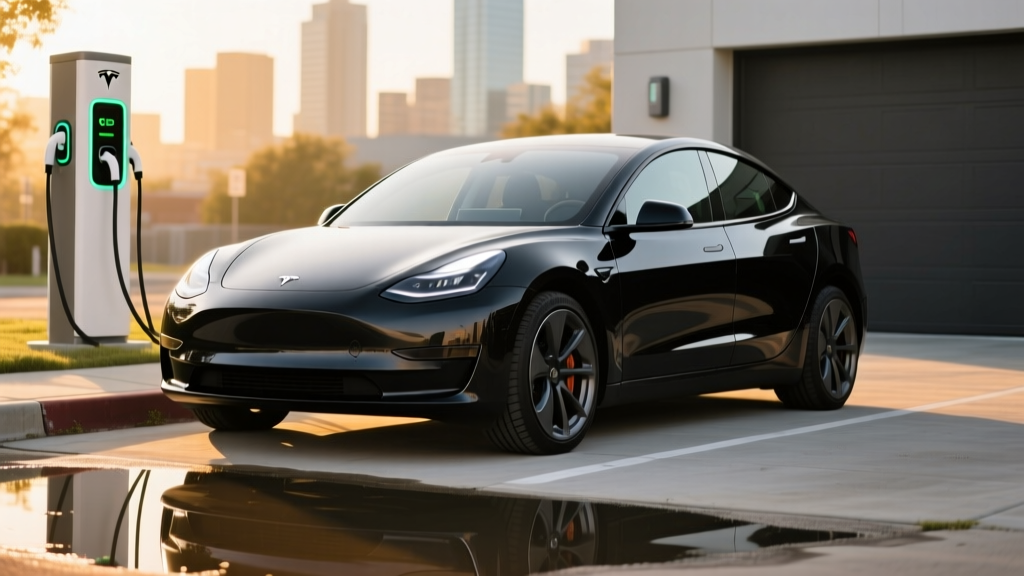
The 2026 Tesla Model 3 RWD (Rear-Wheel Drive) remains the benchmark affordable electric sedan — not because it does everything perfectly, but because it nails the fundamentals that matter most to first-time and repeat EV buyers alike: real-world efficiency, charging infrastructure access, and a total cost of ownership that undercuts most gasoline midsize sedans over five years. With an EPA-estimated 363 miles of range from a 58 kWh (usable) LFP battery, a starting MSRP of $38,990 before incentives, and access to Tesla's 20,000+ Supercharger network (now open to other brands but still the most reliable), the Model 3 RWD is the rational default for commuters, single professionals, and small households who can charge at home.
It is not, however, a family hauler, a luxury cruiser, or a self-driving car. The rear seat is tight for tall adults, the minimalist interior divides opinion, and Tesla's Autopilot and FSD (Supervised) remain SAE Level 2 driver-assist systems — not autonomous driving. If you need space, the Hyundai Ioniq 6 or a Model Y may serve you better. If you want the most miles per dollar with the least charging friction, the 2026 Model 3 RWD is hard to beat.
Range, Efficiency & the Real-World Reality Check
The EPA rates the 2026 Tesla Model 3 RWD at 363 miles of combined range on its 58 kWh usable lithium iron phosphate (LFP) battery pack. That figure lands near the top of the affordable EV sedan segment, trailing only the Lucid Air Pure (419 mi, but at twice the price) and edging past the Hyundai Ioniq 6 SE (361 mi).
- EPA Combined: 363 miles
- Real-world highway (70-75 mph, 65°F): ~290-310 miles
- Real-world city/mixed (moderate climate): ~330-350 miles
- Cold weather (below 32°F, highway): ~240-270 miles (30-35% reduction typical for LFP packs without aggressive preconditioning)
- Extreme cold (below 10°F, short trips): ~210-240 miles
The Model 3 RWD's LFP chemistry is less energy-dense than NMC but more tolerant of daily 100% charging — Tesla actually recommends charging to 100% at least weekly for LFP packs to maintain accurate state-of-charge calibration.
Efficiency is where the Model 3 platform shines. The EPA rates it at 132 MPGe combined (25 kWh/100 mi), making it one of the most efficient EVs sold in the U.S. In real-world mixed driving, owners consistently report 24-27 kWh/100 mi depending on climate and driving style — still exceptional. The low drag coefficient (0.219 Cd) and Tesla's heat pump (standard on all trims since the 2024 Highland refresh) minimize energy waste in both summer cooling and winter cabin heating.
Battery Chemistry, Warranty & Longevity Outlook
The 2026 Model 3 RWD uses a cat's-eye prismatic LFP (lithium iron phosphate) battery pack supplied primarily by CATL. LFP trade-offs versus NMC/NCA chemistry are well-documented:
| Factor | LFP (Model 3 RWD) | NMC/NCA (Long Range/Performance) |
|---|---|---|
| Energy density | Lower (~160 Wh/kg cell) | Higher (~250-300 Wh/kg cell) |
| Cycle life | 3,000+ cycles to 80% SoH | 1,000-2,000 cycles to 80% SoH |
| Cold-weather performance | Weaker; greater range loss below freezing | Better low-temp discharge |
| Daily charging to 100% | Recommended weekly | Not recommended; 80% daily cap |
| Cobalt/nickel content | Zero cobalt, zero nickel | Contains cobalt and nickel |
| Cost per kWh | Lower | Higher |
Tesla's battery and drive unit warranty covers 8 years or 100,000 miles (whichever comes first) with a guaranteed minimum of 70% capacity retention over that period. The vehicle limited warranty is 4 years / 50,000 miles. Independent fleet data from sources like Recurrent Auto show Tesla packs typically retaining 88-92% capacity at 100,000 miles — well above the warranty floor — though LFP packs in cold climates may degrade slightly faster in the first two years before stabilizing.
Charging Speed: DC Fast, Level 2 & the Supercharger Advantage
Charging speed is the Model 3 RWD's most debated spec. The peak DC fast-charge rate is 170 kW — respectable but not class-leading. The Hyundai Ioniq 5 peaks at 240 kW and the Porsche Taycan at 320 kW. However, peak kW is only part of the story; the charge curve and sustained power matter more for real road trips.
| Charging Level | Power / Rate | Time or Miles Added |
|---|---|---|
| DC Fast Charge (V3/V4 Supercharger) | Peak 170 kW | 10-80% in ~25 minutes; ~175 miles in 15 min (per Tesla) |
| DC Fast Charge (CCS adapter, third-party) | Peak 150-170 kW (varies by station) | 10-80% in ~27-30 minutes |
| Level 2 Home (48A / 11.5 kW Wall Connector) | 11.5 kW | ~44 miles per hour of charging; 0-100% in ~5.5 hours |
| Level 2 Home (32A / 7.7 kW) | 7.7 kW | ~30 miles per hour; 0-100% in ~8 hours |
| Level 1 (120V / 12A) | ~1.4 kW | ~5 miles per hour; emergency/top-up only |
The LFP pack's charge curve is flatter than NMC, meaning it sustains closer to peak power longer but never hits the 250+ kW peaks of premium EVs. On a V3 Supercharger (250 kW capable), the Model 3 RWD will pull 170 kW from roughly 10-40% SoC, then taper to ~120 kW through 60%, ~80 kW through 80%, and drop sharply above 90%. For road-trippers, this means planning 20-25 minute stops every 250-280 miles is realistic.
At home, Tesla's Wall Connector ($475, hardwired, up to 48A on a 60A circuit) adds roughly 44 miles of range per hour — more than enough to fully replenish overnight on any 240V circuit. Installation typically runs $800-$2,000 depending on panel capacity and run length; a 200A panel is usually sufficient, but older homes with 100A service may need a $1,500-$3,000 upgrade. Always get a quote from a licensed electrician before committing.
The Model 3 ships with the NACS (North American Charging Standard) connector natively — no adapter needed for Tesla Superchargers. For non-Tesla DC networks using CCS1 (Electrify America, EVgo, some ChargePoint stations), Tesla sells a CCS adapter (~$175). As of 2026, most new non-Tesla DC fast chargers are adding NACS cables, but CCS adapters remain useful for older stations.
Performance, Handling & Drivetrain
The 2026 Model 3 RWD is a single-motor, rear-wheel-drive configuration producing 271 horsepower and 317 lb-ft of torque. Tesla quotes a 0-60 mph time of 5.8 seconds — quick for a base sedan and quicker than most gas-powered Camry or Accord V6 variants. Top speed is electronically limited to 125 mph.
The RWD layout gives the Model 3 a playful, tail-happy character that enthusiasts appreciate, though traction control intervenes aggressively in wet or snowy conditions. The 2024 Highland suspension refresh carries forward into 2026: revised dampers, new bushings, and acoustic glass make this generation noticeably quieter and more compliant over rough pavement than pre-2024 Model 3s. Body roll is well-controlled, steering is quick (if somewhat artificial in feel), and the low center of gravity from the floor-mounted battery pack keeps the sedan planted through corners.
For buyers in snow-belt states, the Long Range AWD ($47,990) adds a front motor, dual-motor all-wheel drive, and an NMC battery for 341 miles of range — a worthwhile upgrade if winter traction is a priority.
Interior, Cargo, Tech & Driver Assistance
The 2026 Model 3 interior carries the Highland-generation redesign: a 15.4-inch center touchscreen (no physical instrument cluster), ambient lighting, ventilated front seats, a rear-seat touchscreen for climate and media, and a glass roof with improved UV rejection. Build quality has improved markedly since the Fremont factory's early years, with tighter panel gaps and higher-grade materials (vegan leather, aluminum trim, textile dash accents).
Dimensions & Space:
- Front headroom: 40.3 in | legroom: 42.7 in
- Rear headroom: 37.8 in | legroom: 35.2 in (tight for passengers over 6'2")
- Cargo (trunk): 21.0 cu ft (including under-floor storage)
- Frunk (front trunk): 3.1 cu ft — enough for a charging cable bag or small backpack
- Total cargo: 24.1 cu ft — less than a Model Y (76 cu ft) or Hyundai Ioniq 5 (56 cu ft)
Tech highlights include Tesla's proprietary infotainment (no Apple CarPlay or Android Auto — a dealbreaker for some), over-the-air updates, Sentry Mode dashcam recording, a built-in trip planner that routes through Superchargers with battery preconditioning, and a mobile app with remote climate, location, and charging control.
Driver Assistance — SAE Level 2, Not Self-Driving:
Basic Autopilot (standard) provides adaptive cruise control and lane centering. Enhanced Autopilot ($6,000) adds auto lane change, Navigate on Autopilot, and Smart Summon. Full Self-Driving (Supervised) ($8,000) adds traffic light/stop sign recognition and city-street autosteer. All require continuous driver supervision. The driver must keep hands on the wheel (or demonstrate attention via cabin camera) and is legally responsible for all vehicle operation. These are not Level 4 autonomous systems like Waymo's robotaxi.
Autopilot's highway performance is among the best in the industry for lane keeping and adaptive cruise smoothness, but FSD (Supervised) in city environments remains inconsistent — expect disengagements every 20-50 miles in complex urban settings based on owner reports. For 2026, Tesla continues to iterate FSD via OTA updates, but buyers should view it as a convenience feature, not a replacement for attentive driving.
Pricing, Tax Credits & Total Cost of Ownership
The 2026 Tesla Model 3 RWD starts at a base MSRP of $38,990 (including destination fee), placing it under the IRS §30D new clean vehicle credit MSRP cap of $55,000 for sedans. The Long Range AWD starts at $47,990, also under the cap. The Performance trim ($52,990) also qualifies on MSRP.
| Trim | Base MSRP | §30D Credit (max) | Effective Price |
|---|---|---|---|
| RWD | $38,990 | Up to $7,500* | From ~$31,490* |
| Long Range AWD | $47,990 | Up to $7,500* | From ~$40,490* |
| Performance AWD | $52,990 | Up to $7,500* | From ~$45,490* |
*Critical §30D Eligibility Caveats (2026 tax year): Per IRS.gov, the full $7,500 credit requires: (1) buyer AGI below $150,000 single / $300,000 joint; (2) vehicle MSRP under the $55,000 sedan cap; (3) battery critical minerals and components meeting phased-in sourcing thresholds (which Tesla's LFP packs, largely sourced from CATL, may only partially satisfy — expect $3,750 for some buyers, $7,500 for others depending on the specific battery batch and current-year sourcing rules). As of 2026, the credit can be transferred to the dealer at point of sale as an instant discount, eliminating the need to wait for tax filing. Always verify your specific VIN's eligibility on fueleconomy.gov before purchase and consult a tax professional.
5-Year Ownership Snapshot (RWD, 15,000 mi/yr):
- Electricity cost: ~$3,750 (at $0.15/kWh national avg; lower with home solar or time-of-use rates)
- Equivalent gasoline cost (30 MPG sedan): ~$9,400 (at $3.50/gal)
- Maintenance savings: ~$2,000 (no oil changes, fewer brake replacements due to regen)
- Insurance: ~$1,200-$1,800/yr (typically 15-25% higher than comparable gas sedans — get quotes before buying)
- Depreciation: Model 3 has historically held value well, though 2024-2025 price cuts compressed used values; expect 45-55% retention at 5 years
How It Stacks Up: Model 3 RWD vs. Key Competitors
The 2026 Model 3 RWD competes in a segment that has matured considerably. Here's how it compares on the specs that matter:
| Spec | 2026 Tesla Model 3 RWD | 2026 Hyundai Ioniq 6 SE | 2026 BMW i4 eDrive35 |
|---|---|---|---|
| EPA Range | 363 mi | 361 mi | 301 mi |
| Battery (usable) | 58 kWh LFP | 77.4 kWh NMC | 81 kWh NMC |
| DC Fast Charge Peak | 170 kW | 240 kW | 205 kW |
| 10-80% DC Time | ~25 min | ~18 min | ~28 min |
| 0-60 mph | 5.8 sec | 6.9 sec | 5.6 sec |
| Horsepower | 271 hp | 225 hp | 281 hp |
| Base MSRP | $38,990 | $42,600 | $57,900 |
| §30D Credit Eligible | Yes (up to $7,500) | No (Korea assembly) | No (Germany assembly) |
| Efficiency (MPGe) | 132 combined | 140 combined | 109 combined |
The Ioniq 6 charges faster and is slightly more efficient, but its Korea-built status disqualifies it from the federal §30D credit (though some state incentives still apply). The BMW i4 is a premium alternative with better materials and driving dynamics but at a $19,000 premium and no tax credit. For pure value-per-mile, the Model 3 RWD with the point-of-sale credit is the most affordable 350+ mile EV sedan on the market.
Who Should Buy the 2026 Model 3 RWD — and Who Shouldn't
- You commute 30-80 miles daily and can charge at home on a 240V circuit
- You want the lowest cost-per-mile EV sedan with access to the most reliable DC fast-charging network
- You qualify for the §30D credit and want the point-of-sale discount
- You prefer a driver-focused, tech-forward cockpit over traditional luxury
- You live in a mild-to-moderate climate (LFP's cold-weather limitations are manageable but real)
- You regularly carry four adults (rear legroom is tight; consider Model Y or Ioniq 5)
- You need cargo space for gear, strollers, or dogs (24 cu ft is sedan-level; SUVs offer 2-3x)
- You live in a sub-zero winter climate and need maximum cold-weather range (consider Long Range AWD with NMC, or a PHEV)
- You require Apple CarPlay/Android Auto (Tesla does not support either)
- You need towing capability (Model 3 is not rated for towing in the U.S.)
Pros & Cons at a Glance
- 363-mile EPA range at a sub-$39K MSRP is unmatched in the segment
- Access to 20,000+ Tesla Supercharger stalls — still the most reliable DC network
- 132 MPGe efficiency keeps per-mile electricity costs among the lowest of any EV
- LFP battery tolerates daily 100% charging and offers 3,000+ cycle life
- Over-the-air updates continuously add features and refine performance
- Strong safety ratings (IIHS Top Safety Pick+; NHTSA 5-star)
- Point-of-sale §30D credit transfer reduces out-of-pocket cost immediately
- 170 kW peak DC charge rate lags 240 kW+ competitors (Hyundai/Kia E-GMP platform)
- Rear seat legroom (35.2 in) is tight for tall passengers
- No Apple CarPlay or Android Auto — Tesla-only infotainment ecosystem
- Cargo space (24 cu ft total) trails crossover rivals significantly
- Insurance premiums run 15-25% higher than comparable gas sedans
- FSD (Supervised) remains expensive ($8,000) and requires full driver attention
- LFP battery loses more range in extreme cold vs. NMC competitors
- No towing rating for U.S.-spec Model 3
Frequently Asked Questions
What is the real-world range of the 2026 Tesla Model 3 RWD?
Expect 290-310 miles on the highway at 70-75 mph in moderate temperatures, 330-350 miles in mixed city/suburban driving, and 240-270 miles in sub-freezing winter highway conditions. The EPA's 363-mile rating assumes a mix of city and highway driving at moderate speeds and temperatures.
How fast does the Model 3 RWD charge at home and on the road?
On a DC fast charger (Supercharger V3/V4), it peaks at 170 kW and charges from 10-80% in approximately 25 minutes. At home on a 48A Level 2 Tesla Wall Connector (11.5 kW), it adds ~44 miles per hour, fully charging in about 5.5 hours. On a standard 120V outlet (Level 1), expect ~5 miles per hour — suitable only for overnight top-ups.
Does the 2026 Model 3 RWD qualify for the $7,500 federal EV tax credit?
It qualifies on MSRP ($38,990, under the $55,000 sedan cap) and most buyers will qualify on income (AGI under $150K single / $300K joint). However, the full $7,500 depends on battery critical-mineral and component sourcing requirements that vary by production batch. Some Model 3 RWD VINs may qualify for the full $7,500, others for $3,750. Check your specific VIN on fueleconomy.gov and verify with your tax professional. The credit can be applied as a point-of-sale discount at Tesla.
Is the Model 3 RWD worth buying vs. the Hyundai Ioniq 6 or BMW i4?
For most buyers, yes — the Model 3 RWD offers the best combination of range, price (after tax credit), and charging network access. The Ioniq 6 charges faster but doesn't qualify for the federal credit. The BMW i4 is more luxurious but costs $19,000 more. If charging speed is your top priority and you have reliable non-Tesla DC fast chargers nearby, the Ioniq 6 is a strong alternative.
Is Tesla's Autopilot or FSD self-driving?
No. Both are SAE Level 2 driver-assist systems. The driver must remain fully attentive, keep hands on the wheel, and is legally responsible for all driving decisions. FSD (Supervised) can handle more scenarios (city streets, traffic lights) but still requires supervision and disengages regularly in complex situations. Level 4 autonomous driving (no driver needed) is currently only available via Waymo's robotaxi service in limited metro areas.
How long will the LFP battery last?
LFP cells are rated for 3,000+ charge cycles to 80% state of health — equivalent to roughly 300,000+ miles in the Model 3 RWD. Tesla's warranty guarantees 70% retention at 8 years / 100,000 miles. Real-world fleet data suggests most Tesla packs retain 88-92% at 100,000 miles. Battery replacement (if needed out of warranty) currently runs $12,000-$16,000 including labor at Tesla service centers.
Can I charge a Model 3 RWD at non-Tesla charging stations?
Yes. The Model 3 uses the NACS connector natively, which is now being adopted by most major charging networks (Electrify America, EVgo, ChargePoint are adding NACS cables through 2026-2027). For older CCS-only stations, Tesla's CCS adapter (~$175) enables compatibility. The in-car navigation will route you to any compatible charger, not just Superchargers.