Rivian occupies a unique space in the American EV landscape: it designs, engineers, and builds its vehicles entirely in the United States at a single massive facility. For buyers asking where are Rivian vehicles made, the answer is straightforward — every R1T pickup and R1S SUV rolls off the line in Normal, Illinois. But understanding Rivian's manufacturing story requires looking beyond geography into how its production approach shapes the vehicles you actually drive, charge, and own.
This profile covers the current 2026 Rivian lineup — the R1T Dual-Motor, Performance Dual-Motor, and Tri-Motor, alongside the R1S variants — with exact EPA range figures, charging speeds, battery chemistry details, pricing after federal tax credits, and real-world ownership insights from the driver's seat.
The Normal, Illinois Factory: Rivian's Manufacturing Home
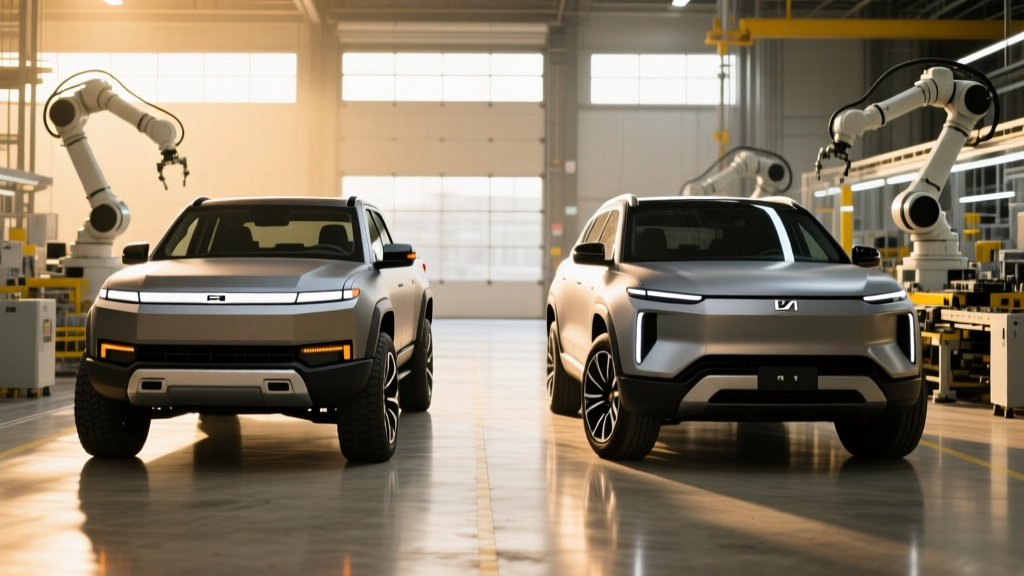
Every consumer Rivian vehicle is manufactured at the company's 1.1 million-square-foot production facility in Normal, Illinois. Rivian acquired the former Mitsubishi Motors plant in 2017 and extensively retooled it for electric vehicle production. The facility handles stamping, body welding, painting, battery pack assembly, powertrain integration, and final vehicle assembly under one roof.
This vertical integration matters for buyers. Unlike automakers that outsource battery pack assembly to third-party suppliers, Rivian builds its battery modules and packs on-site in Normal. The company also manufactures its own drive units (the electric motors and gearboxes) at the facility, giving it tighter control over quality and faster iteration on hardware revisions.
Rivian's upcoming second manufacturing plant in Stanton, Georgia — announced for future production of the R2 platform — is not yet operational as of 2026. All current R1T and R1S vehicles sold today come from Normal, Illinois.
2026 Rivian R1T & R1S: Core Specifications at a Glance
| Spec | R1T Dual-Motor (Standard) | R1T Dual-Motor (Max) | R1T Tri-Motor |
|---|---|---|---|
| EPA Range | ~270 mi | ~352 mi | ~328 mi |
| Battery Capacity (usable) | ~95 kWh | ~141 kWh | ~141 kWh |
| Battery Chemistry | LFP (Standard) / NMC (Max) | NMC | NMC |
| Drivetrain | AWD (Dual-Motor) | AWD (Dual-Motor) | AWD (Tri-Motor) |
| Horsepower | 533 hp | 533 hp | 850 hp |
| 0–60 mph | 4.5 sec | 4.5 sec | 2.9 sec |
| Max DC Fast Charge | ~200 kW | ~220 kW | ~220 kW |
| 10–80% DCFC Time | ~28 min | ~36 min | ~36 min |
| Level 2 Home Charge | 11.5 kW (~25 mi/hr) | 11.5 kW (~25 mi/hr) | 11.5 kW (~25 mi/hr) |
| EPA Efficiency (MPGe) | ~73 MPGe | ~70 MPGe | ~65 MPGe |
| Towing Capacity | 11,000 lbs | 11,000 lbs | 11,000 lbs |
| Starting MSRP (R1T) | $69,900 | $79,900 | $99,900 |
Note: R1S SUV variants share powertrain and battery specs with the R1T but carry a ~$5,000 premium and slightly lower range due to increased weight and less aerodynamic profile. EPA figures from fueleconomy.gov.
Real-World Range: What the EPA Sticker Doesn't Tell You
R1T Dual-Motor Max Pack — EPA: 352 miles. In real-world highway driving at 70–75 mph, expect ~280–310 miles in mild weather. In cold conditions (below 30°F), range can drop to ~240–270 miles due to battery thermal management demands and cabin heating. City driving with regenerative braking recovers energy and can approach or exceed the EPA figure.
R1T Tri-Motor — EPA: 328 miles. The performance-oriented Tri-Motor's higher consumption means real-world highway range closer to ~260–290 miles. Aggressive acceleration and towing will reduce this further.
Rivian's large, boxy truck and SUV bodies create aerodynamic drag that becomes the dominant efficiency factor above 65 mph. Unlike a sedan-shaped EV (such as the Lucid Air or Tesla Model S), the R1T and R1S lose efficiency steeply at highway speeds. Buyers who primarily drive in stop-and-go urban environments will see better-than-EPA results thanks to regenerative braking; those logging interstate miles should plan trips around the lower real-world figure.
Cold-weather range loss is significant in any EV, but Rivian's heat pump system (standard on 2026 models) mitigates some of the penalty by efficiently warming the cabin without relying solely on resistive heating. Preconditioning the battery while plugged in before departure further preserves range.
Charging Speed: DC Fast Charging and Home Level 2
Rivian vehicles use the NACS (North American Charging Standard) connector as of the 2025 model year refresh, granting native access to Tesla Supercharger stations alongside Rivian's own Adventure Network and third-party providers like Electrify America.
| Charging Level | Power (kW) | Miles Added per Hour | Notes |
|---|---|---|---|
| Level 1 (120V household) | ~1.4 kW | ~3–4 mi/hr | Emergency/trickle only; full charge takes days |
| Level 2 (240V home/public) | 11.5 kW (max onboard) | ~25 mi/hr | Full Max Pack charge in ~12–13 hours |
| DC Fast Charge (Max Pack) | Peak ~220 kW | ~200+ mi in 20 min | 10–80% in ~36 min; tapers above 80% |
| DC Fast Charge (Standard/LFP) | Peak ~200 kW | ~180+ mi in 20 min | 10–80% in ~28 min; smaller pack charges faster |
Understanding the charge curve: Rivian's peak DC charge rate of ~220 kW applies to the Max Pack (NMC chemistry) and is sustained roughly between 10% and 35% State of Charge. Above 50% SoC, the rate tapers progressively — by 80% SoC, you're typically charging at 50–70 kW. This is why the 10–80% metric is the most useful real-world benchmark; charging from 80–100% can take nearly as long as the 10–80% session.
The Standard Pack uses LFP (Lithium Iron Phosphate) chemistry, which charges slightly slower at peak but offers a critical advantage: LFP cells tolerate regular 100% charging without accelerated degradation. Rivian recommends daily charging to 100% for LFP-equipped vehicles, effectively giving you the full ~95 kWh usable capacity every day. The Max Pack's NMC chemistry performs best when held between 20–80% for daily use, reserving 100% charges for road trips.
For home charging, a 48-amp Level 2 wall connector on a 60-amp circuit delivers the full 11.5 kW the R1T and R1S can accept. Expect a full overnight charge to replenish even the Max Pack. Installation costs for a home Level 2 setup typically range from $800 to $2,500 depending on panel capacity and run length — consult a licensed electrician for your specific situation.
Battery Chemistry: LFP vs. NMC in the Rivian Lineup
| Attribute | LFP (Standard Pack) | NMC (Max Pack) |
|---|---|---|
| Usable Capacity | ~95 kWh | ~141 kWh |
| Energy Density | Lower (heavier per kWh) | Higher (lighter per kWh) |
| Cycle Life | ~3,000+ cycles | ~1,500–2,000 cycles |
| Daily Charge Recommendation | Charge to 100% freely | 20–80% daily; 100% for trips |
| Cold-Weather Performance | Greater range loss in cold | Better cold-weather retention |
| Cost | Lower (included in base price) | Higher (~$10,000 upgrade) |
| Best For | Daily commuting, cost-conscious buyers | Road trips, towing, maximum range |
The LFP Standard Pack is the pragmatic choice for buyers who charge at home nightly and rarely need more than 250 miles between charges. The NMC Max Pack justifies its premium for frequent travelers, those in cold climates, and anyone who tows regularly (towing can halve effective range regardless of pack size).
Pricing, Trims, and Federal Tax Credit Eligibility
| Model / Trim | Base MSRP | As-Tested (Typical Config) | §30D Credit Eligibility | Effective Price After Credit |
|---|---|---|---|---|
| R1T Dual-Motor Standard | $69,900 | $74,000–$78,000 | Up to $7,500 (if eligible) | ~$62,400–$70,500 |
| R1T Dual-Motor Max | $79,900 | $85,000–$92,000 | Up to $7,500 (if eligible) | ~$72,400–$84,500 |
| R1T Tri-Motor | $99,900 | $105,000–$115,000 | Up to $7,500 (if eligible) | ~$92,400–$107,500 |
| R1S Dual-Motor Standard | $74,900 | $79,000–$84,000 | Up to $7,500 (if eligible) | ~$67,400–$76,500 |
| R1S Dual-Motor Max | $84,900 | $90,000–$98,000 | Up to $7,500 (if eligible) | ~$77,400–$90,500 |
Critical tax credit caveats: Under IRS §30D rules, the full $7,500 federal EV tax credit requires meeting all of the following:
- MSRP cap: Trucks and SUVs must have an MSRP at or below $80,000 (the R1T Dual-Motor Standard qualifies; Max Pack and Tri-Motor configurations may exceed this cap depending on options).
- Buyer income limits: Modified Adjusted Gross Income must not exceed $300,000 (joint filers), $225,000 (head of household), or $150,000 (single). See IRS §30D guidelines.
- Battery sourcing requirements: Critical minerals and battery components must meet phased-in domestic/free-trade sourcing thresholds that tighten annually. Rivian's US-manufactured battery packs position it favorably, but verify current-year compliance on the IRS eligible vehicle list before purchase.
- Point-of-sale transfer: As of 2024, eligible buyers can transfer the credit to the dealer at purchase, reducing the vehicle price at checkout rather than waiting for a tax return offset.
Always confirm eligibility with a tax professional and check the latest IRS qualified vehicle list, as sourcing rules and eligible models update periodically.
Performance, Cargo, and Daily Usability
The Dual-Motor R1T delivers 533 horsepower and a 4.5-second 0–60 mph time — quick for a 7,000-pound truck and more than adequate for highway merging and passing. The Tri-Motor's 850 hp and sub-3-second 0–60 time is supercar territory in a pickup, though you'll pay a significant premium (and accept lower efficiency) for that capability.
Cargo and space (R1T):
- Bed length: 4.5 feet (standard) with the gear tunnel providing an additional ~11 cu ft of enclosed, lockable storage behind the cab
- Frunk (front trunk): ~11 cu ft — large enough for a full-size cooler or two carry-on bags
- Max payload: ~1,760 lbs
- Towing: 11,000 lbs rated (expect ~50% range reduction when towing near max)
Cargo and space (R1S SUV):
- Cargo behind 3rd row: ~10.5 cu ft
- Cargo behind 2nd row (3rd row folded): ~46.7 cu ft
- Max cargo (all rear seats folded): ~88.2 cu ft
- Third-row legroom: ~30.4 inches (best suited for children on longer trips)
- Second-row legroom: ~38.5 inches
The gear tunnel — a pass-through compartment spanning the width of the truck behind the rear seats — is a Rivian-exclusive feature that owners consistently cite as one of the R1T's best design choices. It's ideal for skis, snowboards, camping gear, or groceries you want to keep out of the bed and cabin.
Driver Assistance, Tech, and Notable Drawbacks
Rivian's driver-assistance suite (branded as Driver+ with highway assist) is a Level 2 system per SAE classification. This means it provides combined steering and speed assistance on highways, but the driver must remain fully engaged, hands on or near the wheel, and eyes on the road at all times. It is not autonomous or self-driving.
Standout tech features:
- 15.6-inch center touchscreen running Rivian's proprietary OS with over-the-air updates
- Integrated camp kitchen accessory (R1T) that slides from the gear tunnel
- Powered tonneau cover (R1T) with integrated LED bed lighting
- Vehicle-to-load (V2L) capability — power tools, appliances, or a campsite from the truck's battery
- Phone-as-key with automatic approach detection
- Rivian Adventure Network — proprietary DC fast-charging stations near outdoor recreation destinations
Notable drawbacks:
- No Apple CarPlay or Android Auto — Rivian uses its own infotainment ecosystem exclusively
- Third-row space in the R1S is tight for adults
- Highway efficiency drops significantly above 70 mph due to boxy aerodynamics
- Service center network is still expanding; some rural owners face long drives for warranty work
- Insurance premiums tend to run higher than comparable ICE trucks due to repair costs and parts availability
Warranty Coverage
Rivian backs its vehicles with competitive warranty terms:
- Vehicle limited warranty: 5 years / 60,000 miles
- Battery and drive unit (powertrain) warranty: 8 years / 120,000 miles (whichever comes first), with a guaranteed minimum capacity retention of 70% over the warranty period
- Corrosion perforation warranty: 12 years, unlimited miles
- Roadside assistance: 5 years / 60,000 miles
The 8-year/120,000-mile battery warranty exceeds the federal minimum requirement (8 years/100,000 miles) and provides meaningful peace of mind for a vehicle with a large, expensive battery pack. Rivian's 70% capacity retention guarantee means that if your battery degrades below 70% of its original usable capacity within the warranty window, the company will repair or replace it.
Who Should Buy a Rivian — And Who Should Look Elsewhere
- Outdoor enthusiasts who need a capable truck for camping, towing boats/ATVs, and accessing trailheads
- Buyers who want an EV pickup built in the USA with premium interior quality
- Homeowners with Level 2 charging access who commute daily and take weekend road trips
- Families who value the gear tunnel and frunk for gear-heavy lifestyles
- Families needing three rows of seating with electric powertrain benefits
- Buyers cross-shopping the Tesla Model X, Kia EV9, or BMW iX who want something less common
- Budget is the primary concern — the Ford F-150 Lightning and Chevrolet Silverado EV start significantly lower
- You need Apple CarPlay/Android Auto integration
- You live far from a Rivian service center and cannot tolerate potential service delays
- Your driving is almost exclusively highway commuting — a more aerodynamic EV sedan will deliver better efficiency
Frequently Asked Questions
Where are Rivian vehicles made?
All Rivian R1T pickups and R1S SUVs are manufactured at the company's production facility in Normal, Illinois. This includes battery pack assembly, drive unit manufacturing, and final vehicle assembly. Rivian's planned Georgia factory for the R2 platform is not yet operational.
What is the real-world range of the Rivian R1T?
The EPA rates the R1T Dual-Motor Max Pack at approximately 352 miles, but real-world highway driving at 70+ mph in mild weather yields roughly 280–310 miles. Cold weather (below 30°F) can reduce this to 240–270 miles. The LFP Standard Pack's real-world range is closer to 220–250 miles in mixed driving.
How fast does the Rivian R1T charge at home and on the road?
On a Level 2 home charger (11.5 kW), the R1T adds approximately 25 miles of range per hour — a full overnight charge replenishes even the Max Pack. On DC fast chargers, the Max Pack peaks at ~220 kW and charges from 10–80% in approximately 36 minutes. The Standard Pack (LFP) charges 10–80% in about 28 minutes at a peak of ~200 kW.
Does the Rivian R1T qualify for the $7,500 federal EV tax credit?
Eligibility depends on your specific configuration and personal tax situation. The R1T Dual-Motor Standard ($69,900 MSRP) falls under the $80,000 truck/SUV MSRP cap. Max Pack and Tri-Motor configurations may exceed the cap depending on options. You must also meet IRS income limits ($300,000 joint / $150,000 single) and the vehicle must satisfy battery-sourcing requirements. Verify current eligibility at irs.gov and consult a tax professional.
Is the Rivian R1T worth buying over the Ford F-150 Lightning?
The R1T offers a more premium interior, the unique gear tunnel, stronger off-road capability with quad-motor options, and access to the Rivian Adventure Network. The F-150 Lightning starts at a significantly lower price, has a larger service network, and offers Pro Power Onboard with higher output. Choose the R1T for lifestyle and design differentiation; choose the Lightning for value and fleet-scale service infrastructure.
Does Rivian offer Apple CarPlay or Android Auto?
No. Rivian uses its proprietary infotainment system exclusively and has not announced plans to support Apple CarPlay or Android Auto. The native system supports navigation, media streaming, and phone integration, but buyers who consider CarPlay essential should test the Rivian interface before committing.
What is Rivian's battery warranty?
Rivian provides an 8-year / 120,000-mile warranty on the battery pack and drive units, guaranteeing a minimum of 70% capacity retention over the warranty period. This exceeds the federal minimum standard of 8 years / 100,000 miles.