When Was Rivian Founded? From MIT Lab to America's EV Truck Maker
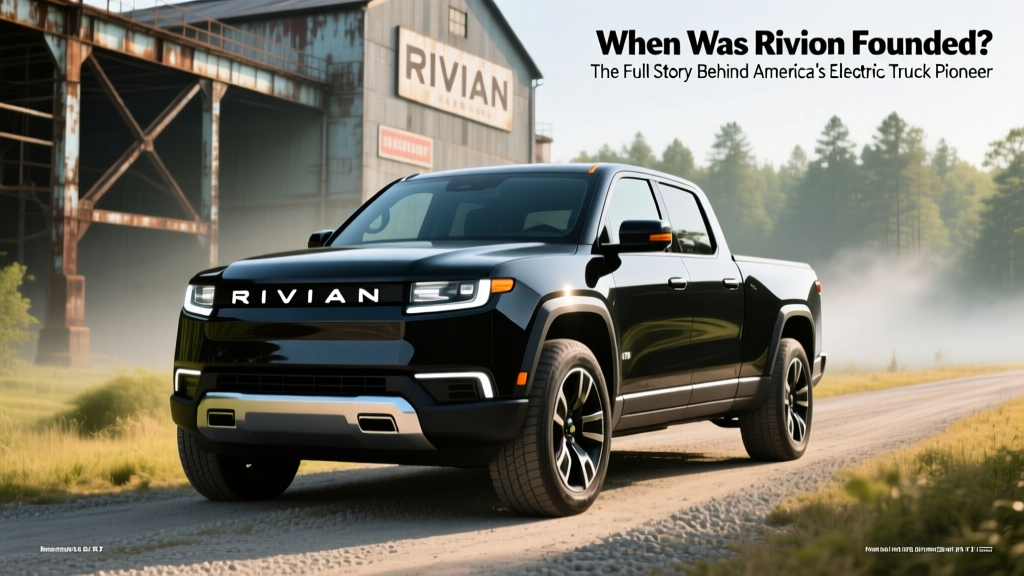
If you've been researching electric trucks and SUVs, you've likely asked: when was Rivian founded? The answer takes us back to 2009, when MIT graduate RJ Scaringe incorporated the company as Mainstream Motors in Rockledge, Florida. The startup was renamed Rivian Automotive in 2011, shifting its focus from a conventional sports car concept to an all-electric adventure platform — a pivot that would eventually produce the R1T pickup and R1S SUV we see on roads today.
Rivian spent nearly a decade in stealth development before unveiling the R1T and R1S prototypes at the 2018 Los Angeles Auto Show. The company secured a landmark $2 billion investment from Amazon in 2019, went public via IPO in November 2021, and began delivering the R1T to customers in September 2021 — making it the first production electric pickup truck to reach American driveways, beating the Ford F-150 Lightning and GMC Hummer EV to market.
As of the 2026 model year, Rivian has expanded its Normal, Illinois production facility, launched its second-generation Gen 2 platform vehicles, and is preparing the smaller, more affordable R2 and R3 crossovers. But the R1T and R1S remain the brand's flagship offerings — and they've matured significantly since those early deliveries.
2026 Rivian R1T and R1S: Complete Spec Breakdown
The 2026 Rivian lineup centers on the R1T (crew-cab pickup) and R1S (three-row SUV), both built on Rivian's skateboard platform with available dual-motor and tri-motor powertrains. Below is the consolidated spec sheet for the most popular configurations.
| Spec | R1T Dual-Motor (Standard) | R1T Tri-Motor | R1S Dual-Motor |
|---|---|---|---|
| EPA Range | 330 mi (Max Pack) | 328 mi (Max Pack) | 321 mi (Max Pack) |
| Battery Capacity | ~149 kWh usable (Max), NMC | ~149 kWh usable (Max), NMC | ~149 kWh usable (Max), NMC |
| Horsepower | 665 hp | 850+ hp | 665 hp |
| 0-60 mph | 3.5 sec | ~2.9 sec | 3.5 sec |
| Drivetrain | Dual-Motor AWD | Tri-Motor AWD | Dual-Motor AWD |
| Max DC Fast Charge | ~220 kW peak | ~220 kW peak | ~220 kW peak |
| 10-80% DC Time | ~36 min | ~36 min | ~36 min |
| Level 2 Home Rate | 11.5 kW (~25 mi/hr) | 11.5 kW (~25 mi/hr) | 11.5 kW (~25 mi/hr) |
| MPGe (combined) | 73 MPGe | 70 MPGe | 73 MPGe |
| Towing Capacity | 11,000 lbs | 11,000 lbs | 7,700 lbs |
| Base MSRP | $71,700 | $99,900 | $75,900 |
| Battery Warranty | 8 yr / 175,000 mi | 8 yr / 175,000 mi | 8 yr / 175,000 mi |
Source: EPA fueleconomy.gov, Rivian official specifications. Specs reflect 2026 model year Max Pack configuration.
Real-World Range: What the EPA Number Doesn't Tell You
Real-World Highway (70 mph): Expect ~260–280 miles
Cold Weather (below 32°F): Expect ~210–240 miles, a 25–35% reduction
Efficiency: ~48 kWh/100 mi combined (heavy vehicle penalty at highway speeds)
Rivian's Max Pack uses NMC (nickel manganese cobalt) lithium-ion cells, which offer high energy density but are more temperature-sensitive than LFP chemistry. In our experience and consistent owner reports, the R1T's boxy aerodynamics and 7,000+ lb curb weight impose a significant highway efficiency penalty. At 65-70 mph on flat terrain in mild weather, expect to consume roughly 48-52 kWh per 100 miles — meaning a full Max Pack yields about 260-280 real-world highway miles before you need to find a charger.
Cold weather compounds this. Without a dedicated heat pump in early Gen 1 models (Gen 2 vehicles improved thermal management), winter range loss of 25-35% is typical. If you're planning a January road trip through the Rockies, budget for 210-240 miles between stops. The Standard Pack (~92 kWh, EPA ~270 mi) is best reserved for commuters with reliable home charging.
Charging Speed: DC Fast Charging and Home Level 2
| Charging Level | Power / Rate | Miles Added per Hour | Notes |
|---|---|---|---|
| Level 1 (120V) | ~1.4 kW | ~3 mi/hr | Emergency/trickle only |
| Level 2 (240V, 48A) | 11.5 kW | ~25 mi/hr | Full charge in ~13 hrs (Max Pack) |
| DC Fast Charge (peak) | ~220 kW | N/A | 10-80% in ~36 min; tapers sharply above 80% |
| DC Fast Charge (avg 10-80%) | ~145 kW sustained | N/A | Charge curve limits sustained speed |
Rivian's Gen 2 vehicles support up to ~220 kW peak DC fast charging on CCS-compatible stations (and NACS via Tesla Supercharger access, which Rivian enabled starting in 2024). However, peak rate is not sustained rate. The charge curve holds near 200+ kW between roughly 10-50% State of Charge, then progressively tapers. Expect a realistic 10-80% session on a 350 kW Electrify America or Tesla Supercharger stall to take about 36 minutes — adequate for road trips, but not class-leading compared to Hyundai/Kia's 800V architecture, which manages 10-80% in under 20 minutes.
For home charging, the onboard 11.5 kW Level 2 charger is robust. A full overnight charge from 20% to 100% on a hardwired 48-amp Wall Connector takes roughly 11-13 hours for the Max Pack. Plan your installation with a licensed electrician — a 60-amp dedicated circuit is required, and panel upgrades (to 200A service) may be necessary in older homes, adding $1,500-$3,500 to typical install costs of $500-$1,200.
Pricing, Trims, and Federal Tax Credit Eligibility
The 2026 Rivian R1T starts at $71,700 for the Dual-Motor Standard Pack. The popular Max Pack Dual-Motor lands around $82,700, while the Tri-Motor performance variant commands $99,900. The R1S SUV carries a slight premium across trims. These prices place Rivian squarely in the luxury truck segment, competing with the Tesla Cybertruck, Ford F-150 Lightning Platinum, and GMC Sierra EV.
| Configuration | Base MSRP | Federal §30D Credit | Effective Price |
|---|---|---|---|
| R1T Dual-Motor Standard | $71,700 | $0 (exceeds MSRP cap) | $71,700 |
| R1T Dual-Motor Max | $82,700 | $0 (exceeds MSRP cap) | $82,700 |
| R1T Tri-Motor | $99,900 | $0 (exceeds MSRP cap) | $99,900 |
| R1S Dual-Motor Standard | $75,900 | $0 (exceeds MSRP cap) | $75,900 |
Critical tax credit note: Under current IRS §30D rules, the federal EV tax credit for new vehicles is capped at $80,000 MSRP for trucks, vans, and SUVs. Most Rivian configurations — especially Max Pack and Tri-Motor variants — exceed this cap and therefore do not qualify for the $7,500 federal credit. Additionally, buyer income limits ($300,000 joint / $150,000 single), critical mineral sourcing, and battery component manufacturing requirements apply. The point-of-sale transfer option is available for eligible vehicles, but Rivian buyers should assume they will pay full MSRP unless selecting a base Standard Pack configuration that falls under the cap — and even then, battery sourcing rules may disqualify the vehicle. Always verify eligibility with a tax professional and the latest IRS guidance.
Performance, Cargo, and Daily-Use Practicality
The dual-motor R1T's 665 hp and 3.5-second 0-60 time make it quicker than any internal-combustion pickup this side of a Raptor — and the tri-motor's sub-3-second sprint enters supercar territory for a vehicle that can tow 11,000 lbs. The quad-motor configuration previously offered has been consolidated into the tri-motor for Gen 2.
Cargo and space (R1T):
- Bed length: 4.5 ft (54 in) with gate closed; extends with mid-gate open
- Gear Tunnel: 11 cu ft lockable pass-through storage (a Rivian exclusive)
- Frunk (front trunk): 11 cu ft, drainable, usable as a cooler
- Max payload: ~1,760 lbs
- Rear legroom: 38.2 inches
Cargo and space (R1S):
- Cargo behind 3rd row: ~12 cu ft
- Cargo behind 2nd row (3rd folded): ~47 cu ft
- Max cargo (all rear rows folded): ~83 cu ft
- Third-row legroom: 30.4 inches (tight for adults on long trips)
The Gear Tunnel is the R1T's party trick — a full-width storage compartment between the cab and bed, perfect for camping gear, golf bags, or the optional slide-out Camp Kitchen. The R1S's third row is best suited for children; adults will find it cramped beyond short trips.
Technology, Driver Assistance, and Notable Drawbacks
Rivian's in-house developed software stack runs on a large 15.6-inch center touchscreen with a clean, responsive interface. Wireless Apple CarPlay and Android Auto are standard. Over-the-air (OTA) updates are frequent and substantive — Rivian has added features like improved regenerative braking profiles, pet mode, and enhanced navigation via OTA since launch.
Driver assistance: Rivian's Driver+ system is a SAE Level 2 hands-on driver-assist feature combining adaptive cruise control and lane centering. It is not autonomous driving — the driver must remain engaged, hands on the wheel, and eyes on the road at all times. It competes with Ford BlueCruise and GM Super Cruise in capability, though it lacks the hands-free highway operation those systems permit on mapped roads.
Notable drawbacks:
- Charging speed: ~36 min 10-80% lags behind 800V competitors (Ioniq 5, EV6 at ~18 min)
- Highway efficiency: The R1T's aerodynamics and weight penalize range at speed
- No federal tax credit on most configurations due to MSRP cap
- Service center density: Rivian's service network is growing but still sparse in rural areas — mobile service helps but can't cover everything
- Insurance costs: Owners report premiums 20-40% higher than comparable ICE trucks due to repair costs and parts availability
- Class-leading off-road capability with 14+ in ground clearance
- Gear Tunnel and frunk offer unmatched storage versatility
- Sub-4-sec 0-60 with 11,000-lb towing (Dual-Motor)
- OTA updates continuously improve the vehicle
- Strong build quality and distinctive design
- Real-world highway range falls well short of EPA sticker
- DC charging speed lags 800V competitors
- Most trims ineligible for federal tax credit
- High insurance and potentially expensive out-of-warranty battery replacement
- Third row in R1S is cramped for adults
Who Should Buy a Rivian — And Who Should Look Elsewhere?
The Rivian R1T is ideal for adventure-oriented buyers who want a daily-drivable electric pickup with genuine off-road chops, creative storage solutions, and enough range for weekend trips. It excels as a camping, skiing, or trail-riding companion that also handles weekday commuting with ease — if you have home charging.
The R1S suits families wanting three rows with electric propulsion and a premium interior, though buyers with tall teenagers or frequent adult passengers in the third row should test-fit before committing.
Look elsewhere if:
- You need maximum highway range — the Tesla Model X (348 mi EPA) or a Lucid Gravity offers more
- DC charging speed is a priority — Hyundai Ioniq 5 / Kia EV6 charge nearly twice as fast
- Your budget relies on the $7,500 federal credit — explore the Ford F-150 Lightning or Chevy Silverado EV, which have eligible configurations
- You want a work truck with an 8-foot bed — the R1T's 4.5-foot bed limits commercial utility
Frequently Asked Questions
When was Rivian founded and by whom?
Rivian was founded in 2009 by RJ Scaringe, originally as Mainstream Motors in Florida, later renamed Rivian Automotive. The company operated in stealth for nearly a decade before revealing its electric truck and SUV prototypes in 2018.
What is the real-world range of the 2026 Rivian R1T?
The EPA rates the R1T Dual-Motor Max Pack at 330 miles. Real-world highway driving at 70 mph typically yields 260-280 miles. In cold weather (below freezing), expect 210-240 miles — a 25-35% reduction. The smaller Standard Pack (~270 mi EPA) is best for commuters with home charging.
How fast does the Rivian R1T charge at home and on the road?
At home on a Level 2 (240V, 48A) charger, the R1T adds about 25 miles of range per hour, with a full Max Pack charge taking roughly 13 hours. On DC fast chargers, it peaks at ~220 kW and charges from 10-80% in approximately 36 minutes. Charge speed tapers significantly above 80% SoC.
Does the Rivian R1T qualify for the federal EV tax credit?
Most configurations do not. Under current IRS §30D rules, trucks and SUVs must have an MSRP at or below $80,000 to qualify. Only the base R1T Standard Pack Dual-Motor ($71,700) potentially qualifies, and even then, battery component sourcing and buyer income caps ($300,000 joint / $150,000 single) must be met. Consult a tax professional.
Is the Rivian R1T worth buying over the Ford F-150 Lightning or Tesla Cybertruck?
The R1T wins on off-road capability, storage innovation (Gear Tunnel, frunk), and build quality. The F-150 Lightning offers a larger bed, lower starting price, and broader tax credit eligibility. The Cybertruck undercuts on price (AWD at ~$79,990) but has polarizing design and limited service infrastructure. Choose the R1T if adventure capability and clever design matter most; choose the Lightning for work-truck utility or the Cybertruck for value-focused performance.
What is the Rivian battery warranty?
Rivian covers the battery pack and drive system for 8 years or 175,000 miles, whichever comes first, with a capacity retention threshold (typically 70%). This is more generous on mileage than the industry-standard 8yr/100,000mi offered by most competitors.
Can Rivians use Tesla Superchargers?
Yes. Starting in 2024, Rivian vehicles gained access to the Tesla Supercharger network using the NACS (North American Charging Standard) connector — either via a built-in NACS port on newer vehicles or an included CCS-to-NACS adapter for earlier models. This significantly expands the available fast-charging network for Rivian owners.