The Short Answer
The first crude electric car was invented around 1832–1839 by Scottish inventor Robert Anderson. The first practical, commercially successful electric vehicles appeared in the 1890s, and by 1900, roughly one-third of all cars on U.S. roads were electric. Modern lithium-ion EVs as we know them began with the GM EV1 in 1996, the Nissan Leaf in 2010, and the Tesla Model S in 2012. Today's 2026 models deliver 250–400+ EPA miles, charge at up to 350 kW, and cost as little as $29,000 before incentives.
From 1832 to Now: A Timeline of Electric Car Invention
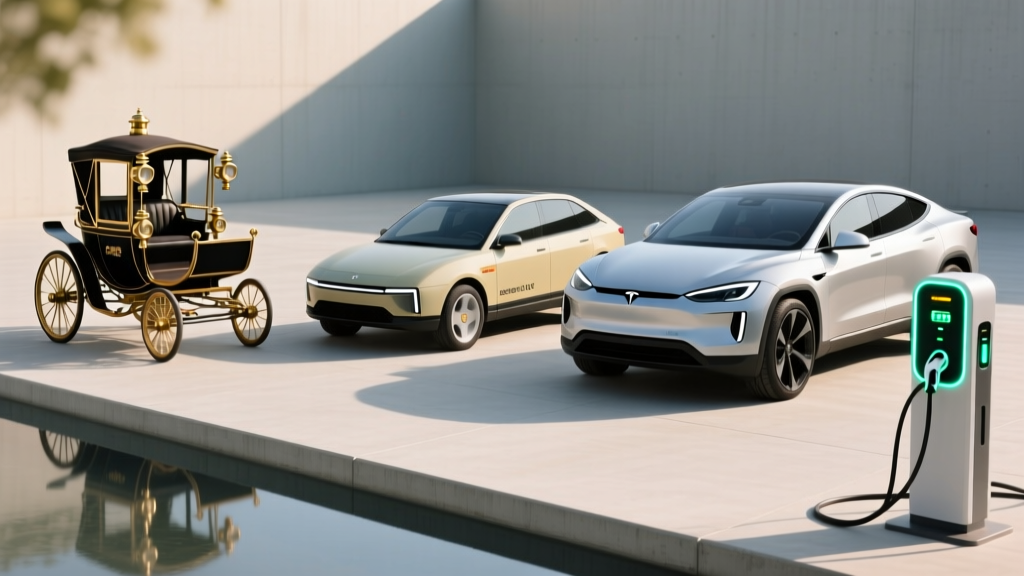
The electric car isn't a 21st-century invention — it actually predates the gasoline automobile. Here's how the technology evolved across nearly two centuries:
- ~1832–1839: Robert Anderson (Scotland) builds the first crude electric carriage using non-rechargeable primary cells.
- 1859: Gaston Planté invents the rechargeable lead-acid battery, making sustained electric propulsion possible.
- 1890–1891: William Morrison builds the first successful electric vehicle in the U.S. — a six-passenger wagon capable of 14 mph in Des Moines, Iowa.
- 1899–1900: Electric cars outsell gasoline and steam cars in the U.S. The U.S. Department of Energy notes that by 1900, 28% of all cars produced were electric.
- 1908: Ford's Model T and cheap gasoline, combined with the electric starter motor (1912), push EVs into decline.
- 1996: GM launches the EV1 — the first mass-produced modern electric car with a nickel-metal hydride battery (later lithium-ion). Range: ~80–140 miles.
- 2008: Tesla Roadster debuts with a lithium-ion battery and 244-mile EPA range, proving long-range EVs are viable.
- 2010: Nissan Leaf launches as the first affordable, mass-market BEV (73-mile EPA range, 24 kWh battery).
- 2012: Tesla Model S arrives with up to 265 miles of range and Supercharger access, redefining the segment.
- 2022–2026: Industry-wide shift to 800V architectures, NACS connector standardization, LFP chemistry adoption, and 300+ mile ranges at sub-$40,000 prices.
Why Early Electric Cars Failed — and Why Today's Are Different
The first generation of electric cars lost to gasoline for three concrete reasons: energy density, refueling infrastructure, and production cost. A 1900 electric car had roughly 40 miles of range from a battery weighing hundreds of pounds. Gasoline carried ~33.7 kWh of energy per gallon and could be refilled in minutes at increasingly common filling stations.
Today's lithium-ion batteries have solved the energy-density problem fundamentally. A 2026 Hyundai Ioniq 6 carries an 84 kWh usable NMC battery pack weighing about 1,000 lbs and delivers a 361-mile EPA range — that's roughly 9× the energy density per pound compared to lead-acid batteries of the early 1900s. Meanwhile, DC fast charging at 350 kW can add 200+ miles in 18 minutes, closing the convenience gap.
Common Misconceptions About EVs — Corrected
| Myth | Fact (with Data) |
|---|---|
| "EVs are a new, unproven technology." | Electric cars are older than gas cars. Modern lithium-ion EVs have been in mass production since 2010 — that's 16 years of real-world data. The Nissan Leaf alone has logged billions of cumulative miles. |
| "EV batteries don't last." | Federal law mandates an 8-year/100,000-mile battery warranty (10 years/150,000 miles in CARB states). Most NMC and LFP packs retain 85–92% capacity at 100,000 miles based on fleet data. |
| "EVs are worse in cold weather." | Range drops 15–30% in sub-freezing temperatures due to cabin heating and battery chemistry. A 300-mile EV may deliver ~220–255 miles at 20°F. Heat pumps (standard on many 2026 models) reduce this loss to ~10–15%. |
| "There aren't enough charging stations." | As of early 2026, the U.S. has over 70,000 public charging stations and 200,000+ ports. The Tesla Supercharger network alone exceeds 30,000 stalls. However, rural "charging deserts" still exist in parts of the Mountain West and Great Plains. |
| "EVs cost more to own." | Higher purchase price is offset by lower fuel and maintenance costs. A 5-year TCO analysis below shows where EVs win and where they don't. |
2026 EV Ownership: Real Costs vs. Gas Cars
Understanding the invention history is interesting, but the real question for today's buyer is: what does it actually cost to own an EV in 2026 compared to a gas car? The answer depends on your driving pattern, electricity rate, and whether you can charge at home.
5-Year Total Cost of Ownership: 2026 Tesla Model 3 RWD vs. 2026 Toyota Camry LE
| Cost Category | Tesla Model 3 RWD (EV) | Toyota Camry LE (Gas) |
|---|---|---|
| Base MSRP | $38,990 | $28,400 |
| Federal Tax Credit (§30D) | −$7,500 (if eligible, point-of-sale) | $0 |
| Effective Purchase Price | $31,490 | $28,400 |
| Fuel/Energy (5 yrs, 75,000 mi) | $3,750 (home charging at $0.14/kWh avg) | $9,375 (30 MPG combined at $3.75/gal) |
| Maintenance (5 yrs) | $1,500 (cabin filter, tires, wipers, brake fluid) | $4,200 (oil changes, filters, brakes, transmission fluid) |
| Insurance (5 yrs avg) | $9,500 (~$1,900/yr) | $7,500 (~$1,500/yr) |
| Depreciation (est. 5 yrs) | $14,000 | $11,000 |
| Estimated 5-Year TCO | $60,240 | $60,475 |
Sources: fueleconomy.gov, IRS §30D. Actual costs vary by state, electricity rate, driving pattern, and insurance profile. Tax credit eligibility requires meeting income caps ($150K single / $300K joint), MSRP caps ($55K cars), and battery-sourcing rules.
The numbers show near-parity over five years, but the shape of the costs is different. EVs front-load cost in the purchase price and recoup through fuel and maintenance savings. If you drive more than 15,000 miles per year, the EV savings compound faster. If you drive under 8,000 miles per year, the gas car may retain a cost advantage.
EV vs. Gas vs. Hybrid: Which Powertrain Fits Your Life?
The invention of the electric car didn't eliminate the internal combustion engine — it added a third option alongside gas and hybrid. Here's a data-driven comparison to help you choose:
| Factor | BEV (e.g., Tesla Model 3) | PHEV (e.g., Toyota RAV4 Prime) | Gas (e.g., Toyota RAV4 LE) |
|---|---|---|---|
| EPA Range / MPGe | 363 mi / 132 MPGe | 42 mi electric + 38 MPG gas | 30 MPG combined |
| Fuel Cost per Mile | $0.04–$0.06 (home) | $0.03 (electric) / $0.12 (gas) | $0.12–$0.14 |
| Home Charging Needed? | Strongly recommended | Recommended for EV-mode savings | No |
| Road Trip Convenience | Plan DC fast stops (15–25 min) | Gas up in 5 min, no planning | Gas up in 5 min |
| Maintenance (annual) | ~$300 | ~$600 | ~$800–$1,000 |
| Cold-Weather Penalty | 15–30% range loss | ~20% electric range loss; gas unaffected | ~5% fuel economy loss |
| Upfront Price Premium | +$5,000–$10,000 (before credit) | +$5,000–$8,000 | Baseline |
What a First-Time EV Buyer Needs to Know in 2026
If you're considering your first EV, the technology has matured significantly since the early Nissan Leaf days. Here's what matters based on real ownership experience:
Home Charging Is the Make-or-Break Factor
Over 80% of EV charging happens at home. A Level 2 home charger (240V, 32–48 amps) adds roughly 25–44 miles of range per hour of charging and costs $500–$2,500 to install depending on your electrical panel. If your home has a 200-amp panel with spare capacity, installation is straightforward. If you need a panel upgrade (common in older homes), add $1,500–$3,000. Always get a quote from a licensed electrician before purchasing the vehicle.
If you live in an apartment or lack dedicated parking, public charging becomes your primary source. This works but is more expensive ($0.30–$0.55/kWh at DC fast chargers vs. $0.14/kWh residential average) and less convenient.
Understand kW vs. kWh — The Most Common EV Confusion
This is non-negotiable for informed buying:
- kWh (kilowatt-hours) = energy capacity. Think of it as the "size of the gas tank." A 75 kWh battery holds 75 kWh of energy.
- kW (kilowatts) = power rate. Think of it as "how fast the pump flows." A 150 kW DC fast charger delivers energy at 150 kilowatts — but only at peak, not sustained.
A 2026 Hyundai Ioniq 5 with an 84 kWh battery charging at a 350 kW stall will peak near 240 kW but taper as the battery fills. The realistic 10–80% charge takes about 18 minutes. Never judge charging speed by peak kW alone — sustained charge curve matters more.
Battery Chemistry: LFP vs. NMC
Many 2026 models offer two battery options:
- LFP (Lithium Iron Phosphate): Longer cycle life (3,000+ cycles), can be charged to 100% daily without degradation concerns, slightly heavier, lower energy density. Common in standard-range trims (Tesla Model 3 RWD, Ford Mustang Mach-E Select).
- NMC (Nickel Manganese Cobalt): Higher energy density (more range per pound), better cold-weather performance, but recommended to charge to 80% daily. Used in long-range and performance trims.
Federal Tax Credit: §30D Rules for 2026
The IRS §30D credit offers up to $7,500 for qualifying new EVs, but eligibility is complex:
- Income caps: $150,000 single / $225,000 head of household / $300,000 joint filers (modified AGI)
- MSRP caps: $55,000 for sedans/coupes; $80,000 for SUVs, trucks, and vans
- Battery sourcing: Critical minerals and battery components must meet escalating domestic/free-trade-agreement sourcing thresholds
- Point-of-sale transfer: You can transfer the credit to the dealer for an immediate price reduction rather than waiting for tax filing
Always verify current eligibility on the IRS website and consult a tax professional — sourcing rules tighten annually and model eligibility changes.
Decision Framework: Should You Buy an EV, Hybrid, or Gas Car?
If → Then Framework for 2026 Buyers
| Your Situation | Best Powertrain Choice | Why |
|---|---|---|
| Home charging available, commute under 60 miles/day, moderate climate | BEV | Lowest per-mile cost, minimal maintenance, wake up "full" every day |
| Home charging available, frequent 400+ mile road trips | PHEV or BEV with 300+ mi range | PHEV eliminates range anxiety; long-range BEV works if you plan DC stops |
| Apartment living, no reliable charging access | HEV (conventional hybrid) | No plug needed, 50+ MPG, Toyota Prius achieves 57 MPG combined |
| Extreme cold climate (regularly below 10°F), rural area | PHEV or HEV | 20–30% BEV range loss in deep cold; gas backup eliminates risk |
| Budget under $28,000, low annual miles (<8,000) | Gas or used HEV | EV price premium isn't recouped at low mileage; fuel savings don't offset |
| High annual miles (20,000+), home charging available | BEV | Maximum fuel savings (~$5,600 over 5 years vs. gas at 15,000 mi/yr) |
| Towing frequently (5,000+ lbs) | PHEV truck or diesel/HEV | BEV range drops 40–50% under heavy towing; PHEV offers flexibility |
Frequently Asked Questions
Who invented the first electric car?
Scottish inventor Robert Anderson built the first crude electric carriage between 1832 and 1839, though it used non-rechargeable cells. The first practical electric vehicle was built by American William Morrison around 1890–1891 in Des Moines, Iowa. Neither resembles a modern EV — the technology required over a century of battery development to become viable.
Why did electric cars disappear for most of the 20th century?
Three factors: the discovery of cheap Texas crude oil, Henry Ford's mass-produced Model T (priced at $650 vs. $1,750 for an electric), and the invention of the electric starter motor in 1912, which eliminated the dangerous hand-crank that gas cars required. By the 1920s, electric cars had effectively vanished from the consumer market.
What was the first modern electric car?
The GM EV1 (1996) is widely considered the first modern production EV, with 60–80 miles of range from lead-acid batteries (later 100–140 miles with NiMH). However, the Tesla Roadster (2008) was the first to use lithium-ion cells and prove that 200+ mile range was achievable, while the Nissan Leaf (2010) was the first affordable mass-market BEV.
How much does it cost to charge an EV at home in 2026?
At the U.S. residential average of $0.14–$0.17 per kWh, fully charging a 75 kWh battery (roughly 300 miles of range) costs $10.50–$12.75. That's equivalent to paying about $1.25–$1.50 per gallon of gasoline. Annual electricity cost for 15,000 miles of driving is approximately $700–$850, compared to $1,875 for gas at 30 MPG and $3.75/gallon.
Do EV batteries need to be replaced?
Rarely within normal ownership. Federal law requires manufacturers to warranty EV batteries for at least 8 years/100,000 miles against capacity loss below 70%. Real-world data from high-mileage fleets shows most NMC and LFP packs retain 85–92% capacity at 100,000 miles. Full battery replacement costs $5,000–$20,000 depending on the vehicle but is uncommon before 200,000+ miles.
Are EVs truly better for the environment?
Over their full lifecycle, yes — even on coal-heavy grids. A 2026 EV charged on the average U.S. grid produces roughly 50–65% fewer lifetime CO₂ emissions than an equivalent gas car, according to EPA analysis. On grids with high renewable penetration (California, Pacific Northwest), the reduction exceeds 75%. Battery manufacturing does create a larger upfront carbon "debt" that is typically offset within 6–18 months of driving.