The Short Answer: Apple CarPlay Is Not Coming to Tesla in 2026
If you've been searching for when is Apple CarPlay coming to Tesla, the honest answer as of 2026 remains: there is no official integration announced, and Tesla has shown no signs of reversing its long-standing decision to keep its proprietary infotainment ecosystem closed to third-party phone projection. Unlike nearly every other major automaker — from Ford and Hyundai to BMW and Rivian — Tesla does not support Apple CarPlay or Android Auto in any of its current production vehicles, including the refreshed Model 3 Highland, the Juniper Model Y, the Cybertruck, or the latest Model S and Model X.
Tesla's position isn't a rumor or a timing issue. It's a deliberate product philosophy. CEO Elon Musk has stated publicly that Tesla intends to build the best native infotainment experience rather than defer to phone-based interfaces. The company has invested heavily in its own navigation, media streaming (Spotify, Apple Music, Tidal, YouTube, Netflix), gaming, and phone-as-a-key functionality to reduce the perceived need for CarPlay.
For buyers who consider CarPlay a dealbreaker, this remains one of the most polarizing aspects of Tesla ownership. Let's examine what Tesla offers instead, the workarounds available, and whether the absence of CarPlay should influence your purchase decision — using the 2026 Tesla Model Y Long Range AWD as our reference vehicle.
2026 Tesla Model Y Long Range AWD: Spec Overview
| Specification | 2026 Model Y Long Range AWD |
|---|---|
| EPA Estimated Range | 320 miles |
| Battery Capacity | ~78.1 kWh usable (NMC chemistry) |
| Drivetrain | Dual-Motor AWD |
| Horsepower | 384 hp (combined) |
| 0–60 mph | 4.8 seconds |
| Max DC Fast Charge Rate | 250 kW peak (CCS/NACS) |
| 10–80% DC Fast Charge Time | ~27 minutes |
| Level 2 Home Charging (11.5 kW) | ~44 miles per hour of charging |
| Efficiency | 122 MPGe combined / 27 kWh/100 mi |
| Cargo Volume (rear seats up) | 30.2 cu ft |
| Cargo Volume (rear seats folded) | 72.0 cu ft |
| Rear Legroom | 41.6 inches |
| Battery & Drive Unit Warranty | 8 years / 120,000 miles |
| Base MSRP | $47,990 (before destination) |
The Model Y remains Tesla's volume leader and one of the best-selling vehicles of any powertrain in the United States. The Juniper refresh brought a quieter cabin, revised suspension tuning, ambient lighting, a rear touchscreen for passengers, and improved efficiency — but not CarPlay.
Tesla's Infotainment: What You Get Instead of CarPlay
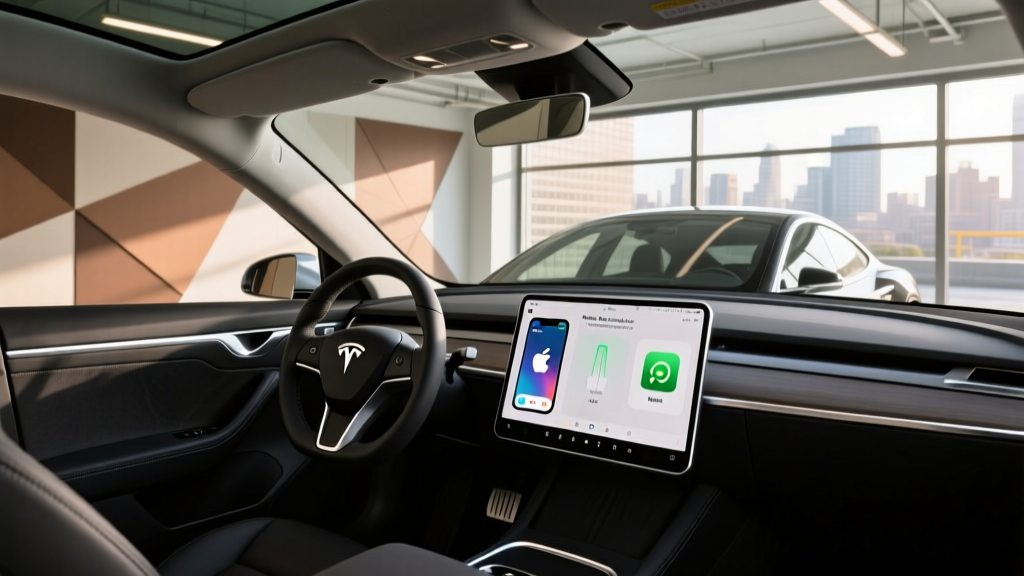
Tesla's 15.4-inch center touchscreen (in the Model Y and Model 3) runs a Linux-based operating system with deep vehicle integration that CarPlay cannot match. Here's what's native:
- Navigation: Tesla's built-in nav includes real-time Supercharger routing, battery preconditioning for fast charging, and traffic-aware routing. It plans charging stops automatically on long trips — something CarPlay navigation apps still handle less seamlessly.
- Music & Media: Native apps for Spotify, Apple Music, Tidal, Amazon Music, TuneIn, podcasts, YouTube, Netflix, Disney+, and more. Audio plays through the vehicle's immersive sound system without phone dependency.
- Phone Integration: Bluetooth handles calls, contacts, and basic audio. The Tesla app enables phone-as-a-key, remote climate control, Summon, and vehicle location.
- Calendar Sync: Tesla syncs with your phone's calendar and can navigate to upcoming appointments automatically.
- Gaming: A growing library of games playable while parked, including Cyberpunk 2077 and Stardew Valley.
- Dashcam & Sentry Mode: Integrated camera recording and security monitoring, accessible from the touchscreen.
The advantage is cohesion: everything runs natively, with no cable or wireless handshake required. The disadvantage is that you're locked into Tesla's ecosystem, and app updates depend entirely on Tesla's software roadmap.
Workarounds: How Tesla Owners Get CarPlay-Like Functionality
While there's no official CarPlay support, the aftermarket has developed several solutions:
1. Tesla Mobile App Mirroring (Limited)
Tesla's app provides basic remote functions but does not mirror your phone's interface to the car screen.
2. Aftermarket CarPlay Adapters (e.g., Carlinkit, Hansshow)
Third-party hardware modules ($250–$400) connect to the Tesla's USB port and run a browser-based CarPlay interface through the Tesla web browser. Results vary: latency can be noticeable, and the experience is not as smooth as native CarPlay in other vehicles. Firmware updates from Tesla can also break compatibility.
3. Browser-Based Workarounds
Tesla's built-in web browser can access some web apps, but this is cumbersome while driving and not a true CarPlay replacement.
None of these solutions match the seamless, safety-certified CarPlay integration found in a Ford Mustang Mach-E or Hyundai Ioniq 5. If CarPlay is a non-negotiable feature for your daily driving workflow, these workarounds may not satisfy you.
Charging Performance: DC Fast and Home Level 2
| Charging Method | Power (kW) | Speed (miles added) | Time / Notes |
|---|---|---|---|
| Level 1 (120V household) | ~1.4 kW | ~3–4 miles per hour | Emergency/trickle only |
| Level 2 (240V, 48A Wall Connector) | 11.5 kW | ~44 miles per hour | Full charge in ~7 hours |
| DC Fast (Tesla Supercharger V3/V4) | 250 kW peak | ~200 miles in 15 min | 10–80% in ~27 min; tapers above 80% |
| DC Fast (CCS station w/ adapter) | Up to 250 kW | Varies by station | Tesla includes CCS adapter with new vehicles |
Tesla's Supercharger network remains the gold standard for reliability and ease of use. The Model Y's 250 kW peak charge rate is competitive, though rivals like the Hyundai Ioniq 5 (which peaks at ~240 kW on an 800V architecture and achieves 10–80% in ~18 minutes) charge faster in practice due to a flatter charge curve.
One critical nuance: Tesla's peak 250 kW is only sustained at lower states of charge. Above 50% SoC, the rate tapers significantly. Expect an average charge rate closer to 140–160 kW across the full 10–80% session. This is why Tesla quotes 10–80% times rather than peak kW — the sustained rate matters more than the headline number.
For home charging, Tesla's Wall Connector at 48 amps (11.5 kW) is the recommended Level 2 solution. Installation typically requires a 60-amp circuit and costs $500–$2,000 depending on your electrical panel's capacity and the distance from panel to charger. Most Model Y owners charge overnight and start each day with a full battery, making public charging an occasional road-trip need rather than a daily requirement.
Pricing, Trims, and Federal Tax Credit Eligibility
| 2026 Model Y Trim | Base MSRP | Est. After §30D Credit | §30D Eligible? |
|---|---|---|---|
| Long Range RWD | $44,990 | ~$37,490 | Yes (if sourcing rules met) |
| Long Range AWD | $47,990 | ~$40,490 | Yes (if sourcing rules met) |
| Performance | $51,490 | ~$43,990 | Yes (if sourcing rules met) |
The federal EV tax credit under IRS §30D offers up to $7,500 for qualifying new EVs, and since 2024, buyers can transfer the credit to the dealer at the point of sale for an immediate price reduction. However, eligibility is not guaranteed for every Tesla buyer. You must meet all of the following:
- Income caps: Modified adjusted gross income (MAGI) must not exceed $150,000 (single), $225,000 (head of household), or $300,000 (married filing jointly).
- MSRP cap: The vehicle's MSRP must not exceed $55,000 for sedans or $80,000 for SUVs/trucks. All Model Y trims fall under the $80,000 SUV cap.
- Battery sourcing: A percentage of critical minerals and battery components must be sourced from the US or free-trade-agreement countries. These thresholds increase annually. Check fueleconomy.gov for the current eligibility status of specific VINs.
- Final assembly: The vehicle must undergo final assembly in North America. All US-market Model Y vehicles are assembled in Austin, Texas or Fremont, California, satisfying this requirement.
Tesla's eligibility for the full $7,500 credit has fluctuated as battery-sourcing rules tighten. Always verify current status on fueleconomy.gov or with your Tesla advisor before finalizing a purchase.
Pros and Cons: Tesla Model Y Without CarPlay
Pros
- Class-leading Supercharger network reliability and coverage
- 320-mile EPA range with strong real-world efficiency (122 MPGe)
- Native navigation with automatic Supercharger trip planning and battery preconditioning
- Spacious cargo area (72 cu ft folded) with front trunk (frunk)
- Over-the-air software updates continuously add features
- Strong resale value relative to most EV competitors
- 8-year/120,000-mile battery and drive unit warranty
- Access to native streaming apps without phone dependency
Cons
- No Apple CarPlay or Android Auto — not available, not announced
- Aftermarket CarPlay adapters are clunky and unreliable
- DC fast charging is slower than 800V rivals (Ioniq 5, EV6, Taycan)
- No physical buttons or stalks — all controls routed through touchscreen
- FSD (Supervised) remains a Level 2 system requiring full driver attention, despite the $8,000 price tag
- Insurance premiums tend to be higher than comparable non-Tesla EVs
- Build quality inconsistency still reported by some owners
Is the Model Y Worth It Without CarPlay? The Decision Framework
Choose the Tesla Model Y if: You value the Supercharger network, want native trip planning that handles charging stops automatically, prefer a minimalist cabin, and can adapt to Tesla's infotainment ecosystem. If you primarily use your phone for navigation and can switch to Tesla's built-in nav, the CarPlay absence becomes less significant over time.
Choose a competitor (Hyundai Ioniq 5, Ford Mustang Mach-E, Volkswagen ID.4) if: Apple CarPlay or Android Auto is essential to your daily workflow, you want faster 800V DC charging, you prefer physical buttons and traditional control layouts, or you want a more conventional dealership service experience.
The competitors listed above all offer native wireless CarPlay and Android Auto, competitive range (270–320 miles EPA), and access to growing third-party fast-charging networks. The Ioniq 5 in particular charges from 10–80% in approximately 18 minutes on a 350 kW charger — roughly 9 minutes faster than the Model Y — thanks to its 800V architecture.
However, Tesla's Supercharger network still outpaces Electrify America, EVgo, and ChargePoint in uptime and plug-and-charge simplicity. If you road-trip frequently, this advantage is substantial.
Frequently Asked Questions
Has Tesla ever announced Apple CarPlay support?
No. As of 2026, Tesla has never announced plans to support Apple CarPlay or Android Auto. The company considers its proprietary infotainment system a core differentiator and has invested in native apps, navigation, and media to replace phone projection.
Can I add CarPlay to my Tesla with an aftermarket device?
Third-party adapters like Carlinkit or Hansshow modules ($250–$400) can display a CarPlay-like interface through Tesla's web browser, but the experience involves noticeable latency, potential compatibility breaks after Tesla software updates, and is not officially supported by Tesla or Apple. It is not equivalent to factory-integrated CarPlay.
Will Apple's next-generation CarPlay change Tesla's stance?
Apple has announced a next-generation CarPlay with deeper vehicle integration (instrument cluster, climate controls). However, this requires automaker cooperation at the hardware level. Tesla has not signed on as a partner, and there is no indication they will. Automakers like Porsche, Aston Martin, and Mercedes-Benz are adopting next-gen CarPlay, but Tesla remains independent.
Does the Tesla Model Y qualify for the $7,500 federal tax credit?
The Model Y qualifies for up to $7,500 under IRS §30D, provided the buyer meets income caps ($150K single / $300K joint), the MSRP is under $80,000 (all Model Y trims qualify), and the vehicle's battery meets critical-mineral and component-sourcing thresholds. Eligibility can change as sourcing rules tighten annually. Verify current status at fueleconomy.gov before purchasing.
What is the real-world range of the 2026 Model Y Long Range?
The EPA rates it at 320 miles. Real-world highway driving at 70–75 mph typically yields 265–285 miles. In cold weather (below 30°F), expect 220–255 miles without preconditioning. Tesla's heat pump and battery preconditioning help reduce winter losses when used properly.
How does Tesla's charging speed compare to competitors?
The Model Y peaks at 250 kW DC and achieves 10–80% in approximately 27 minutes. The Hyundai Ioniq 5 and Kia EV6, with 800V architectures, peak at ~240 kW but sustain higher rates longer, achieving 10–80% in roughly 18 minutes on a 350 kW charger. For home Level 2 charging, the Model Y's 11.5 kW rate (~44 mi/hr) is competitive and sufficient for overnight charging.
Is Tesla's Autopilot or FSD self-driving?
No. Both Autopilot and Full Self-Driving (Supervised) are SAE Level 2 driver-assistance systems. The driver must remain fully engaged, keep hands on the wheel, and monitor the road at all times. Tesla's FSD does not make the vehicle autonomous. Only Level 4 services like Waymo operate without a human driver, and those are limited to specific geofenced areas.