The Short Answer: When Did Electric Cars Start?
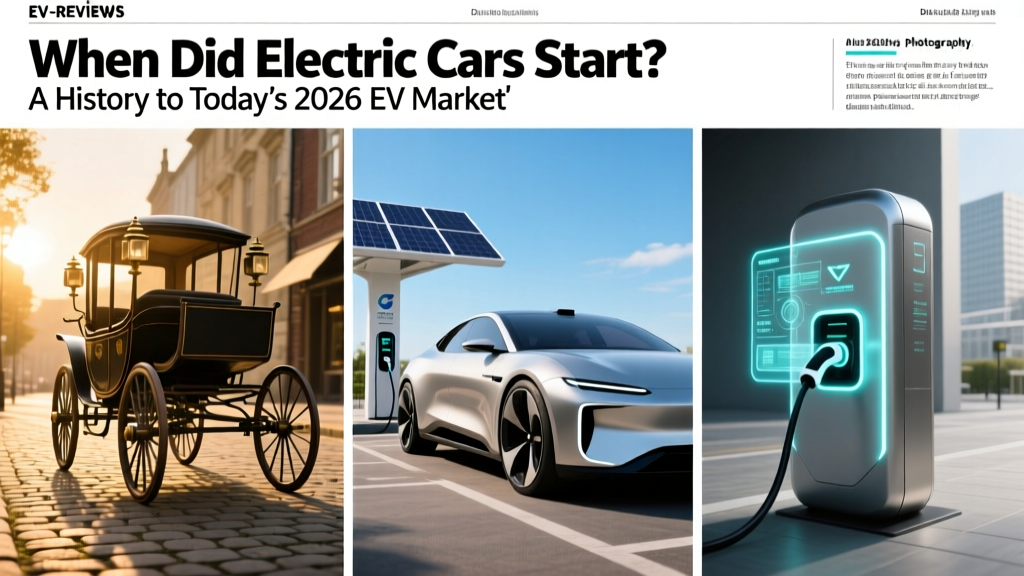
Electric cars trace back to the 1830s, when Scottish inventor Robert Anderson built the first crude electric carriage. The first practical electric vehicle debuted in the 1870s, and by 1900, EVs accounted for roughly a third of all vehicles on U.S. roads. The modern EV era began in 2008 with the Tesla Roadster, followed by the Nissan Leaf in 2010. Today in 2026, EVs routinely deliver 250–400+ miles of EPA range, charge at up to 350 kW, and compete directly with gas cars on total cost of ownership.
If you've landed here wondering when did electric start in the automotive world, the answer spans nearly two centuries — but the part that matters for your wallet is what's happened in the last five years. Battery costs have plummeted from over $1,200 per kWh in 2010 to roughly $115 per kWh in 2025–2026, according to BloombergNEF. That single number explains why EVs went from niche curiosity to mainstream option.
From 1830s Carriages to 2026: The EV Timeline That Matters
The early history of electric vehicles is full of false starts. Here's the timeline compressed to what actually shaped the cars you can buy today:
- 1832–1839: Robert Anderson builds a non-rechargeable electric carriage in Scotland.
- 1870s–1880s: Rechargeable batteries (lead-acid) enable practical electric vehicles in Europe and the U.S.
- 1900: EVs hold ~33% of the U.S. car market, outselling gasoline cars. They're quiet, clean, and don't require hand-cranking.
- 1910s–1920s: Cheap Texas oil, the electric starter (1912), and Ford's Model T at $650 crush the early EV market.
- 1996: GM launches the EV1, the first modern production EV. Limited range (~80 miles), lease-only, famously recalled and crushed.
- 2008: Tesla Roadster debuts with 244 miles of range using lithium-ion cells — the proof of concept for modern EVs.
- 2010: Nissan Leaf (73-mile EPA range, $32,780) and Chevy Volt (PHEV) bring electrification to the mass market.
- 2017–2020: Chevy Bolt delivers 238 miles at $36,620; Tesla Model 3 hits 310+ miles at $35,000 (promised). Battery costs cross $150/kWh.
- 2022–2023: Hyundai Ioniq 5, Ford F-150 Lightning, and Rivian R1T prove EVs work across segments. NACS (Tesla's connector) begins winning the standards war.
- 2024–2026: Sub-$30,000 EVs appear (Chevy Equinox EV at ~$33,000 before incentives), 350 kW charging becomes available, and LFP battery chemistry extends to non-Tesla brands.
The takeaway: EVs aren't new technology. What's new is that they've finally crossed the price, range, and charging-speed thresholds that make them practical for the majority of drivers.
2026 EVs vs. Gas Cars: The Numbers Side by Side
History is interesting, but the comparison that matters today is what you'll actually drive and pay for. Here's how a representative 2026 EV stacks up against a comparable gas vehicle across the metrics that hit your bank account:
| Metric | 2026 EV (e.g., Hyundai Ioniq 6 SE Long Range) | 2026 Gas Car (e.g., Toyota Camry LE) |
|---|---|---|
| Base MSRP | ~$39,500 | ~$29,500 |
| After §30D Federal Tax Credit | ~$32,000 (if eligible; see IRS rules below) | $29,500 (no credit) |
| EPA Range / Tank Range | 361 miles (EPA); expect ~290–310 mi highway | ~530 miles (13.2 gal × 40 mpg hwy) |
| Efficiency | 140 MPGe combined / 24 kWh/100mi | 32 MPG combined |
| Fuel/Energy Cost per Mile | ~$0.04 (home charging at $0.15/kWh) | ~$0.11 (at $3.50/gal, 32 MPG) |
| Annual Fuel/Energy (12,000 mi) | ~$480 | ~$1,312 |
| Maintenance per Year | ~$300 (no oil, fewer brake pads via regen) | ~$650 (oil, filters, more brake wear) |
| 0–60 mph | 5.1 seconds (225 HP, RWD) | 7.6 seconds (203 HP) |
| Battery/Powertrain Warranty | 10 yr / 100,000 mi (battery + drivetrain) | 5 yr / 60,000 mi (powertrain) |
Sources: fueleconomy.gov, manufacturer spec sheets, IRS §30D guidelines. Tax credit eligibility depends on MSRP caps, buyer income, and battery sourcing — always verify at irs.gov.
The Real Cost of EV Ownership in 2026
Sticker price tells only part of the story. Here's a 5-year cost breakdown for a typical buyer driving 12,000 miles annually, comparing an EV with a similar gas sedan. This is where the "when did electric start being cheaper?" question gets answered:
| Cost Category (5 Years) | EV (after credit) | Gas Car |
|---|---|---|
| Net Purchase Price | $32,000 | $29,500 |
| Fuel / Electricity | $2,400 | $6,560 |
| Maintenance | $1,500 | $3,250 |
| Insurance (avg) | $7,500 (~15–20% higher) | $6,250 |
| Home Charger Install (Level 2) | $1,200 (one-time) | $0 |
| Depreciation (est. 5-yr) | $14,000 | $11,500 |
| 5-Year Total | $58,600 | $57,060 |
The EV costs roughly $1,540 more over five years in this scenario — but that gap closes fast if you drive more miles (higher fuel savings), if your state offers additional rebates (California's CVRP, Colorado's $5,000 credit), or if you buy a lower-priced EV. At 20,000 miles per year, the EV pulls ahead by year four.
Where EVs save money: Fuel and maintenance are dramatically cheaper. Regenerative braking means brake pads can last 100,000+ miles. No oil changes, no transmission fluid, no spark plugs.
Where EVs cost more: Insurance premiums run 15–25% higher on average due to repair complexity and battery replacement costs. Upfront purchase price is still higher before incentives. Depreciation has improved but remains steeper for some models.
Common EV Myths vs. 2026 Facts
A lot of EV skepticism comes from information that was true in 2015 but isn't anymore. Here's what the data actually shows:
| Myth | 2026 Fact |
|---|---|
| "EV batteries need replacing every few years." | Modern NMC and LFP batteries degrade ~1.5–2.5% per year. At that rate, you'll still have 85–90% capacity at 100,000 miles. Federal law mandates 8-year/100,000-mile battery warranties (10 years/150,000 miles in CARB states). |
| "You can't take road trips." | The 2026 Supercharger network exceeds 30,000 stalls in North America, now open to NACS-equipped Fords, GMs, Rivians, and more. Electrify America and other CCS networks cover major corridors. A 600-mile trip in an Ioniq 5 adds ~35 minutes of charging. |
| "EVs don't work in cold weather." | Cold reduces range by 15–30% depending on temperature and heat pump availability. A 300-mile EV with a heat pump (standard on most 2026 models) still delivers 220–250 miles at 20°F. Preconditioning while plugged in mitigates this significantly. |
| "Charging takes forever." | At a 250 kW DC fast charger, a 2026 Ioniq 5 charges 10–80% in ~18 minutes. Level 2 home charging (7.7 kW) adds ~30 miles per hour — plug in at night, wake up full. |
| "EVs are worse for the environment." | Per the Union of Concerned Scientists, an EV charged on the dirtiest U.S. grid still produces fewer lifetime emissions than a 34 MPG gas car. On cleaner grids (Pacific Northwest, New York), the advantage is 3–5×. |
What a First-Time EV Buyer Actually Needs to Know
If you're considering your first EV in 2026, these are the practical realities that determine whether you'll love it or regret it:
Home Charging Access Is the Deciding Factor
EV ownership is transformative when you charge at home. A Level 2 charger (240V, 32–48 amps) costs $500–$800 for the unit and $600–$1,800 for professional installation, depending on whether your electrical panel needs an upgrade to 200 amps. If you can install one, you'll do 90%+ of your charging at home at ~$0.12–$0.18/kWh — far cheaper than gas.
If you can't charge at home (apartment, street parking, no garage), EV ownership is significantly harder. You'll rely on public DC fast charging at $0.30–$0.50/kWh, which erases most fuel savings and adds 20–40 minutes to your week. A PHEV (plug-in hybrid) may be a better fit.
Understand kW vs. kWh — It Matters
This is the single most common point of confusion:
- kWh (kilowatt-hours) = battery capacity. Think of it as the "gas tank size." A 77 kWh battery holds 77 kWh of energy.
- kW (kilowatts) = charge rate or power output. Think of it as "gallons per minute at the pump." A 150 kW charger delivers energy faster than a 50 kW charger.
A 77 kWh battery charging at 150 kW doesn't fill in 30 minutes — charging slows above 80% to protect the battery. Expect a 10–80% charge in 18–25 minutes depending on the vehicle and charger.
Cold Weather and Highway Driving Reduce Range
EPA range stickers assume mixed driving at moderate temperatures. In reality:
- Highway driving at 75 mph: Expect 80–88% of EPA range.
- Cold weather (below 30°F): Expect 70–85% of EPA range without preconditioning; 80–90% with a heat pump and preconditioning.
- Combined cold + highway: Plan for 65–75% of EPA range on a winter road trip.
Buy 20–30% more EPA range than your longest regular trip to stay comfortable.
The §30D Federal Tax Credit Is Not Guaranteed
The up-to-$7,500 federal tax credit under IRC §30D has strict eligibility requirements for 2026:
- MSRP caps: $80,000 for SUVs, vans, and trucks; $55,000 for sedans and other vehicles.
- Buyer income caps: $150,000 single / $225,000 head of household / $300,000 married filing jointly (modified AGI).
- Battery sourcing: Critical minerals and battery components must meet escalating domestic/free-trade sourcing thresholds each year — this disqualifies some models.
- Point-of-sale transfer: You can apply the credit at purchase to reduce your out-of-pocket cost, but you must attest to income eligibility and repay if you exceed limits.
Always verify current eligibility on the fueleconomy.gov tax credit page and consult a tax professional. State incentives vary and stack on top in some jurisdictions.
Decision Framework: Should You Buy an EV, Hybrid, or Stick With Gas?
Choose a Battery EV (BEV) if:
- You can install a Level 2 home charger
- Your daily commute is under 80 miles round-trip
- You take road trips fewer than 4–5 times per year (or are willing to plan charging stops)
- You want the lowest per-mile operating cost and minimal maintenance
- You qualify for the §30D credit and/or state incentives
Choose a Plug-in Hybrid (PHEV) if:
- You can charge at home but have range anxiety for longer trips
- Your daily driving is under 30–45 miles (most PHEVs cover this on battery alone)
- You regularly drive 200+ miles in areas with sparse charging
- You want EV-like daily driving with gas-car flexibility
Choose a Standard Hybrid (HEV) if:
- You cannot charge at home
- You want better fuel economy without any charging behavior change
- Your budget is tighter (HEVs start ~$28,000)
- You drive in extreme cold frequently and want maximum range certainty
Stick with Gas (for now) if:
- You drive fewer than 6,000 miles per year (fuel savings won't offset the EV premium)
- You have no home or workplace charging access and your area has limited public infrastructure
- You regularly tow heavy loads over long distances (EV towing cuts range 40–50%)
What's Next: The EV Market From Here
The EV landscape in 2026 is unrecognizable compared to even 2020. LFP (lithium iron phosphate) batteries now offer 10-year+ lifespans with minimal degradation, though at lower energy density than NMC chemistry. The NACS connector has won the North American standard war, meaning virtually all new EVs can access Tesla's Supercharger network. Solid-state batteries remain announced for late-2020s production but aren't yet available in any consumer vehicle.
What hasn't changed since the 1830s is the core promise: electric propulsion is simpler, smoother, and cheaper to operate than internal combustion. The technology just finally caught up to the promise.
Frequently Asked Questions
When did electric cars first outsell gas cars?
They didn't, exactly — but around 1900, electric vehicles held roughly a third of the U.S. automobile market, briefly outselling gasoline-powered cars. Steam actually held the largest share. The introduction of Ford's affordable Model T in 1908, combined with cheap petroleum and the electric starter (eliminating hand-cranking), shifted the market decisively to gasoline by the 1920s.
Why did electric cars disappear for nearly 100 years?
Energy density. Gasoline contains roughly 33.7 kWh of energy per gallon, and a 15-gallon tank weighs about 90 pounds while delivering 400+ miles of range. Early lead-acid batteries weighed hundreds of pounds and delivered 40–60 miles. It took lithium-ion battery technology — and specifically the cost reductions driven by consumer electronics and then Tesla's Gigafactory scale — to close that gap enough for mass adoption.
When did Tesla start making electric cars?
Tesla Motors (now Tesla, Inc.) was founded in 2003. The first production vehicle, the original Tesla Roadster, launched in 2008 with 244 miles of EPA range — roughly triple what any other EV offered at the time. The Model S followed in 2012, the Model X in 2015, the mass-market Model 3 in 2017, and the Model Y in 2020.
Are EVs actually cheaper to own than gas cars in 2026?
It depends on your mileage, electricity rates, and whether you qualify for incentives. For a driver covering 12,000–15,000 miles per year with home charging access and the $7,500 federal credit, a mid-priced EV typically reaches cost parity with a comparable gas car within 3–5 years. For lower-mileage drivers without incentives, gas cars may still cost less over a 5-year hold. The fueleconomy.gov side-by-side tool lets you compare specific models with your local electricity and gas prices.
How long do EV batteries actually last?
Based on data from Tesla fleet reports, Consumer Reports, and manufacturer warranty claims, modern lithium-ion EV batteries (both NMC and LFP chemistry) typically lose 10–15% of their original capacity over 100,000–150,000 miles. Federal law requires manufacturers to warrant the battery for at least 8 years/100,000 miles against falling below ~70% capacity. Complete battery replacement is rare and typically costs $5,000–$15,000 out of warranty depending on the pack size.
What was the first modern electric car?
The 2008 Tesla Roadster is widely considered the first modern EV — it was the first highway-legal, production electric car to use lithium-ion battery cells and deliver over 200 miles of range. The Nissan Leaf (2010) was the first modern mass-market, affordable EV, selling over 500,000 units globally in its first decade.