When Did Electric Cars Come Out? The Quick Answer
Electric cars first appeared in the 1830s, when Scottish inventor Robert Anderson built a crude electric carriage. The first practical production EVs arrived in the 1880s–1890s, and by 1900, electric vehicles outsold gasoline and steam cars combined in the United States. The modern era of highway-capable, lithium-ion EVs began with the 2008 Tesla Roadster, followed by the mass-market 2010 Nissan Leaf and 2012 Tesla Model S. Today's 2026 EVs deliver 250–400+ miles of EPA range, DC fast-charge in under 20 minutes, and cost as little as $29,990 before incentives.
If you've landed here wondering about EV origins because you're considering your first electric purchase, you're not alone. Monthly searches for "when did electric cars come out" consistently trend as new buyers discover that electrification isn't a 2020s phenomenon — it's a 190-year-old technology that finally matured. Below, we'll cover the milestones that matter, then pivot to what actually affects your wallet in 2026: real costs, real range, and a practical decision framework for your next vehicle.
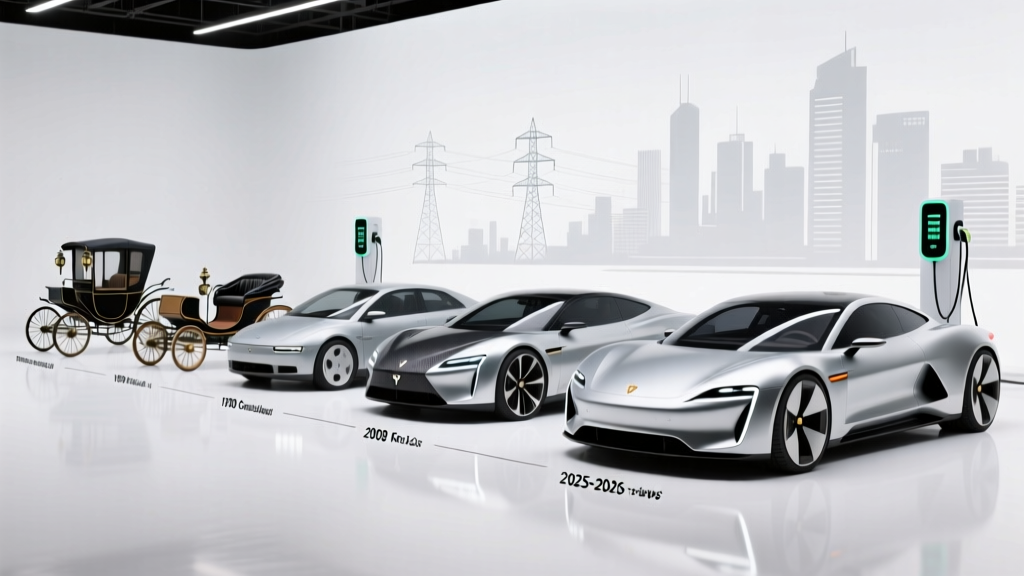
The EV Timeline: Key Milestones That Shaped Today's Market
Understanding EV history helps explain why today's battery chemistry, charging networks, and pricing look the way they do.
- 1832–1839: Robert Anderson's non-rechargeable electric carriage in Scotland — proof of concept, not practical transport.
- 1884: Thomas Parker builds the first practical production electric car in London using rechargeable batteries.
- 1899–1900: EVs peak in the U.S., holding 38% of the automobile market (gas: 22%, steam: 40%). The Baker Electric and Columbia were top sellers.
- 1908: The Ford Model T launches at $850, undercutting EVs that cost $1,000–$3,000. Cheap gasoline and the electric starter seal the EV's fate for decades.
- 1996: GM introduces the EV1 — the first mass-produced modern EV (1,117 units, lease-only, famously recalled and crushed).
- 2008: Tesla Roadster launches at $109,000 with 244 miles of range on lithium-ion cells, proving EVs could be desirable.
- 2010: Nissan Leaf debuts at $32,780 with 73 miles EPA range — the first affordable mass-market BEV.
- 2012: Tesla Model S (265 miles EPA) establishes the long-range luxury EV template.
- 2020–2022: Volkswagen ID.4, Ford Mustang Mach-E, Hyundai Ioniq 5, and GMC Hummer EV broaden the market.
- 2023–2025: NACS (Tesla's charging connector) becomes the North American standard; most automakers adopt it for 2025+ models.
- 2026: Over 80 BEV models available in the U.S., with median EPA range above 280 miles and base prices starting under $30,000.
The throughline: battery energy density doubled roughly every decade since 2008, while cost per kWh dropped from ~$1,200 in 2010 to approximately $115–$130 by 2025 (BloombergNEF battery price survey). That cost curve is the single reason EVs are now competitive with gas cars on purchase price.
2026 EV vs Gas vs Hybrid: How Do They Actually Compare?
History is interesting, but the question that matters now is: which powertrain saves you more over five years? Let's compare a typical 2026 compact crossover across all three.
| Metric | BEV (e.g., Hyundai Ioniq 5) | PHEV (e.g., Toyota RAV4 Prime) | Gas (e.g., Toyota RAV4 LE) |
|---|---|---|---|
| Base MSRP | $42,600 | $43,690 | $30,490 |
| Federal tax credit (§30D) | Up to $7,500* | Up to $7,500* | $0 |
| Effective price after credit | ~$35,100 | ~$36,190 | $30,490 |
| EPA range / fuel economy | 303 mi / 114 MPGe | 42 mi electric, 38 MPG gas | 30 MPG combined |
| Annual fuel cost (15k mi/yr) | ~$540 (home L2, $0.14/kWh) | ~$780 (mixed) | ~$1,750 ($3.50/gal) |
| 5-year fuel total | $2,700 | $3,900 | $8,750 |
| 5-year maintenance estimate | ~$1,200 | ~$2,400 | ~$3,100 |
| 5-year total cost (purchase + fuel + maint.) | ~$39,000 | ~$42,490 | ~$42,340 |
*§30D credit eligibility depends on buyer income caps ($150k single / $300k joint), MSRP caps ($55k cars / $80k SUVs and trucks), and battery critical-mineral sourcing requirements. Verify current-year rules at IRS.gov. Credit can now be transferred at point of sale as a down-payment reduction.
The takeaway: the BEV wins on total cost over five years by roughly $3,000–$3,500, but only if you can charge at home. Without home charging, the PHEV becomes the safer bet — it gives you 42 electric miles for daily commuting and a gas engine for road trips, eliminating charging-infrastructure risk entirely.
Real 2026 EV Ownership Costs: What the Sticker Doesn't Tell You
EVs have matured enormously since the 73-mile Leaf of 2010, but ownership economics depend heavily on your specific situation. Here's what first-time buyers need to budget for.
Purchase Price and Incentives
The 2026 EV market spans $29,990 (Nissan LEAF S, 149 mi range) to $130,000+ (Lucid Air Grand Touring, 512 mi). The median transaction price for a new BEV in late 2025 was approximately $48,500, per Kelley Blue Book. The federal §30D credit of up to $7,500 narrows the gap with gas vehicles, but sourcing rules disqualify some trims — always check the EPA's qualifying vehicle list before committing.
Home Charging Installation
This is the hidden cost most buyers overlook. A Level 2 (240V, 32–48 amp) home charger installation typically runs:
| Component | Low End | High End | Notes |
|---|---|---|---|
| Level 2 charger hardware | $200 | $700 | ChargePoint Home Flex, Emporia, Wallbox |
| Electrician labor | $500 | $2,000 | Depends on panel proximity, wall type |
| Electrical panel upgrade (if needed) | $1,500 | $4,000 | Required if panel is below 200A or full |
| Permits and inspection | $50 | $300 | Varies by municipality |
| Total (typical, no panel upgrade) | $750 | $2,700 | Most homes with 200A panels |
| Total (with panel upgrade) | $2,250 | $6,700 | Older homes, 100A service |
Get at least three quotes from licensed electricians. A panel upgrade is the single biggest variable — homes built before 1990 frequently need one.
Charging Cost vs Gasoline
At the U.S. average residential electricity rate of ~$0.16/kWh (EIA, late 2025), charging a 77 kWh battery (Hyundai Ioniq 5) from 10–80% at home costs approximately $8.60 for roughly 200 miles of range — about 4.3 cents per mile. Compare that to a 30 MPG gas car at $3.50/gallon: 11.7 cents per mile. Public DC fast charging is more expensive — typically $0.30–$0.55/kWh, or 8–15 cents per mile — which is why home charging is the economic linchpin of EV ownership.
Insurance, Maintenance, and Depreciation
EV insurance premiums average 15–25% higher than comparable gas vehicles, driven by higher repair costs and battery replacement exposure. Budget an extra $200–$500/year. Maintenance is genuinely lower — no oil changes, no transmission fluid, fewer brake replacements thanks to regenerative braking. Expect $200–$400/year in maintenance versus $500–$800 for gas. Depreciation has been steeper for EVs (some models losing 50%+ in three years), though this is stabilizing as the used-EV market matures.
Common EV Misconceptions — Fact-Checked with Data
As EVs have moved from niche to mainstream, myths have persisted. Here are the ones that most affect buying decisions.
| Myth | Fact (with data) |
|---|---|
| "EV batteries need replacing every few years." | Federal law mandates battery warranties of at least 8 years / 100,000 miles. Real-world data from Tesla, Hyundai, and GM shows most packs retain 85–92% capacity at 150,000 miles. Replacement cost is $8,000–$20,000 but rarely needed within ownership. |
| "EVs don't have enough range for road trips." | The 2026 median BEV EPA range is ~280 miles. The Tesla Supercharger and Electrify America networks add 150–200 miles in 15–20 minutes at DC fast chargers. A 600-mile trip takes roughly one extra 30-minute stop. |
| "Cold weather makes EVs unusable." | Real: EVs lose 20–35% range at 20°F vs 70°F, primarily from cabin heating and battery chemistry. Mitigations: preconditioning (warming the battery while plugged in), heat pumps (standard on most 2026 models), and seat/steering wheel heaters reduce the penalty to ~15–20%. |
| "EVs are worse for the environment because of electricity generation." | Even on coal-heavy grids, lifecycle emissions for EVs are 50–70% lower than gas cars over 150,000 miles (Union of Concerned Scientists, 2024 analysis). On cleaner grids (California, Pacific Northwest), the advantage exceeds 80%. |
| "Charging takes too long." | At home (Level 2, 11.5 kW), you add ~40 miles per hour of charging — a full overnight replenishment. On road trips, 2026 models with 800V architecture (Hyundai Ioniq 5, Kia EV6, Porsche Taycan) charge 10–80% in 18 minutes at 250–350 kW chargers. |
| "Autopilot/FSD means the car drives itself." | Tesla Autopilot, FSD (Supervised), GM Super Cruise, and Ford BlueCruise are all SAE Level 2 driver-assistance systems. The driver must remain engaged, hands on or near the wheel, eyes on the road. No consumer vehicle is self-driving. |
First-Time EV Buyer's Decision Framework
Rather than asking "should I buy an EV?" — which is too broad — work through this specific framework based on your actual driving life.
Step 1: Can you charge at home?
- Yes (garage, driveway, or landlord-approved outlet): A BEV is almost certainly your best economic choice. Proceed to Step 2.
- No (apartment, street parking, no outlet access): Strongly consider a PHEV instead. You get electric commuting without infrastructure dependency. Alternatively, check if your workplace offers Level 2 charging.
Step 2: What's your typical daily mileage?
- Under 60 miles/day: Any current BEV (even the 149-mile Nissan LEAF) handles daily driving with massive buffer. A PHEV covers this entirely on electric.
- 60–150 miles/day: Target a BEV with 280+ miles EPA range. Real-world highway range is ~80% of EPA, so a 300-mile EPA vehicle gives you ~240 real miles — enough with margin.
- Over 150 miles/day or frequent 400+ mile road trips: Prioritize DC fast-charge speed (look for 200+ kW peak, 10–80% under 20 minutes) over raw range. The Hyundai Ioniq 5 (238 kW peak, ~18 min 10–80%) and Tesla Model 3 (250 kW peak, ~15 min) excel here.
Step 3: What's your climate?
- Mild (rarely below 40°F): EPA range figures are realistic within ~10%.
- Cold (frequent sub-30°F winters): Add 25–30% to your required range. If you need 200 real miles in winter, buy a 300+ EPA-mile BEV with a heat pump. LFP battery chemistry (used in base Tesla Model 3/Y and some Ford models) handles cold slightly worse than NMC — factor this in for northern states.
Step 4: Does the math work after incentives?
- Check §30D eligibility: Your modified adjusted gross income must be under $150,000 (single) or $300,000 (joint). The vehicle MSRP must be under $55,000 (cars) or $80,000 (SUVs/trucks). The battery must meet critical-mineral and component sourcing thresholds that tighten annually. Use the IRS qualifying list and confirm with your tax professional.
- Compare 5-year total cost: Use the table above as a template. Plug in your local electricity rate (check your utility bill), your annual mileage, and your state's gas prices. If the BEV's 5-year total beats gas by $2,000+, and you can charge at home, the math favors electric.
What to Look for in a 2026 EV: Spec Priorities
When you've decided on a BEV, evaluate candidates on these specific metrics — not marketing slogans:
- EPA range: Target 280+ miles for versatility. Always subtract 15–20% for real-world highway and another 20–30% for cold weather.
- Battery capacity and chemistry: Usable kWh (not gross) tells you actual energy storage. NMC offers higher energy density; LFP offers longer cycle life and can be charged to 100% daily without degradation concern.
- DC fast-charge rate: Peak kW matters, but sustained rate matters more. A vehicle peaking at 250 kW but tapering to 80 kW at 50% SoC will be slower than one sustaining 200 kW to 80%. Look for published 10–80% charge times.
- Connector: For 2026, NACS is the standard for Tesla, Ford, GM, Rivian, Hyundai/Kia, and most others. CCS1 remains on some carryover models. Ensure the vehicle matches the chargers you'll use most.
- Battery warranty: Minimum 8 years / 100,000 miles, covering capacity retention above 70%. Hyundai offers 10 years / 100,000 miles — the current best.
- Heat pump: Essential for cold-climate buyers. Reduces winter range loss by 5–10 percentage points.
- ADAS level: Every mainstream system (Tesla Autopilot, GM Super Cruise, Ford BlueCruise, Toyota Safety Sense, Honda Sensing) is SAE Level 2. You remain the driver. Evaluate on lane-centering smoothness, adaptive cruise behavior, and driver-monitoring quality — not "autonomy."
Frequently Asked Questions
Who made the first electric car?
Robert Anderson of Scotland built the first crude electric carriage around 1832–1839, using non-rechargeable primary cells. The first practical, rechargeable electric car is credited to Thomas Parker, who built one in London in 1884. In the U.S., William Morrison built a six-passenger electric wagon in 1890–1891 that could reach 14 mph.
Why did electric cars disappear in the early 1900s?
Three factors: the 1908 Ford Model T cost roughly one-third as much as an EV; Charles Kettering's 1912 electric starter eliminated the dangerous hand-crank for gas engines; and cheap Texas oil plus expanding road networks favored gasoline's longer range and faster refueling. By 1935, EVs were essentially extinct in the U.S. market.
When did modern electric cars become practical for average buyers?
The 2010 Nissan Leaf (73 miles EPA, ~$33,000 before incentives) was the first mass-market EV, but range limitations made it a second-car solution. The 2017 Chevrolet Bolt EV (238 miles, $36,620) was the first affordable long-range option. True price parity with gas vehicles — after incentives and fuel savings — arrived around 2023–2025 for compact crossovers and sedans.
How long do EV batteries actually last?
Data from fleets and long-term owners shows most lithium-ion EV batteries retain 85–92% of original capacity after 150,000 miles. Federal warranty requirements mandate coverage for at least 8 years / 100,000 miles at a minimum 70% capacity threshold. LFP chemistry batteries (base Tesla Model 3, some Ford models) show even slower degradation in lab testing, with projections of 80%+ retention at 300,000 miles. Full battery replacement is rare and costs $8,000–$20,000 depending on pack size.
Are EVs actually cheaper to own than gas cars in 2026?
Over five years and 75,000 miles, a typical BEV with home charging saves $3,000–$5,000 in total cost compared to a comparable gas vehicle, primarily from fuel and maintenance savings. Without home charging, public DC fast charging costs can erase much of the fuel savings, making a PHEV the more economical choice. Always model your specific electricity rate, annual mileage, and local gas prices.
What's the difference between kW and kWh?
This is the most common EV confusion. kW (kilowatts) measures power — the rate of energy flow, like water pressure in a hose. It determines charging speed (a 250 kW charger fills faster than a 50 kW one). kWh (kilowatt-hours) measures energy — the total amount stored or delivered, like gallons in a tank. A 77 kWh battery holds 77 kilowatt-hours of energy. Think of it this way: kW is how fast you fill the tank; kWh is how big the tank is.
The electric car's journey from 1830s curiosity to 2026 daily driver took nearly two centuries, but the technology finally reached the inflection point where it makes financial and practical sense for the majority of new-car buyers — provided you can charge at home and choose the right model for your mileage and climate. The history is fascinating; the spreadsheet is what matters.