If you've been researching a Tesla purchase or scrolling through owner forums, you've likely encountered the term "HW3" (sometimes written as Hardware 3 or AP3). It's not a vehicle model — it's the Autopilot computer that powers Tesla's driver-assistance and Full Self-Driving (FSD) features across the Model 3, Model Y, Model S, and Model X. Understanding what HW3 can and cannot do is critical before you buy, especially as Tesla transitions newer vehicles to HW4.
This guide explains exactly what Tesla HW3 is, which 2026 vehicles still carry it, how it performs in real-world driving, and whether you should insist on HW4 instead.
SAE Automation Level Reminder
Tesla's Autopilot and FSD (Supervised) are SAE Level 2 driver-assistance systems. The driver must remain attentive, keep hands on the wheel, and be prepared to take over at any moment. These are not Level 4 robotaxi systems like Waymo. Never treat them as self-driving.
What Tesla HW3 Actually Is
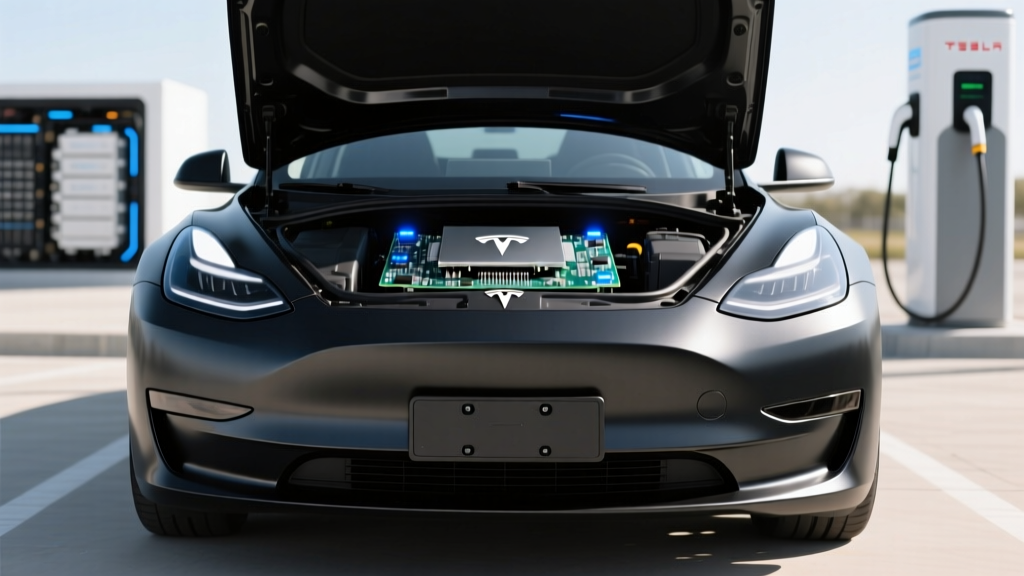
Tesla HW3 — officially called the Full Self-Driving Computer when it launched in April 2019 — is a custom-designed neural network processing unit (NPU) that Tesla engineered in-house to replace the NVIDIA Drive PX2 chip used in HW2 and HW2.5 vehicles. The HW3 board houses two redundant System-on-Chip (SoC) processors, each with 12 CPU cores and a dedicated neural network accelerator capable of processing up to 144 TOPS (trillions of operations per second) combined.
The computer ingests data from Tesla's camera suite (8 cameras in HW3 vehicles: front-facing narrow, main, wide, left/right forward-looking repeaters, left/right rearward-looking, and a rear-view camera) and runs real-time inference to enable features like:
- Adaptive cruise control with stop-and-go
- Autosteer (lane centering on marked roads)
- Auto Lane Change
- Navigate on Autopilot (highway on-ramp to off-ramp)
- Smart Summon (parking lot navigation)
- Traffic Light and Stop Sign Control
- City Streets driving (with FSD Supervised subscription)
HW3 was a landmark because it was the first automotive chip designed specifically for vision-only autonomous driving inference, rather than adapted from mobile or gaming GPUs.
Which 2026 Teslas Still Use HW3?
As of early 2026, Tesla has been transitioning production to HW4 (also called AI4), which features higher-resolution cameras (up to 5 megapixels vs HW3's 1.2 megapixels), a redesigned camera suite with a self-cleaning front camera lens, and a more powerful processor. However, HW3 vehicles remain on the road in large numbers, and some inventory or used vehicles still carry HW3.
| Attribute | HW3 | HW4 |
|---|---|---|
| Camera Resolution | 1.2 MP | Up to 5 MP |
| Number of Cameras | 8 | 7 (removed front narrow) |
| Processor Architecture | Dual SoC, 144 TOPS | Redesigned NPU, higher throughput |
| Front Camera Self-Cleaning | No | Yes |
| Ultrasonic Sensors (USS) | Removed in late HW3 builds | None (Tesla Vision only) |
| FSD Feature Parity | Supported with some limitations | Full feature support |
If you're buying a used Tesla from 2019–2023, there's a strong chance it has HW3. Tesla offered a free upgrade from HW2.5 to HW3 for owners who had purchased the FSD package, but HW3-to-HW4 upgrades have not been offered as of 2026.
Real-World FSD Performance on HW3
Tesla's FSD (Supervised) software runs on both HW3 and HW4, but the experience differs. On HW3, the lower-resolution cameras mean the neural network has less visual detail to work with, particularly in challenging conditions:
- Rain and fog: HW3 cameras struggle more with water droplets and reduced contrast. HW4's higher resolution and self-cleaning front lens handle these better.
- Lane markings at night: HW3's 1.2 MP sensors capture less light detail, leading to more frequent disengagements on poorly lit roads.
- Distant object detection: HW4 can resolve objects further ahead, giving the system more reaction time at highway speeds.
That said, for daily commuting on well-marked suburban and urban roads, HW3-based FSD (Supervised) handles the vast majority of scenarios competently. Expect occasional phantom braking, hesitation at complex unprotected left turns, and the need to take over in construction zones — limitations that persist across both hardware generations.
What FSD (Supervised) Does NOT Do on Any Hardware
- Drive without your supervision — you must watch the road
- Navigate unmapped or severely degraded roads reliably
- Handle all weather conditions (heavy snow, torrential rain)
- Eliminate your liability — you are the responsible driver at all times
Specs: The Vehicles That Carry HW3
Because HW3 is a computer platform rather than a single vehicle, it spans multiple Tesla models. Below are the specs for the most common HW3-equipped vehicle still widely available: the 2025 Tesla Model 3 Long Range AWD (one of the last model years commonly built with HW3 before the HW4 transition accelerated).
| Spec | Value |
|---|---|
| EPA Range | 341 miles |
| Battery Capacity | ~75 kWh usable (NMC chemistry) |
| Drivetrain | Dual-motor AWD |
| Horsepower | ~346 hp combined |
| 0–60 mph | 4.2 seconds |
| MPGe (combined) | 134 MPGe |
| Efficiency | 25 kWh/100 mi |
| Max DC Fast Charge | 250 kW (peak) |
| 10–80% DC Charge Time | ~27 minutes |
| Level 2 Charge Rate | 11.5 kW (~44 mi/hr) |
| Cargo Volume | 23 cu ft (rear) + 3 cu ft (frunk) |
| Rear Legroom | 35.3 inches |
| Battery Warranty | 8 years / 120,000 miles |
| Base MSRP | $47,740 |
Real-World Range Note
The EPA estimates 341 miles for the Model 3 Long Range AWD. In real-world highway driving at 70–75 mph, expect ~280–300 miles. In cold weather (below 32°F), range can drop to 240–260 miles due to battery resistance and cabin heating demands. Preconditioning the battery while plugged in mitigates some of this loss.
Charging Speed: What HW3-Era Teslas Deliver
HW3 has no bearing on charging hardware — charge speed is determined by the vehicle's battery pack and onboard charger. Here's what a typical HW3-era Model 3 Long Range delivers:
| Level | Power | Miles Added per Hour |
|---|---|---|
| Level 1 (120V outlet) | ~1.4 kW | ~5 mi/hr |
| Level 2 (240V home) | 11.5 kW | ~44 mi/hr |
| DC Fast Charge (Supercharger) | Up to 250 kW peak | ~200+ mi in 15 min (taper above 60%) |
The charge curve matters: the Model 3 Long Range pulls its peak 250 kW only between roughly 10–30% State of Charge (SoC). Above 60%, the rate tapers significantly, dropping below 75 kW past 80%. This is why Tesla recommends charging to 80% at Superchargers — the last 20% can take as long as the first 60%.
Tax Credit and Pricing for HW3-Era Teslas
Whether a Tesla qualifies for the federal §30D EV tax credit depends on the model year, MSRP, buyer income, and battery component/critical mineral sourcing — not the Autopilot hardware version.
| Trim | MSRP | Est. Credit | Effective Price |
|---|---|---|---|
| RWD (LFP battery) | $38,990 | Up to $7,500* | ~$31,490 |
| Long Range AWD | $47,740 | Up to $7,500* | ~$40,240 |
| Performance | $54,990 | Up to $7,500* | ~$47,490 |
*Credit eligibility requires: buyer AGI ≤ $150K (single) / $300K (joint), vehicle MSRP ≤ $55K (sedan), and meeting battery sourcing thresholds per IRS rules. The credit can be transferred to the dealer at point of sale. Always verify current eligibility on irs.gov and consult a tax professional.
Should You Buy HW3 or Wait for HW4?
Choose a HW3 Tesla If:
- You're buying used and want to save $10,000–$15,000 vs new
- Your commute is primarily on well-marked suburban/highway roads
- You don't plan to rely heavily on FSD (Supervised) for city driving
- You value proven hardware with years of software optimization
Insist on HW4 If:
- You're buying new and want the latest camera resolution and processor
- You frequently drive in rain, fog, or poorly lit rural roads
- You plan to subscribe to FSD and use it extensively
- You want the longest possible runway for future software improvements
Tesla has not committed to bringing full feature parity to HW3 indefinitely. While FSD updates continue to support HW3 as of 2026, it's reasonable to expect that eventually, the most advanced neural network models may require HW4's higher-resolution sensor input. If long-term FSD access matters to you, HW4 is the safer bet.
Pros of HW3 Teslas
- Wide availability on the used market at lower prices
- Still receives FSD (Supervised) updates in 2026
- Mature, well-tested hardware with years of refinement
- Lower insurance costs vs newer HW4 builds in some regions
Cons of HW3 Teslas
- Lower camera resolution limits performance in poor conditions
- No front camera self-cleaning (rain/snow obstruction)
- Potential long-term FSD feature divergence from HW4
- No upgrade path from HW3 to HW4 offered by Tesla
How to Check if a Tesla Has HW3 or HW4
Before purchasing any Tesla, verify the hardware:
- In the vehicle: Go to Controls → Software → Additional Vehicle Information. The "Autopilot Computer" field will read "Full Self-Driving Computer" (HW3) or "AI4" (HW4).
- VIN check: Later VINs from mid-2023 onward are increasingly HW4, but the cutoff varies by factory and model. Don't rely on model year alone.
- Camera inspection: HW4 vehicles have a camera housing above the rearview mirror that looks different (larger, single camera unit) and a self-cleaning nozzle for the front camera visible on the hood line.
Frequently Asked Questions
Can Tesla upgrade my HW3 to HW4?
As of 2026, Tesla has not offered a HW3-to-HW4 upgrade program. Tesla did previously upgrade HW2.5 owners to HW3 for free (if they had purchased FSD), but the camera suite and wiring harness differences between HW3 and HW4 make a retrofit significantly more complex and costly. There is no announced plan for such a program.
Does HW3 support the latest FSD version?
Yes. As of 2026, Tesla's FSD (Supervised) v13.x continues to support HW3. However, certain perception improvements leverage HW4's higher-resolution cameras, meaning HW4 may deliver marginally better performance in edge cases. Tesla has stated it will continue to support HW3, but future feature divergence is possible.
Is HW3 safe for highway driving?
HW3-based Autopilot and FSD are SAE Level 2 systems that perform well on highways when the driver remains engaged. NHTSA data shows that driver-assist systems reduce certain crash types but require constant supervision. HW3's Autopilot handles lane centering, adaptive cruise, and lane changes reliably on well-marked highways.
Will HW3 Teslas lose value faster than HW4?
Possibly. As Tesla's software increasingly leverages HW4's superior sensors, the market may price HW3 vehicles at a wider discount. However, HW3 Teslas already trade at lower used prices, so much of this depreciation may already be reflected.
What about Tesla's ultrasonic sensors (USS)?
Later HW3 builds (late 2022 onward) removed ultrasonic sensors in favor of "Tesla Vision" — a camera-only approach for parking and proximity detection. Early HW3 vehicles (2019–2022) still have USS. If tight parking garages are part of your routine, an earlier HW3 build with USS may actually offer more reliable close-range detection than the Tesla Vision-only approach.
Does the Autopilot computer affect range or efficiency?
No. HW3 and HW4 consume negligible power relative to the traction battery. Your range is determined by battery chemistry, driving style, temperature, and speed — not the Autopilot computer generation.
Sources: EPA Fuel Economy, IRS §30D Clean Vehicle Credits, NHTSA Automated Vehicle Safety.