What Is an Electric Vehicle? The Short Answer
An electric vehicle (EV) — technically a battery electric vehicle (BEV) — is a car powered entirely by an onboard lithium-ion battery pack driving one or more electric motors. There is no gasoline engine, no exhaust pipe, and no traditional multi-speed transmission. You recharge the battery by plugging into an external power source: a home outlet, a dedicated Level 2 wallbox, or a public DC fast charger. As of the 2026 model year, mainstream EVs deliver an EPA-estimated range between 220 and 400+ miles per charge, with battery capacities typically spanning 58 to 100+ kWh (kilowatt-hours, the unit of stored energy). Electricity cost to drive 100 miles averages $3.50–$6.00 depending on your utility rate, compared to $12–$18 for a comparable gas car at current fuel prices.
How Does an EV Actually Work?
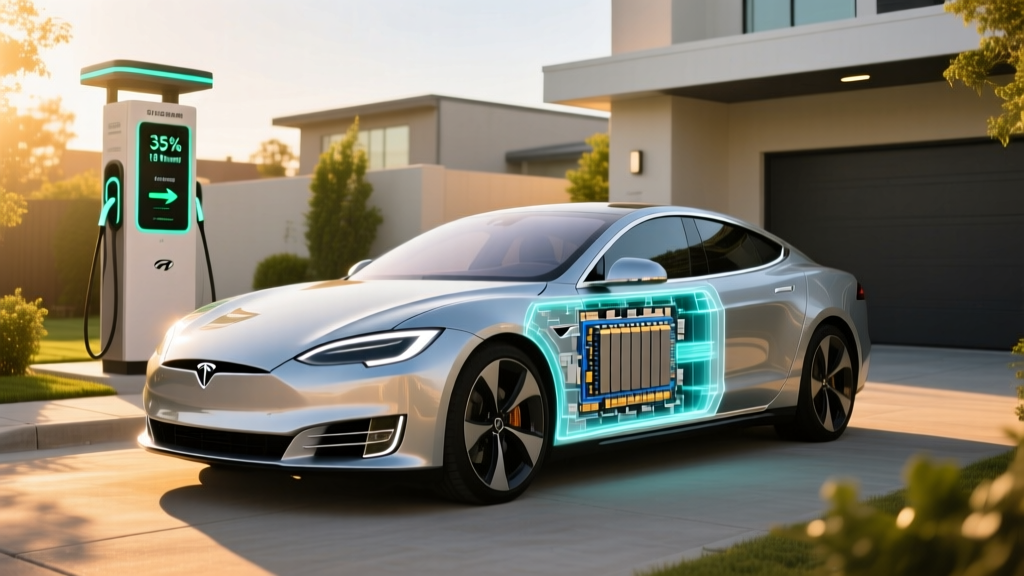
Strip away the marketing and an EV's powertrain is remarkably simple. A high-voltage battery pack — usually mounted low in the chassis for a flat floor and a low center of gravity — stores energy measured in kWh. When you press the accelerator, an inverter converts the battery's DC current to AC (on most models), feeding one or two electric motors that produce instant torque. Regenerative braking recaptures kinetic energy during deceleration, converting it back into electricity to extend range.
Because electric motors deliver maximum torque from 0 RPM, EVs feel immediately responsive off the line. A mid-range EV like the 2026 Hyundai Ioniq 5 (168 kW rear motor, 58 kWh or 84 kWh battery options) hits 0–60 mph in roughly 7.2 seconds in Standard Range and 5.1 seconds in the Long Range RWD, while dual-motor AWD variants dip into the low 4-second range. No gear shifts, no turbo lag, no power-band waiting.
The battery pack is also the single most expensive component, which is why federal law mandates an 8-year/100,000-mile minimum warranty on EV batteries (10 years/150,000 miles in CARB states like California, New York, and Massachusetts). Most manufacturers warranty the pack against dropping below 70% of original capacity.
EV vs. Gas Car vs. Hybrid: The Numbers
The real purchase decision isn't philosophical — it's arithmetic. Here's how a typical 2026 midsize EV stacks up against a comparable gas sedan and a plug-in hybrid over five years and 75,000 miles of mixed driving.
| Cost Category | BEV (e.g., Tesla Model 3 RWD) | Gas Sedan (e.g., Honda Accord 1.5T) | PHEV (e.g., Toyota Prius Prime) |
|---|---|---|---|
| Base MSRP | $38,990 | $29,990 | $33,975 |
| Fed. Tax Credit (§30D) | Up to $7,500* | $0 | Up to $7,500* |
| Fuel / Energy (75k mi) | ~$2,900 | ~$8,400 | ~$4,600 |
| Maintenance (5 yr) | ~$1,200 | ~$3,100 | ~$2,400 |
| Est. Insurance (5 yr) | ~$9,500 | ~$7,800 | ~$8,200 |
| 5-Year Total (before resale) | ~$45,090 | ~$49,290 | ~$41,675 |
*§30D credit eligibility depends on buyer AGI, vehicle MSRP caps ($55k sedans / $80k SUVs & trucks), battery sourcing, and point-of-sale transfer. Verify at IRS.gov. Credit phases and sourcing rules change — this reflects 2026 rules.
A few observations from the table: EVs carry a higher sticker price but recoup much of it through dramatically lower energy and maintenance costs. There's no oil, no spark plugs, no timing belt, no transmission fluid, and brake pads often last 100,000+ miles thanks to regenerative braking. However, EV insurance premiums run 15–25% higher on average due to repair complexity and battery replacement exposure — a real cost you must budget for.
Charging: Where the Rubber Meets the Grid
Understanding EV charging is where most first-time buyers get stuck. The key is distinguishing kW (power — how fast energy flows) from kWh (energy — how much the battery holds). Think of kW as the hose diameter and kWh as the bucket size.
| Level | Power | Miles Added per Hour | Typical Use |
|---|---|---|---|
| Level 1 (120V) | 1.0–1.4 kW | 3–5 mi/hr | Overnight trickle; PHEVs & low-mileage drivers |
| Level 2 (240V) | 7.2–11.5 kW | 25–44 mi/hr | Home wallbox, workplace, shopping centers |
| DC Fast Charge | 50–350 kW | 150–800+ mi/hr (peak) | Highway road trips; 10–80% in 18–35 min |
For daily life, Level 2 home charging is the backbone. A 40-amp hardwired Level 2 wallbox (9.6 kW) will fully replenish a 75 kWh battery overnight in about 8 hours. Expect to pay $500–$800 for the charger itself and $800–$2,500 for professional installation depending on panel capacity and run length — more if your home needs a 200-amp service upgrade ($1,500–$3,500).
On road trips, DC fast charging is the play. A 2026 EV on a 350 kW Electrify America or Tesla Supercharger station will typically peak between 175 and 270 kW and charge from 10% to 80% in roughly 18–28 minutes. Critical caveat: charge curves taper sharply above 80% to protect the battery. That "350 kW" headline number is a peak, not a sustained rate. Plan road-trip stops around 10–80% increments and you'll be fine; chase 100% at a DC charger and you'll waste 20+ minutes.
Cold weather also matters. In sub-30°F testing, expect a 20–30% range reduction due to battery chemistry resistance and cabin heating load. Preconditioning the battery (a feature most EVs offer via the app or nav-routed charging) can recover some of that loss by warming the pack before you plug in.
Real-World Ownership: What the Sticker Doesn't Tell You
EPA range numbers are a starting point, not a guarantee. A 2026 EV with a 330-mile EPA rating will realistically deliver 270–290 miles at sustained 75 mph highway speeds, 240–260 in cold winter weather, and 310+ in mild city driving with regen working in your favor. Always budget your daily driving around ~80% of the EPA number and you'll never sweat it.
Home charging access is the single biggest predictor of EV satisfaction. If you own a home with a garage or driveway, a Level 2 install makes EV ownership nearly effortless — you wake up every morning with a "full tank." Apartment dwellers and street parkers face a harder road: rely on workplace chargers, public Level 2 networks (ChargePoint, EVgo, Tesla Destination), or occasional DC fast-charge sessions. It's doable, but it adds friction and cost — public DC charging often runs $0.35–$0.55/kWh, roughly double the home rate.
Driving patterns also dictate whether an EV makes sense. If your typical day is under 80 miles with predictable routes, even a modest-range EV works beautifully. If you regularly tow, haul, or drive 300+ miles in remote areas with sparse charger coverage, a PHEV or a long-range EV (350+ mi EPA) is the more honest choice.
Common EV Myths vs. Facts
| Myth | Fact |
|---|---|
| "Batteries need replacing every few years." | Modern NMC and LFP packs are engineered for 1,500–3,000+ cycles. Data from Tesla's 2025 Impact Report shows average degradation of ~12% at 200,000 miles. Most packs outlast the car. |
| "EVs are worse for the environment because of electricity." | Even on coal-heavy grids, lifetime emissions are 50–70% lower than gas cars per EPA lifecycle analysis. On renewables-heavy grids, the gap widens dramatically. |
| "You can't take an EV on a road trip." | The U.S. now has 200,000+ public charging ports, with the NACS (Tesla) standard opening Supercharger access to Ford, GM, Rivian, Hyundai, and more. A 600-mile trip adds ~40 minutes of charging. |
| "EVs are slow and boring." | A 2026 Tesla Model 3 Performance does 0–60 in 2.9 seconds. A Hyundai Ioniq 5 N does it in 3.25. Instant torque makes even modest EVs feel quick. |
| "The tax credit is $7,500 for everyone." | §30D has buyer AGI caps ($150k single / $300k joint), MSRP caps, and critical-mineral/battery-component sourcing rules. Many popular models qualify for partial or no credit. Check fueleconomy.gov before committing. |
Decision Framework: Should You Buy an EV?
Choose a full BEV if:
- You have reliable home or workplace Level 2 charging access
- Your daily driving is under 150 miles
- You want the lowest per-mile operating cost and minimal maintenance
- You qualify for the §30D tax credit and your target model is eligible
Choose a PHEV if:
- You want 30–45 miles of electric commuting but also take frequent long road trips without charging stops
- Your home charging situation is uncertain (apartment, shared driveway)
- You want EV-like daily driving with gas-car fallback range
Stick with a hybrid or gas car if:
- You regularly tow heavy loads or drive in extreme cold with no charging infrastructure
- You live in a rural charging desert and cannot install a home charger
- Your budget is tight and you can't absorb the higher upfront cost even with credits
Frequently Asked Questions
How long does an EV battery really last?
Modern lithium-ion packs are designed for 15–20 years of typical use. Real-world fleet data shows ~10–15% capacity loss at 150,000–200,000 miles for NMC chemistry; LFP packs (used in base Tesla Model 3 RWD and some Rivian trims) show even slower degradation. Out-of-warranty pack replacement runs $8,000–$20,000 depending on capacity, but is rarely needed in the vehicle's first 15 years.
What does it cost to charge an EV at home vs. in public?
At the U.S. residential average of ~$0.16/kWh, fully charging a 75 kWh battery costs about $12 — roughly equivalent to 3.5 gallons of gas but good for 250+ miles. Public DC fast charging averages $0.35–$0.55/kWh, narrowing but still usually beating gas on a per-mile basis. Check your utility's EV time-of-use rate; off-peak charging can drop home rates to $0.07–$0.10/kWh.
Are EVs safe in a crash?
Yes. EVs consistently earn top scores from IIHS and NHTSA. The low-mounted battery lowers the center of gravity (reducing rollover risk), and the absence of a front engine creates a larger crumple zone. Battery packs are housed in reinforced enclosures and undergo puncture, crush, and thermal runaway testing per FMVSS standards.
Do I need to upgrade my home electrical panel for a charger?
Not always, but possibly. Most homes with a 200-amp panel can add a 40-amp Level 2 circuit without an upgrade. Older homes with 100-amp service, or those already running heavy loads (electric heat, dryer, oven, hot tub), may need a panel upgrade — budget $1,500–$3,500. Always get a licensed electrician to do a load calculation before committing.
What's the difference between NACS, CCS, and CHAdeMO?
These are DC fast-charging connector standards. NACS (North American Charging Standard, developed by Tesla) is now the dominant standard for 2026-model-year vehicles from Ford, GM, Rivian, Hyundai, Kia, and others. CCS1 is being phased out on new models but remains on many 2020–2025 EVs. CHAdeMO is essentially legacy (Nissan Leaf). For 2026 buyers, NACS is the connector to prioritize.