If you've ever scrolled through a Tesla's touchscreen and seen "Dog Mode" appear in the climate menu, you've likely wondered what it actually does — and whether it's safe to rely on. First introduced via an over-the-air (OTA) software update in early 2019, Dog Mode has since become one of the most recognizable pet-safety features in the electric-vehicle industry. In this guide, we'll explain exactly what Dog Mode is, how it works across Tesla's 2025–2026 lineup, what it costs in battery consumption, and which Tesla models are best suited for pet owners.
What Is Dog Mode in Tesla and How Does It Work?
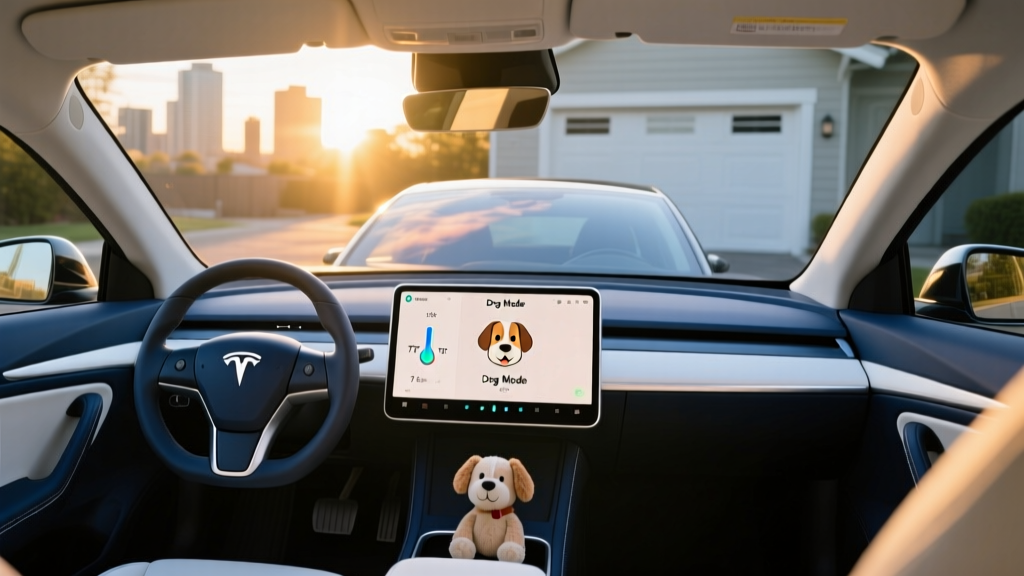
Dog Mode is a climate-control setting that keeps the cabin at a safe, preset temperature when you leave your vehicle unattended with a pet inside. When activated, the system maintains the selected temperature (default is usually 70°F / 21°C) and displays a prominent message on the center touchscreen visible from outside the car:
"My owner will be back soon. Don't worry! The A/C is on and the cabin temperature is XX°F / XX°C."
This message serves two critical purposes: it reassures passersby that the animal is safe, and it helps prevent well-meaning (but potentially destructive) Good Samaritan interventions like breaking a window.
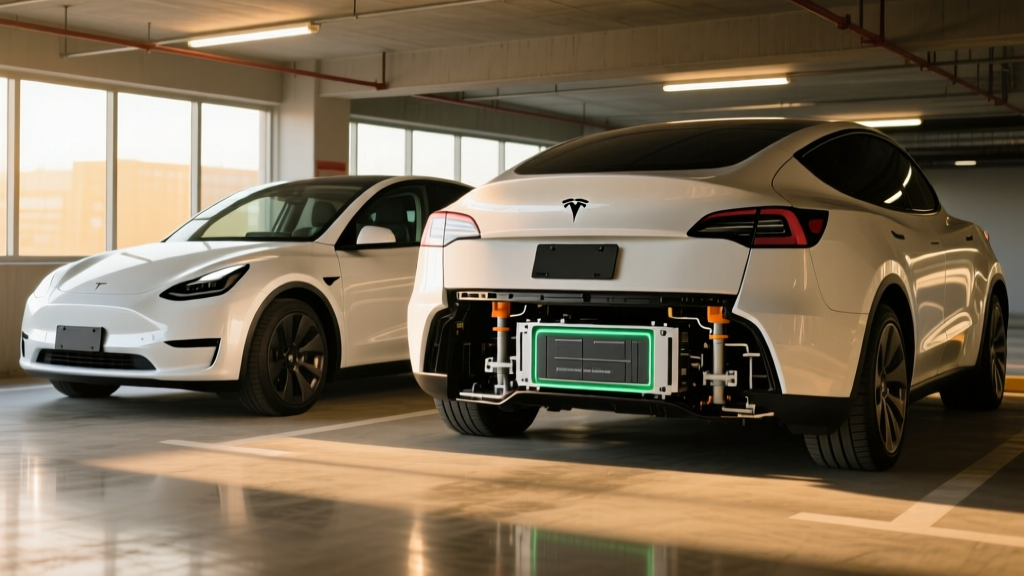
Under the hood, Dog Mode leverages Tesla's high-voltage traction battery to power the HVAC compressor and cabin fans. Unlike a gas-powered car that would need the engine idling to run air conditioning, an EV can sustain cabin cooling or heating for hours using battery energy alone — with no tailpipe emissions, no carbon monoxide risk, and no engine noise.
Activating Dog Mode: Step-by-Step
- Tap the fan icon at the bottom of the touchscreen to open climate controls.
- Select the "Dog" icon (alongside "Keep" and "Camp" modes).
- Set the desired cabin temperature using the +/- controls.
- Exit the vehicle. The system will confirm Dog Mode is active on the exterior display.
You can also monitor and adjust Dog Mode remotely via the Tesla mobile app, which shows real-time cabin temperature, lets you change the setpoint, and sends a notification if battery State of Charge (SoC) drops below 20%.
Battery Consumption: What Dog Mode Costs Your State of Charge
The most common concern among EV owners is how much range Dog Mode actually consumes. The answer depends on ambient temperature, cabin insulation, and whether you're cooling or heating.
Estimated Battery Drain in Dog Mode
| Condition | Estimated Energy Use | Range Loss per Hour |
|---|---|---|
| Mild weather (65–75°F), cooling | ~0.5–1.0 kWh/hr | ~2–4 miles |
| Hot weather (90°F+), heavy A/C | ~1.5–2.5 kWh/hr | ~5–8 miles |
| Cold weather (30°F), heating | ~2.0–4.0 kWh/hr | ~7–14 miles |
Note: Tesla models with a heat pump (Model Y, refreshed Model 3, Model S/X post-2021) use significantly less energy for heating than older resistive-heater models.
On a Model Y Long Range with its 75 kWh usable battery, you could theoretically sustain Dog Mode in mild weather for 30+ hours before fully depleting the battery. Tesla's software enforces a safety cutoff: Dog Mode will automatically deactivate if SoC falls to approximately 20%, preserving enough energy to reach a charger. You'll receive a push notification via the app before this happens.
Which Tesla Models Support Dog Mode in 2026?
Dog Mode is available on all current-production Tesla vehicles running software version 2024.38 or later. This includes:
Tesla Lineup: Dog Mode Compatibility & Key Specs for Pet Owners
| Model | EPA Range | Battery (usable kWh) | Cargo (rear seats up) | Heat Pump | Base MSRP |
|---|---|---|---|---|---|
| Model 3 Long Range AWD | 363 mi | ~75 kWh (NMC) | 23 cu ft | Yes | $47,740 |
| Model Y Long Range AWD | 320 mi | ~75 kWh (NMC) | 30 cu ft | Yes | $44,990 |
| Model S Long Range | 402 mi | ~95 kWh (NMC) | 28 cu ft | Yes | $79,990 |
| Model X Long Range | 335 mi | ~95 kWh (NMC) | 37 cu ft (5-seat) | Yes | $79,990 |
Sources: fueleconomy.gov, Tesla.com (2025–2026 model year). Prices before destination fee and before any applicable incentives.
Charging Specs: Getting Back on the Road Fast
If you've used significant battery running Dog Mode, you'll want to know how quickly each model recovers range. Tesla's Supercharger network remains the gold standard for DC fast charging reliability, with V4 stalls now delivering up to 350 kW at select locations.
Charging Speed Comparison (2025–2026 Models)
| Model | Peak DC Fast Charge | 10–80% Time | Level 2 (Home, 48A/11.5 kW) |
|---|---|---|---|
| Model 3 Long Range | 250 kW (V3 Supercharger) | ~25 min | ~44 mi/hr |
| Model Y Long Range | 250 kW (V3 Supercharger) | ~27 min | ~40 mi/hr |
| Model S Long Range | 250 kW (V3 Supercharger) | ~30 min | ~41 mi/hr |
| Model X Long Range | 250 kW (V3 Supercharger) | ~32 min | ~36 mi/hr |
Note: Peak kW is a maximum, not a sustained rate. Charging curves taper significantly above 80% SoC. Preconditioning the battery (navigating to a Supercharger via the onboard nav) is essential for achieving peak rates, especially in cold weather.
All current Tesla vehicles use the NACS (North American Charging Standard) connector natively. Tesla has opened the Supercharger network to non-Tesla EVs via a built-in CCS-to-NACS adapter at select locations, but Tesla owners plug in directly — no adapter needed.
Dog Mode vs. Keep Climate On vs. Camp Mode: What's the Difference?
Tesla actually offers three "stay-on" climate modes, and understanding the distinction matters:
- Dog Mode: Designed specifically for leaving pets unattended. Displays the safety message on the exterior screen. Locks the touchscreen to prevent pets from accidentally changing settings. Maintains temperature indefinitely (until 20% SoC cutoff).
- Keep Climate On: Maintains temperature but does not display the exterior message. Intended for brief stops (e.g., grabbing coffee). Deactivates after a timeout period.
- Camp Mode: Keeps climate running and maintains USB power and the touchscreen for media playback. Designed for sleeping in the vehicle. Does not display the pet-safety message.
For pet safety, Dog Mode is the correct choice — the exterior message is critical for preventing unnecessary concern or intervention.
Tax Credit Eligibility: Does a Tesla Qualify for the Federal EV Credit?
This is where it gets complicated for 2026 buyers. Under the Inflation Reduction Act's §30D Clean Vehicle Credit, eligibility hinges on battery component sourcing, critical mineral requirements, MSRP caps, and buyer income limits.
2026 Federal EV Tax Credit: Tesla Eligibility at a Glance
| Requirement | Model 3 / Model Y | Model S / Model X |
|---|---|---|
| MSRP Cap (SUVs: $80,000; Sedans: $55,000) | ✅ Qualifies (under cap) | ❌ Exceeds sedan cap |
| Buyer Income Cap (AGI: $150K single / $300K joint) | Applies | Applies |
| Battery Sourcing (§30D critical minerals + components) | Partial credit likely ($3,750) | N/A (over MSRP cap) |
| Point-of-Sale Transfer Available | Yes | N/A |
Source: IRS §30D guidelines. Battery sourcing rules tighten annually. Consult a tax professional for your specific situation. State and local incentives may apply separately — check AFDC for your area.
As of 2026, the Model 3 and Model Y are the Tesla vehicles most likely to qualify for at least a partial $3,750 federal credit (the half tied to critical-mineral sourcing), depending on the specific build date and battery pack origin. The Model S and Model X exceed the MSRP cap and do not qualify for the new-vehicle credit regardless of buyer income.
Performance, Safety, and the Pet-Owner Experience
Dog Mode doesn't change how a Tesla drives, but the broader vehicle platform matters if you're choosing a Tesla specifically as a pet-friendly EV. Here's how the lineup stacks up on performance and practicality:
| Spec | Model 3 LR AWD | Model Y LR AWD | Model X LR |
|---|---|---|---|
| 0–60 mph | 4.2 sec | 4.8 sec | 3.8 sec |
| Horsepower | ~384 hp | ~384 hp | ~670 hp |
| Drivetrain | Dual-motor AWD | Dual-motor AWD | Dual-motor AWD |
| MPGe (combined) | 132 MPGe | 122 MPGe | 109 MPGe |
| Efficiency | 25 kWh/100mi | 27 kWh/100mi | 31 kWh/100mi |
| Rear Legroom | 35.2 in | 41.6 in | 38.4 in |
| Battery Warranty | 8 yr / 120,000 mi | 8 yr / 120,000 mi | 8 yr / 150,000 mi |
For pet owners, the Model Y offers the best combination of cargo space (30 cu ft behind the second row, expanding to 76 cu ft with seats folded — enough for a large crate), elevated ride height for easy loading, and a heat pump that minimizes energy draw during Dog Mode in cold weather.
ADAS Note: Autopilot and FSD Are NOT Self-Driving
Tesla's Autopilot and Full Self-Driving (Supervised) are classified as SAE Level 2 driver-assistance systems. The driver must remain fully attentive, keep hands on the steering wheel, and be prepared to take over at any moment. These systems do not make the vehicle autonomous. Only Level 4 services like Waymo operate without a human driver.
✅ Pros for Pet Owners
- Dog Mode is the most visible, well-designed pet-safety climate feature in any EV
- Large battery packs sustain climate for many hours without range anxiety
- Heat pump (Model Y, refreshed Model 3, S/X) drastically reduces heating energy draw
- Mobile app monitoring gives real-time temperature and SoC visibility
- Spacious cargo areas (Model Y, X) accommodate crates and large breeds
- Supercharger network provides reliable road-trip charging for pet stops
- OTA updates continuously improve the feature
❌ Cons to Consider
- Extreme heat (110°F+) still stresses the HVAC system and drains battery faster
- No backup if the 12V auxiliary system faults (rare but possible)
- Model 3 cargo space is limited for large dog crates
- Model S/X pricing exceeds the federal tax credit MSRP cap
- Tesla's panel gaps and interior durability have improved but still draw criticism vs. legacy luxury brands
- No physical buttons — touchscreen-only climate controls frustrate some drivers
- Insurance premiums for Teslas tend to run higher than average
Who Should Buy a Tesla If Dog Mode Is a Priority?
Dog Mode is available across the entire Tesla lineup, so the right model depends on your broader needs:
- Best for daily commuting with a small-to-medium dog: Model 3 Long Range — lowest cost, best efficiency (132 MPGe), and Dog Mode handles quick grocery stops easily.
- Best for families with large dogs or crates: Model Y Long Range — 30 cu ft of cargo, heat pump for cold-weather efficiency, and the best shot at a partial federal tax credit.
- Best for road-tripping with pets: Model S Long Range — 402-mile EPA range means fewer charging stops, and the larger 95 kWh battery sustains Dog Mode longer on extended breaks.
- Best for maximum space and falcon-wing novelty: Model X — 37 cu ft of cargo (5-seat config), and the falcon-wing doors make loading large crates dramatically easier in tight parking spots.
Frequently Asked Questions
Is Dog Mode safe in extreme summer heat?
Dog Mode will maintain cabin temperature even in 100°F+ ambient heat, but the HVAC compressor works harder and battery drain increases to roughly 1.5–2.5 kWh per hour. Tesla's 20% SoC safety cutoff provides a backup, but you should never leave a pet unattended for extended periods in extreme heat regardless of technology. Plan your errands to minimize time away from the vehicle.
Can I check on my pet remotely while Dog Mode is active?
Yes. The Tesla mobile app shows the current cabin temperature and lets you adjust the setpoint. Some owners also use the vehicle's Sentry Mode cameras (if equipped and active) to visually check the cabin via the app's live camera feed, though this feature varies by model year and software version.
Does Dog Mode work if the car is parked in a garage?
Yes, but it's unnecessary in a climate-controlled garage. Dog Mode will still run the HVAC to maintain the set temperature. In an enclosed garage, there's no safety concern about exhaust (since there's no combustion engine), but you're using battery energy needlessly.
What happens if the battery runs out while Dog Mode is on?
Tesla's software prevents this scenario. Dog Mode automatically deactivates when the battery reaches approximately 20% SoC, and the app sends a push notification warning you well before that threshold. The vehicle will then enter a low-power sleep state. It is extremely unlikely — but not impossible — for the 12V auxiliary system to fault independently, which could interrupt cabin climate. This is rare and not specific to Dog Mode.
Does Dog Mode affect my Tesla's battery warranty?
No. Using Dog Mode is a normal, intended use of the vehicle's climate system and battery. Tesla's battery warranty covers 8 years / 120,000 miles (Model 3/Y) or 8 years / 150,000 miles (Model S/X) with a minimum 70% capacity retention threshold. Normal climate usage, including Dog Mode, does not void this warranty.
Do any non-Tesla EVs offer a similar feature?
A few competitors have introduced similar features. Hyundai/Kia offer a "Pet Mode" on the Ioniq 5 and EV9, and Ford's BlueCruise-equipped vehicles have cabin-monitoring features. However, Tesla's Dog Mode remains the most mature, widely deployed, and recognizable pet-safety climate feature in the EV market, largely because Tesla pioneered it and has iterated on it via OTA updates for over six years.
Always verify current pricing, tax credit eligibility, and feature availability on Tesla.com and IRS.gov before purchasing. Rules and specs change frequently. This article reflects 2025–2026 model-year data as of publication.