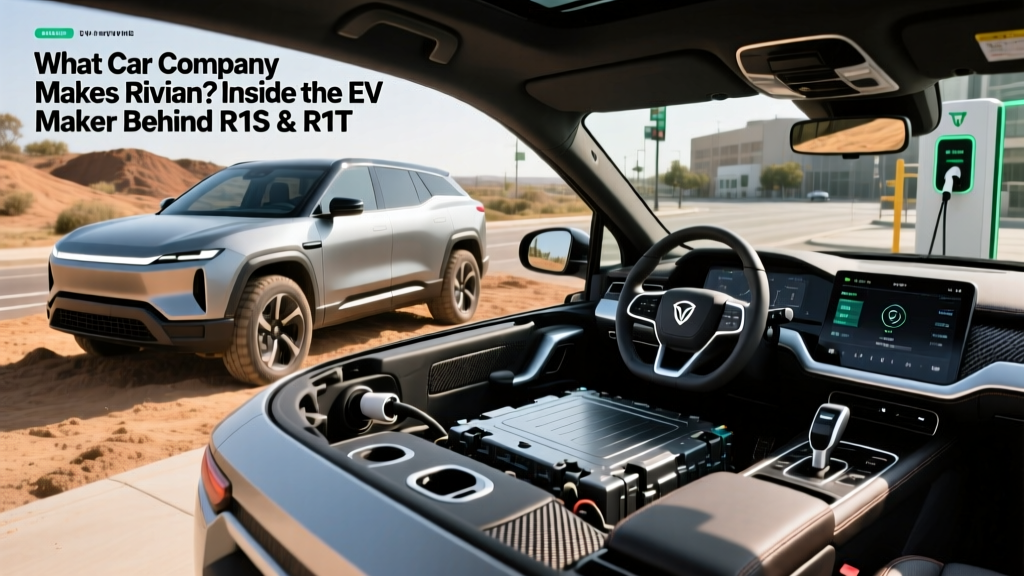
What Car Company Makes Rivian? The Short Answer
If you've been searching for "what car company makes Rivian," the answer surprises many shoppers: Rivian isn't made by a legacy automaker. Rivian Automotive, Inc. is an independent, publicly traded U.S. electric-vehicle company (NASDAQ: RIVN) headquartered in Irvine, California. It was founded in 2009 by MIT engineer RJ Scaringe and began customer deliveries of its R1T pickup and R1S SUV in late 2021 from its manufacturing plant in Normal, Illinois.
Rivian designs, engineers, and manufactures its own vehicles in-house — no parent company, no joint-venture badge sharing. Amazon holds a significant minority stake and uses Rivian's EDV delivery vans, but Amazon does not own or operate Rivian. Volkswagen Group has invested in Rivian's software joint venture, but VW does not build Rivian vehicles. For buyers, this means Rivian operates more like Tesla — a vertically integrated EV startup — than a sub-brand of Ford or GM.
Rivian's 2026 Lineup: R1S SUV and R1T Pickup at a Glance
Rivian currently sells two consumer vehicles, both built on a shared skateboard platform with dual-motor AWD as standard and a quad-motor option for maximum performance. Below are the core specifications for the 2026 model year.
| Spec | R1S (SUV) | R1T (Pickup) |
|---|---|---|
| Drivetrain | Dual-Motor AWD / Quad-Motor AWD | Dual-Motor AWD / Quad-Motor AWD |
| Battery (usable) | ~106 kWh (Standard) / ~141 kWh (Max Pack) | ~106 kWh (Standard) / ~141 kWh (Max Pack) |
| Chemistry | NMC (Nickel Manganese Cobalt) | NMC |
| EPA Range (Standard) | ~330 mi | ~352 mi |
| EPA Range (Max Pack) | ~410 mi | ~420 mi |
| 0-60 mph (Dual-Motor) | ~4.5 sec | ~4.5 sec |
| 0-60 mph (Quad-Motor) | ~3.0 sec | ~3.0 sec |
| Peak DC Fast Charge | 220 kW | 220 kW |
| 10-80% DC Charge | ~27 min | ~27 min |
| Level 2 Home Charge | 11.5 kW (~25 mi/hr) | 11.5 kW (~25 mi/hr) |
| Towing Capacity | 7,700 lb | 11,000 lb |
| Base MSRP (Dual-Motor) | $75,900 | $69,900 |
Sources: Rivian R1S specs, Rivian R1T specs, fueleconomy.gov.
Real-World Range: What the EPA Sticker Doesn't Tell You
EPA estimates for the R1S Max Pack sit around 410 miles, but plan for ~310-340 miles on sustained highway driving at 70+ mph, and 250-290 miles in freezing temperatures with cabin heat running. The Standard Pack (~330 mi EPA) realistically delivers 250-275 highway miles in moderate weather.
Rivian's NMC packs deliver strong energy density, but the R1S and R1T are heavy, boxy vehicles. Aerodynamic drag dominates at highway speed, which is why 75-mph range falls well below the EPA combined figure. Cold weather compounds the loss: NMC chemistry slows ion movement below freezing, and resistive cabin heating draws significant energy. Rivian's heat pump (standard on newer builds) mitigates this somewhat, but expect a 20-30% range reduction in sub-30°F conditions.
For daily commuting under 50 miles round-trip, even the Standard Pack provides a comfortable buffer. Road-trippers should plan charging stops around 200-250 miles apart in winter to maintain a safety margin.
Charging Speed: DC Fast, Level 2, and the NACS Shift
Rivian vehicles peak at 220 kW on DC fast chargers, with a 10-80% charge time of approximately 27 minutes on the Standard Pack. The Max Pack, due to its larger capacity, takes roughly 35-40 minutes for the same 10-80% session because the charge curve tapers more aggressively above 60% state of charge to protect the larger NMC pack.
| Charging Level | Power | Miles Added per Hour | Typical Use Case |
|---|---|---|---|
| Level 1 (120V) | ~1.4 kW | ~3-4 mi/hr | Emergency top-up only |
| Level 2 (240V, 48A) | 11.5 kW | ~25 mi/hr | Overnight home charging |
| DC Fast Charge | Up to 220 kW | ~550 mi/hr (peak) | Road trips, 10-80% in ~27 min |
Starting in 2024, Rivian adopted the NACS (Tesla) charging port on new vehicles and provided CCS-to-NACS adapters for earlier owners. As of 2026, Rivian drivers have access to Tesla's Supercharger network — over 25,000 stalls in North America — using a native NACS port or adapter. This dramatically improves road-trip charging reliability compared to Rivian's early CCS-only days.
At home, Rivian's Wall Connector (or any J1772/NACS Level 2 station) delivers 11.5 kW on a 60-amp circuit, adding roughly 25 miles of range per hour. A full overnight charge from 20% to 100% takes about 9-10 hours on the Standard Pack.
Pricing, Trims, and Federal Tax Credit Eligibility
Rivian's pricing places it firmly in the premium segment. The R1T starts at $69,900 for the Dual-Motor Standard Pack, while the R1S begins at $75,900. Quad-Motor and Max Pack configurations push prices well above $90,000.
| Model & Trim | MSRP | Federal §30D Credit Eligible? |
|---|---|---|
| R1T Dual-Motor Standard | $69,900 | Potentially — see rules below |
| R1T Dual-Motor Max Pack | $83,900 | No — exceeds $80,000 SUV/truck cap |
| R1T Quad-Motor | $87,900+ | No — exceeds MSRP cap |
| R1S Dual-Motor Standard | $75,900 | Potentially — see rules below |
| R1S Dual-Motor Max Pack | $89,900 | No — exceeds MSRP cap |
Federal tax credit rules (IRS §30D) are strict for 2026:
- MSRP cap: Vans, SUVs, and pickups must be under $80,000. Only the base Dual-Motor Standard Pack R1T ($69,900) and R1S ($75,900) qualify on price.
- Income cap: Buyer AGI must not exceed $150,000 (single), $225,000 (head of household), or $300,000 (joint).
- Battery sourcing: Critical minerals and battery components must meet phased-in domestic/free-trade sourcing thresholds. Rivian has worked to shift supply chains, but eligibility can change by build date.
- Point-of-sale transfer: Qualified buyers can apply the credit as an instant discount at delivery rather than waiting for tax filing.
Always verify current eligibility on IRS.gov and confirm your specific VIN with the dealer before purchase. Tax professionals can help determine whether your AGI and filing status qualify.
Performance, Tech, and Daily Livability
The Dual-Motor R1T and R1S produce approximately 533 horsepower and hit 0-60 mph in about 4.5 seconds — quick for vehicles weighing over 6,000 pounds. The Quad-Motor variants, with independent motors at each wheel, deliver over 1,000 horsepower and a 3.0-second 0-60 time, rivaling sports sedans.
Rivian's software-defined architecture enables over-the-air updates that have added features like improved regenerative braking profiles, updated navigation, and enhanced Driver+ (SAE Level 2) highway assist. Driver+ combines adaptive cruise and lane centering on divided highways, but the driver must remain attentive — this is not self-driving.
Interior highlights include:
- 15.6-inch central touchscreen with Rivian's custom OS
- 12.3-inch digital instrument cluster
- Available camp kitchen (R1T) with slide-out induction cooktop
- Gear Tunnel (R1T): 11.7 cu ft of lockable, pass-through storage behind the cab
- R1S cargo: 104.7 cu ft with second and third rows folded; 46.7 cu ft behind the third row
- Front trunk (frunk): 11.1 cu ft on R1T, 11.2 cu ft on R1S
- Ground clearance up to 14.9 inches with adjustable air suspension
Efficiency, Warranty, and Ownership Costs
EPA efficiency for the Dual-Motor R1T Standard Pack is approximately 73 MPGe combined, translating to about 46 kWh per 100 miles. The R1S is slightly less efficient due to its taller, boxier profile. These figures are typical for large, heavy electric trucks and SUVs — the Ford F-150 Lightning and GMC Hummer EV are in a similar range.
Rivian's warranty coverage:
- Battery & Drive System: 8 years / 175,000 miles (whichever comes first)
- Limited Vehicle Warranty: 5 years / 60,000 miles
- Corrosion Perforation: 12 years / unlimited miles
The 175,000-mile battery warranty is notably generous compared to the industry-standard 8-year/100,000-mile coverage from most competitors. Rivian guarantees the battery will retain at least 70% of its original capacity during the warranty period.
Rivian vs. Competitors: Is It Worth Buying?
Rivian's closest rivals depend on the model:
- R1T vs. Ford F-150 Lightning: The Lightning starts lower (~$55,000) and offers more traditional truck utility, but the R1T's quad-motor performance, Gear Tunnel, and off-road capability are unmatched.
- R1T vs. Tesla Cybertruck: The Cybertruck offers polarizing styling and stainless-steel construction, but Rivian's build quality, interior refinement, and Supercharger access (via NACS) make it a more polished daily driver as of 2026.
- R1S vs. Tesla Model X: The Model X has falcon-wing doors and more third-row space, but the R1S offers superior off-road capability and a more conventional, practical design.
- R1S vs. Jeep Grand Wagoneer EV (upcoming): Stellantis has announced an electric Grand Wagoneer, but it remains unreleased. Rivian has a multi-year head start in the electric three-row SUV segment.
Choose Rivian if: You need a premium electric truck or SUV with genuine off-road capability, you value unique features like the Gear Tunnel or camp kitchen, and you want Supercharger network access for road trips.
Look elsewhere if: You need the lowest possible price (F-150 Lightning), maximum towing range (Rivian's range drops sharply when towing 8,000+ lbs), or you prefer a dealership service network (Rivian uses mobile service and its own service centers).
Rivian R1T & R1S: Pros and Cons
- Class-leading off-road capability with 14.9" ground clearance and quad-motor torque vectoring
- Unique utility: Gear Tunnel, camp kitchen, front trunk
- NACS port provides Tesla Supercharger access
- Generous 8-year/175,000-mile battery warranty
- Over-the-air updates continuously add features
- High starting price; most trims exceed the $80,000 federal tax credit MSRP cap
- Towing range drops to ~150-180 miles with heavy loads
- Limited service center network; mobile service can't handle major repairs
- Third row in R1S is tight for adults on long trips
- Max Pack adds significant weight, reducing efficiency
Frequently Asked Questions
Is Rivian owned by Ford, GM, or another major automaker?
No. Rivian is an independent, publicly traded company (NASDAQ: RIVN). Ford invested $500 million early on but has since sold its stake. Amazon and Volkswagen have investments, but neither controls Rivian's manufacturing or product decisions.
What is the real-world range of a Rivian on a road trip?
Expect 250-275 highway miles from the Standard Pack and 310-340 from the Max Pack in moderate weather at 70-75 mph. Cold weather and towing reduce these figures by 20-40%.
Does Rivian qualify for the $7,500 federal EV tax credit?
Only the base Dual-Motor Standard Pack R1T ($69,900) and R1S ($75,900) fall under the $80,000 MSRP cap for trucks/SUVs. Buyer income limits and battery sourcing rules also apply. Verify on IRS.gov.
How fast does a Rivian charge at home?
On a 240V, 48-amp Level 2 home charger, Rivian vehicles charge at 11.5 kW, adding about 25 miles of range per hour. A full overnight charge takes 9-10 hours for the Standard Pack.
Can Rivian use Tesla Superchargers?
Yes. New Rivian vehicles built from 2024 onward have a native NACS port. Earlier models can use Tesla Superchargers with a Rivian-provided CCS-to-NACS adapter.
Where are Rivian vehicles built?
All Rivian consumer vehicles are manufactured at the company's plant in Normal, Illinois — a former Mitsubishi factory that Rivian retrofitted for EV production.