What warehouse.tesla Actually Means for EV Buyers
If you've searched warehouse.tesla, you're likely trying to track a Tesla delivery, check regional inventory, or understand how Tesla's decentralized fulfillment model works. Unlike traditional dealerships, Tesla doesn't operate franchised lots. Instead, the company uses a network of regional delivery hubs, service centers, and logistics warehouses to move vehicles from the factory to your driveway.
The term "warehouse.tesla" isn't an official Tesla portal or consumer-facing website. It's a shorthand some buyers use when searching for Tesla's internal logistics, delivery tracking, or inventory allocation systems. In practice, Tesla manages deliveries through your Tesla Account, where VIN assignment, delivery scheduling, and trade-in coordination happen.
This guide explains how Tesla's delivery infrastructure works in 2026, what to expect from regional warehouse operations, and how to navigate the process whether you're picking up a Model Y, Model 3, Cybertruck, or the refreshed Model S/X lineup.
How Tesla's Warehouse and Delivery Network Operates
Tesla's distribution model bypasses the dealer middleman entirely. Vehicles roll off the line at Gigafactory Texas (Austin), Gigafactory Nevada (powertrains), Gigafactory Shanghai (for non-US markets), and Gigafactory Berlin (Europe) and enter a logistics pipeline managed by Tesla's internal fleet operations.
Here's the typical journey:
- Factory to regional hub: Vehicles ship by rail or car-hauler to one of several dozen delivery centers across the US. Major hubs exist in California, Texas, Florida, New York, Illinois, and Washington.
- VIN assignment: Tesla assigns your VIN when the vehicle is allocated to a delivery center, usually 1-3 weeks before your scheduled pickup.
- Pre-delivery inspection (PDI): The local delivery center performs a PDI, detailing, and any software provisioning before your appointment.
- Delivery appointment: You arrive at the delivery center (or, in some metro areas, opt for at-home/mobile delivery) to complete paperwork, inspect the vehicle, and drive away.
There is no public-facing "warehouse.tesla" website to browse inventory the way you'd search a dealer lot. Tesla's online inventory page shows available new and used vehicles filtered by your region, and your Tesla Account surfaces your specific order once matched.
Tracking Your Tesla Order: From Factory to Warehouse to Driveway
Tesla's order tracking is notoriously opaque compared to legacy automakers. Here's what the stages in your Tesla Account actually mean in 2026:
| Order Status | What It Means | Typical Timeline |
|---|---|---|
| Order Placed | Your $250 order fee is received; configuration is locked | Day 0 |
| Order in Production Queue | Your build slot is scheduled based on region and config | 1-6 weeks (varies by model) |
| Vehicle Built / VIN Assigned | Your car is physically built and allocated to a delivery region | 1-3 weeks before delivery |
| In Transit | Vehicle is en route from factory to your regional delivery center | 3-14 days depending on distance |
| Ready for Delivery | PDI complete; scheduling opens in your Tesla Account | 1-7 days before appointment |
| Delivered | Paperwork signed, vehicle in your possession | Delivery day |
If your Tesla Account shows your vehicle has arrived at the local warehouse or delivery center, expect a delivery appointment notification within a few days. You can message your delivery advisor through the app to confirm timing.
What to Expect at a Tesla Delivery Center Pickup
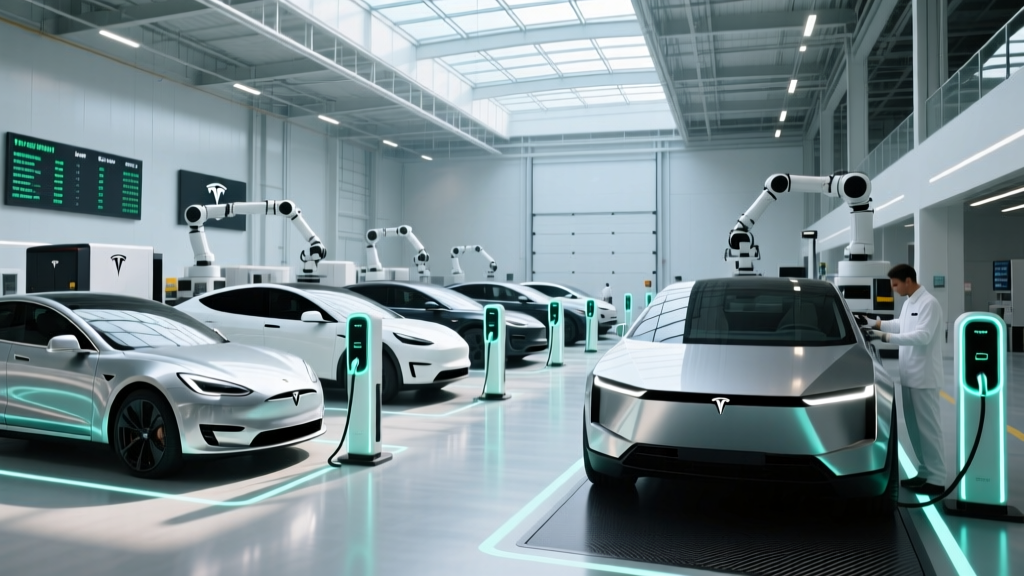
Tesla delivery centers are functional, not luxurious. Think industrial warehouse with a customer-facing reception area, not a marble-floored showroom. Here's what the process looks like:
- Arrive early: Plan for 60-90 minutes total. Bring your driver's license, insurance card (or proof of coverage binding as of delivery day), and payment method for any balance due.
- Document review: You'll sign the purchase agreement, odometer disclosure, and any financing or lease documents via Tesla's digital paperwork flow.
- Vehicle walkaround: A delivery specialist walks you to your car (often parked in a warehouse bay or outdoor lot). Inspect the paint, panel gaps, glass, interior, and wheels carefully. Tesla's QC has improved, but cosmetic defects still surface.
- Feature walkthrough: The specialist covers basics — charging port, key card/fob pairing, app setup, Autopilot activation. This is abbreviated compared to a traditional dealer delivery.
- Drive away: Once you accept the vehicle, it's yours. Any post-delivery cosmetic issues must be filed as service requests through the app.
Tesla Model Lineup: What's Available at Delivery Centers in 2026
Tesla's US consumer lineup has consolidated around a few core vehicles. Here's what you're most likely to encounter at a regional warehouse or delivery center:
| Model | EPA Range | 0-60 mph | Starting MSRP | §30D Credit Eligible? |
|---|---|---|---|---|
| Model 3 RWD | 363 mi | 5.8 sec | $38,990 | Yes (if sourcing/battery rules met) |
| Model 3 Long Range AWD | 341 mi | 4.2 sec | $45,990 | Yes (if sourcing/battery rules met) |
| Model Y Long Range AWD | 320 mi | 4.8 sec | $44,990 | Yes (if sourcing/battery rules met) |
| Model Y Performance | 285 mi | 3.5 sec | $49,990 | Yes (if sourcing/battery rules met) |
| Cybertruck AWD | 340 mi | 4.1 sec | $79,990 | No (MSRP over $80K SUV cap) |
| Model S Long Range | 402 mi | 3.1 sec | $79,990 | No (MSRP over $55K sedan cap) |
| Model X Long Range | 335 mi | 3.8 sec | $84,990 | No (MSRP over $80K SUV cap) |
The Model 3 and Model Y are the volume leaders and the most common vehicles flowing through Tesla's warehouse and delivery network. Both qualify for the federal §30D tax credit when battery sourcing and critical mineral requirements are satisfied — but eligibility hinges on the specific build date and supply chain status at time of delivery. Always verify current eligibility on IRS.gov before assuming the full $7,500 applies.
Federal Tax Credit Rules That Affect Warehouse Deliveries
The §30D new clean vehicle credit has specific requirements that Tesla buyers must understand before taking delivery:
- MSRP caps: Sedans (Model 3) must be under $55,000. SUVs, vans, and trucks (Model Y, Cybertruck) must be under $80,000.
- Buyer income limits: AGI must not exceed $150K single / $225K head of household / $300K joint filing.
- Battery sourcing: A percentage of critical minerals and battery components must be sourced from the US or FTA-partner countries. These thresholds increase annually.
- Point-of-sale transfer: You can transfer the credit to Tesla at delivery, reducing your out-of-pocket cost immediately rather than claiming it on your tax return.
The Model 3 RWD and Long Range, and the Model Y Long Range, typically fall within MSRP caps. Cybertruck, Model S, and Model X exceed the caps and do not qualify for the new-vehicle credit regardless of battery sourcing.
Tesla Charging Specs: What You Need Before Taking Delivery
Picking up your Tesla at a delivery warehouse is the easy part. Charging infrastructure is where real ownership begins. Here's what to know about the 2026 Tesla fleet's charging capabilities:
| Spec | Model 3/Y (2026) | Cybertruck | Model S/X |
|---|---|---|---|
| Battery Chemistry | LFP (RWD) / NMC (LR & Perf) | NMC | NMC |
| Battery Capacity (usable) | ~60 kWh (RWD) / ~75 kWh (LR) | ~123 kWh | ~95 kWh |
| Peak DC Fast Charge | 170 kW (RWD) / 250 kW (LR) | 350 kW (800V arch) | 250 kW |
| 10-80% DC Time | ~25 min (RWD) / ~22 min (LR) | ~15 min | ~28 min |
| Level 2 Home Charging | 11.5 kW (44 mi/hr) | 11.5 kW (37 mi/hr) | 11.5 kW (41 mi/hr) |
| Connector | NACS (native) | NACS (native) | NACS (native) |
Tesla vehicles use the NACS (North American Charging Standard) connector natively, which means direct access to the Supercharger network — over 25,000 stalls in North America as of early 2026. No adapter is required for Tesla's own network.
For home charging, Tesla's Wall Connector ($420 hardware) delivers up to 11.5 kW on a 60A circuit, adding roughly 37-44 miles of range per hour. Most owners need a 240V/48A+ circuit installed by a licensed electrician. Expect $500-$2,000 for installation depending on panel proximity and local permit requirements. A standard 120V outlet (Level 1) adds only 3-5 miles per hour — viable only for low-mileage commuters.
Common warehouse.tesla Questions Answered
Can I visit a Tesla warehouse to browse inventory in person?
No. Tesla's regional delivery centers and logistics warehouses are not open for walk-in browsing. You can view available inventory online at tesla.com/inventory and place an order for delivery to your nearest center.
How long does a Tesla sit at the warehouse before delivery?
Typically 3-10 days after arriving at the regional delivery center, assuming your financing, trade-in, and paperwork are in order. High-volume periods (quarter-end, especially March/June/September/December) can compress or extend this window.
Can I choose a specific delivery center for pickup?
Yes. During the order process, you select your preferred delivery location. Tesla allocates your vehicle to the nearest warehouse serving that center. You can change your delivery location before VIN assignment, but doing so after allocation may delay your timeline.
What if I find damage when picking up from the warehouse?
Document everything on the delivery paperwork before signing. Tesla's delivery specialists will note the issue, and you can file a service request through the app for repair — typically handled via mobile service or a service center appointment. Do not accept the vehicle with undocumented cosmetic damage.
Does Tesla offer at-home delivery instead of warehouse pickup?
In select metro areas, Tesla offers mobile delivery where a specialist brings the vehicle to your home or office. Availability depends on your ZIP code and is offered during the scheduling step in your Tesla Account.
Is Buying Through Tesla's Warehouse-Direct Model Worth It?
Advantages
- No dealer markup or negotiation — fixed MSRP pricing
- Transparent online ordering with no pressure tactics
- Direct access to Supercharger network with native NACS
- Over-the-air updates keep vehicles current post-delivery
- Point-of-sale tax credit transfer reduces upfront cost
Drawbacks
- Limited ability to test-drive your exact configuration before committing
- Quality control inconsistencies — panel gaps and paint issues still reported
- Post-delivery service relies on mobile service or limited service center capacity
- Delivery timelines can shift unexpectedly based on factory allocation
- No trade-in negotiation — Tesla's trade-in offers are often below private-party value
Tesla's warehouse-direct model works best for buyers who are comfortable ordering a vehicle sight-unseen (based on a generic test drive), value the Supercharger network, and want a streamlined purchase without dealership friction. If you prefer to inspect multiple examples, negotiate pricing, or have a local service relationship, a traditional dealer-backed EV from Hyundai, Ford, or BMW may suit you better.
Final Take: Navigating warehouse.tesla as a 2026 EV Buyer
There is no secret "warehouse.tesla" portal — Tesla's delivery infrastructure is managed through your Tesla Account and the company's internal logistics. What matters is understanding the pipeline: factory → regional warehouse/delivery center → your driveway. Armed with realistic timelines, inspection discipline at pickup, and clear knowledge of §30D credit eligibility, you can navigate Tesla's direct-delivery model confidently.
The Model 3 and Model Y remain the core of Tesla's volume and the most credit-eligible options. Cybertruck, Model S, and Model X serve niche use cases but fall outside federal credit caps. Regardless of which model you're tracking through the warehouse system, verify your VIN's credit status, install a Level 2 home charger before delivery day, and inspect your vehicle thoroughly before signing.