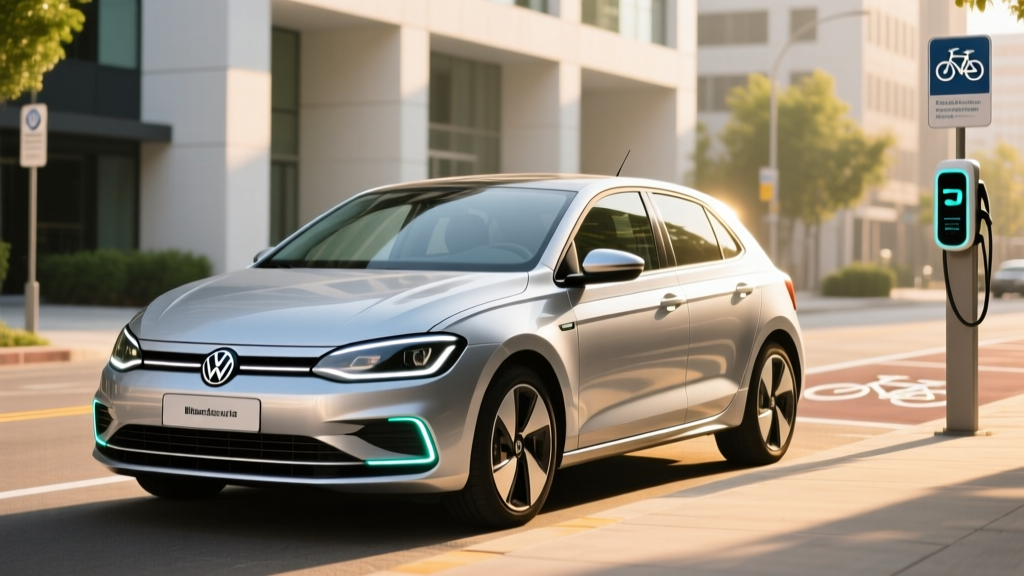
The short answer: The Volkswagen Polo Electric — officially branded the ID.Polo — is VW's upcoming battery-electric successor to the long-running gas Polo hatchback. As of early 2026, Volkswagen has confirmed the ID.Polo for European and global markets, built on the MEB Entry platform with an estimated up to 450 km (~280 miles) WLTP range and a starting price near €25,000 (~$27,000 USD). A US release remains unconfirmed and unlikely before 2027 at the earliest. If you're searching for a "polo electric" to buy today in North America, the closest available alternatives are the Chevrolet Bolt EV/EUV (discontinued after 2023 but returning for 2026), the Nissan Leaf, or the Mini Cooper SE.
What Is the VW Polo Electric (ID.Polo)?
The Volkswagen ID.Polo is a subcompact electric hatchback positioned below the ID.3 in VW's EV lineup. It rides on a shortened version of VW's MEB Entry architecture — a cost-optimized variant of the Modular Electric Drive Matrix platform that also underpins the ID.2all concept. The production ID.Polo was previewed at the 2024 Geneva Motor Show and is slated for European deliveries starting in 2026.
Volkswagen has confirmed several key specifications for the ID.Polo:
- Battery options: 37 kWh and 52 kWh usable capacity (LFP chemistry for the base pack, NMC for the larger option)
- Estimated range: Up to 450 km (~280 miles) on the WLTP cycle for the 52 kWh variant; the 37 kWh pack targets roughly 300 km (~186 miles) WLTP
- Motor output: Single front-mounted motor producing approximately 130 kW (~174 hp) in the standard tune, with a GTI-badged performance variant rumored at up to 165 kW (~221 hp)
- DC fast charging: Expected peak rate of 100-125 kW, enabling a 10-80% charge in approximately 25-30 minutes
- Level 2 AC charging: 11 kW onboard charger (3-phase, standard in Europe)
These figures are based on Volkswagen's preliminary announcements and concept-vehicle disclosures. Final production specs may differ at launch.
Polo Electric vs. Gas Polo: The Numbers
For buyers in markets where the gas Polo is still sold (primarily Europe, Latin America, and parts of Asia), the central question is whether the electric version justifies its higher upfront cost. Here's a side-by-side comparison using the most current available data:
| Specification | VW ID.Polo (Electric, Est.) | VW Polo 1.0 TSI (Gas) |
|---|---|---|
| Powertrain | BEV, front motor | 1.0L turbo 3-cyl |
| Horsepower | ~174 hp (130 kW) | 95-110 hp |
| 0-100 km/h (0-62 mph) | ~7.5 seconds (est.) | 10.4-11.2 seconds |
| Range / Tank | ~280 mi WLTP (52 kWh) | ~430 mi (40L tank, 45 mpg) |
| Energy/fuel cost per mile | ~$0.04-$0.06 (home charging) | ~$0.12-$0.15 (gasoline) |
| Estimated base price (EU) | ~€25,000 ($27,000) | ~€18,500 ($20,000) |
| Maintenance (annual avg.) | ~$200-$350 | ~$500-$800 |
| CO2 tailpipe emissions | 0 g/km | ~110-125 g/km |
The real-world math: At 12,000 miles per year, the gas Polo costs roughly $1,440-$1,800 in fuel annually. The ID.Polo charged primarily at home (at $0.14/kWh average) would cost approximately $480-$720 per year in electricity — a savings of $720-$1,080 annually. That $7,000 price premium pays itself back in roughly 6.5 to 9.5 years through fuel savings alone, before factoring in reduced maintenance (no oil changes, fewer brake replacements due to regenerative braking).
However, the gas Polo still wins on refueling speed and total range: a 5-minute fill-up delivers 430+ miles, while the ID.Polo requires a 25-30 minute DC fast charge to recover 80% of its ~280-mile range.
Charging the ID.Polo: Home, Public, and Reality
Charging is where EV ownership either clicks or breaks down. The ID.Polo's expected charging profile looks like this:
| Charging Level | Power (kW) | Miles Added per Hour | 10-80% Time | Typical Use Case |
|---|---|---|---|---|
| Level 1 (120V household) | ~1.4 kW | ~5-6 mi/hr | ~30+ hours | Emergency/overnight trickle |
| Level 2 (240V home/public) | 11 kW | ~40-45 mi/hr | ~4-5 hours | Daily home charging |
| DC Fast Charge | 100-125 kW peak | ~250-300 mi/hr (peak) | ~25-30 minutes | Road trips, quick top-ups |
Critical real-world caveat on charging speed: The 100-125 kW peak rate applies only between roughly 10-50% state of charge. Above 80%, the charge curve tapers significantly — expect the final 80-100% to take nearly as long as the 10-80% session. This is normal lithium-ion battery behavior, not a defect. For daily driving, charging to 80% at home on Level 2 is the recommended practice for long-term battery health.
Home charging access is the make-or-break factor. If you have a garage or driveway where a Level 2 (240V) charger can be installed, the ID.Polo becomes a "plug in at night, wake up full" proposition. Home installation typically costs $500-$2,000 depending on electrical panel proximity and local permit requirements. If you rely exclusively on public charging, the convenience equation deteriorates — public DC fast charging costs roughly $0.30-$0.48/kWh, nearly eliminating the fuel-cost advantage over gasoline.
Who Should Buy the Polo Electric — and Who Shouldn't?
Not every driver is a good candidate for a compact EV hatchback. Here's a practical decision framework based on real ownership patterns:
Choose the VW ID.Polo (or a similar compact EV) if:
- Your daily driving is under 80 miles round-trip (covers 90%+ of your trips without needing a mid-day charge)
- You have access to Level 2 home or workplace charging
- You primarily drive in urban or suburban environments where regenerative braking maximizes efficiency
- You want low running costs and minimal scheduled maintenance
- You're in a market where the ID.Polo is available (currently: Europe-first)
Look elsewhere (hybrid, PHEV, or gas) if:
- You regularly drive 200+ miles in a single day or live in a charging-desert region
- You have no access to home or workplace charging and must rely on public infrastructure
- You live in an extreme cold-weather climate — expect 25-40% range reduction in sustained sub-freezing temperatures due to battery heating demands and reduced chemical efficiency
- You need cargo space beyond what a subcompact hatchback offers (the ID.Polo's estimated cargo volume is ~13-14 cu ft behind the rear seats)
- You're in the US and need a vehicle available now — the ID.Polo is not confirmed for North America
Real Costs of Ownership: Beyond the Sticker Price
EV ownership economics involve more than just the purchase price and fuel savings. Here's a realistic 5-year cost breakdown comparing the ID.Polo (electric) to the gas Polo, assuming 12,000 miles/year, European pricing, and home charging:
| Cost Category (5 Years) | VW ID.Polo (Electric) | VW Polo 1.0 TSI (Gas) |
|---|---|---|
| Purchase price (base) | ~$27,000 | ~$20,000 |
| Fuel/energy (60,000 mi) | ~$3,000 (home charging) | ~$8,400 |
| Maintenance | ~$1,200 | ~$3,200 |
| Insurance (avg.) | ~$5,500 | ~$4,200 |
| Home charger install | ~$1,200 (one-time) | $0 |
| Estimated 5-yr total | ~$37,900 | ~$35,800 |
Key observations:
- The ID.Polo's higher purchase price is partially offset by dramatically lower fuel and maintenance costs over 5 years.
- EV insurance premiums typically run 15-25% higher than comparable gas vehicles, due to higher repair costs for battery and powertrain components.
- Battery replacement is a common concern, but VW's standard EV battery warranty covers 8 years / 160,000 km (~100,000 miles) with a guaranteed minimum 70% state of health. Real-world degradation data from VW's existing MEB vehicles (ID.3, ID.4) shows approximately 5-8% capacity loss over the first 100,000 miles — well within warranty thresholds.
- Resale value for compact EVs remains uncertain; early depreciation curves for the ID.3 suggest steeper drops than equivalent gas hatchbacks, though this may stabilize as the market matures.
Common Misconceptions About Compact EVs Like the Polo Electric
| Myth | Fact |
|---|---|
| "The battery will need replacing in a few years" | Modern LFP and NMC batteries are engineered for 1,500-3,000+ charge cycles. At 280 miles per cycle, that's 420,000-840,000 miles before reaching end-of-life (70% capacity). VW warranties the pack for 8 years/100,000 miles minimum. |
| "EVs are worse in cold weather" | Range drops 25-40% in sustained sub-freezing temps — this is real. But preconditioning (warming the battery while plugged in) recovers much of the loss. Heat pump-equipped EVs (expected on the ID.Polo) further mitigate cold-weather impact. |
| "Public charging is unreliable everywhere" | Reliability varies by network. Tesla Superchargers consistently report 99%+ uptime. Electrify America, IONITY, and other networks have improved but still experience 5-15% failure rates at some stations. Home charging eliminates this variable entirely for daily use. |
| "A small EV battery means constant range anxiety" | With 280 miles of WLTP range (~230-250 miles real-world highway), the ID.Polo covers the average driver's weekly commuting on a single charge. Range anxiety is primarily a road-trip concern, manageable with route planning and 25-minute DC fast stops. |
| "EVs aren't actually cleaner" | Lifecycle emissions depend on your electricity grid. On a grid with 40%+ renewables, an EV like the ID.Polo produces 50-70% fewer lifecycle CO2 emissions than an equivalent gas car over 150,000 miles (source: EPA). As grids decarbonize, the advantage grows. |
US Availability: Should American Buyers Wait?
Here's the hard truth for US-based shoppers: Volkswagen has not confirmed the ID.Polo for the American market. VW's US EV strategy currently centers on the ID.4 (assembled in Chattanooga, TN), the upcoming ID.7 sedan, and the ID.Buzz van. The subcompact hatchback segment is comparatively small in the US, and VW's American EV portfolio reflects that reality.
If you're a US buyer drawn to the Polo Electric concept — a small, affordable, efficient hatchback — here are the closest currently available or announced alternatives:
- Chevrolet Bolt EV/EUV (2026 return): GM has confirmed the Bolt's return on the Ultium platform with expected CCS/NACS charging and a sub-$30,000 price. EPA range for the previous generation was 259 miles; the 2026 model is expected to match or exceed that.
- Mini Cooper SE: Available now in the US with 114 miles EPA range (too low for many buyers) but a new-generation model with ~250 miles is expected for 2025-2026.
- Nissan Leaf: Still available with up to 212 miles EPA range (62 kWh pack), though it uses the aging CHAdeMO connector — a disadvantage as the industry consolidates around NACS.
- Hyundai Kona Electric: 261 miles EPA range, 100 kW DC fast charging, and a starting MSRP around $33,000 — arguably the strongest US-available compact EV hatchback today.
For US buyers, the federal §30D tax credit of up to $7,500 (subject to MSRP caps of $55,000 for sedans/hatchbacks, buyer income limits of $150,000 single / $300,000 joint, and battery critical-mineral sourcing requirements) can significantly reduce the effective price of these alternatives. The ID.Polo, if it ever reaches the US, would likely qualify given its price point — but that remains speculative.
Frequently Asked Questions
Is the VW Polo Electric available to buy right now?
No. The VW ID.Polo is confirmed for European markets with deliveries expected to begin in 2026. It is not currently on sale anywhere, and a US launch has not been announced. Volkswagen's official product timeline lists it as an upcoming model.
How does the ID.Polo's range compare to other small EVs?
The estimated 280 miles WLTP (~230-250 miles EPA equivalent) for the 52 kWh variant places it in the upper tier of subcompact EVs. For context: the Hyundai Kona Electric delivers 261 miles EPA, the previous-gen Chevy Bolt achieved 259 miles EPA, and the Mini Cooper SE managed only 114 miles EPA. The ID.Polo's LFP base pack option (~186 miles) trades range for lower cost and longer cycle life.
What battery chemistry does the ID.Polo use?
Volkswagen has indicated the base 37 kWh pack will use LFP (lithium iron phosphate) chemistry, which offers superior cycle life (3,000+ cycles), better thermal stability, and lower cost — at the expense of lower energy density and slightly reduced cold-weather performance. The larger 52 kWh pack is expected to use NMC (nickel manganese cobalt) for higher energy density. LFP batteries can also be safely charged to 100% regularly, unlike NMC packs where 80% daily charging is recommended for longevity.
Will the ID.Polo support NACS (Tesla Supercharger) connectors?
In Europe, the ID.Polo will use CCS2 (the European standard). For a hypothetical US launch, VW has committed to adopting the NACS connector across its North American EV lineup by 2025-2026, so a US-spec ID.Polo would likely feature NACS and Supercharger access. This remains unconfirmed pending an official US launch announcement.
How much will it cost to insure the Polo Electric?
Exact insurance premiums depend on driver profile, location, and insurer. Based on current compact EV data, expect premiums 15-25% higher than the gas Polo equivalent — roughly $1,100-$1,400/year vs. $900-$1,100/year for the gas model. The higher cost reflects EV-specific repair expenses (battery protection, specialized technician requirements) rather than higher accident risk.
Is a compact EV practical for a family?
For a single adult or couple with moderate cargo needs, a compact EV hatchback like the ID.Polo works well. For families with children, car seats, strollers, and grocery hauls, the limited rear-seat and cargo space (estimated ~13-14 cu ft) becomes restrictive. A compact crossover EV (ID.4, Kona Electric, Bolt EUV) offers substantially more utility at a modest price premium.