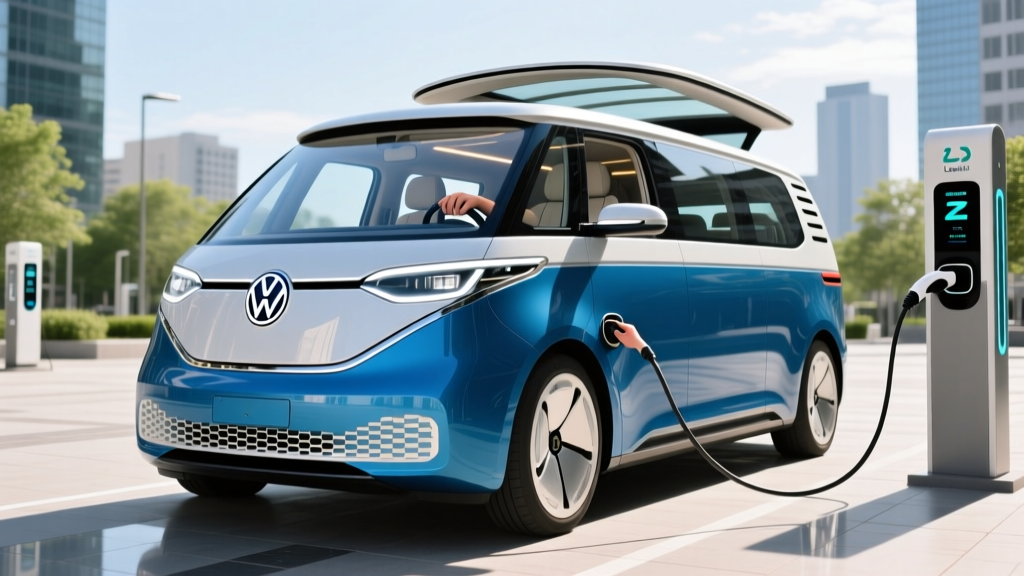
If you're searching for the Volkswagen EV Bus, you're looking at the Volkswagen ID. Buzz — VW's all-electric revival of its iconic Microbus, now a three-row, seven-passenger electric van. For the 2026 model year, the ID. Buzz pairs a 91 kWh (usable) NMC battery with rear-wheel or all-wheel drive, delivering an EPA-estimated 232 miles of range (RWD) or 231 miles (AWD 4MOTION). Pricing starts at approximately $59,995 for the Pro S trim, rising to around $69,995 for the fully loaded 1st Edition AWD. It qualifies for a partial federal tax credit depending on your income, filing status, and the vehicle's battery-sourcing compliance under IRS §30D rules — more on that below.
Quick Verdict: Is the VW ID. Buzz Right for You?
The ID. Buzz is best for families who want a distinctive, spacious electric people-mover with decent range and DC fast charging up to 186 kW. It is not the longest-range EV in its price class, and real-world highway or cold-weather range will drop to roughly 185–200 miles. If your daily driving stays under 150 miles and you can charge at home, it's a compelling alternative to a gas minivan. If you regularly road-trip 400+ miles or live in a charging desert, a plug-in hybrid minivan like the Chrysler Pacifica Hybrid may serve you better.
Range, Battery & Efficiency: What the EPA Number Doesn't Tell You
The ID. Buzz uses a 91 kWh usable battery pack (approximately 96 kWh gross) with NMC (nickel manganese cobalt) chemistry. Volkswagen rates the rear-wheel-drive Pro S at 232 miles EPA, while the AWD 4MOTION drops to 231 miles EPA. Efficiency lands around 87 MPGe combined for the RWD model, translating to roughly 38 kWh per 100 miles — a figure that reflects the van's boxy aerodynamics and 5,600+ lb curb weight.
Real-World Range Expectations
EPA Sticker: 232 miles (RWD) / 231 miles (AWD)
Highway driving (70–75 mph): Expect ~195–210 miles
Cold weather (below 32°F): Expect ~170–190 miles without preconditioning
Mixed suburban/city with regen: ~220–235 miles (regen recovers energy in stop-and-go)
The ID. Buzz's tall, flat-front profile creates significant aerodynamic drag at highway speeds. In our experience and consistent with third-party testing, plan on a 10–15% reduction from EPA on long highway trips, and up to 25% in sub-freezing conditions if you don't precondition the battery.
| Spec | Pro S (RWD) | Pro S AWD (4MOTION) |
|---|---|---|
| EPA Range | 232 miles | 231 miles |
| Battery (usable / gross) | 91 kWh / ~96 kWh (NMC) | 91 kWh / ~96 kWh (NMC) |
| Horsepower | 282 hp | 335 hp |
| 0–60 mph | ~7.9 sec | ~6.5 sec |
| Max DC Fast Charge | 186 kW | 186 kW |
| 10–80% DC Charge Time | ~26 min | ~26 min |
| Level 2 Charge Rate | 11 kW (AC) | 11 kW (AC) |
| MPGe (combined) | 87 MPGe | 85 MPGe |
| Towing Capacity | Not rated | Not rated |
| Starting MSRP | $59,995 | $64,995 |
| Battery Warranty | 8 yr / 100,000 mi (≥70% capacity) | 8 yr / 100,000 mi (≥70% capacity) |
Charging Speed & Infrastructure: What You'll Actually Experience
The ID. Buzz supports a peak DC fast-charge rate of 186 kW via its CCS1 connector (Volkswagen has not adopted NACS for the ID. Buzz as of the 2026 model year, though CCS-to-NACS adapters are widely available for Tesla Supercharger access). On a 350 kW Electrify America or comparable station, you'll see peak speeds near 175–186 kW up to roughly 40% state of charge, after which the charge curve tapers significantly. The 10–80% charge takes approximately 26 minutes under ideal battery-temperature conditions.
Key charging-curve reality: The ID. Buzz does not sustain peak kW for the full session. Average power from 10–80% is closer to 120–130 kW, which is typical for vehicles in this class but means you won't see 186 kW for more than a few minutes. Always precondition the battery by navigating to a DC fast charger in the vehicle's nav system — this warms the pack and enables faster charging, especially below 50°F.
| Level | Power | Miles Added Per Hour | Typical Use Case |
|---|---|---|---|
| Level 1 (120V outlet) | ~1.4 kW | ~3–4 mi/hr | Emergency / overnight trickle |
| Level 2 (240V home) | 11 kW (max) | ~28–30 mi/hr | Daily home charging (~8 hrs 10–100%) |
| DC Fast Charge | Up to 186 kW | ~250+ mi/hr (peak) | Road trips, 10–80% in ~26 min |
Home charging note: At 11 kW on Level 2, a full charge from 10% takes roughly 8 hours — fine for overnight charging. However, you'll need a 48-amp dedicated circuit (60-amp breaker) to get the full 11 kW. Many homes require a panel upgrade or new circuit installation. Budget $800–$2,500 for a professional Level 2 installation depending on your electrical panel's proximity to the garage and whether a 200-amp service upgrade is needed.
ID. Buzz vs. Gas Minivan: The Real Cost Comparison
The most common cross-shopping question is the ID. Buzz versus a conventional minivan like the Honda Odyssey or Toyota Sienna. Below is a 5-year ownership cost estimate assuming 12,000 miles/year, $3.50/gallon gas, and $0.14/kWh home electricity (national average).
| Cost Category | ID. Buzz Pro S (RWD) | Honda Odyssey EX-L |
|---|---|---|
| MSRP (approx.) | $59,995 | $42,110 |
| Est. Federal Tax Credit (§30D) | Up to $7,500* | $0 |
| Effective Purchase Price | ~$52,495 | $42,110 |
| Fuel/Energy (5 yr / 60k mi) | ~$3,150 (home charging) | ~$9,450 (22 MPG avg) |
| Maintenance (5 yr) | ~$1,200 | ~$3,800 |
| Insurance (5 yr est.) | ~$12,500 | ~$9,500 |
| Depreciation (est. 5 yr) | ~$22,000 | ~$16,000 |
| Total 5-Year Cost | ~$91,345 | ~$80,860 |
*Tax credit eligibility depends on buyer income caps ($150K single / $300K joint), battery critical-mineral and component sourcing requirements, and MSRP caps ($80K for vans/SUVs). Verify current-year eligibility at IRS.gov §30D or with a tax professional. Point-of-sale transfer is available if eligible.
The takeaway: The ID. Buzz saves roughly $6,300 on fuel and $2,600 on maintenance over 5 years, but the higher purchase price, insurance premiums, and steeper depreciation close the gap. The EV wins on operating cost; the gas minivan wins on upfront affordability and lower depreciation risk. If you drive more than 15,000 miles/year or have access to cheap/free workplace charging, the ID. Buzz's economics improve significantly.
Federal Tax Credit & Incentives: What You Can Actually Claim
The ID. Buzz falls under the van/SUV MSRP cap of $80,000 for §30D eligibility. Here's the current checklist for the federal clean vehicle credit:
- MSRP cap: Must be ≤ $80,000 (all ID. Buzz trims qualify)
- Buyer income cap: AGI ≤ $150,000 (single) / $225,000 (head of household) / $300,000 (joint)
- Battery sourcing: Must meet critical-mineral and battery-component requirements that tighten annually — the ID. Buzz's eligibility for the full $7,500 vs. a partial $3,750 depends on the current-year sourcing thresholds
- Assembly: Final assembly must be in North America (the ID. Buzz is assembled in Hannover, Germany — this may disqualify it from the §30D new-vehicle credit; verify at fueleconomy.gov)
- Point-of-sale transfer: If eligible, you can transfer the credit to the dealer at purchase for an immediate price reduction
Critical note: Because the ID. Buzz is built in Germany, it likely does not meet the North American final-assembly requirement for the §30D new-vehicle credit. This is a significant ownership-cost factor. Some buyers may qualify for a commercial vehicle credit (§45W) if the vehicle is leased rather than purchased, as the leasing entity (lessor) can claim the credit and pass savings through. Consult a tax professional and check IRS guidance before assuming credit eligibility.
Common Misconceptions About the VW EV Bus
| Myth | Fact |
|---|---|
| "It gets 232 miles no matter how you drive." | EPA is a lab estimate. Highway driving at 75 mph yields ~195–210 real miles; cold weather drops it further. |
| "It charges at 186 kW the whole time." | Peak rate is 186 kW but only briefly. Average 10–80% rate is ~120–130 kW; charging tapers sharply above 80%. |
| "It qualifies for the full $7,500 tax credit." | German assembly likely disqualifies it from §30D. Lease structures via §45W may offer savings — verify with your dealer and tax advisor. |
| "I don't need a home charger." | Public-only charging is possible but adds 3–5x the per-mile energy cost and significant time. A Level 2 home install is strongly recommended. |
| "It can tow a trailer." | Volkswagen has not rated the US-spec ID. Buzz for towing as of 2026. Do not assume trailer capability. |
Interior, Tech & Daily Usability
The ID. Buzz seats seven across three rows, with a flat floor enabled by the skateboard-style MEB platform. Cargo volume is approximately 18.6 cubic feet behind the third row, expanding to 75+ cubic feet with the second and third rows folded — competitive with the Chrysler Pacifica but slightly less than the Honda Odyssey's maximum.
Tech highlights include a 12.9-inch infotainment touchscreen, wireless Apple CarPlay and Android Auto, a digital instrument cluster, and available augmented-reality head-up display. Volkswagen's ID. Software 4.0 addresses many of the earlier-generation touch-capacitive steering wheel and slider complaints, with improved responsiveness and physical shortcut buttons.
Driver assistance: The ID. Buzz comes with VW's IQ.DRIVE suite, which includes adaptive cruise control, lane-keeping assist, and automatic emergency braking. This is an SAE Level 2 system — the driver must remain engaged with hands on the wheel and eyes on the road at all times. It is not autonomous or self-driving.
ADAS Limitation Notice
VW IQ.DRIVE is a Level 2 driver-assistance system. It does NOT drive the vehicle autonomously. You must monitor traffic, keep hands on the steering wheel, and be prepared to take over instantly. Performance degrades in heavy rain, construction zones, and faded lane markings.
Who Should Buy the ID. Buzz — and Who Shouldn't
Decision Framework: Is the VW ID. Buzz Your Best Option?
Choose the ID. Buzz if:
- You drive under 150 miles/day and can charge at home overnight
- You want a distinctive, retro-styled electric family hauler with three rows
- You value low operating costs and zero tailpipe emissions for school runs and local trips
- You live in a region with adequate DC fast-charging infrastructure for occasional road trips
Consider alternatives if:
- You regularly drive 300+ miles between charging stops (range and charge speed will frustrate you)
- You cannot install a Level 2 home charger (apartment/condo without EV infrastructure)
- You need to tow a trailer (not rated for towing in the US)
- You want to maximize the federal tax credit — a US-assembled EV like the Rivian R1S or Tesla Model X may qualify more cleanly
- Budget is tight — a Chrysler Pacifica Hybrid (32 electric-only miles, 30 MPG combined, ~$50K MSRP) offers plug-in flexibility at lower cost
Frequently Asked Questions
What is the real-world range of the Volkswagen EV Bus (ID. Buzz)?
The EPA rates the ID. Buzz RWD at 232 miles, but real-world highway driving typically yields 195–210 miles. In cold weather (below freezing), expect 170–190 miles without battery preconditioning. City driving with regenerative braking can match or slightly exceed the EPA number.
How long does it take to charge the ID. Buzz at home?
On a Level 2 (240V, 48-amp) home charger delivering 11 kW, charging from 10% to 100% takes approximately 8 hours — ideal for overnight charging. A standard 120V outlet (Level 1) adds only 3–4 miles per hour and is impractical for daily use with this vehicle's battery size.
Does the VW ID. Buzz qualify for the $7,500 federal tax credit?
Likely not for a direct purchase. The ID. Buzz is assembled in Germany, and the §30D credit requires North American final assembly. However, leasing the vehicle may allow the lessor to claim a commercial clean vehicle credit (§45W) and pass savings to you as a reduced lease payment. Verify current rules at IRS.gov and with your tax advisor.
How does the ID. Buzz compare to a Chrysler Pacifica Hybrid?
The Pacifica Hybrid offers 32 miles of electric-only range, then operates as a conventional hybrid at 30 MPG combined. It costs ~$10,000 less upfront, qualifies for no federal EV credit (it previously qualified but check current status), and has no range anxiety for road trips. The ID. Buzz offers zero-emissions driving and lower per-mile fuel costs but at a higher purchase price and with range planning required for longer trips.
Is the ID. Buzz good in cold weather?
The ID. Buzz uses a heat pump for cabin heating (standard on most trims), which helps preserve range compared to resistive heating. However, all EVs lose range in cold weather — expect a 15–25% reduction in sub-freezing temperatures. Preconditioning the battery while plugged in mitigates both range loss and slow cold-weather charging.
Can I use Tesla Superchargers with the ID. Buzz?
Yes, with a CCS-to-NACS adapter. As of 2026, Tesla has opened many Supercharger stalls to non-Tesla CCS-equipped vehicles via adapter. Volkswagen does not include a NACS adapter with the ID. Buzz, but third-party adapters (such as those from Lectron or A2Z) are widely available for $150–$250. Confirm stall compatibility via the Tesla app before relying on Superchargers for road trips.