Quick Verdict: The EV Sedan VW Should Have Launched Years Ago
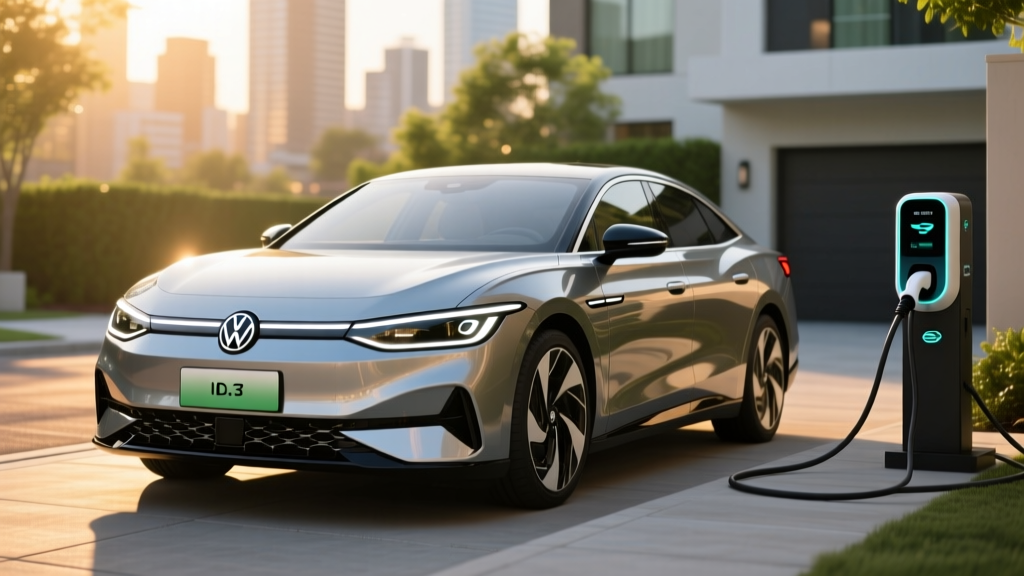
The 2026 Volkswagen ID.7 arrives as VW's flagship electric sedan on the MEB platform, directly targeting the Tesla Model 3, Hyundai Ioniq 6, and BMW i4. With an EPA-estimated range reaching 340 miles on the Pro S trim, a spacious fastback cabin, and VW's most refined EV software to date, the ID.7 is the automaker's most competitive electric offering yet. But is it enough to win over sedan shoppers in a market dominated by crossovers? We break down every spec that matters.
| Spec | ID.7 Pro | ID.7 Pro S | ID.7 GTX (AWD) |
|---|---|---|---|
| EPA Range | 310 mi | 340 mi | 290 mi |
| Battery (usable) | 77 kWh (NMC) | 86 kWh (NMC) | 86 kWh (NMC) |
| Horsepower | 282 hp | 282 hp | 335 hp |
| 0–60 mph | 6.5 sec | 6.3 sec | 5.4 sec |
| Drivetrain | RWD | RWD | AWD (dual-motor) |
| DC Fast Charge (peak) | 175 kW | 200 kW | 200 kW |
| 10–80% DC Time | ~28 min | ~26 min | ~26 min |
| Level 2 Rate | 11 kW (~37 mi/hr) | 11 kW (~37 mi/hr) | 11 kW (~37 mi/hr) |
| MPGe (combined) | 114 MPGe | 118 MPGe | 104 MPGe |
| Efficiency | 29 kWh/100 mi | 28 kWh/100 mi | 32 kWh/100 mi |
| Base MSRP | $51,495 | $55,995 | $60,495 |
Real-World Range: What the EPA Sticker Doesn't Tell You
The ID.7 Pro S posts a strong 340-mile EPA estimate thanks to its 86 kWh usable battery and slippery 0.23 Cd drag coefficient. The standard Pro trim with the smaller 77 kWh pack returns 310 miles, while the dual-motor GTX sacrifices range for traction at 290 miles. All trims use nickel-manganese-cobalt (NMC) lithium-ion cells, which offer higher energy density than LFP chemistry but require more careful state-of-charge management for long-term longevity.
- City / moderate climate: 320–340 mi (regen-heavy driving recovers energy)
- Highway (70–75 mph sustained): 275–295 mi (aerodynamic drag dominates at speed)
- Cold weather (below 32°F): 240–270 mi (cabin heating and battery resistance reduce efficiency 20–30%)
- Worst-case (highway + cold + headwind): ~220 mi
The ID.7's standard heat pump helps mitigate cold-weather losses compared to EVs without one, but plan for roughly 75% of the EPA sticker on winter road trips.
For daily commuting and mixed driving, most owners will see 300–320 miles on a full charge in the Pro S. That's genuinely competitive — it edges past the Hyundai Ioniq 6 SEL (305 mi EPA) and matches the Tesla Model 3 Long Range AWD (341 mi EPA). According to fueleconomy.gov, the ID.7 Pro S returns 118 MPGe combined, translating to roughly 28 kWh per 100 miles — respectable for a 4,800-pound sedan.
Charging Speed: DC Fast Charging and Home Level 2
Charging speed is where the ID.7's MEB platform shows its age relative to 800-volt rivals. The Hyundai Ioniq 6 can accept 240+ kW on a 350 kW charger and hit 10–80% in about 18 minutes. The ID.7 peaks at 200 kW on the Pro S and GTX, which is adequate but not class-leading.
| Charging Level | Power / Rate | Time / Mileage Added | Notes |
|---|---|---|---|
| Level 1 (120V household) | ~1.4 kW | ~4 mi/hr | Emergency/top-up only; full charge takes 60+ hours |
| Level 2 (240V home, 48A) | 11 kW | ~37 mi/hr; full charge ~8–9 hr | Requires NACS connector (2026 model year); overnight standard |
| DC Fast (Pro S/GTX peak) | 200 kW | 10–80% in ~26 min | Sustains ~175 kW to 40% SoC, then tapers; 80–100% adds ~18 min |
| DC Fast (Pro peak) | 175 kW | 10–80% in ~28 min | Slightly smaller pack charges marginally slower |
Charging curve reality check: The ID.7 holds its peak 200 kW rate only briefly — typically between 10% and 25% state of charge. From 25–60%, expect sustained rates of 140–165 kW. Above 80%, the curve drops sharply to protect the NMC cells, falling below 50 kW. This is standard behavior for MEB-based EVs, but it means a 10–90% session takes roughly 40 minutes, not the 26 minutes VW advertises for 10–80%.
For the 2026 model year, the ID.7 ships with a native NACS (North American Charging Standard) port, granting access to Tesla Superchargers via VW's partnership without an adapter. It also remains compatible with CCS1 stations through a NACS-to-CCS adapter — useful on Electrify America, EVgo, and ChargePoint networks. VW recommends preconditioning the battery via the navigation system before DC fast charging; this warms the cells to optimal temperature and can shave 3–5 minutes off your session.
Performance and Drivetrain
The ID.7 isn't a sports sedan, and VW doesn't pretend otherwise. The rear-wheel-drive Pro and Pro S use a single APP550 motor producing 282 horsepower and 339 lb-ft of torque. The 0–60 mph time of 6.3–6.5 seconds is adequate for merging and passing but won't thrill anyone cross-shopping a Tesla Model 3 Performance (3.1 seconds).
The GTX trim adds a front motor for dual-motor all-wheel drive, bumping output to 335 hp and dropping the sprint to 5.4 seconds. It also gains a sport-tuned suspension and more aggressive steering calibration. All trims feature a low center of gravity from the floor-mounted battery, and the ID.7's 17.4-foot length with rear-wheel steering (optional on Pro S, standard on GTX) gives it a surprisingly tight 32.1-foot turning circle — helpful for city parking.
Regenerative braking offers three levels selectable via steering-wheel paddles, plus a "B" mode for stronger one-pedal-style driving. However, the ID.7 does not come to a complete stop in B mode like some competitors — you'll still need the brake pedal at very low speeds. The adaptive cruise control integrates regen intelligently, pre-emptively slowing the car when it detects a lead vehicle decelerating.
Interior Space, Cargo, and Technology
The ID.7's fastback silhouette hides a genuinely roomy cabin. Rear-seat legroom measures 39.1 inches — more than the Model 3 (35.3 in) and nearly matching the Mercedes EQE. The trunk offers 18.8 cubic feet behind the rear seats, expanding to 52.4 cu ft with the 60/40 split folded. There's no frunk; the space under the hood houses HVAC components and the 12V auxiliary battery.
The 15-inch touchscreen runs VW's ID. Software 4.0, which is a substantial improvement over the laggy, glitch-prone ID.3/ID.4 early software. Wireless Apple CarPlay and Android Auto are standard. The available augmented-reality head-up display overlays navigation arrows onto the road ahead, and the Travel Assist system (VW's Level 2 driver-assistance suite) handles lane centering and adaptive cruise competently on highways.
Notable tech drawbacks: the touch-sensitive steering wheel controls remain fiddly compared to physical buttons, and the climate control slider is positioned low on the center stack where it's hard to reach while driving. The driver display is a compact 5.3-inch screen rather than a full digital cluster — some buyers will find this too small, though the head-up display compensates.
Pricing, Trims, and Federal Tax Credit Eligibility
The 2026 ID.7 starts at $51,495 for the Pro trim (including destination). The Pro S, which most buyers will prefer for its 340-mile range and added features, is $55,995. The GTX AWD tops the lineup at $60,495. Fully loaded Pro S models with the optional AR head-up display, panoramic roof, and 20-inch wheels approach $62,000.
| Trim | Base MSRP | As-Tested (typical) | Est. After §30D Credit |
|---|---|---|---|
| Pro | $51,495 | $53,500 | ~$44,000–$51,495* |
| Pro S | $55,995 | $60,200 | ~$48,495–$55,995* |
| GTX AWD | $60,495 | $65,800 | ~$52,995–$60,495* |
*Credit amount depends on battery-sourcing compliance, buyer income, and point-of-sale transfer election. See eligibility checklist below.
- MSRP cap: Sedans must be under $55,000. The ID.7 Pro qualifies at $51,495; the Pro S at $55,995 exceeds the cap unless reclassified. The GTX at $60,495 does not qualify.
- Buyer income cap: AGI must not exceed $150,000 (single), $225,000 (head of household), or $300,000 (married filing jointly).
- Battery sourcing: A percentage of critical minerals and battery components must be sourced from the U.S. or FTA partners. VW has confirmed partial compliance for the ID.7 Pro; full $7,500 credit availability depends on the specific build date and battery lot. Check the VIN on fueleconomy.gov before purchasing.
- Point-of-sale transfer: Eligible buyers can transfer the credit to the dealer for an immediate price reduction rather than waiting to claim it on their tax return.
Always verify eligibility with a tax professional and the IRS clean vehicle credit page before finalizing a purchase.
Warranty and Long-Term Ownership
VW covers the ID.7's battery and powertrain for 8 years or 100,000 miles, whichever comes first. The battery warranty guarantees a minimum 70% state-of-health (capacity retention) over that period. If the pack degrades below 70% within the warranty window, VW will repair or replace modules to restore it above that threshold. The limited vehicle warranty is 4 years / 50,000 miles, with 2 years of complimentary scheduled maintenance.
NMC battery chemistry in the ID.7 is expected to lose roughly 8–12% capacity over the first 100,000 miles based on degradation data from the ID.4 (which shares the MEB platform). Owners who regularly DC fast-charge and frequently charge to 100% may see faster degradation; VW recommends setting a daily charge limit of 80% and using DC fast charging only for road trips. For buyers prioritizing maximum battery longevity, it's worth noting that LFP-based competitors (like the base Tesla Model 3) tolerate daily 100% charges better, though they sacrifice some energy density and cold-weather performance.
Pros, Cons, and Who Should Buy the ID.7
- Class-leading rear-seat legroom (39.1 in) and generous trunk space
- 340-mile EPA range on Pro S — top-tier for electric sedans
- Native NACS port with Tesla Supercharger access
- Standard heat pump for cold-weather efficiency
- Refined ride quality and low cabin noise
- Improved ID. Software 4.0 infotainment
- DC fast-charge speed (200 kW peak) trails 800V competitors
- Pro S and GTX trims may not qualify for full §30D credit due to MSRP cap
- Touch-sensitive steering controls and low-mounted climate slider
- No front trunk (frunk)
- Rear visibility limited by fastback roofline
- Driver display is small at 5.3 inches
- You need a spacious electric sedan with strong highway range and a comfortable ride
- Rear-seat passenger room is a priority (family, rideshare, tall passengers)
- You value access to Tesla Superchargers via native NACS
- You mostly charge at home overnight and take road trips 2–4 times per year
- Fastest possible DC charging is critical (consider Hyundai Ioniq 6 with 800V architecture)
- You want performance-sedan acceleration (Tesla Model 3 Performance or BMW i4 M50)
- You need the full $7,500 tax credit and your target trim exceeds the $55,000 MSRP cap
Frequently Asked Questions
What is the real-world range of the 2026 VW ID.7?
The ID.7 Pro S carries a 340-mile EPA estimate. In real-world mixed driving, expect 300–320 miles. Sustained highway driving at 70–75 mph drops this to roughly 275–295 miles, and cold weather (below 32°F) can reduce range to 240–270 miles. The standard Pro trim with the 77 kWh battery delivers 310 miles EPA, translating to approximately 275–290 miles in mixed real-world use.
How fast does the ID.7 charge at home and on the road?
On a Level 2 home charger (240V, 48 amps), the ID.7 charges at 11 kW, adding about 37 miles of range per hour — a full charge takes 8–9 hours overnight. On a DC fast charger, the Pro S and GTX peak at 200 kW and reach 10–80% in approximately 26 minutes. The Pro peaks at 175 kW with a 10–80% time of about 28 minutes. Charging above 80% slows significantly to protect battery health.
Does the VW ID.7 qualify for the federal EV tax credit?
It depends on the trim and your income. The ID.7 Pro at $51,495 falls under the IRS $55,000 sedan MSRP cap and may qualify for up to $7,500 if battery critical-mineral and component sourcing requirements are met and your AGI is within limits. The Pro S ($55,995) and GTX ($60,495) exceed the sedan MSRP cap and likely do not qualify for the federal credit. Always verify your specific VIN on fueleconomy.gov and consult a tax professional.
Is the VW ID.7 worth buying vs. the Tesla Model 3 or Hyundai Ioniq 6?
The ID.7 wins on rear-seat space and ride comfort, making it ideal for families and those who prioritize cabin room. The Tesla Model 3 Long Range offers similar range (341 mi EPA) with faster Supercharger network access, a more mature software ecosystem, and better performance. The Hyundai Ioniq 6 charges significantly faster thanks to its 800V architecture (10–80% in ~18 min) but has a tighter rear seat. If back-seat room and comfort matter most, the ID.7 is the strongest pick. If charging speed or performance is paramount, look at the Ioniq 6 or Model 3 respectively.
What are the biggest drawbacks of the ID.7?
The primary limitations are its 200 kW peak DC charging speed (behind 800V competitors), the lack of a frunk, touch-sensitive controls that frustrate some drivers, and MSRP pricing that pushes higher trims above the federal tax credit cap. The 5.3-inch driver display also feels undersized compared to competitors with full digital clusters.
How long will the ID.7's battery last?
VW warranties the battery for 8 years or 100,000 miles with a 70% capacity-retention guarantee. Based on MEB platform data from the ID.4, expect approximately 8–12% degradation over 100,000 miles with normal use. Minimizing DC fast charging, avoiding regular 100% charges, and preconditioning the battery in cold weather will help maximize long-term battery health.