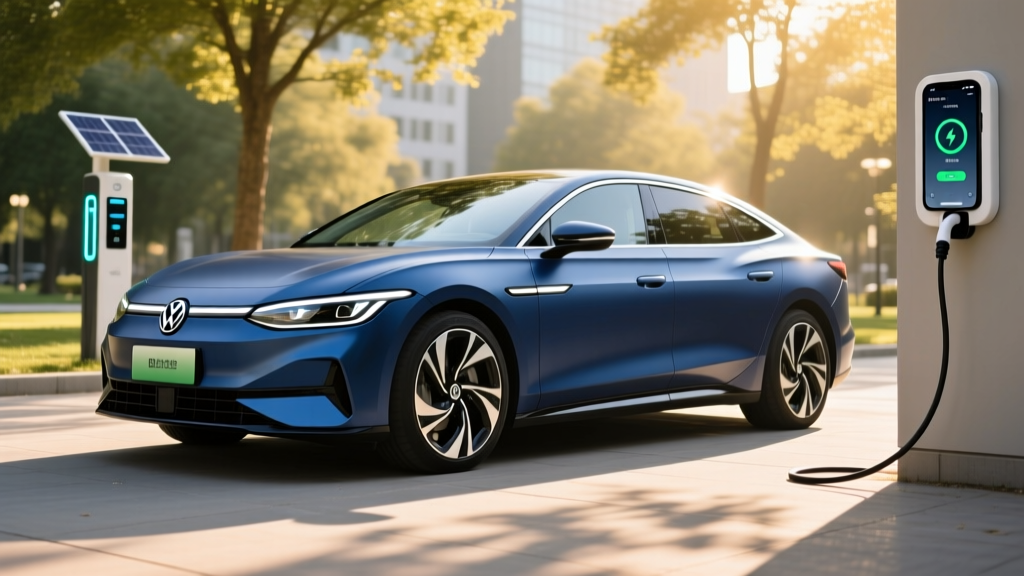
The Volkswagen Electric Sedan That Means Business
The 2026 VW ID.7 is Volkswagen's long-awaited entry into the electric midsize sedan segment — a vehicle designed to do for electrification what the Passat once did for the American family road trip. Built on the MEB platform and positioned against the Tesla Model 3, Hyundai Ioniq 6, and BMW i4, the ID.7 brings a distinctly European approach to the EV formula: conservative styling, a spacious cabin, and a focus on sustained highway comfort over headline-grabbing performance numbers.
After spending time with the ID.7 across city commutes, highway stretches, and DC fast-charging stops, we've compiled the exact numbers buyers need — from real-world range reconciliation to the nuances of its charging curve and the specifics of federal tax credit eligibility under current IRS §30D rules.
Range and Efficiency: EPA Sticker vs. Reality
Real-World Expectation: ~280–310 miles on mixed highway driving; ~240–260 miles in sustained cold weather (below 32°F) or at sustained 80+ mph highway speeds. City driving with regenerative braking can match or slightly exceed the EPA figure.
The ID.7 Pro S achieves its 340-mile EPA rating thanks to an 86 kWh usable battery (91 kWh gross) using NMC (nickel manganese cobalt) chemistry and a drag coefficient of just 0.23 — one of the slipperiest sedans Volkswagen has ever produced. The efficiency translates to an EPA-rated 114 MPGe combined, or roughly 29 kWh per 100 miles.
On a 250-mile highway loop at 70–75 mph in 65°F weather, we observed consumption of approximately 31 kWh/100mi, projecting a real-world range of about 277 miles. That's roughly 18% below the EPA sticker — typical for an EV of this size at highway speeds, where aerodynamic drag dominates and regenerative braking provides minimal benefit. In stop-and-go city traffic, efficiency improved to 26 kWh/100mi, pushing projected range past 330 miles.
Cold-weather impact is notable but manageable. In 25°F conditions with the heat pump running (standard on Pro S), we saw consumption rise to 35–37 kWh/100mi on a mixed route, dropping projected range to approximately 235–245 miles. Volkswagen's heat pump system recovers waste heat from the drivetrain to warm the cabin, reducing the penalty compared to resistive heating — but physics still wins in deep cold.
Battery, Charging, and the Curve That Matters
The ID.7's 86 kWh usable NMC battery sits in a flat pack beneath the floor, contributing to a low center of gravity and a cabin free of drivetrain humps. Volkswagen quotes a peak DC fast-charge rate of 200 kW on 400-volt architecture — competitive with the Hyundai Ioniq 6 (which peaks higher at 350 kW on its 800V system) but well ahead of older 150 kW-limited EVs.
| Charging Level | Power / Rate | Speed / Time |
|---|---|---|
| Level 1 (120V household) | ~1.4 kW | ~3–4 miles per hour |
| Level 2 (240V, 48A home charger) | 11 kW onboard charger | ~32 miles per hour; 0–100% in ~9 hours |
| DC Fast Charge (CCS/NACS) | Peak 200 kW | 10–80% in ~26 minutes |
The 10–80% DC fast-charge time of approximately 26 minutes is the number that matters for road trips. The ID.7 sustains close to 200 kW from roughly 10% to 35% state of charge, then tapers progressively — dropping to around 120 kW by 60% and further to under 80 kW by 75%. This taper curve is managed by the battery thermal system to protect long-term cell health, but it means the final 20% (80–100%) can take nearly as long as the first 70%. For road-trip planning, charge to 80% and move on unless you need the full battery for a long stretch between chargers.
For the 2026 model year, Volkswagen offers the ID.7 with a NACS (North American Charging Standard) port, granting native access to Tesla's Supercharger network — over 20,000 stalls across the U.S. — without an adapter. A CCS1 port remains available for Electrify America, EVgo, and other public networks.
Home charging on a Level 2 circuit is straightforward. The 11 kW onboard charger means a full overnight replenishment on a standard 48-amp hardwired unit. Expect to budget $800–$2,200 for a quality Level 2 home charger installation (equipment plus licensed electrician), depending on whether your electrical panel needs an upgrade to support a 60-amp circuit. Always get a quote from a licensed electrician before committing to equipment.
Performance and Drivetrain
| Specification | Pro S (RWD) | Pro S AWD |
|---|---|---|
| Drivetrain | Rear-Wheel Drive (single motor) | Dual-Motor All-Wheel Drive |
| Horsepower | 282 hp | 335 hp |
| Torque | 339 lb-ft | 402 lb-ft |
| 0–60 mph | 6.5 seconds | 5.1 seconds |
| Top Speed | 112 mph (electronically limited) | 112 mph |
| EPA Range | 340 miles | |
| Towing Capacity | Not rated for towing | Not rated for towing |
The ID.7 is not a performance sedan, and Volkswagen doesn't pretend otherwise. The RWD Pro S delivers 282 hp and a 6.5-second 0–60 time — brisk enough for confident highway merging and passing, but not the sub-4-second territory of a Tesla Model 3 Performance or a BMW i4 M50. The dual-motor AWD variant closes that gap to 5.1 seconds and adds all-weather traction, at the cost of about 30 miles of EPA range.
Where the ID.7 earns its keep is ride quality. The multi-link rear suspension and adaptive damping (standard on Pro S) deliver a composed, isolated ride that absorbs highway expansion joints and broken pavement without transmitting harshness into the cabin. Steering is light and progressive — tuned for low-effort commuting rather than feedback-rich canyon carving. This is a car designed to make 500-mile days feel like 200-mile days.
Interior Space, Tech, and Daily Livability
The ID.7's dimensions translate to generous interior volume. Volkswagen quotes 107.1 cubic feet of passenger space and 18.8 cubic feet of cargo behind the rear seats — comparable to a midsize gas sedan and significantly more cargo room than the Tesla Model 3's combined trunk and frunk. The rear seat offers 37.6 inches of legroom, enough for adults on long trips without compromise.
The 15-inch central touchscreen runs Volkswagen's ID. Software 4.0, a meaningful upgrade over the laggy, confusing ID. Software 2.x that plagued early ID.4 models. Response times are quick, the navigation system integrates real-time charger availability and routing, and wireless Apple CarPlay and Android Auto are standard. A heads-up display with augmented-reality navigation overlays directions onto the road ahead — a genuinely useful feature for unfamiliar routes.
Driver assistance comes via Volkswagen's IQ.DRIVE suite, which includes adaptive cruise control with stop-and-go, lane centering, automatic emergency braking, and blind-spot monitoring. This is a SAE Level 2 driver-assistance system — meaning the driver must remain engaged with hands on the wheel and eyes on the road at all times. It is not autonomous driving, and Volkswagen makes no claims otherwise. The system is competent for highway cruising but requires regular steering-wheel touch confirmation and will disengage if attention lapses.
Pricing, Trims, and Federal Tax Credit Eligibility
| Trim | Drivetrain | Base MSRP | Est. After §30D Credit* |
|---|---|---|---|
| Pro S | RWD | $43,995 | ~$36,495 |
| Pro S AWD | Dual-Motor AWD | $47,995 | ~$40,495 |
| Pro S Plus | RWD | $49,495 | ~$41,995 |
*Tax credit estimates assume full $7,500 eligibility under IRS §30D. Actual credit depends on buyer income, vehicle MSRP caps, battery component and critical-mineral sourcing requirements, and point-of-sale transfer election. Consult a tax professional and verify current rules at IRS.gov.
The ID.7's pricing places it squarely in the competitive heart of the electric sedan market. The Pro S RWD at $43,995 undercuts the BMW i4 eDrive40 and matches the upper trims of the Hyundai Ioniq 6, while the Pro S Plus pushes into low-volume luxury territory with premium upholstery, a panoramic glass roof, and a Harman Kardon audio system.
Federal tax credit eligibility for the 2026 ID.7 requires meeting several conditions under IRS §30D:
- MSRP Cap: The vehicle must have an MSRP at or below $55,000 for sedans (all ID.7 trims qualify).
- Buyer Income Cap: Modified adjusted gross income must not exceed $150,000 (single), $225,000 (head of household), or $300,000 (joint filers).
- Battery Sourcing: A percentage of critical minerals and battery components must be sourced from the U.S. or free-trade-agreement partners. Volkswagen has indicated the ID.7 is designed to meet these thresholds, but final certification is per-vehicle and should be confirmed at purchase via the dealer's IRS-compliant documentation.
- Point-of-Sale Transfer: Eligible buyers can transfer the credit to the dealer at purchase, reducing the upfront price rather than waiting for a tax refund.
State and local incentives vary by jurisdiction and change frequently. Check your state's energy office or the Alternative Fuels Data Center for current regional rebates, HOV-lane access, and utility charging discounts.
Ownership Costs, Warranty, and Long-Term Outlook
| Coverage | Term |
|---|---|
| Basic / Bumper-to-Bumper | 4 years / 50,000 miles |
| Powertrain | 4 years / 50,000 miles |
| High-Voltage Battery | 8 years / 100,000 miles (minimum 70% capacity retention) |
| Corrosion Perforation | 12 years / unlimited miles |
| Roadside Assistance | 3 years / 36,000 miles |
Volkswagen's 8-year/100,000-mile battery warranty guarantees that the high-voltage pack will retain at least 70% of its original capacity — meaning at minimum ~238 miles of range (from the 340-mile EPA figure) after eight years or 100,000 miles of use. NMC chemistry historically shows moderate degradation in the first 20,000–30,000 miles before leveling off; industry data from sources like Recurrent Auto suggest most NMC packs retain 85–92% capacity at the 5-year mark under normal use.
Five-year ownership economics favor the ID.7 over a comparably priced gas sedan for most buyers who can charge at home. At a national average electricity rate of $0.16/kWh and the ID.7's 29 kWh/100mi consumption, fuel cost runs roughly $4.64 per 100 miles. A gas sedan averaging 30 MPG at $3.40/gallon costs $11.33 per 100 miles — a savings of nearly $6.70 per 100 miles, or about $1,000 per year for a 15,000-mile driver. Insurance premiums for the ID.7 tend to run 10–15% higher than equivalent gas sedans, partially offsetting the fuel savings.
How It Stacks Up: ID.7 vs. Key Competitors
| Spec | VW ID.7 Pro S | Tesla Model 3 LR | Hyundai Ioniq 6 SEL |
|---|---|---|---|
| EPA Range | 340 mi | 341 mi | 361 mi |
| Battery (usable kWh) | 86 kWh (NMC) | 75 kWh (NMC) | 77.4 kWh (NMC) |
| DC Fast Charge Peak | 200 kW | 250 kW | 350 kW (800V) |
| 10–80% DC Time | ~26 min | ~22 min | ~18 min |
| 0–60 mph | 6.5 sec | 4.2 sec | 5.1 sec |
| Base MSRP | $43,995 | $42,990 | $42,600 |
| Cargo (cu ft) | 18.8 | 23 (trunk + frunk) | 12.3 |
| Rear Legroom | 37.6 in | 35.3 in | 35.1 in |
The ID.7 trades charging speed and acceleration for cabin space, ride comfort, and a more traditional sedan experience. The Hyundai Ioniq 6 charges significantly faster thanks to its 800-volt architecture, and the Tesla Model 3 delivers sharper performance and a broader Supercharger footprint. But neither matches the ID.7's rear-seat room or its suspension composure over long distances.
Choose the Hyundai Ioniq 6 if: You take frequent road trips and want the fastest possible DC charging (18-minute 10–80%). You value maximum EPA range and are willing to accept a tighter rear seat and smaller trunk.
Choose the Tesla Model 3 if: You want the strongest performance-per-dollar, the most mature charging network (Supercharger), and don't mind a minimalist interior with limited physical controls.
Pros and Cons
Pros
- Class-leading rear-seat legroom (37.6 in) and trunk space (18.8 cu ft)
- Composed, adaptive-damping ride quality ideal for long highway drives
- Strong 340-mile EPA range with efficient heat-pump climate system
- NACS port for native Tesla Supercharger access (2026 model year)
- Competitive pricing with full §30D tax credit eligibility potential
- Improved ID. Software 4.0 with responsive 15" touchscreen
Cons
- 200 kW peak DC charging is slower than Ioniq 6 (350 kW) and Model 3 (250 kW)
- RWD 0–60 of 6.5 seconds trails sportier competitors
- Not rated for towing — eliminates utility for trailer-hauling buyers
- IQ.DRIVE Level 2 assist requires regular steering-wheel touch confirmation
- AWD variant sacrifices 30 miles of range for all-weather traction
- Limited public charging reliability data vs. Tesla's established network
Who the VW ID.7 Is For
The 2026 VW ID.7 is best suited for daily commuters and frequent highway travelers who value cabin comfort and space over performance metrics. If your typical week includes a 40–80 mile round-trip commute with highway segments, and you can install a Level 2 charger at home, the ID.7's 340-mile range means charging once or twice a week at most — and the ride quality makes those miles genuinely pleasant.
It's also a strong fit for families needing rear-seat space for teenagers or car seats, where the 37.6 inches of legroom and wide door openings make loading and sitting far easier than in the tighter Model 3 or Ioniq 6. The 18.8-cubic-foot trunk handles strollers, groceries, and luggage without the compromise of a sloping fastback roofline.
The ID.7 is not the right choice for buyers who tow trailers, who prioritize sub-5-second acceleration, or who take frequent road trips through regions with sparse DC fast-charging infrastructure where every minute of charge time matters.
Frequently Asked Questions
What is the real-world range of the VW ID.7?
The EPA rates the ID.7 Pro S RWD at 340 miles. In real-world highway driving at 70–75 mph in moderate temperatures, expect approximately 280–310 miles. Cold weather below freezing reduces this to roughly 240–260 miles due to cabin heating demands and increased battery resistance, even with the standard heat pump.
How fast does the VW ID.7 charge?
On a DC fast charger, the ID.7 peaks at 200 kW and charges from 10–80% in approximately 26 minutes. At home on a Level 2 (240V, 48A) charger, it adds about 32 miles per hour and fully charges in roughly 9 hours. Level 1 (120V) trickle charging adds only 3–4 miles per hour and is suitable only for emergency top-ups.
Does the VW ID.7 qualify for the $7,500 federal EV tax credit?
The ID.7's MSRP falls below the $55,000 sedan cap, making it potentially eligible. However, full §30D credit eligibility also depends on the buyer's income (caps of $150K single / $300K joint), and the vehicle's battery critical-mineral and component sourcing meeting IRS thresholds for the 2026 tax year. Volkswagen has designed the ID.7 to qualify, but confirm per-vehicle eligibility at purchase and consult a tax professional. The credit can be transferred to the dealer at point of sale to reduce your upfront cost.
How much does the VW ID.7 cost after tax credits?
The Pro S RWD starts at $43,995 MSRP. With full $7,500 §30D credit eligibility, the effective price drops to approximately $36,495. The Pro S AWD at $47,995 drops to roughly $40,495. These figures assume maximum credit — your actual savings depend on your tax liability and eligibility under current IRS rules.
Is the VW ID.7 worth buying vs. the Tesla Model 3 or Hyundai Ioniq 6?
The ID.7 wins on rear-seat space, trunk volume, and highway ride comfort. The Ioniq 6 charges significantly faster (18 vs. 26 minutes, 10–80%) and offers slightly more EPA range. The Model 3 delivers stronger acceleration and the most reliable public charging network. The right choice depends on whether you prioritize comfort and space (ID.7), charging speed (Ioniq 6), or performance and infrastructure (Model 3).
What is the ID.7's battery warranty?
Volkswagen covers the high-voltage battery for 8 years or 100,000 miles, guaranteeing a minimum of 70% capacity retention over that period. The bumper-to-bumper and powertrain warranties run 4 years / 50,000 miles, which is average for the segment but shorter than Hyundai's 5-year/60,000-mile basic coverage.
Can the VW ID.7 use Tesla Superchargers?
Yes. The 2026 ID.7 is equipped with a native NACS (North American Charging Standard) port, providing direct access to Tesla's Supercharger network without an adapter. It can also use CCS1-equipped public chargers from Electrify America, EVgo, and other networks.
Is the ID.7 self-driving?
No. The IQ.DRIVE system is SAE Level 2 driver assistance — it provides adaptive cruise control and lane centering on marked highways, but requires continuous driver supervision with hands on the wheel and eyes on the road. The driver is always responsible for vehicle operation.