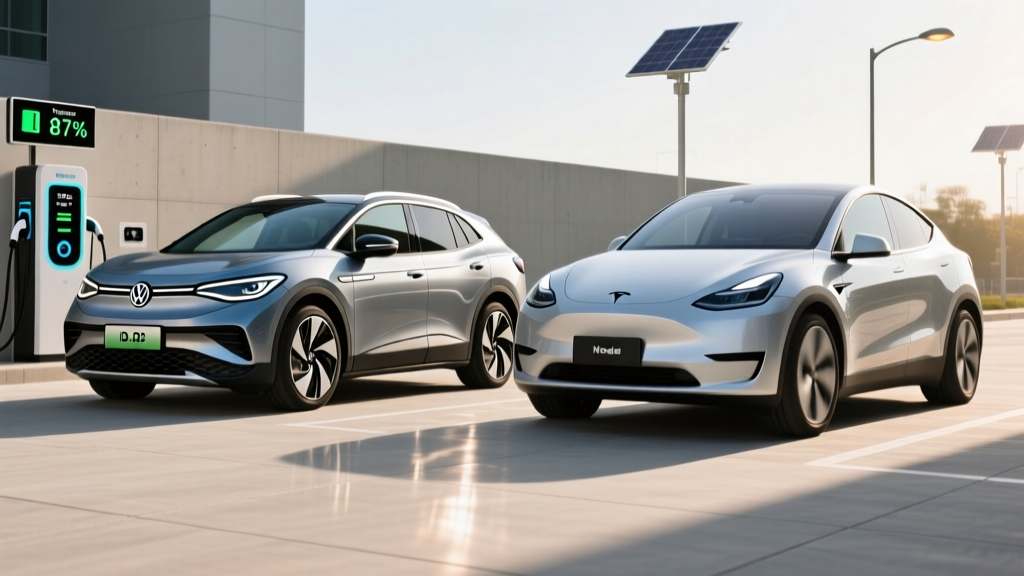
The compact electric SUV segment has two heavyweights that consistently top buyer shopping lists: the Volkswagen ID.4 and the Tesla Model Y. Both offer practical cargo space, family-friendly interiors, and enough range for road trips. But when you dig into the spec sheets, charging curves, and total ownership costs, meaningful differences emerge. This head-to-head VW Tesla comparison breaks down every number that matters — from EPA range and DC fast-charging speeds to federal tax credit eligibility — so you can pick the right EV SUV with confidence.
Quick Verdict
Choose the VW ID.4 if you want a lower entry price, a traditional dealership experience, a comfortable ride tuned for daily commuting, and straightforward controls.
Choose the Tesla Model Y if you prioritize maximum range, access to the Supercharger network, rapid DC fast-charging, over-the-air updates, and class-leading cargo volume.
Side-by-Side Specs at a Glance
| Specification | 2026 VW ID.4 Pro S AWD | 2026 Tesla Model Y Long Range AWD |
|---|---|---|
| EPA Range | 275 miles | 320 miles |
| Battery (usable) | 82 kWh (NMC) | ~78 kWh (NMC) |
| Max DC Fast Charge | 175 kW | 250 kW |
| 10–80% DCFC Time | ~28 min | ~22 min |
| Level 2 Home Charge | 11 kW (~37 mi/hr) | 11.5 kW (~44 mi/hr) |
| 0–60 mph | 5.7 sec | 4.8 sec |
| Horsepower | 295 hp | 384 hp |
| Drivetrain | Dual-motor AWD | Dual-motor AWD |
| MPGe (combined) | 104 MPGe | 117 MPGe |
| Efficiency | 32 kWh/100 mi | 28 kWh/100 mi |
| Cargo (rear seats up) | 30.3 cu ft | 30.2 cu ft (+ 4.1 cu ft frunk) |
| Cargo (rear seats down) | 64.2 cu ft | 72.1 cu ft |
| Base MSRP | $45,295 | $47,990 |
| Battery Warranty | 8 yr / 100,000 mi | 8 yr / 120,000 mi |
Range and Real-World Efficiency
VW ID.4 Pro S AWD
EPA: 275 miles. Real-world highway driving at 70 mph typically yields 235–255 miles. In freezing temperatures (below 32°F), expect a 20–30% reduction, dropping effective range to roughly 190–220 miles.
Tesla Model Y Long Range AWD
EPA: 320 miles. Highway cruising at 70 mph delivers approximately 275–295 miles. Cold-weather range drops to around 225–260 miles, aided by the Model Y's standard heat pump which mitigates cabin-heating energy draw.
The Model Y's 45-mile EPA advantage is significant on paper and holds up in practice. Tesla's superior aerodynamic efficiency (lower drag coefficient) and more aggressive thermal management give it an edge on long road trips where every charging stop matters. The ID.4 compensates with a slightly larger usable battery (82 kWh vs. ~78 kWh), but the Tesla extracts more miles per kilowatt-hour thanks to its lighter curb weight and optimized drivetrain.
For daily commuting under 60 miles round-trip, both vehicles offer ample buffer. But if you regularly drive 300+ mile routes — say, Denver to Grand Junction or Atlanta to Charleston — the Model Y's extra range means fewer stops and shorter total trip times.
Charging Speed: DC Fast and Home Level 2
| Charging Level | VW ID.4 | Tesla Model Y |
|---|---|---|
| Level 1 (120V, 1.4 kW) | ~5 mi/hr | ~5 mi/hr |
| Level 2 (240V, home) | 11 kW / ~37 mi/hr | 11.5 kW / ~44 mi/hr |
| DC Fast Charge (peak) | 175 kW | 250 kW |
| 10–80% DCFC Time | ~28 minutes | ~22 minutes |
| Connector | CCS (NACS adapter available) | NACS (native Supercharger) |
Charging speed is where Tesla maintains a clear advantage. The Model Y's peak 250 kW DC fast-charging rate on V3 Superchargers means you can recover roughly 200 miles of range in about 15 minutes under ideal conditions. The ID.4 peaks at 175 kW on compatible Electrify America or third-party CCS stations — still respectable, but you'll spend about 6 more minutes at the charger on a typical road-trip stop.
The charging curve matters as much as peak rate. Both vehicles taper significantly above 80% state of charge (SoC) to protect battery longevity. The ID.4's curve is relatively flat between 20–60% SoC before stepping down, while the Model Y sustains its peak rate slightly longer before tapering. For practical road-trip planning, charge to 80% and go — the last 20% takes nearly as long as the first 80% on both vehicles.
At home on a Level 2 charger, both vehicles will fully recharge overnight. The Tesla edges ahead with slightly faster Level 2 speeds, but the difference is negligible for owners who plug in every evening. A standard 48-amp home charger (hardwired, 60-amp circuit) will replenish either vehicle from 20% to full in roughly 7–8 hours. According to fueleconomy.gov, home charging remains the most cost-effective method at an average of $0.13–$0.16 per kWh nationally.
Performance and Driving Dynamics
The Model Y Long Range AWD hits 60 mph in 4.8 seconds with 384 horsepower from its dual-motor setup. That's genuinely quick for a family SUV — quick enough to merge onto fast-moving highways with confidence and overtake without hesitation. The steering is precise, the center of gravity is low, and the regenerative braking (adjustable in recent model years) allows for near one-pedal driving in stop-and-go traffic.
The ID.4 Pro S AWD posts a 5.7-second 0–60 time with 295 hp. It's not slow by any measure, but it feels more relaxed and comfort-oriented than the Tesla. VW tuned the suspension for ride quality over sportiness — it absorbs potholes and expansion joints with less harshness than the Model Y's firmer setup. The ID.4's turning circle is notably tight at 31.5 feet, making it easier to maneuver in urban parking situations.
Neither vehicle is designed for towing duty. The Model Y is rated for 3,500 lbs (when properly equipped), while the ID.4 manages 2,700 lbs. If you need serious towing capacity, look to the Ford F-150 Lightning or Rivian R1S instead.
Interior, Cargo, and Technology
Both SUVs seat five adults comfortably, though the Model Y offers slightly more rear legroom (41.6 inches vs. 37.6 inches in the ID.4). Cargo volume with rear seats up is virtually identical at ~30 cubic feet, but the Model Y pulls ahead with seats folded (72.1 vs. 64.2 cu ft) and adds a 4.1 cu ft front trunk (frunk) that the ID.4 lacks.
Technology philosophies diverge sharply:
Tesla Model Y: A minimalist cabin dominated by a 15.4-inch center touchscreen. Nearly all vehicle functions — climate, mirrors, glovebox — route through the screen. The infotainment system is responsive, includes built-in navigation with real-time Supercharger routing, and receives frequent over-the-air (OTA) updates that add features post-purchase. Autopilot comes standard (SAE Level 2 driver assist); Full Self-Driving (Supervised) is a $8,000 option that adds automated lane changes, traffic-light recognition, and city-street navigation, but still requires full driver attention at all times.
VW ID.4: A more conventional interior with physical buttons for climate and volume, a 12.9-inch touchscreen, and a digital instrument cluster behind the steering wheel. VW's IQ.DRIVE suite includes adaptive cruise control, lane-keeping assist, and emergency braking (all SAE Level 2). The interface has improved over earlier model years, but some owners report slower screen response compared to Tesla. Apple CarPlay and Android Auto are wireless.
⚠ Driver-Assist Limitations
Both Tesla Autopilot/FSD and VW IQ.DRIVE are SAE Level 2 systems. The driver must remain fully engaged, keep hands on the wheel (or demonstrate attentiveness), and be prepared to take over instantly. Neither system is autonomous or "self-driving." Only Level 4 services like Waymo operate without a human driver, and those are limited to geofenced urban areas.
Pricing, Trims, and Federal Tax Credit Eligibility
| Trim | MSRP | Est. After §30D Credit* |
|---|---|---|
| VW ID.4 Standard Range (RWD) | $39,735 | ~$32,235 |
| VW ID.4 Pro S AWD | $45,295 | ~$37,795 |
| Tesla Model Y Long Range AWD | $47,990 | ~$40,490 |
| Tesla Model Y Performance | $52,490 | ~$44,990 |
*Estimated prices assume full $7,500 federal tax credit eligibility. Actual credit depends on buyer income, MSRP caps, battery sourcing requirements, and point-of-sale transfer rules under IRS §30D.
Under current §30D rules, both vehicles qualify for up to $7,500 in federal tax credits, but eligibility is not automatic. Key requirements include:
- MSRP cap: SUVs must have a base MSRP at or below $80,000 (both vehicles qualify)
- Buyer income cap: Modified adjusted gross income must not exceed $150,000 (single), $225,000 (head of household), or $300,000 (joint filing)
- Battery sourcing: A percentage of critical minerals and battery components must be sourced from the US or free-trade-agreement countries — this requirement tightens annually and may affect eligibility for specific build dates
- Point-of-sale transfer: Buyers can transfer the credit to the dealer at purchase, reducing the upfront price rather than waiting for a tax refund
Always verify current eligibility on irs.gov before purchasing, as battery-sourcing rules and eligible vehicle lists update periodically. Consult a tax professional for your specific situation.
Warranty and Long-Term Ownership
Volkswagen provides an 8-year/100,000-mile battery warranty that guarantees the pack will retain at least 70% of its original capacity. The limited vehicle warranty covers 4 years/50,000 miles.
Tesla's battery warranty extends to 8 years/120,000 miles (also 70% capacity retention), and the limited vehicle warranty is 4 years/50,000 miles. The extra 20,000 miles of battery coverage may matter to high-mileage commuters.
Both vehicles use NMC (nickel manganese cobalt) lithium-ion battery chemistry, which offers high energy density but is more sensitive to sustained high states of charge. For longest battery life, daily charging to 80% SoC is recommended, with 100% reserved for long trips. Degradation data from Recurrent Auto shows both platforms retaining approximately 90–93% of original capacity after 3 years of typical use — well within warranty thresholds.
Pros and Cons
VW ID.4 Pros
- Lower starting MSRP ($39,735)
- Comfortable, quiet ride quality
- Physical buttons for climate/volume
- Tight turning circle for city driving
- Strong dealer service network
VW ID.4 Cons
- Slower DC fast-charging (175 kW peak)
- Less EPA range than Model Y
- No front trunk (frunk)
- Touch-capacitive steering wheel controls frustrate some drivers
- Smaller rear legroom
Tesla Model Y Pros
- Class-leading 320-mile EPA range
- 250 kW DC fast-charging
- Supercharger network reliability
- Best-in-class cargo volume (72.1 cu ft)
- Frequent OTA feature updates
Tesla Model Y Cons
- Higher base price ($47,990)
- Minimalist interior isn't for everyone
- Firmer ride over rough roads
- No Apple CarPlay / Android Auto
- Service center wait times in some markets
Which VW or Tesla SUV Should You Buy?
The right choice depends on your daily driving pattern, charging setup, and priorities.
Buy the VW ID.4 if: You commute under 80 miles daily, have reliable home Level 2 charging, prefer a comfortable ride over sporty handling, want physical controls, and the lower MSRP helps your budget. The ID.4 is an excellent, understated EV that does everything a family needs without flash.
Buy the Tesla Model Y if: You take regular road trips where the 45 extra miles of range and faster charging meaningfully reduce stops, you value maximum cargo space, you want access to the Supercharger network's reliability, and you're comfortable with a screen-centric interface. The Model Y remains the efficiency benchmark in this segment.
Frequently Asked Questions
What is the real-world range of the VW ID.4 and Tesla Model Y?
The ID.4 delivers approximately 235–255 miles on the highway (EPA 275). The Model Y achieves 275–295 highway miles (EPA 320). Cold weather reduces both by 20–30%.
How fast do these EVs charge at home and on the road?
On Level 2 home charging, the ID.4 adds ~37 miles per hour and the Model Y adds ~44 miles per hour. On DC fast chargers, the ID.4 peaks at 175 kW (10–80% in ~28 min) while the Model Y peaks at 250 kW (10–80% in ~22 min).
Do the VW ID.4 and Tesla Model Y qualify for the $7,500 federal tax credit?
Both currently qualify under §30D, but eligibility depends on your income (must be under caps), the vehicle's MSRP (must be ≤$80,000 for SUVs), and battery-sourcing requirements that change annually. Verify on irs.gov before purchasing.
Can I use Tesla Superchargers with the VW ID.4?
VW offers a NACS adapter that provides access to Tesla's Supercharger network for CCS-equipped ID.4 models. Charging speeds are limited to the ID.4's 175 kW peak and the Supercharger's CCS-compatible output.
Which has more cargo space?
With rear seats folded, the Model Y offers 72.1 cu ft vs. the ID.4's 64.2 cu ft. The Model Y also includes a 4.1 cu ft frunk that the ID.4 lacks.
Is Tesla Autopilot self-driving?
No. Autopilot and FSD (Supervised) are SAE Level 2 driver-assistance systems. The driver must remain fully attentive and in control at all times. These systems assist with steering, acceleration, and braking but do not replace the driver.