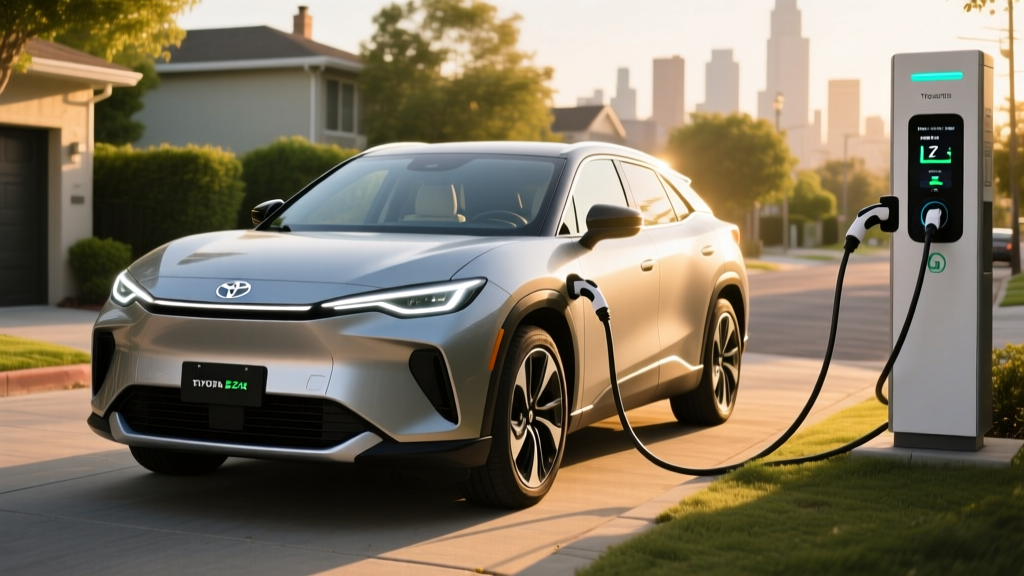
Toyota took its time entering the battery-electric vehicle market, and the 2024 Toyota bZ4X is the result of that deliberate approach. Built on Toyota's e-TNGA platform and developed in partnership with Subaru (which sells the mechanically similar Solterra), the bZ4X is a compact electric crossover aimed squarely at mainstream buyers transitioning from gas-powered RAV4s and Highlanders. But does its spec sheet hold up against the Hyundai Ioniq 5, Ford Mustang Mach-E, and Volkswagen ID.4 in a rapidly maturing EV segment?
After examining the EPA data, charging performance, real-world efficiency, and ownership economics, here is everything you need to decide whether the 2024 bZ4X belongs on your shortlist.
Quick Verdict: Who the 2024 bZ4X Is For
Choose the 2024 Toyota bZ4X if: You want a comfortable, practical compact EV crossover with Toyota's reputation for reliability, a strong battery warranty, and you primarily commute or take moderate-length trips rather than frequent cross-country road trips.
Look elsewhere if: You need class-leading range, the fastest DC charging speeds, or a frunk for additional cargo.
Range, Battery, and Efficiency
| Spec | Value |
|---|---|
| EPA Range (FWD) | 252 miles |
| EPA Range (AWD) | 228 miles |
| Battery Capacity (Usable) | 71.4 kWh |
| Battery Chemistry | NMC (Nickel Manganese Cobalt) |
| Efficiency (FWD) | 119 MPGe combined / 28 kWh/100 mi |
| Efficiency (AWD) | 104 MPGe combined / 32 kWh/100 mi |
| Horsepower (FWD) | 201 hp |
| Horsepower (AWD) | 214 hp |
| 0-60 mph (FWD) | ~7.1 seconds |
| 0-60 mph (AWD) | ~5.8 seconds |
| Drivetrain | Single-motor FWD or Dual-motor AWD |
| Max DC Fast Charge | 150 kW |
| 10-80% DC Charge Time | ~30 minutes |
| Level 2 Charge Rate | 6.6 kW (~25 mi/hr) |
| Base MSRP (XLE FWD) | $43,070 |
| Base MSRP (Limited AWD) | $49,920 |
📊 Real-World Range Reality Check
The FWD bZ4X carries an EPA-estimated 252 miles of range, while the AWD model drops to 228 miles. In real-world highway driving at 70-75 mph, expect approximately 210-230 miles from the FWD variant and 190-210 miles from the AWD model. Cold-weather operation (below freezing) can reduce range by 20-30%, bringing the AWD model down to roughly 160-175 miles in harsh winter conditions. City driving with frequent regenerative braking opportunities will get you closer to — or slightly above — the EPA sticker.
The bZ4X uses an NMC (nickel manganese cobalt) lithium-ion battery with 71.4 kWh of usable capacity. Unlike some competitors that have moved to LFP (lithium iron phosphate) chemistry for lower-cost trims, Toyota has stuck with NMC for its higher energy density, which helps keep the pack relatively compact for the vehicle's size. According to fueleconomy.gov, the FWD model achieves 119 MPGe combined.
Charging Performance: DC Fast Charging and Home Setup
Charging speed is where the bZ4X reveals one of its most significant limitations relative to competitors. The maximum DC fast-charge rate is 150 kW — adequate, but notably behind the Hyundai Ioniq 5's 240 kW capability and the Tesla Model Y's ~250 kW peak on V3 Superchargers.
| Charging Level | Power | Speed |
|---|---|---|
| Level 1 (120V household) | ~1.4 kW | ~4-5 mi/hr |
| Level 2 (240V home) | 6.6 kW | ~25 mi/hr (full charge ~11 hrs) |
| DC Fast Charge (peak) | 150 kW | 10-80% in ~30 min |
A few important notes for prospective owners:
- Charge curve taper: The bZ4X peaks near 150 kW only at lower states of charge (roughly 10-30% SoC). Above 50%, the rate drops significantly, and charging from 80-100% on DC is slow. This is standard for NMC batteries but means your real-world fast-charging stop will be roughly 30 minutes for a 10-80% session — not the 18 minutes you'd see in an Ioniq 5.
- CCS connector: The bZ4X uses the CCS1 connector for DC fast charging. Toyota has announced a transition to NACS (Tesla's connector) for future models, but the 2024 bZ4X requires a CCS-to-NACS adapter for Tesla Supercharger access, which Toyota began providing to owners.
- Preconditioning: The bZ4X offers battery preconditioning when you navigate to a DC fast charger via the built-in navigation system. This warms the battery for optimal charge speed — essential in cold weather. However, unlike some competitors, preconditioning is tied to the nav system rather than being manually toggleable, which some owners find limiting.
- Home charging: At 6.6 kW on Level 2, a full overnight charge takes approximately 11 hours. Most owners who plug in nightly will never need a full 0-100% charge, so this is adequate for daily use. A 40-amp or 48-amp Level 2 home charger (hardwired, 240V) is the recommended setup.
Performance and Driving Dynamics
The 2024 bZ4X is not positioned as a performance EV, and its acceleration figures reflect that. The front-wheel-drive model uses a single front-mounted motor producing 201 hp and 196 lb-ft of torque, achieving a 0-60 mph time of approximately 7.1 seconds. The dual-motor all-wheel-drive model bumps output to 214 hp and 248 lb-ft, cutting the 0-60 time to roughly 5.8 seconds.
These numbers place the bZ4X behind the Mustang Mach-E (which hits 60 in as little as 3.5 seconds in GT trim) and the Ioniq 5 (5.0 seconds with AWD). However, the bZ4X prioritizes ride comfort over sportiness. The suspension tuning absorbs road imperfections well, and the cabin remains quiet at highway speeds — qualities that matter more to the crossover buyer demographic Toyota is targeting.
The AWD system uses separate front and rear motors with torque distribution managed electronically. It's competent in rain and light snow but not a substitute for a dedicated off-roader. Toyota's X-MODE traction management (borrowed from Subaru) provides selectable terrain modes for the AWD variant.
Interior, Cargo, and Technology
Inside, the bZ4X offers a spacious cabin with a flat floor thanks to the dedicated EV platform. Key dimensions:
- Front legroom: 42.1 inches
- Rear legroom: 35.3 inches
- Cargo volume (rear seats up): 27.7 cubic feet
- Cargo volume (rear seats folded): 56.9 cubic feet
- Frunk: None — the bZ4X does not offer a front trunk
The lack of a frunk is a missed opportunity for additional weatherproof storage, something competitors like the Mach-E and Ioniq 5 provide. Cargo capacity is competitive for the segment, though the Volkswagen ID.4 offers slightly more at 30.3 cubic feet behind the rear row.
Infotainment: The bZ4X features a 12.3-inch touchscreen running Toyota's latest Audio Multimedia system with wireless Apple CarPlay and Android Auto, built-in navigation, and a Wi-Fi hotspot. The system is responsive and well-organized, though the absence of physical knobs for volume and climate control (the climate controls are touch-capacitive) frustrates some drivers.
Driver Assistance (Toyota Safety Sense 3.0): Standard equipment includes adaptive cruise control, lane-keeping assist, automatic emergency braking with pedestrian detection, blind-spot monitoring, and rear cross-traffic alert. Toyota's Proactive Driving Assist provides gentle braking and steering support in certain scenarios. This is an SAE Level 2 driver-assistance system — it requires the driver to remain fully engaged with hands on the wheel and eyes on the road at all times. It is not a self-driving system.
Pricing, Trims, and Federal Tax Credit Eligibility
The 2024 bZ4X is offered in two trim levels: XLE and Limited. Each is available in FWD or AWD.
| Trim | Drivetrain | MSRP (incl. destination) |
|---|---|---|
| XLE | FWD | $43,070 |
| XLE | AWD | $45,150 |
| Limited | FWD | $47,840 |
| Limited | AWD | $49,920 |
All 2024 bZ4X trims fall well under the IRS §30D MSRP cap of $80,000 for SUVs, so the vehicle itself is not disqualified on price. However, federal tax credit eligibility depends on several factors that change periodically:
- Buyer income caps: Modified adjusted gross income must not exceed $150,000 (single), $225,000 (head of household), or $300,000 (joint filers).
- Battery sourcing requirements: The credit is split into two $3,750 halves — one for critical minerals sourcing and one for battery component manufacturing. These requirements tighten annually. Check the latest fueleconomy.gov tax credit page for the current bZ4X eligibility status, as battery supply chains shift.
- Point-of-sale transfer: As of 2024, eligible buyers can transfer the credit to the dealer at purchase, reducing the out-of-pocket price immediately rather than waiting for a tax refund.
💰 Potential Price After Credit: If the bZ4X qualifies for the full $7,500 federal credit and you meet income requirements, the XLE FWD drops to an effective price of approximately $35,570 — a compelling entry point for a well-equipped compact EV crossover. Always confirm eligibility with your tax professional and the dealer before purchase, as sourcing rules evolve.
Warranty and Long-Term Ownership
Toyota backs the bZ4X with one of the strongest battery warranties in the segment:
- Basic vehicle warranty: 3 years / 36,000 miles
- Powertrain warranty: 5 years / 60,000 miles
- EV battery warranty: 8 years / 100,000 miles (covering defects and capacity loss below 70% of original capacity)
The 70% capacity retention threshold over 8 years/100,000 miles is standard for the industry. Real-world NMC battery degradation data from similar Toyota hybrids suggests the bZ4X pack should retain 85-90% capacity over that period under normal use conditions. Toyota also includes 2 years of complimentary maintenance and roadside assistance.
Long-term ownership costs benefit from Toyota's dealer network (over 1,400 US locations), which matters when you need warranty service — a significant advantage over newer EV-only brands with sparse service footprints.
How the 2024 bZ4X Compares to Key Competitors
| Spec | Toyota bZ4X (FWD) | Hyundai Ioniq 5 (RWD) | Ford Mustang Mach-E (RWD) | VW ID.4 (RWD) |
|---|---|---|---|---|
| EPA Range | 252 mi | 303 mi | 250 mi | 275 mi |
| Battery | 71.4 kWh | 77.4 kWh | 70 kWh | 82 kWh |
| Max DC Charge | 150 kW | 240 kW | 150 kW | 170 kW |
| 10-80% DC | ~30 min | ~18 min | ~30 min | ~28 min |
| 0-60 mph | 7.1 sec | 7.0 sec | 6.3 sec | 7.7 sec |
| Base MSRP | $43,070 | $45,850 | $42,995 | $39,735 |
| Cargo (seats up) | 27.7 cu ft | 27.2 cu ft | 29.7 cu ft | 30.3 cu ft |
The bZ4X sits in the middle of this competitive set. The Ioniq 5 dominates on range and charging speed. The ID.4 undercuts on price and offers more cargo space. The Mach-E delivers the sportiest driving experience. The bZ4X's advantages are its Toyota badge (resale value, dealer network, perceived reliability) and strong battery warranty.
✅ Pros
- Strong battery warranty (8yr/100k mi)
- Comfortable, quiet ride quality
- Spacious rear seat with flat floor
- Comprehensive Toyota Safety Sense 3.0 standard
- Large Toyota dealer/service network
- Competitive pricing after potential tax credit
- Wireless Apple CarPlay and Android Auto
❌ Cons
- Shorter range than Ioniq 5 and ID.4
- Slow DC charging vs. 800V competitors (150 kW max)
- No front trunk (frunk)
- AWD range drops to just 228 miles
- Touch-capacitive climate controls
- Preconditioning tied only to nav system
- Modest acceleration compared to Mach-E
Frequently Asked Questions
What is the real-world range of the 2024 Toyota bZ4X?
In mixed driving, expect 220-240 miles from the FWD model and 200-220 miles from the AWD model. Highway driving at sustained speeds above 70 mph reduces range to roughly 210-230 miles (FWD) and 190-210 miles (AWD). Cold weather (below 32°F) can reduce these figures by 20-30%. The bZ4X's heat pump (standard on all trims) helps mitigate cold-weather cabin heating losses, which is a notable advantage over EVs without one.
How fast does the bZ4X charge at home and on the road?
At home on a Level 2 (240V, 6.6 kW) charger, the bZ4X adds approximately 25 miles of range per hour, with a full 0-100% charge taking about 11 hours. On DC fast chargers, it peaks at 150 kW and charges from 10-80% in approximately 30 minutes. This is adequate but noticeably slower than 800V-architecture competitors like the Ioniq 5 (18 minutes) and Kia EV6 (18 minutes).
Does the 2024 bZ4X qualify for the $7,500 federal EV tax credit?
The bZ4X is below the $80,000 MSRP cap for SUVs under IRS §30D rules, and Toyota has worked to qualify the battery supply chain. However, eligibility for the full $7,500, partial $3,750, or no credit depends on current critical minerals and battery component sourcing requirements, which tighten each year. Check the fueleconomy.gov database for the latest status and consult a tax professional for your specific situation. Income caps also apply ($150K single / $300K joint).
Is the 2024 bZ4X worth buying over the Hyundai Ioniq 5 or VW ID.4?
If charging speed and maximum range are your top priorities, the Ioniq 5 is the stronger pick. If you want the lowest entry price and most cargo room, the ID.4 has an edge. The bZ4X makes the most sense for buyers who value Toyota's reliability track record, extensive dealer network, strong battery warranty, and comfortable ride — and who don't regularly take trips requiring fast DC charging stops. It's a solid, if not class-leading, compact EV crossover.
Can the bZ4X use Tesla Superchargers?
The 2024 bZ4X uses a CCS1 connector natively. Toyota has provided a CCS-to-NACS adapter to bZ4X owners, enabling access to Tesla's Supercharger network (which has a far larger footprint than any CCS-only network in the US). Confirm adapter availability with your dealer at the time of purchase.
What is the battery replacement cost for the bZ4X?
Full EV battery replacement costs remain high — typically $10,000-$15,000+ for a pack of this size. However, the 8-year/100,000-mile warranty (covering degradation below 70%) and NMC chemistry's proven longevity mean most owners should never face an out-of-pocket replacement. Individual module-level repairs may be possible at lower cost if a specific cell group fails outside warranty.