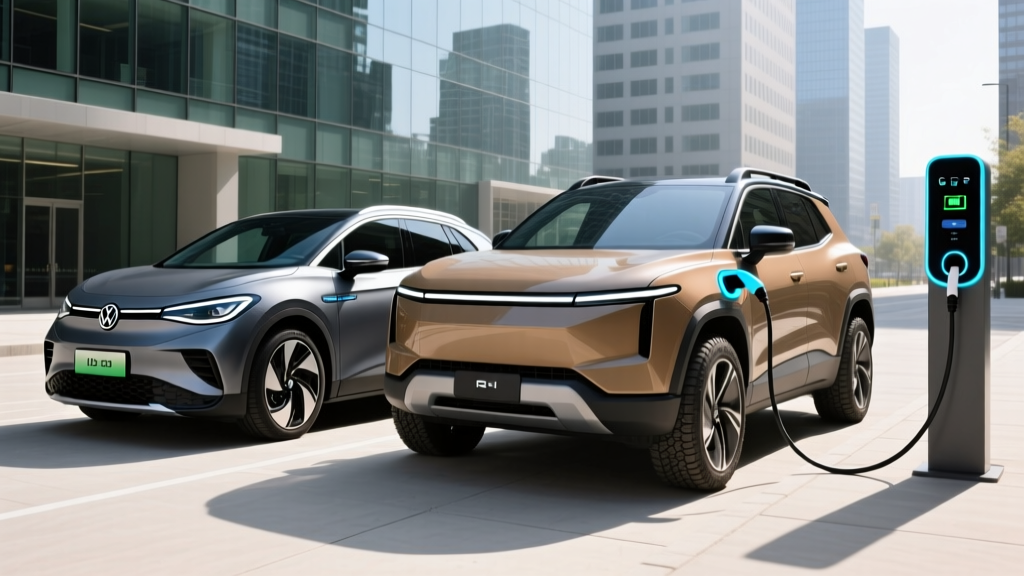
Shoppers cross-referencing VW and Rivian are usually weighing two very different philosophies: Volkswagen's value-oriented, mass-market ID.4 crossover against Rivian's premium, adventure-ready R1S SUV. Both seat families, both offer all-wheel drive, and both compete for the same electrified buyer — but the overlap ends there. This comparison breaks down the 2026 model-year specs, real-world range expectations, charging speeds, and total ownership costs so you can decide which actually fits your driveway.
Quick Verdict: Two EVs, Two Missions
The 2026 VW ID.4 targets buyers who want a practical, comfortable electric crossover near $40,000 before incentives, with competitive range and a mature charging footprint. The 2026 Rivian R1S is a three-row, body-on-frame electric SUV aimed at families who tow, explore, and want flagship performance — at roughly double the price. Neither is objectively "better." They simply solve different problems.
2026 VW ID.4 vs Rivian R1S: Core Specifications
| Spec | VW ID.4 Pro S AWD | Rivian R1S Dual-Motor |
|---|---|---|
| EPA Range | 275 mi (est.) | 352 mi (Large Pack) |
| Battery (usable) | 77 kWh, NMC | 128.9 kWh, NMC (Large) |
| Peak DC Charge Rate | 175 kW | 220 kW (est.) |
| 10–80% DC Fast Charge | ~30 min | ~27 min |
| Level 2 Home Charge Rate | 11 kW (~33 mi/hr) | 11.5 kW (~34 mi/hr) |
| 0–60 mph | 5.4 sec (AWD) | 4.5 sec (Dual-Motor) |
| Horsepower | 295 hp | 533 hp |
| Drivetrain | Dual-motor AWD | Dual-motor AWD |
| MPGe (combined) | 104 MPGe (est.) | 73 MPGe (est.) |
| Towing Capacity | 2,700 lbs | 7,700 lbs |
| Base MSRP | ~$41,995 | ~$75,900 |
| Battery Warranty | 8 yr / 100,000 mi | 8 yr / 175,000 mi |
Sources: fueleconomy.gov, VW and Rivian manufacturer spec sheets. Figures reflect 2025–2026 model-year data and may vary by trim.
Range and Efficiency: Sticker vs. Reality
Real-World Range Reality Check
VW ID.4 AWD: EPA-estimated 275 miles. Expect 230–250 miles on sustained highway driving at 70+ mph; approximately 190–210 miles in sub-freezing winter conditions due to battery thermal losses and cabin heating demands.
Rivian R1S Dual-Motor (Large Pack): EPA-estimated 352 miles. Expect 280–310 miles highway; approximately 240–270 miles in cold weather. The R1S's brick-like aerodynamics and 6,000+ lb curb weight hit efficiency hard at speed.
The ID.4's smaller battery means shorter absolute range, but its efficiency per mile is meaningfully better — around 28–30 kWh/100 mi versus the R1S at roughly 44–48 kWh/100 mi. For daily commuting under 60 miles round-trip, the ID.4's range is more than sufficient and cheaper to refill. The R1S's advantage shows on longer trips where fewer charging stops matter, though its larger battery also means longer total charge times if you arrive at a low state of charge.
Efficiency matters for your wallet too. At the US average residential electricity rate of ~$0.16/kWh (per EIA data), filling the ID.4 from 10–80% at home costs roughly $8.60. The R1S, same session proportionally, costs around $14.40. Over 15,000 miles a year, the ID.4 uses about $660 in home electricity; the R1S burns closer to $1,060.
Charging Speed: DC Fast and Home Level 2
Charging Comparison: VW ID.4 vs Rivian R1S
| Level | VW ID.4 | Rivian R1S |
|---|---|---|
| Level 1 (120V, ~1.4 kW) | ~4 mi/hr | ~4 mi/hr |
| Level 2 (240V, 48A) | 11 kW / ~33 mi/hr | 11.5 kW / ~34 mi/hr |
| DC Fast Charge (peak) | 175 kW (CCS/NACS adapter) | 220 kW (NACS native) |
| 10–80% DC Fast Time | ~30 minutes | ~27 minutes |
| Miles Added in 15 min (DC) | ~95 mi (peak) | ~140 mi (peak) |
Both vehicles charge at similar rates on a home Level 2 circuit — overnight replenishment is a non-issue for either. The R1S edges ahead on DC fast charging thanks to its NACS-native connector (Tesla Supercharger access out of the box) and higher peak rate. However, peak kW is never sustained: both vehicles taper significantly above 80% state of charge to protect the NMC cells. A realistic road-trip strategy targets 10–80% sessions and avoids the slow 80–100% tail.
VW ID.4 owners rely on the CCS1 connector natively, though VW has committed to NACS adoption for future models and offers adapters for Supercharger access. For now, ID.4 charging means Electrify America, EVgo, and ChargePoint DC stations — networks that have improved reliability but still trail Tesla's Supercharger network in uptime per J.D. Power EV Experience Index surveys.
Performance, Space, and Daily Usability
The R1S's 533 hp and 4.5-second 0–60 time make it genuinely quick for a three-row SUV, and its 7,700-lb towing capacity opens up camper and boat duty that the ID.4 simply can't handle. The ID.4's 295 hp and 5.4-second sprint are adequate for merging and passing, not thrilling — but the crossover's lighter weight (~4,700 lbs vs ~6,900 lbs) makes it more nimble in urban driving and easier on tires.
Interior Dimensions and Cargo
| Measurement | VW ID.4 | Rivian R1S |
|---|---|---|
| Seating | 5 passengers | 7 passengers (3 rows) |
| Cargo (behind 2nd row) | 30.3 cu ft | 46.7 cu ft |
| Cargo (max, seats folded) | 64.2 cu ft | 104.6 cu ft |
| Rear Legroom | 37.6 in | 36.5 in (2nd row) |
| Frunk | No | 11.1 cu ft (e-trunk) |
If you need a third row, the R1S wins by default. If you're a family of four or fewer, the ID.4's cabin is airy, comfortable, and the cargo area handles strollers, groceries, and road-trip luggage without complaint. The R1S's e-trunk (front trunk) adds useful sealed storage for charging cables or muddy gear — a detail VW skipped.
Tech and Driver Assistance
The ID.4 runs VW's ID. Software 4.0 with a 12.9-inch touchscreen, wireless Apple CarPlay/Android Auto, and Travel Assist (a solid Level 2 lane-centering + adaptive cruise system). It's functional but not cutting-edge. Rivian's R1S features a 15.6-inch center display, a custom Qualcomm-based compute platform, OTA updates that materially add features, and the Rivian Driver+ system (also Level 2 — not self-driving). Rivian's software is generally regarded as more polished and responsive, with features like Gear Guard (a winch-cable security system) and Camp Mode that appeal to the outdoor-use case.
Pricing, Trims, and Federal Tax Credit Eligibility
2026 Pricing and Estimated Tax-Credit-Adjusted Cost
| Trim | MSRP | Est. After §30D Credit* |
|---|---|---|
| VW ID.4 Standard (RWD) | ~$39,995 | ~$32,495 |
| VW ID.4 Pro S AWD | ~$46,495 | ~$38,995 |
| Rivian R1S Dual-Motor (Large) | ~$75,900 | ~$68,400 |
| Rivian R1S Tri-Motor (Max Pack) | ~$99,900 | Ineligible (MSRP cap) |
*Federal §30D credit eligibility depends on buyer income limits ($150K single / $300K joint MAGI), vehicle MSRP caps ($80,000 for SUVs), battery critical-mineral and component sourcing requirements, and point-of-sale transfer election. Always verify current-year rules at IRS.gov and consult a tax professional.
§30D Federal Tax Credit Checklist
- MSRP Cap: SUVs (including ID.4 and R1S) must be ≤ $80,000 MSRP. R1S Dual-Motor qualifies; Tri-Motor/Max Pack trims may not.
- Buyer Income Cap: Modified AGI ≤ $300,000 (joint) / $150,000 (single).
- Battery Sourcing: Critical minerals and battery components must meet escalating domestic-content thresholds. Both VW and Rivian have worked to qualify, but specific trim eligibility can change — verify at purchase.
- Point-of-Sale Transfer: You can elect to transfer the credit to the dealer at purchase, reducing your out-of-pocket cost immediately rather than waiting for a tax refund.
Warranty and Long-Term Ownership
Both vehicles carry an 8-year/100,000-mile battery and powertrain warranty — standard for the segment. Rivian extends that to 175,000 miles on the battery, which is notably generous and signals confidence in their Samsung SDI-sourced NMC packs. VW matches the industry baseline at 100,000 miles with a 70% capacity-retention threshold.
Maintenance costs favor both EVs over ICE equivalents (no oil changes, fewer brake replacements due to regen braking), but the R1S's heavier weight, larger tires (275/50R21 on Adventure trims), and air suspension mean higher consumable costs long-term. Budget roughly $200–$400/year more for the Rivian on tires and suspension service compared to the ID.4's simpler setup.
Pros, Cons, and Who Should Buy Which
VW ID.4 — Pros & Cons
Pros:
- Strong value under $47K before incentives
- Comfortable ride quality, quiet cabin
- Good efficiency (low kWh/100mi)
- Compact footprint for urban parking
- Widespread CCS charging network access
Cons:
- Infotainment software can lag
- No front trunk (frunk)
- Modest 2,700-lb tow rating
- CCS-only (no native NACS yet)
- Real-world winter range drops below 210 mi
Rivian R1S — Pros & Cons
Pros:
- Three-row seating for 7 passengers
- 7,700-lb towing capacity
- NACS native — full Supercharger access
- Excellent software and OTA updates
- 352-mi EPA range (Large Pack)
- Air suspension, off-road capability
Cons:
- Starting at ~$75,900 — premium pricing
- Heavy: 6,900 lbs hurts efficiency
- High tire and brake wear costs
- Some trims exceed $80K MSRP cap (no tax credit)
- Service center availability still expanding
Which Should You Buy?
Choose the VW ID.4 if: You're a family of 2–4, commute under 60 miles daily, want to stay under $50K out the door, don't tow, and prioritize low operating cost over performance thrills.
Choose the Rivian R1S if: You need three rows, tow a camper or boat, take regular road trips over 300 miles, want Supercharger-native access, and have the budget for a premium SUV with higher long-term consumable costs.
Frequently Asked Questions
What is the real-world range of the VW ID.4 and Rivian R1S?
The ID.4 AWD delivers roughly 230–250 miles on highway trips and 190–210 in freezing weather against its 275-mile EPA sticker. The R1S Large Pack manages 280–310 highway and 240–270 cold-weather against its 352-mile EPA rating. Both lose 15–25% in winter — a function of NMC chemistry and cabin heating loads, not a defect.
How fast do they charge on road trips?
The ID.4 peaks at 175 kW DC, adding ~95 miles in 15 minutes and reaching 10–80% in about 30 minutes. The R1S peaks at ~220 kW, adds ~140 miles in 15 minutes, and hits 10–80% in roughly 27 minutes. Both taper charge speed significantly above 80% SoC — plan to unplug at 80% for fastest road-trip pacing.
Does the Rivian R1S qualify for the $7,500 federal tax credit?
The R1S Dual-Motor (Large Pack, ~$75,900 MSRP) qualifies under the §30D SUV cap of $80,000, provided the buyer meets income limits and the vehicle's battery sourcing satisfies current-year critical-mineral and component requirements. Higher trims (Tri-Motor, Max Pack) may exceed the cap and become ineligible. Always confirm at the point of sale and reference IRS guidance.
Is the VW ID.4 worth buying over the Rivian R1S?
They serve different needs. The ID.4 wins on value, efficiency, and urban practicality. The R1S wins on range, towing, seating, and capability. Neither is a direct substitute for the other — the right choice depends on your passenger count, towing needs, and budget.
Do either of these vehicles have self-driving capability?
No. Both VW's Travel Assist and Rivian's Driver+ are SAE Level 2 driver-assistance systems — the driver must remain fully engaged with hands on the wheel and eyes on the road at all times. Neither vehicle offers Level 3 or Level 4 autonomous driving.
What are the battery warranties?
VW covers the ID.4 battery for 8 years or 100,000 miles (whichever comes first) with a 70% capacity-retention threshold. Rivian covers the R1S battery for 8 years or 175,000 miles — a significantly longer mileage limit that benefits high-mileage drivers.