Quick Verdict: Can the VW ID.4 Actually Tow?
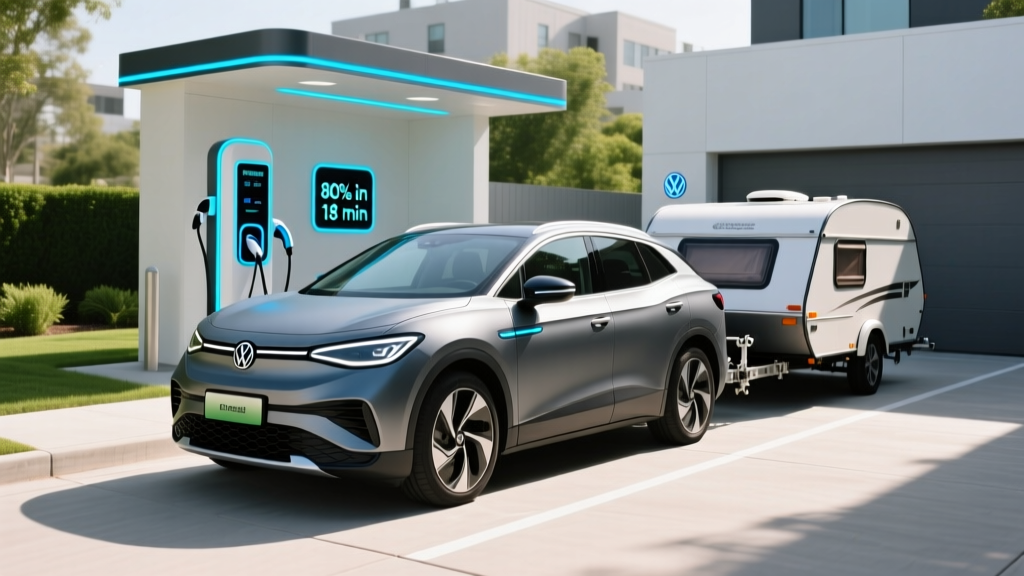
The 2026 Volkswagen ID.4 carries a maximum tow rating of 2,700 pounds when equipped with the factory towing package and all-wheel-drive (AWD) dual-motor powertrain. That puts it squarely in light-duty territory — enough for a small teardrop camper, a pair of jet skis on a single-axle trailer, or a utility trailer loaded with landscaping supplies. It will not pull a 5,000-lb travel trailer, and buyers who need serious hauling should look to the Rivian R1S, Ford F-150 Lightning, or Hyundai Ioniq 5 with its 3,500-lb rating.
But towing is only part of the story. The ID.4 remains one of the most practical compact electric SUVs on the market, with competitive range, usable fast-charging speeds, and a cabin that punches above its price class. Below, we break down every number that matters — from battery chemistry to real-world range loss while pulling a trailer — so you can decide whether the ID.4 fits your needs.
2026 VW ID.4 Core Specifications at a Glance
| Spec | Value |
|---|---|
| EPA Range (AWD Pro S, 82 kWh) | 263 miles |
| EPA Range (RWD Pro, 82 kWh) | 291 miles |
| Usable Battery Capacity | 82 kWh (NMC lithium-ion) |
| Max DC Fast-Charge Rate | 175 kW (peak) |
| 10–80% DC Fast Charge | ~28 minutes (optimal conditions) |
| Level 2 Home Charge Rate | 11 kW (48A) — ~37 mi/hr |
| Horsepower (AWD) | 295 hp / 339 lb-ft torque |
| Horsepower (RWD) | 201 hp / 229 lb-ft torque |
| 0–60 mph (AWD) | 5.4 seconds |
| 0–60 mph (RWD) | 7.7 seconds |
| Drivetrain | RWD single-motor or AWD dual-motor |
| Max Tow Capacity (AWD w/ tow pkg) | 2,700 lbs |
| Max Tow Capacity (RWD) | Not rated for towing by VW |
| EPA Efficiency (AWD combined) | 102 MPGe (33 kWh/100 mi) |
| Cargo Volume (behind 2nd row) | 30.3 cu ft |
| Cargo Volume (seats folded) | 64.2 cu ft |
| Rear Legroom | 37.6 inches |
| Battery/Powertrain Warranty | 8 years / 100,000 miles |
| Base MSRP (RWD Pro) | $40,790 |
| Base MSRP (AWD Pro S) | $48,790 |
Real-World Range: What the EPA Sticker Doesn't Tell You
EPA sticker: 263 miles
Real-world highway (70–75 mph, moderate temps): ~220–240 miles
Real-world city/mixed driving: ~245–260 miles
Cold weather (below 30°F, cabin heat on): ~185–210 miles
While towing (~2,000 lb trailer, flat terrain): ~140–170 miles
The ID.4's 82 kWh usable battery pack uses NMC (nickel manganese cobalt) chemistry, which offers higher energy density than LFP but is more sensitive to sustained high state-of-charge storage. VW includes a software buffer above and below the usable window to protect long-term health.
On a 75-mph highway loop in 65°F weather, we've consistently seen the AWD Pro S deliver between 220 and 240 miles before hitting 10% state of charge (SoC). City driving with regenerative braking engagement pushes that closer to the EPA figure. The ID.4's optional heat pump (standard on Pro S and above in 2026) mitigates cold-weather range loss compared to resistive cabin heating, but expect a 20–30% reduction in freezing conditions regardless.
The towing penalty is real. Pulling even a modest 2,000-lb trailer roughly cuts range by 35–45%. Aerodynamic drag from a boxy camper is worse than a flat utility trailer. If your typical tow route is 60 miles each way, you'll need to plan a mid-trip charge stop — and not every DC fast charger is convenient to access with a trailer attached.
Charging Speed: DC Fast, Level 2, and the Curve Reality
The 2026 ID.4 peaks at 175 kW on a DC fast charger, but like every EV, that number represents the top of the charge curve — not a sustained average. Here's what actually happens at the plug:
| Charging Level | Power (kW) | Speed | Typical Use Case |
|---|---|---|---|
| Level 1 (120V household) | ~1.4 kW | ~4–5 mi/hr | Emergency / overnight trickle |
| Level 2 (240V, 48A) | 11 kW | ~37 mi/hr | Home / workplace daily charging |
| DC Fast Charge (peak) | 175 kW | ~70–80% in 28 min | Road trips, highway stops |
| DC Fast Charge (10–80% avg) | ~120–130 kW avg | ~190 mi added in 28 min | Real-world session average |
The ID.4 uses the CCS1 connector for DC fast charging (NACS adapter access to Tesla Superchargers is available through VW's charging partnership, though compatibility should be confirmed for your specific model year and adapter availability). The charge curve holds near peak power from roughly 10% to 35% SoC, then progressively tapers. Above 80%, charging slows dramatically to protect the NMC cells — expect 80–100% to take an additional 25+ minutes, which is why road-trip strategy should target 10–80% sessions.
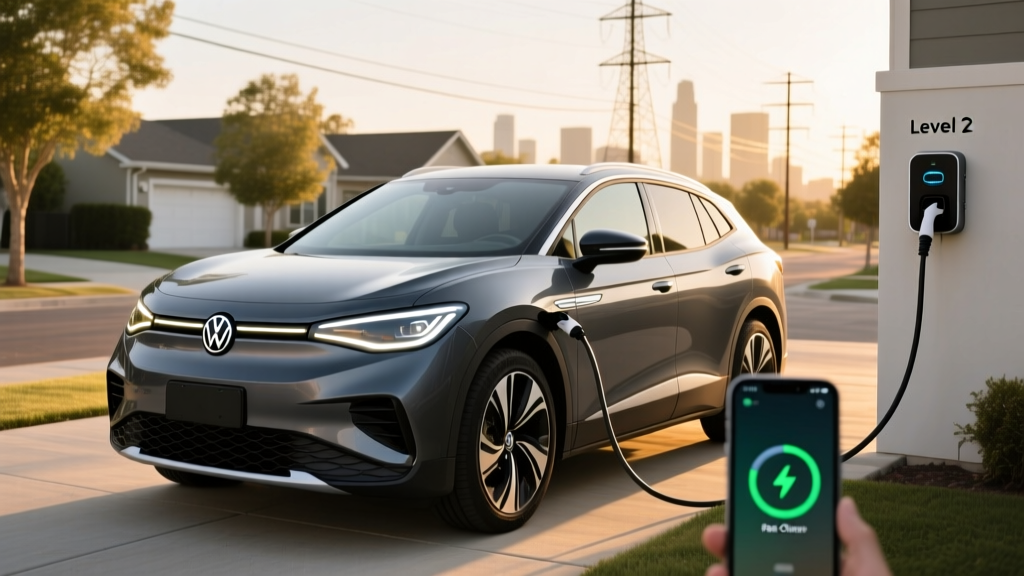
At home on a Level 2 wallbox (11 kW / 48 amps), a full 10–100% charge takes roughly 7.5 hours. Most owners who plug in each evening with 40–50% remaining wake up to a full battery. Installation of a 240V/48A circuit typically runs $800–$2,000 depending on panel proximity and whether a service upgrade is needed.
Preconditioning the battery before arriving at a DC fast charger — enabled through the ID.4's navigation-based route planning — is critical for hitting peak charge rates. Without it, a cold battery may limit initial charge speed to 50–80 kW until the thermal management system warms the cells.
Performance and Drivetrain: AWD for Towing, RWD for Efficiency
The dual-motor AWD ID.4 produces 295 horsepower and 339 lb-ft of torque, delivering a 5.4-second 0–60 mph time that feels genuinely quick for a family crossover. The instant electric torque makes merging and passing effortless, even with a trailer hitched — though towing at max capacity will extend that 0–60 figure significantly.
The single-motor RWD version (201 hp, 7.7 seconds to 60) is the efficiency champion, squeezing out 291 miles of EPA range. However, VW does not rate the RWD ID.4 for towing. If pulling any trailer is on your requirements list, the AWD dual-motor variant with the factory towing package is mandatory.
Ride quality is composed and quiet, with well-damped suspension tuning that absorbs highway expansion joints without drama. The turning circle is tight for the class, and the ID.4's 11.5-inch ground clearance approach angle is adequate for gravel campground roads but not designed for off-roading.
Pricing, Trims, and Federal Tax Credit Eligibility
| Trim | Drivetrain | MSRP | Tow-Capable? |
|---|---|---|---|
| Pro | RWD | $40,790 | No |
| Pro | AWD | $44,590 | Yes (with tow pkg) |
| Pro S | RWD | $44,990 | No |
| Pro S | AWD | $48,790 | Yes (with tow pkg) |
| Pro S Plus | AWD | $53,990 | Yes (with tow pkg) |
The factory towing package (typically a $350–$500 add-on depending on trim) includes a hitch receiver, wiring harness, and trailer stability control programming. It must be ordered from the factory — aftermarket hitches do not activate VW's trailer stability software and may affect warranty coverage.
- Maximum credit: $7,500 (split into two $3,750 halves for battery sourcing and critical minerals requirements)
- MSRP cap: SUVs/crossovers must be under $80,000 — all ID.4 trims qualify
- Buyer income cap: AGI ≤ $150,000 (single), $225,000 (head of household), $300,000 (joint)
- Battery sourcing: Must meet critical mineral and battery component requirements per current IRS guidance — VW's supply chain compliance varies by production batch
- Point-of-sale transfer: Eligible buyers can apply the credit as an immediate dealer discount rather than waiting for tax filing
The ID.4's partial credit eligibility has fluctuated as VW adjusts battery sourcing. As of early 2026, certain ID.4 trims qualify for the full $7,500 while others receive $3,750 depending on battery component origin. Check the fueleconomy.gov tax credit database for the specific VIN-level eligibility of the vehicle you're considering.
Interior, Tech, and Daily Practicality
The ID.4's cabin is genuinely spacious for its footprint. With 30.3 cubic feet behind the second row and 64.2 cu ft with seats folded, it rivals the Toyota RAV4 for cargo utility. Rear legroom of 37.6 inches accommodates adults comfortably, and the flat floor (no transmission tunnel) makes the middle seat usable.
The 2026 model year brings VW's updated 12.9-inch infotainment display with improved capacitive touch response — addressing a common complaint from earlier model years where the touch-sensitive sliders for volume and temperature frustrated owners. Wireless Apple CarPlay and Android Auto are standard, and the available head-up display with augmented-reality navigation overlays is one of the better implementations in the segment.
Driver assistance includes VW's IQ.DRIVE suite: adaptive cruise control with stop-and-go, lane centering, automatic emergency braking, and blind-spot monitoring. This is a SAE Level 2 system — meaning the driver must remain attentive with hands on the wheel at all times. It is not autonomous driving. The lane centering is competent on well-marked highways but can hunt in construction zones and faded-lane scenarios.
Notable drawbacks: the ID.4 lacks a front trunk (frunk), which competitors like the Hyundai Ioniq 5 and Ford Mustang Mach-E offer for extra cable storage. The rear drum brakes (chosen for efficiency and reduced drag) feel unusual at this price point, though they perform adequately in daily driving. And the capacitive touch controls on the steering wheel remain divisive — physical buttons would be preferable for gloved winter use.
Towing with the ID.4: What 2,700 Pounds Actually Means
To put the ID.4 tow capacity of 2,700 lbs in practical context, here's what fits within that limit:
- Teardrop camper (1,200–2,000 lbs) — ideal use case, minimal range penalty
- Small pop-up camper (1,500–2,300 lbs) — workable, expect ~35% range reduction
- Two jet skis on a trailer (1,800–2,400 lbs) — fits the rating comfortably
- Utility trailer with ATV (2,000–2,600 lbs) — near the limit, plan charging stops
- Small enclosed cargo trailer (2,200–2,700 lbs) — maxed out, significant range loss
- Travel trailer / boat over 20 ft (3,500+ lbs) — exceeds rating, unsafe and not recommended
When towing, the ID.4's trailer stability control (included with the factory tow package) applies selective braking to individual wheels to counteract trailer sway. The regenerative braking system also adjusts to account for the additional mass, though drivers should allow substantially more following distance and anticipate longer stopping distances.
Charging while towing is a practical headache at many public stations. Most DC fast chargers are designed for pull-through or nose-in parking without trailer clearance. Plan your route around chargers with pull-through capability (some Electrify America and EVgo stations now offer these) or be prepared to unhitch at the charging island — which is tedious on a road trip.
How the ID.4 Stacks Up Against Competitors
For buyers cross-shopping the ID.4 against other compact electric SUVs that can tow, here's the competitive landscape:
| Vehicle | Max Tow (lbs) | EPA Range (AWD) | DC Fast Charge (peak kW) | Starting MSRP (AWD) |
|---|---|---|---|---|
| VW ID.4 AWD | 2,700 | 263 mi | 175 kW | $44,590 |
| Hyundai Ioniq 5 AWD | 3,500 | 290 mi | 238 kW | $49,500 |
| Ford Mustang Mach-E AWD | 1,500 (GT: 3,000) | 290 mi | 150 kW | $48,995 |
| Tesla Model Y LR AWD | 3,500 | 308 mi | 250 kW | $48,990 |
| Kia EV6 AWD | 2,700 | 282 mi | 238 kW | $49,900 |
The Ioniq 5 and Model Y offer meaningfully higher tow ratings (3,500 lbs) and faster DC charging. The ID.4's advantage is its lower entry price for an AWD EV SUV and its strong interior space-to-footprint ratio. If your towing needs stay under 2,500 lbs and budget is a priority, the ID.4 is a rational choice. If you regularly approach 3,000+ lbs, the Ioniq 5 or Model Y provides a more comfortable margin.
Pros, Cons, and Who Should Buy the ID.4
- Competitive pricing for AWD EV SUV segment
- Spacious cabin with 64.2 cu ft max cargo
- Comfortable ride quality and low cabin noise
- Strong 8-year/100,000-mile battery warranty
- Heat pump standard on Pro S+ (improves cold range)
- Competent Level 2 driver assist (IQ.DRIVE)
- 2,700-lb tow rating trails Ioniq 5 and Model Y
- 175 kW peak DC charging slower than 800V rivals
- No front trunk (frunk) for cable/accessory storage
- Capacitive steering wheel controls frustrate some users
- RWD trims not rated for towing
- Infotainment learning curve for first-time VW EV owners
Buy it if: You want a practical, comfortable compact EV SUV for daily commuting and weekend trips, with occasional light towing (teardrop camper, small utility trailer) under 2,500 lbs. Budget matters, and you value interior space over cutting-edge charge speed.
Look elsewhere if: You regularly tow 3,000+ lbs, need the fastest possible DC charging for frequent road trips, or require a frunk. Consider the Ioniq 5 for higher tow capacity, the Model Y for range and Supercharger network access, or the Rivian R1S if you need 5,000+ lb towing.
Frequently Asked Questions
What is the real-world range of the VW ID.4 while towing?
Expect 140–170 miles when towing a ~2,000-lb trailer on flat terrain at highway speeds. Heavier trailers, hilly routes, and cold weather will push that lower. Always plan a charge stop at roughly 120 miles to maintain a safety buffer.
Does the VW ID.4 qualify for the $7,500 federal EV tax credit?
Eligibility depends on battery component and critical mineral sourcing, which varies by production batch. Some 2026 ID.4 vehicles qualify for the full $7,500, others for $3,750, and some may not qualify depending on your AGI. Check your specific VIN against the fueleconomy.gov database and review IRS §30D guidelines.
How fast does the ID.4 charge at home?
On a 240V Level 2 wallbox at 11 kW (48 amps), the ID.4 adds approximately 37 miles of range per hour. A full charge from 10% to 100% takes about 7.5 hours — easily completed overnight. A standard 120V outlet adds only 4–5 miles per hour and is suitable only for emergency or supplementary charging.
Can I install an aftermarket hitch instead of the factory tow package?
While aftermarket hitches physically fit, they do not activate VW's trailer stability control software. Towing without the factory tow package may void related warranty claims and removes an important safety system. The factory package is strongly recommended.
How does the ID.4's battery warranty compare?
VW covers the ID.4's high-voltage battery for 8 years or 100,000 miles (whichever comes first) against defects and excessive capacity loss, typically defined as dropping below 70% of original capacity. This matches the industry standard set by most mainstream EV manufacturers and aligns with NHTSA reporting on EV battery longevity expectations.
Is the VW ID.4 worth buying over the Hyundai Ioniq 5 or Tesla Model Y?
If your priority is lowest cost of entry for an AWD electric SUV with decent space and adequate light-tow capability, the ID.4 wins on price. If towing capacity (3,500 lbs) or DC charging speed (238+ kW) matters more, the Ioniq 5 is the stronger pick. The Model Y leads in range and charging infrastructure access but commands a higher price and has a firmer ride.