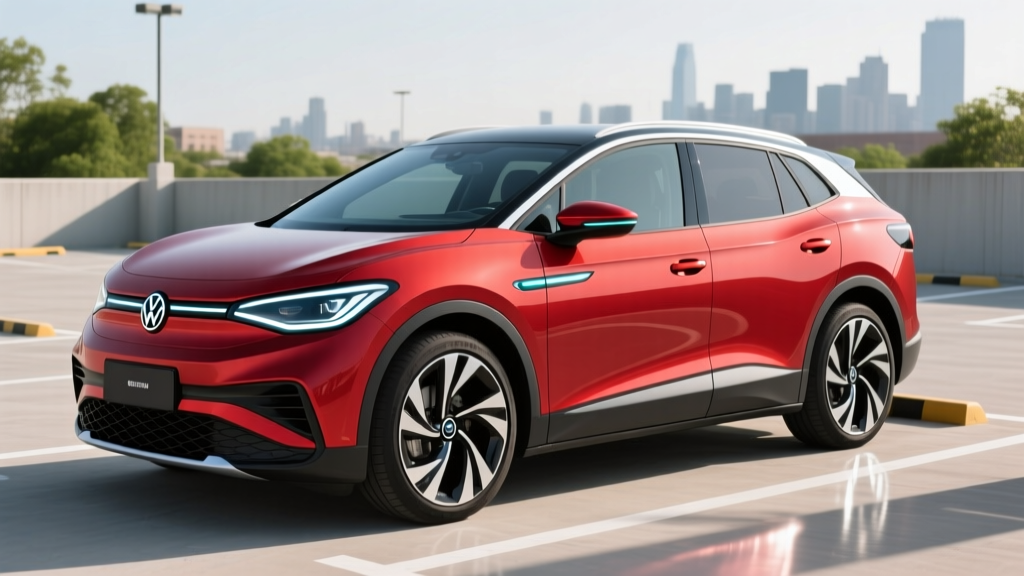
The Volkswagen ID.4 has always been a competent, if unremarkable, electric crossover. For 2025 and into the 2026 model year, VW finally addressed the single loudest complaint from owners and reviewers alike: the maddening lack of physical controls and the capacitive-touch-everything interior. The result is a cabin that feels more intuitive, more premium, and frankly more like what ID.4 buyers expected in the first place. But beyond the headline-grabbing VW ID.4 redesign physical controls update, there are meaningful changes to infotainment software, charging speed, and trim packaging that reshape the value proposition.
We spent time with the 2026 ID.4 across highway commuting, cold-weather driving, and DC fast-charging stops to deliver a data-driven verdict. Here is everything you need to know before you buy.
Quick Verdict: The ID.4 Grows Up
The 2026 ID.4 is the version Volkswagen should have launched in 2021. The return of physical volume knobs, tactile steering-wheel buttons, and an illuminated slider bar for climate and media transforms the daily ownership experience. Underneath, the 82 kWh (usable) NMC battery and 175 kW peak DC fast-charging capability remain competitive in the compact electric SUV segment. At a starting MSRP of $39,735 for the Standard Range S trim, and potentially eligible for the full $7,500 federal tax credit under IRS §30D rules, the ID.4 slots into a value sweet spot between the Hyundai Ioniq 5 and the Tesla Model Y.
EPA Estimated: 291 miles (Pro S AWD, 20" wheels)
Real-World Highway (70 mph, moderate temps): ~240–260 miles
Real-World Cold Weather (below 30°F, highway): ~200–225 miles
City/Stop-and-Go (regen-heavy): ~275–290 miles
Expect 10–15% range loss on sustained highway driving and up to 25–30% in freezing temperatures with cabin heat. The ID.4's heat pump (standard on Pro S and above) mitigates cold-weather loss compared to competitors without one.
Full Specifications at a Glance
| Spec | Pro S (RWD) | Pro S Plus (AWD) |
|---|---|---|
| EPA Range | 291 mi | 274 mi |
| Battery (Usable) | 82 kWh, NMC | 82 kWh, NMC |
| Horsepower | 282 hp | 335 hp |
| 0–60 mph | 7.3 sec | 5.4 sec |
| Drivetrain | Rear-wheel drive | Dual-motor AWD |
| Max DC Fast Charge | 175 kW | 175 kW |
| 10–80% DCFC Time | ~28 min | ~28 min |
| Level 2 Home Charge | 11 kW (AC) | 11 kW (AC) |
| MPGe (Combined) | 107 MPGe | 98 MPGe |
| Efficiency | 31 kWh/100 mi | 34 kWh/100 mi |
| Cargo (rear seats up) | 30.3 cu ft | 30.3 cu ft |
| Cargo (rear seats folded) | 64.2 cu ft | 64.2 cu ft |
| Rear Legroom | 37.6 in | 37.6 in |
| Towing Capacity | 2,200 lbs (w/ factory hitch) | 2,700 lbs (w/ factory hitch) |
| Battery Warranty | 8 yr / 100,000 mi | 8 yr / 100,000 mi |
| Base MSRP | $41,235 | $49,235 |
Sources: EPA fueleconomy.gov, Volkswagen USA. MSRP excludes destination. Specs reflect 2026 model year.
The Redesign: Physical Controls That Finally Make Sense
The core of the 2026 interior update is straightforward: Volkswagen listened. The pre-2025 ID.4 used capacitive-touch sliders for volume and climate, unlit touch-sensitive steering wheel buttons, and a small infotainment screen that felt a generation behind. The redesign replaces nearly all of that.
What changed:
- Physical volume knob — a proper rotary dial returns to the center console and on the steering wheel spoke, replacing the frustrating capacitive slider.
- Illuminated steering-wheel buttons — backlit, tactile buttons for cruise control, media, and voice commands. You can actually find them at night without looking down.
- Upgraded 12.9-inch infotainment screen — running VW's ID.Software 4.0 with faster response times, wireless Apple CarPlay/Android Auto, and a redesigned navigation interface with integrated charging route planning.
- Physical climate shortcut bar — a persistent on-screen strip with direct-access icons for seat heat, steering wheel heat, defrost, and A/C, eliminating the multi-tap nightmare of earlier models.
- Improved center console — reconfigured cupholders, a usable wireless phone charging pad (15W), and a covered storage bin.
The net effect is an interior that feels closer to the Tiguan in usability while retaining the EV-specific digital instrument cluster and minimalist aesthetic. For buyers cross-shopping the Ioniq 5 or Model Y, this removes what was previously the ID.4's most glaring weakness.
Charging: 175 kW Peak, But Watch the Curve
The 2026 ID.4 retains the 175 kW peak DC fast-charging capability introduced with the 82 kWh battery pack upgrade. At a compatible 350 kW charger (Electrify America, which VW includes 3 years of complimentary charging with purchase), the ID.4 can add roughly 70% of its battery in about 28 minutes.
| Charging Level | Power / Rate | Time / Miles Added |
|---|---|---|
| Level 1 (120V household) | ~1.4 kW | ~3–4 mi/hr |
| Level 2 (240V home, 48A) | 11 kW | ~32 mi/hr; full charge in ~8.5 hr |
| DC Fast Charge (peak) | 175 kW | 10–80% in ~28 min |
| DC Fast Charge (sustained avg) | ~110–130 kW avg | 10–80% realistic avg rate |
The charging curve reality: Peak 175 kW is achieved only between approximately 10–35% State of Charge (SoC) with a preconditioned battery. Above 50% SoC, the rate tapers to roughly 100 kW, and above 80% it drops below 50 kW. This is normal NMC battery behavior, but it means your actual average charging speed on a road trip is closer to 110–130 kW — still competitive with the Ioniq 5 (which peaks higher at 240 kW on its 800V architecture) but slower than the Hyundai's sustained curve.
Home charging setup: The ID.4's 11 kW onboard AC charger is a strong point. On a 48-amp Level 2 home circuit (requiring a 60-amp breaker), you'll recover roughly 32 miles of range per hour, meaning a depleted battery fully replenishes overnight in about 8.5 hours. This is faster than the base Tesla Model Y's 11.5 kW rate and adequate for daily use. Budget $500–$1,500 for a quality Level 2 home charger installation depending on your panel capacity and run length — confirm amperage requirements with a licensed electrician.
Performance and Driving Impressions
The single-motor RWD Pro S produces 282 horsepower and reaches 60 mph in 7.3 seconds — adequate for merging and passing but not exciting. The dual-motor AWD Pro S Plus bumps output to 335 hp with a 5.4-second sprint, which feels genuinely quick in a family crossover.
Ride quality remains one of the ID.4's strongest attributes. The MEB platform delivers a low center of gravity, compliant suspension tuning, and impressively quiet cabin isolation at highway speeds. The turning circle (31.5 feet on RWD) is remarkably tight for a compact SUV, making it genuinely easy to park in urban environments.
Regenerative braking: VW offers three regen levels via paddle shifters (D, B, and an adaptive mode). The B mode provides strong one-pedal-like deceleration but does not bring the car to a complete hold — you still need the brake pedal at stoplights. This is a deliberate engineering choice, but it disappoints EV veterans accustomed to full one-pedal driving in vehicles like the Chevrolet Equinox EV or Model Y.
Pricing, Trims, and Federal Tax Credit Eligibility
| Trim | Drivetrain | MSRP | After Est. §30D Credit* |
|---|---|---|---|
| Standard Range S | RWD | $39,735 | ~$32,235 |
| Pro | RWD | $41,235 | ~$33,735 |
| Pro S | RWD | $45,735 | ~$38,235 |
| Pro S Plus | AWD | $49,235 | ~$41,735 |
| Pro S Plus w/ Gradient Pkg | AWD | $52,735 | ~$45,235 |
*Federal tax credit estimates assume full eligibility. Actual credit amount depends on battery sourcing compliance, buyer income, and MSRP caps. Always verify with a tax professional and consult IRS §30D guidelines.
§30D Tax Credit Eligibility Checklist
- MSRP cap: The ID.4 qualifies as an SUV under IRS rules (MSRP cap: $80,000). All current trims fall well below this threshold. ✅
- Buyer income cap: Modified AGI must not exceed $150,000 (single), $225,000 (head of household), or $300,000 (joint). Check your prior-year or current-year MAGI.
- Battery sourcing: The ID.4's battery is assembled using cells from SK On, with critical mineral and component sourcing that has met §30D requirements for the full $7,500 credit in recent model years. VW confirms continued compliance for 2026, but always verify the specific VIN with your dealer and the fueleconomy.gov credit lookup tool.
- Point-of-sale transfer: As of 2024, the credit can be transferred to the dealer at purchase, reducing your out-of-pocket cost immediately rather than waiting for a tax refund. This is available on the ID.4.
- Final assembly: The ID.4 for the U.S. market is assembled in Chattanooga, Tennessee. ✅
Driver Assistance and Safety Technology
The 2026 ID.4 comes equipped with Volkswagen's IQ.DRIVE suite as standard across all trims:
- Travel Assist: Adaptive cruise control with lane-centering — functional on highways and well-marked roads. This is an SAE Level 2 system, meaning the driver must remain fully engaged with hands on the wheel and eyes on the road at all times.
- Front Assist: Automatic emergency braking with pedestrian detection.
- Lane Assist: Lane-keeping support with gentle steering correction.
- Park Assist Plus: Automated parking with memory function for repeated spots (available on Pro S and above).
VW's Travel Assist is a driver-assistance system, not an autonomous driving feature. It does not handle construction zones, unmapped roads, or complex intersections. You must supervise at all times. This is comparable to Toyota Safety Sense and Honda Sensing, and below the hands-off capability of GM's Super Cruise (Level 2+ on mapped highways). Do not confuse this with Level 4 robotaxi services like Waymo.
The ID.4 earned the IIHS Top Safety Pick+ designation for the prior model year, with "Good" ratings across all crash-test categories. NHTSA awarded it a 5-star overall safety rating. Expect the 2026 model to carry forward these ratings given the structural carryover.
Pros and Cons
- Physical controls finally fix the biggest usability complaint
- Competitive EPA range (291 mi RWD) at a strong price point
- Excellent ride quality and cabin quietness
- Standard heat pump on Pro S and above
- U.S.-built (Chattanooga, TN) with strong §30D credit eligibility
- Tight turning circle for urban driving
- 3 years complimentary Electrify America charging
- 175 kW peak DCFC is slower than Ioniq 5 (240 kW) and Model Y (~250 kW)
- No full one-pedal driving (regen doesn't hold at 0 mph)
- AWD range drops to 274 mi — noticeable on road trips
- No front trunk (frunk) — cargo space is rear-only
- Rear drum brakes (cost-saving measure, though low maintenance)
- Infotainment still slightly behind Tesla/Hyundai in responsiveness
Who Should Buy the 2026 VW ID.4?
Choose the ID.4 if:
- You want a mainstream EV from a legacy brand with a large dealer network
- Home Level 2 charging is your primary routine and road trips are occasional
- You value ride comfort and cabin quietness over sporty performance
- You want a physical-knob, tactile-button interior without going full Tesla-minimalist
- Federal tax credit eligibility is important to your purchase math
Look elsewhere if:
- DC fast-charging speed is your top priority (consider Ioniq 5 or EV6 with 800V architecture)
- You need maximum range for frequent 300+ mile road trips (consider Model Y Long Range at 330+ mi)
- You want hands-off highway driving assist (consider GM vehicles with Super Cruise)
- You need a frunk for additional cargo flexibility
Frequently Asked Questions
What is the real-world range of the 2026 VW ID.4?
The EPA rates the ID.4 Pro S (RWD) at 291 miles. In real-world highway driving at 70 mph in moderate temperatures, expect 240–260 miles. In cold weather below 30°F with cabin heating, plan for 200–225 miles. The standard heat pump on Pro S trims helps mitigate cold-weather range loss compared to EVs without one.
How fast does the ID.4 charge at home and on the road?
On a 48-amp Level 2 home charger, the ID.4 charges at 11 kW, adding about 32 miles per hour and fully recharging overnight in roughly 8.5 hours. On a DC fast charger, it peaks at 175 kW and can go from 10–80% in approximately 28 minutes with a preconditioned battery. Average sustained DCFC rate is closer to 110–130 kW due to the charging curve taper above 50% SoC.
Does the 2026 VW ID.4 qualify for the federal EV tax credit?
Yes, the ID.4 is expected to qualify for the full $7,500 federal tax credit under IRS §30D for the 2026 model year, as it is assembled in Tennessee and meets battery sourcing requirements. However, eligibility depends on your income (MAGI caps apply), the vehicle's MSRP (must be under $80,000 for SUVs — all trims qualify), and specific battery component sourcing. The credit can be applied at point of sale. Verify your specific eligibility with the IRS or a tax professional.
Is the VW ID.4 worth buying over the Hyundai Ioniq 5 or Tesla Model Y?
It depends on priorities. The ID.4 wins on ride comfort, cabin quietness, and now interior usability with the physical controls redesign. The Ioniq 5 charges significantly faster (240 kW peak, 800V architecture) and has a more distinctive design. The Model Y offers the longest range, best charging network access, and most advanced software, but a firmer ride and polarizing minimalism. For buyers who prioritize comfort and value over performance and charging speed, the ID.4 is a strong pick.
Does the ID.4 have a front trunk (frunk)?
No. The ID.4 does not have a front trunk. All cargo space is in the rear: 30.3 cubic feet behind the second row and 64.2 cubic feet with the rear seats folded. This is a packaging limitation of the MEB platform compared to dedicated EV architectures like Hyundai's E-GMP.
What is the battery warranty on the 2026 ID.4?
Volkswagen covers the ID.4's high-voltage battery for 8 years or 100,000 miles, whichever comes first. The warranty guarantees the battery will retain at least 70% of its original capacity during that period. The general vehicle warranty is 4 years / 50,000 miles.
For the latest EPA data, visit fueleconomy.gov. For current tax credit rules, consult IRS.gov §30D. Safety ratings: NHTSA / IIHS.