The Quick Answer: Are EVs Practical in Africa?
Electric vehicles in Africa are viable in 2026 — but only for specific use cases. If you live in a major metro area (Nairobi, Johannesburg, Cape Town, Accra, Cairo) with access to home solar or reliable grid power and a daily commute under 150 km, an EV can cut your per-kilometer fuel cost by 40–65% compared to petrol. If you regularly drive long intercity routes, live in areas with frequent load-shedding or grid instability, or lack secure parking for home charging, a hybrid (HEV or PHEV) remains the more practical choice today. The charging network is growing — South Africa alone has over 600 public chargers as of early 2026 — but coverage outside urban corridors is still sparse.
Where EVs Actually Work on the Continent
The phrase "electric vehicles in Africa" covers 54 countries with wildly different infrastructure realities. Lumping them together obscures more than it reveals. Here's how the landscape breaks down by region and readiness:
South Africa leads the continent in EV infrastructure. The national charging network, anchored by operators like GridCars and ElectroSA, includes roughly 600+ public AC and DC chargers concentrated along the N1 (Johannesburg–Cape Town), N3 (Johannesburg–Durban), and Garden Route corridors. DC fast chargers peak at 60–150 kW at major stops. Eskom's grid instability (load-shedding stages 2–4 in 2025–2026) remains the biggest wildcard — a home solar-plus-battery system (R150,000–R300,000 installed) largely solves this but adds significant upfront cost.
Kenya has emerged as a surprising EV hub, driven by Nairobi's tech-forward ecosystem and relatively low electricity tariffs (~KSh 23/kWh or ~$0.18/kWh for residential). Companies like BasiGo are electrifying bus fleets, and a small but growing number of private EV owners charge at home or at a handful of public stations. The government reduced excise duty on EVs to 10% (from 20%) in the 2023 Finance Act, making imports more affordable.
Egypt benefits from heavily subsidized electricity and government incentives for locally assembled EVs. Cairo's traffic congestion actually favors EVs — regenerative braking recaptures energy in stop-and-go conditions, and zero tailpipe emissions matter in a city with severe air quality issues. Infinity Power and other operators have deployed several hundred public chargers across Greater Cairo and the North Coast.
Morocco is positioning itself as an EV manufacturing hub (Stellantis and BYD have production facilities), with a growing domestic charging network along the autoroute system connecting Casablanca, Rabat, Marrakech, and Tangier.
Rest of continent: Outside these markets, public charging infrastructure ranges from minimal to nonexistent. EV ownership is possible but requires self-sufficiency — home solar charging is essentially mandatory.
Real Costs: EV vs Petrol vs Hybrid in Africa
The purchase price of EVs in most African markets remains significantly higher than comparable petrol cars due to import duties, shipping costs, and low volume. But the running-cost equation often flips dramatically in the EV's favor — especially where petrol prices are high and electricity is cheap.
| Category | Petrol SUV (e.g., Toyota RAV4 2.5L) | Hybrid (RAV4 Hybrid) | EV (BYD Atto 3 / Omoda E5) |
|---|---|---|---|
| Purchase price (approx.) | R 650,000 | R 750,000 | R 700,000–R 850,000 |
| Fuel/energy cost (100,000 km) | R 135,000 (8.5 L/100 km @ R24/L) | R 82,000 (5.2 L/100 km @ R24/L) | R 28,000–R 42,000 (16 kWh/100 km @ R2.50–R4.00/kWh) |
| Maintenance (5 years) | R 45,000 | R 40,000 | R 18,000 (no oil, fewer brake changes) |
| Insurance (5 years, avg.) | R 75,000 | R 80,000 | R 95,000 (higher premiums typical) |
| Home solar install (if needed) | — | — | R 150,000–R 250,000 (shared benefit) |
| 5-Year Total (excl. solar) | R 905,000 | R 952,000 | R 841,000–R 1,005,000 |
The numbers reveal a nuanced picture. If you already have home solar or access to cheap grid power, the EV wins on running costs — the per-kilometer energy cost is roughly R0.28–R0.42 versus R1.15 for petrol. But the higher purchase price and insurance premiums mean the break-even point typically arrives around year 4–5, depending on annual mileage. If you drive less than 10,000 km/year, a hybrid may be the more cost-effective choice.
Which EVs Are Actually Available — and What Do They Cost?
The African EV market in 2026 is dominated by Chinese manufacturers offering relatively affordable models, alongside premium offerings from European brands. Here are the most relevant models with real specs:
| Model | Battery (kWh) | Range (WLTP) | DC Fast Charge (peak kW) | 10–80% Time | Approx. Price (ZAR/KES) |
|---|---|---|---|---|---|
| BYD Atto 3 (Extended) | 60.5 kWh (LFP Blade) | 420 km | 88 kW | ~29 min | R 720,000 / KES 5.8M |
| BYD Dolphin | 60.4 kWh (LFP Blade) | 427 km | 88 kW | ~29 min | R 560,000 / KES 4.5M |
| Omoda E5 | 61 kWh (LFP) | 430 km | 80 kW | ~32 min | R 680,000 |
| GWM Ora 03 (Good Cat) | 63 kWh (NMC) | 400 km | 67 kW | ~40 min | R 650,000 |
| Volvo EX30 (Single Motor) | 69 kWh (NMC) | 344 km (WLTP) | 153 kW | ~25 min | R 830,000 |
| BMW iX1 (eDrive20) | 64.7 kWh (NMC) | 430 km | 130 kW | ~29 min | R 1,150,000 |
| Mercedes EQA 250+ | 66.6 kWh (NMC) | 420 km | 100 kW | ~32 min | R 1,250,000 |
A few things jump out from this data. First, most affordable models peak at 67–88 kW on DC fast charging — adequate for urban life but noticeably slow on long road trips compared to 200+ kW vehicles sold in North America and Europe. Second, LFP (lithium iron phosphate) batteries dominate the affordable segment. LFP is well-suited to African conditions: it handles heat better than NMC, tolerates regular 100% charging without accelerated degradation, and avoids cobalt/nickel supply-chain concerns. The trade-off is lower energy density (heavier for the same range) and weaker cold-weather performance — though cold weather is rarely a concern in most of Africa.
Range figures above are WLTP, which tend to run 10–15% higher than real-world highway driving. For a BYD Atto 3 with a 420 km WLTP rating, expect roughly 320–350 km of real-world mixed driving and as low as 280–300 km at sustained 120 km/h highway speeds in hot conditions with air conditioning running.
Charging Infrastructure: The Honest Picture
Charging access is the single biggest variable determining whether electric vehicles in Africa are practical for your situation. Here's what the infrastructure actually looks like:
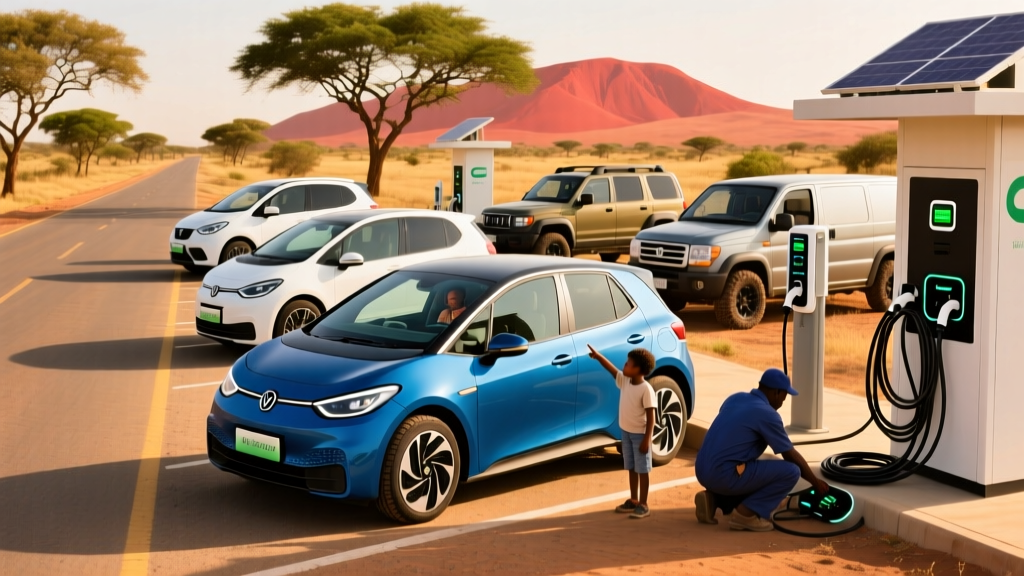
Home charging (Level 2, 7 kW AC): This is where 80–90% of African EV charging happens. A standard 7 kW wallbox (R8,000–R15,000 for the unit, R5,000–R15,000 for installation) adds roughly 40–50 km of range per hour. A full overnight charge covers most daily commutes. The critical requirement: you need a dedicated 30A circuit and reliable grid power. In load-shedding-prone areas, pairing a wallbox with a home inverter/battery system (5–10 kWh, R80,000–R200,000) or solar panels (5 kW system, R80,000–R120,000) is strongly recommended.
Public DC fast charging (50–150 kW): South Africa's network is the most developed, with GridCars and ElectroSA operating chargers along major highways. Expect to pay R4.50–R6.50/kWh at public DC stations — significantly more than home electricity but still cheaper per kilometer than petrol. Kenya's network is smaller but growing, with chargers in Nairobi, Mombasa, and along the Nairobi–Nakuru corridor. Egypt has a more extensive network through Infinity and other operators.
Public AC charging (7–22 kW): Available at some malls, hotels, and office parks in major cities. Useful for top-ups during the workday but too slow for meaningful road-trip charging.
The reality gap: Outside major metros and highway corridors, public charging is essentially absent. A road trip from Johannesburg to Maputo, or Nairobi to Mombasa, requires careful planning and may involve stretches of 200+ km with no public chargers. This is improving, but slowly.
Real-World Ownership: What First-Time African EV Buyers Must Know
Based on ownership patterns across South Africa, Kenya, and Egypt, here are the practical realities that brochures don't cover:
Heat and battery health: African heat is generally less harmful to batteries than extreme cold (which saps range dramatically). However, sustained ambient temperatures above 35°C combined with frequent DC fast charging can accelerate degradation over 5–8 years. LFP batteries handle heat better than NMC. Most manufacturers provide an 8-year/160,000 km battery warranty guaranteeing at least 70% capacity retention — read the fine print on what voids it.
Grid instability: If your area experiences regular load-shedding or brownouts, you need a backup plan. Options include a home battery system (Tesla Powerwall, Sunsynk, or similar) that can charge the car during outages, or timing charges to off-peak hours when the grid is stable. Some EV owners in South Africa report using their vehicle's battery as a de facto home backup via V2L (vehicle-to-load) adapters — the BYD Atto 3 and Dolphin both support this, delivering up to 3.3 kW of AC power to run household appliances during outages.
Service and parts: EV service networks in Africa are thin. BYD, Volvo, and BMW have the most established dealer support in South Africa and Kenya. For less common brands, expect longer wait times for parts and fewer qualified technicians. This is a genuine ownership risk — factor it into your decision.
Resale value: The used EV market in Africa is immature. Depreciation curves are hard to predict because transaction volumes are low. Early data from South Africa suggests EVs depreciate faster than popular petrol/hybrid models (Toyota, VW) in the first 3 years, partly due to buyer skepticism and limited demand. This may stabilize as the market grows.
Myths vs Facts: Clearing Up Common Misconceptions
| Myth | Fact |
|---|---|
| "EVs can't handle African roads and heat." | Modern EVs are tested to operate in –30°C to +50°C. Heat is actually less damaging to range than cold. Ground clearance and suspension are model-dependent, not EV-specific — a BYD Atto 3 has 175 mm clearance, comparable to many crossovers. |
| "There's nowhere to charge." | Home charging covers 80%+ of daily needs for most owners. The real gap is long-distance intercity charging — and that's improving, especially in South Africa, Egypt, Morocco, and Kenya. |
| "EV batteries won't last and replacement costs a fortune." | LFP batteries (in most affordable models) are rated for 3,000+ charge cycles before reaching 80% capacity — that's 1.2+ million km. Replacement costs are high ($8,000–$15,000 equivalent) but rarely needed within the vehicle's practical lifespan. |
| "EVs are worse for the environment because the grid runs on coal." | South Africa's grid is ~80% coal, but an EV on Eskom power still produces roughly 30–40% fewer lifecycle CO₂ emissions than an equivalent petrol car (per IEA lifecycle analyses). In Kenya (~90% geothermal/hydro) or Morocco (~40% renewables), the advantage is much larger. And grids are getting cleaner over time. |
| "You need a Tesla to own an EV." | Tesla does not officially sell vehicles in most African markets. The most popular EVs are BYD, GWM, Omoda, Volvo, and BMW — with Chinese brands dominating the affordable segment. |
Decision Framework: Should You Buy an EV, Hybrid, or Stick with Petrol?
Use this to determine the right powertrain for your situation:
Choose a full EV (BEV) if:
- Your daily driving is under 150 km round-trip
- You have secure home parking where you can install a Level 2 charger
- You have solar panels or a home battery to manage grid instability
- You rarely drive routes longer than 300 km one-way (or are willing to plan charging stops)
- You live in or near a major metro with some public charging backup
- You want the lowest per-kilometer running cost and don't mind the higher upfront price
Choose a plug-in hybrid (PHEV) if:
- You want electric-only commuting (typically 40–70 km range) but need petrol flexibility for long trips
- Your area has frequent grid outages and you lack solar/battery backup
- You regularly drive 300+ km routes with no charging infrastructure
- You want to reduce fuel costs without range-anxiety risk
Choose a conventional hybrid (HEV) if:
- You cannot install a home charger (apartment living, no secure parking)
- Your driving pattern is unpredictable and often long-distance
- You want better fuel economy with zero behavioral change
- You're in a region with no public charging and no plans to install home charging
Stick with petrol/diesel if:
- You drive in extremely remote areas regularly (rural routes, cross-border trips to neighboring countries with no infrastructure)
- Your budget is constrained and upfront cost is the top priority
- You need a vehicle type not yet available as an EV in your market (certain bakkies/LCVs, heavy SUVs for off-road use)
Tax, Import Duties, and Incentives
Unlike the US (where the IRS §30D credit offers up to $7,500 for qualifying EVs), most African countries do not yet have direct purchase subsidies for individual EV buyers. However, several markets have reduced import duties or excise taxes:
- Kenya: Excise duty on EVs reduced to 10% (from 20%) as of the 2023 Finance Act. VAT still applies at 16%.
- South Africa: No direct EV purchase incentive as of 2026. EVs face the same ad valorem luxury tax and VAT as ICE vehicles. Industry groups have lobbied for tax relief, but no legislation has passed. The Department of Trade, Industry and Competition published a policy paper in 2024 signaling future incentives, but implementation remains pending.
- Egypt: Reduced customs duties on EVs (down to 0–5% for fully electric vehicles, compared to 40–135% for petrol cars depending on engine size). This makes EVs relatively more competitive in Egypt than in most African markets.
- Morocco: Exemption from the "vignette" (annual vehicle tax) for electric vehicles. Some municipal parking incentives in Casablanca and Rabat.
- Rwanda: VAT exemption on EVs and charging equipment since 2021, one of the most progressive EV policies on the continent.
Always verify current incentive status with your country's revenue authority — these policies change frequently and may have conditions (e.g., locally assembled vs imported).
Frequently Asked Questions
Can I charge an EV from a standard household outlet in Africa?
Yes, but slowly. A standard 220V/15A outlet delivers roughly 3.3 kW (Level 1), adding about 15–20 km of range per hour. A full charge from empty would take 18–24 hours for a 60 kWh battery. This works for overnight top-ups if your daily driving is under 80 km, but a dedicated Level 2 wallbox (7 kW) is strongly recommended for regular use. Ensure your wiring can handle sustained 15A draw — many older African homes have wiring that cannot safely deliver this for 8+ hours continuously.
How do I handle load-shedding with an EV in South Africa?
Three approaches: (1) Install a home battery/inverter system (5–10 kWh) that keeps your charger running during outages — cost R80,000–R200,000 depending on capacity. (2) Use your EV's scheduled charging feature to charge only during known stable grid windows (typically late night/early morning). (3) Use V2L (vehicle-to-load) to power essential home circuits from your EV's battery during outages — the BYD Atto 3, Dolphin, and some other models support this with a ~R3,000 adapter. A 60 kWh battery can power essential home loads for 2–3 days.
What's the real-world range of a BYD Atto 3 on African highways?
The BYD Atto 3 Extended Range has a 60.5 kWh LFP battery and a WLTP range of 420 km. In real-world South African highway driving at 110–120 km/h with A/C on (ambient 30–35°C), expect approximately 300–330 km before needing to charge. At more conservative speeds (90–100 km/h), you can stretch this to 350–370 km. This is sufficient for most daily driving but requires planning for Johannesburg–Durban (570 km) or Nairobi–Mombasa (480 km) trips.
Are EV insurance premiums really higher in Africa?
Yes, typically 15–30% higher than equivalent petrol vehicles. Insurers cite higher repair costs (specialized body shops, expensive battery replacement if damaged), limited claims data, and higher vehicle values. In South Africa, expect comprehensive premiums of roughly 3.5–4.5% of vehicle value annually for an EV, versus 2.5–3.5% for a comparable petrol SUV. Some insurers (OUTsurance, Discovery Insure in SA) have started offering EV-specific products — shop around.
Can I take an EV on a cross-border road trip in Africa?
With careful planning, yes — but options are limited. South Africa to Namibia (via the N7 to Windhoek, ~1,500 km) is feasible using chargers in Cape Town, Springbok, and Windhoek, but requires multiple overnight charging stops. South Africa to Mozambique (Maputo) is possible with chargers in Maputo, but the route between has gaps. Cross-border trips into Zimbabwe, Botswana, or deeper into the continent are not practical with current infrastructure. Always carry a portable Level 1 charger and verify charger operational status via apps like PlugShare before departing.
Sources: Vehicle specifications from BYD Auto and Volvo Cars official spec sheets. South African charging data from GridCars network. Kenya EV policy from the Kenya Revenue Authority. Electricity tariff data from Eskom and Kenya Power. IEA lifecycle emissions data from the IEA Global EV Outlook.