Quick Verdict: The Sensible Electric Crossover
The Volkswagen ID.4 occupies a specific niche in the EV market: the practical, no-drama electric compact crossover. It isn't the quickest in its class, doesn't boast the longest range, and its infotainment still frustrates. But for buyers who want a spacious, comfortable EV with competitive charging speeds, strong safety credentials, and a price that undercuts rivals like the Hyundai Ioniq 5 and Ford Mustang Mach-E, the ID.4 makes a compelling case — especially when federal tax credits apply.
For 2026, VW continues to refine the ID.4 with incremental software and packaging updates, while the core hardware — a 77 kWh usable NMC battery, available rear-wheel or all-wheel drive, and up to 170 kW DC fast charging — remains a proven, if conservative, formula. Let's break down exactly what you get.
Range and Efficiency: EPA vs. the Real World
EPA Estimated: 275 miles (RWD Pro S) / 263 miles (AWD Pro S)
Real-World Highway (70 mph): ~220–240 miles
Cold Weather (below 32°F): ~190–215 miles (mixed driving)
City/Commute Driving: Often meets or slightly exceeds EPA due to regen efficiency
The ID.4's EPA range of 275 miles for the rear-wheel-drive Pro S trim is competitive but not class-leading. The Hyundai Ioniq 5 Long Range delivers 311 miles, and the Tesla Model Y Long Range pushes past 310. However, EPA numbers rarely tell the full story.
In sustained highway driving at 70 mph with climate control running, expect to use between 28 and 32 kWh per 100 miles depending on temperature and terrain. That translates to roughly 220–240 miles before you'll want to stop. In cold weather — say, a January commute in Chicago — lithium-ion chemistry becomes less efficient, cabin heating draws significant power (the ID.4 uses a heat pump on most trims, which helps), and you'll see range drop to approximately 190–215 miles on a full charge.
Efficiency on the combined cycle sits at approximately 104 MPGe (RWD) per fueleconomy.gov, or about 32 kWh/100 mi. That's respectable but trails the Ioniq 5 and Model Y, both of which achieve around 110–120 MPGe combined.
| Spec | RWD Pro S | AWD Pro S Plus |
|---|---|---|
| EPA Range | 275 mi | 263 mi |
| Battery (usable) | 77 kWh NMC | 77 kWh NMC |
| Max DC Charge Rate | 170 kW | 170 kW |
| 10–80% DC Fast Charge | ~30 min | ~30 min |
| Level 2 Home Charging | 11 kW (~37 mi/hr) | 11 kW (~37 mi/hr) |
| Horsepower | 282 hp | 335 hp |
| 0–60 mph | 7.3 sec | 5.4 sec |
| MPGe (combined) | 104 MPGe | 101 MPGe |
| Base MSRP | $44,995 | $52,495 |
| Battery/Powertrain Warranty | 8 yr / 100,000 mi | 8 yr / 100,000 mi |
Charging Speed: Home and DC Fast Charging
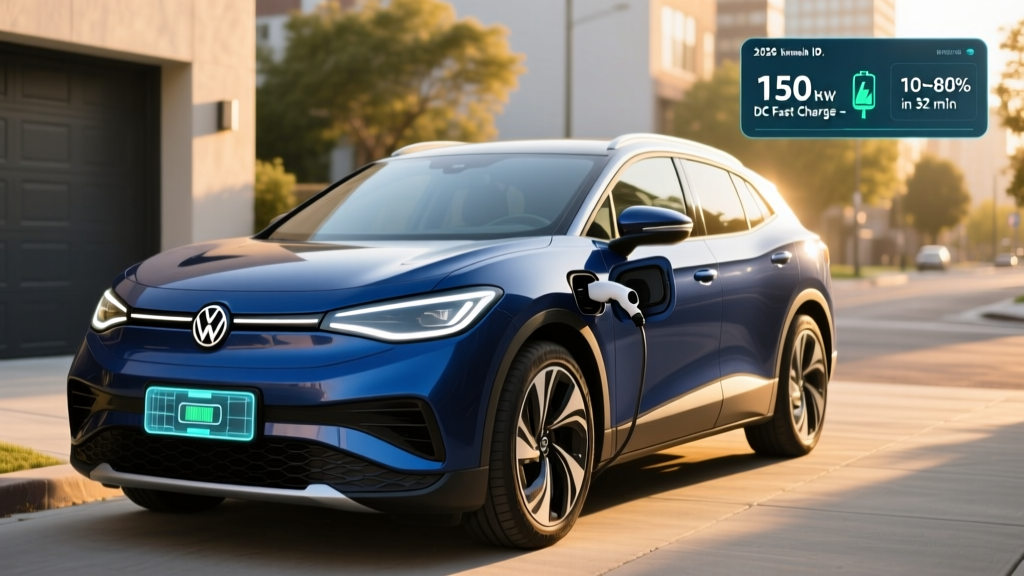
Charging is where the ID.4 delivers adequate but not exceptional performance. The 170 kW peak DC fast-charge rate means you can add roughly 70% of the battery (10–80%) in about 30 minutes at a compatible station. That's slower than the Ioniq 5's 800V architecture (10–80% in ~18 min at 240 kW) and the Tesla Model Y (~15 min on a V3 Supercharger), but it's perfectly serviceable for road-trip stops.
One important detail: the ID.4's charge curve tapers noticeably above 80% state of charge. If you need to charge to 100% on a road trip, budget an additional 20–25 minutes for that final 20%. For daily driving, charging to 80% at home is recommended for long-term battery health with NMC chemistry.
| Level | Power | Miles Added per Hour | Use Case |
|---|---|---|---|
| Level 1 (120V) | ~1.4 kW | ~4–5 mi/hr | Overnight trickle, emergencies |
| Level 2 (240V, 48A) | 11 kW | ~37 mi/hr | Home daily charging (~7 hr full) |
| DC Fast Charge | 170 kW peak | ~190 mi in 30 min (10–80%) | Road trips, public stations |
At home on a Level 2 charger (NACS connector for 2026 models, with CCS1 adapters still compatible at many public networks), a full charge from empty takes roughly 7 hours. For most owners who plug in nightly and drive 30–50 miles daily, the ID.4 will be topped up by morning without issue. Installation of a home Level 2 charger typically costs $500–$2,000 depending on panel capacity and run length — consult a licensed electrician for your specific setup.
Performance and Driving Dynamics
The rear-wheel-drive ID.4 produces 282 horsepower from its single rear motor, delivering a 0–60 mph time of 7.3 seconds. That's leisurely by EV standards — the Ioniq 5 RWD hits 60 in about 7.0 seconds, and the Model Y RWD in roughly 6.5. However, the ID.4's torque delivery is smooth and immediate from a stop, making it feel quicker in city driving than the stopwatch suggests.
Step up to the AWD Pro S Plus with dual motors and you get 335 hp and a 0–60 time of 5.4 seconds. The dual-motor setup also adds genuine all-weather capability with torque vectoring to the rear axle. Ride quality is a genuine strength: the ID.4 is tuned for comfort over sportiness, soaking up potholes and highway expansion joints with a composure that rivals the best in class. Steering is light and predictable, if lacking in feedback.
Regenerative braking offers multiple levels via steering-wheel paddles, but the ID.4 does not offer true one-pedal driving in the way a Nissan Leaf or Chevrolet Bolt does. You'll still need to use the brake pedal for full stops — a minor frustration for EV veterans accustomed to aggressive regen.
Interior Space, Cargo, and Technology
The ID.4's interior is where it makes one of its strongest arguments. Rear-seat legroom measures 37.6 inches, which is generous for the compact crossover segment — adults ride comfortably in back, and rear-facing child seats install without front-seat compromise. Cargo volume behind the second row is 30.3 cubic feet, expanding to 64.2 cubic feet with the rear seats folded. That's competitive with the RAV4 and CR-V in terms of utility, though the ID.4 lacks a front trunk (frunk) — the space is occupied by HVAC and electronics components on the MEB platform.
The 12.9-inch infotainment touchscreen (upgraded from earlier 12-inch units) runs VW's ID.Software 4.x, which has improved responsiveness and menu logic over the launch-version software. Wireless Apple CarPlay and Android Auto are standard. However, VW's reliance on capacitive touch sliders for volume and climate temperature — rather than physical knobs — remains a usability complaint shared by owners and reviewers alike. The sliders are unlit on lower trims, making nighttime adjustments frustrating.
On the driver-assistance front, the ID.4 comes standard with VW IQ.DRIVE, a suite of Level 2 (SAE) driver-assistance features including adaptive cruise control with stop-and-go, lane centering, automatic emergency braking, and blind-spot monitoring. This is not a hands-free system like GM's Super Cruise or Ford's BlueCruise — you must keep your hands on the wheel. Travel Assist, VW's combined lane-centering and adaptive cruise function, works well on highways but requires consistent driver engagement, as all Level 2 systems do.
Pricing, Trims, and Federal Tax Credit Eligibility
The 2026 VW ID.4 lineup is structured across several trims, with pricing that positions it as a value-oriented option in the electric crossover segment:
| Trim | MSRP | Est. After §30D Credit* |
|---|---|---|
| Pro (RWD) | $39,995 | ~$32,495 |
| Pro S (RWD) | $44,995 | ~$37,495 |
| AWD Pro | $47,995 | ~$40,495 |
| AWD Pro S Plus | $52,495 | ~$44,995 |
*Federal tax credit estimates assume full §30D eligibility. Actual credit depends on battery sourcing, buyer income, and MSRP caps. See checklist below.
The ID.4 is assembled at VW's Chattanooga, Tennessee plant, which has historically helped it meet the North American assembly requirement of the IRS §30D clean vehicle credit. However, the full $7,500 credit depends on meeting both critical-mineral and battery-component sourcing thresholds that the IRS updates annually. As of 2026, buyers should verify current eligibility on the IRS website or with a tax professional before relying on the credit in their purchase decision.
- MSRP Cap: SUVs/crossovers must be under $80,000 MSRP — all ID.4 trims qualify ✓
- Buyer Income Cap: AGI must not exceed $150K (single), $225K (head of household), $300K (joint) — verify against your tax return
- North American Assembly: ID.4 is built in Chattanooga, TN ✓
- Battery Sourcing: Critical minerals and battery components must meet phased-in thresholds — check IRS.gov for current-year battery compliance
- Point-of-Sale Transfer: Eligible buyers can transfer the credit to the dealer at purchase for an immediate price reduction
Pros, Cons, and Who Should Buy the ID.4
- Comfortable ride quality and quiet cabin
- Spacious rear seat and competitive cargo volume
- Strong safety ratings (IIHS Top Safety Pick+)
- Competitive pricing before and after tax credits
- Heat pump standard on most trims (cold-weather efficiency)
- U.S.-built, supporting §30D credit eligibility
- Infotainment touch sliders are frustrating, especially at night
- DC fast charging slower than Ioniq 5 and Model Y
- No front trunk (frunk)
- No true one-pedal driving mode
- Range trails key competitors by 25–40 miles
- RWD acceleration is unremarkable for an EV
Who the ID.4 suits best: The ID.4 is ideal for families and commuters who prioritize comfort, interior space, and value over cutting-edge performance or maximum range. If your daily drive is under 50 miles with home charging available, and you take a handful of road trips per year where 30-minute DC fast-charge stops are acceptable, the ID.4 delivers an excellent ownership experience. It's less suited for buyers who want the fastest possible charging (look at the Ioniq 5), the longest range (Model Y Long Range), or sporty driving dynamics (BMW iX or even the Mach-E GT).
How the ID.4 Stacks Up Against Competitors
The compact electric crossover segment is crowded, and the ID.4 faces direct competition from several strong alternatives:
- Hyundai Ioniq 5: Faster charging (800V, ~18 min 10–80%), longer range (311 mi), more distinctive design. Slightly less rear-seat room. Better for road-trip-heavy buyers.
- Tesla Model Y: Longest range in class (~310+ mi), fastest Supercharger network access, best efficiency. Ride quality is firmer, and build quality varies. Better for efficiency-focused buyers and Tesla ecosystem users.
- Ford Mustang Mach-E: More engaging to drive, sportier design, competitive range. Less cargo space. Better for driving-enthusiast buyers.
- Kia EV6: Shares the Ioniq 5's 800V platform and fast charging. Slightly less rear-seat room. A strong alternative if you prefer Kia's styling and dealer network.
Frequently Asked Questions
What is the real-world range of the VW ID.4?
The EPA rates the RWD ID.4 Pro S at 275 miles, but in real-world highway driving at 70 mph, expect approximately 220–240 miles. In cold weather below freezing, that drops to roughly 190–215 miles. City commuters using regenerative braking may meet or slightly exceed the EPA figure.
How fast does the VW ID.4 charge at home and on the road?
On a Level 2 home charger (240V, 48A), the ID.4 charges at up to 11 kW, adding about 37 miles of range per hour — a full charge takes roughly 7 hours. On a DC fast charger, it peaks at 170 kW and can go from 10–80% in about 30 minutes at a compatible station.
How much does the VW ID.4 cost after the federal tax credit?
If you qualify for the full $7,500 §30D credit, the base Pro trim drops to approximately $32,495 and the well-equipped Pro S RWD to around $37,495. Eligibility depends on your income, the vehicle's battery sourcing compliance, and MSRP caps (all ID.4 trims fall under the $80K SUV cap). Verify current-year rules at IRS.gov or consult a tax professional.
Is the VW ID.4 worth buying over the Tesla Model Y or Hyundai Ioniq 5?
It depends on your priorities. The ID.4 wins on ride comfort, interior space, and value pricing after tax credits. The Model Y offers superior range and charging infrastructure; the Ioniq 5 charges significantly faster. If comfort and price matter most, the ID.4 is a strong pick. If range and charging speed are your top concerns, test-drive the competitors.
Does the VW ID.4 qualify for the full $7,500 federal EV tax credit?
The ID.4 is assembled in Chattanooga, TN, meeting the North American assembly requirement. Whether it qualifies for the full $7,500, a partial $3,750, or no credit depends on the current-year battery critical-mineral and component sourcing thresholds set by the IRS, as well as your personal income. Always check the latest IRS guidance before purchasing.
What is the battery warranty on the VW ID.4?
Volkswagen covers the ID.4's high-voltage battery and electric powertrain for 8 years or 100,000 miles, whichever comes first. The warranty guarantees the battery will retain at least 70% of its original capacity during that period — consistent with industry norms from Hyundai, Kia, Ford, and Tesla.