Quick Verdict: The Sensible Electric Crossover
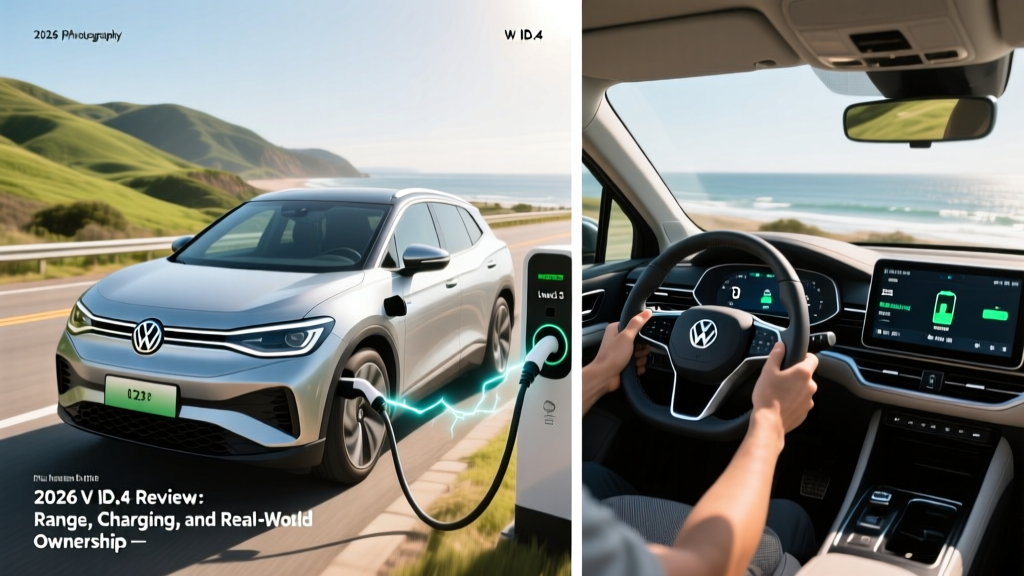
The Volkswagen ID.4 doesn't try to be the flashiest EV on the block. No gull-wing doors, no sub-3-second 0-60 claims, no autonomous driving pretensions. What it does offer is a practical, well-built electric compact SUV with competitive range, reasonable charging speeds, and a price that — after federal incentives — undercuts many rivals. For the 2026 model year, VW has refined the infotainment system, bumped efficiency slightly, and maintained the ID.4's position as one of the most accessible electric family haulers on the market.
If you're cross-shopping the ID.4 against the Hyundai Ioniq 5, Tesla Model Y, or Ford Mustang Mach-E, this review breaks down every number that matters: real-world range, charging curves, ownership costs, and whether you'll actually qualify for the federal tax credit.
Range, Battery, and Efficiency
The 2026 VW ID.4 comes with two battery options depending on trim. The Standard Range model uses a 62 kWh (usable) battery pack, while the Pro and Pro S trims step up to an 82 kWh (usable) pack. Both use NMC (nickel manganese cobalt) lithium-ion chemistry, which prioritizes energy density over the LFP chemistry found in some base Tesla and BYD models. That means you get more range per kilogram, but VW recommends keeping daily charges to 80% to maximize long-term battery health — reserving 100% for road trips.
- ID.4 Pro (RWD, 82 kWh): EPA-estimated 275 miles. Expect 240–260 miles in mixed highway driving, and as low as 195–215 miles in sub-30°F winter conditions.
- ID.4 Pro S Plus (AWD, 82 kWh): EPA-estimated 254 miles. Real-world highway: ~220–240 miles. Cold weather: ~175–200 miles.
- ID.4 Standard Range (RWD, 62 kWh): EPA-estimated 206 miles. Real-world highway: ~175–190 miles.
These numbers reflect the ID.4's boxy crossover aerodynamics and its weight (~4,700 lbs for AWD). If your commute is mostly city driving with frequent regenerative braking, you'll land closer to — or even slightly above — the EPA sticker. Sustained 75+ mph highway driving in cold weather is where the ID.4 loses the most ground.
| Spec | Standard Range (RWD) | Pro (RWD) | Pro S Plus (AWD) |
|---|---|---|---|
| Battery (usable) | 62 kWh (NMC) | 82 kWh (NMC) | 82 kWh (NMC) |
| EPA Range | 206 mi | 275 mi | 254 mi |
| Efficiency | 104 MPGe / 32 kWh/100mi | 107 MPGe / 31 kWh/100mi | 100 MPGe / 34 kWh/100mi |
| Horsepower | 201 hp | 282 hp | 335 hp |
| 0–60 mph | ~7.7 sec | ~7.2 sec | ~5.4 sec |
| Drivetrain | Rear-Wheel Drive | Rear-Wheel Drive | Dual-Motor AWD |
| Max DC Fast Charge | 135 kW | 175 kW | 175 kW |
| 10–80% DC Charge | ~30 min | ~28 min | ~28 min |
| Level 2 Charge Rate | 11 kW (~37 mi/hr) | 11 kW (~37 mi/hr) | 11 kW (~37 mi/hr) |
Efficiency lands in the middle of the compact EV SUV pack. The EPA rates the ID.4 Pro at 107 MPGe combined, which translates to roughly 31 kWh per 100 miles. That's slightly behind the Hyundai Ioniq 5 (114 MPGe) but comparable to the Ford Mustang Mach-E Extended Range.
Charging Speeds: DC Fast, Level 2, and Home Setup
Charging is where the ID.4's engineering philosophy shows: competent but not class-leading. The Pro and AWD trims peak at 175 kW on a DC fast charger, while the Standard Range model tops out at 135 kW. VW quotes a 10–80% charge time of approximately 28 minutes for the 82 kWh models.
| Charge Level | Power / Voltage | Miles Added per Hour | Notes |
|---|---|---|---|
| Level 1 (120V) | ~1.4 kW | ~4–5 mi/hr | Emergency/trickle only; not practical for daily use |
| Level 2 (240V, 48A) | 11 kW | ~37 mi/hr | Full charge overnight (~7.5 hrs for 82 kWh pack) |
| DC Fast (CCS) | Peak 175 kW | ~190 mi in 30 min | 10–80% in ~28 min; tapers significantly above 80% |
Charging curve reality check: The ID.4 hits its 175 kW peak only between roughly 10–30% state of charge. By 50% SoC, you'll see speeds drop to around 120–130 kW, and above 80%, charging slows dramatically to protect the battery — often below 40 kW. This is normal behavior for NMC packs with active thermal management, but it means charging from 80–100% at a DC fast charger is painfully slow and not worth your time. Plan to charge to 80% and go.
For home charging, the ID.4's 11 kW onboard charger is a strong point. On a 48-amp Level 2 circuit (like a ChargePoint Home Flex or Emporia Vue), you'll add roughly 37 miles of range per hour, or fully recharge the 82 kWh pack in about 7.5 hours. That's enough to wake up with a full battery every morning on a standard overnight schedule. Installation costs for a Level 2 home charger typically range from $800 to $2,500 depending on whether your electrical panel needs an upgrade — a 200-amp panel is usually sufficient, but older homes with 100-amp service may face a $1,500–$3,000 panel upgrade.
The ID.4 uses the CCS1 connector for DC fast charging in North America. VW has not yet transitioned to NACS (Tesla's connector) for the ID.4, though adapters are expected as Electrify America and other networks add NACS cables. For now, the ID.4 has access to Electrify America's network (which VW includes 3 years of complimentary charging on certain trims) plus the broader CCS-compatible public infrastructure.
Performance and Driving Impressions
The ID.4 is not a performance EV, and that's by design. The rear-wheel-drive Pro model produces 282 horsepower and reaches 60 mph in roughly 7.2 seconds — adequate for highway merging and passing, but not thrilling. The dual-motor AWD Pro S Plus bumps output to 335 hp and drops the 0–60 time to approximately 5.4 seconds, which feels genuinely quick in daily driving thanks to instant electric torque.
Ride quality is where the ID.4 earns its keep. VW tuned the suspension for comfort over sportiness, and the result is a compliant, quiet cruiser that absorbs potholes and highway expansion joints without drama. The steering is light and precise, though it lacks the feedback enthusiasts crave. Regenerative braking offers multiple levels selectable via steering-wheel paddles, including a B-mode for stronger regen — but true one-pedal driving (coming to a complete stop without touching the brake) is not as aggressive as what you'll find in a Chevrolet Bolt or Nissan Leaf.
The turning circle is a standout: just 31.5 feet curb-to-curb, thanks to the rear-wheel-drive architecture's tight steering angle. That makes the ID.4 surprisingly maneuverable in parking garages and urban environments — a genuine advantage over longer-wheelbase competitors.
Interior, Cargo, and Technology
Inside, the ID.4 leans minimalist. A 12-inch touchscreen (upgraded from earlier model years) anchors the dashboard, running VW's latest ID. Software 4.0. The system is noticeably more responsive than the laggy software that plagued 2021–2023 models, with faster boot times, wireless Apple CarPlay and Android Auto, and improved voice recognition. Physical buttons are scarce — climate controls and steering-wheel functions use capacitive touch sliders that can be finicky to operate while driving. This remains one of the ID.4's most consistent owner complaints.
Cargo and passenger space:
- Rear cargo volume: 30.3 cu ft (behind second row), 64.2 cu ft (seats folded)
- Front legroom: 41.1 inches
- Rear legroom: 37.6 inches
- No front trunk (frunk) — the space is occupied by HVAC and electronics
The cargo area is competitive with the Hyundai Ioniq 5 (27.2 / 59.3 cu ft) but trails the Tesla Model Y (30.2 / 76.2 cu ft with seats folded). The lack of a frunk is a missed opportunity for stashing charging cables or groceries, and it's something competitors like the Ford Mustang Mach-E and Rivian R2 offer.
Driver assistance: The ID.4 comes standard with VW's IQ.DRIVE suite, which includes adaptive cruise control with stop-and-go, lane-keeping assist, automatic emergency braking with pedestrian detection, and blind-spot monitoring. Available Travel Assist combines adaptive cruise and lane centering for highway driving — this is an SAE Level 2 system, meaning you must keep your hands on the wheel and eyes on the road at all times. It is not self-driving, and it does not handle complex urban intersections or construction zones reliably. Think of it as a sophisticated cruise control, not a replacement for your attention.
Pricing, Trims, and Federal Tax Credit
For 2026, the VW ID.4 lineup starts at approximately $39,735 for the Standard Range trim and climbs to around $52,000 for a fully loaded AWD Pro S Plus with the Gradient package. Here's how the trims break down:
| Trim | MSRP | Est. Federal Credit (§30D) | Effective Price |
|---|---|---|---|
| Standard Range (RWD) | $39,735 | Up to $7,500* | ~$32,235 |
| Pro (RWD) | $43,735 | Up to $7,500* | ~$36,235 |
| Pro S (RWD) | $47,235 | Up to $7,500* | ~$39,735 |
| AWD Pro S | $50,235 | Up to $7,500* | ~$42,735 |
| AWD Pro S Plus | $52,235 | Up to $7,500* | ~$44,735 |
*Federal tax credit eligibility is not automatic. Under IRS §30D rules, the $7,500 credit requires:
- MSRP cap: The vehicle must have an MSRP at or below $80,000 for SUVs — all ID.4 trims qualify.
- Buyer income cap: Adjusted gross income must not exceed $150,000 (single), $225,000 (head of household), or $300,000 (married filing jointly).
- Battery sourcing: A percentage of critical minerals and battery components must be sourced from the U.S. or free-trade-agreement countries. These thresholds tighten annually. VW assembles the ID.4 at its Chattanooga, Tennessee plant, which helps with final-assembly requirements, but battery cell sourcing determines the exact credit amount — which could be $3,750 or $7,500 depending on the model year's sourcing compliance.
- Point-of-sale transfer: As of 2024, buyers can transfer the credit to the dealer at purchase, reducing the sale price directly rather than waiting for a tax refund. This is available for the ID.4 if the dealer is registered with the IRS Energy Credits Online system.
Verify your specific eligibility with a tax professional and the IRS's official guidance before counting on the full $7,500. Battery-sourcing rules change annually, and partial credits ($3,750) are possible if only one of the two sourcing thresholds is met.
Warranty and Long-Term Ownership
VW backs the ID.4's battery and powertrain with an 8-year / 100,000-mile warranty, which is the federal minimum for EVs and matches most competitors. The battery warranty guarantees that the pack will retain at least 70% of its original capacity during that period. If degradation drops below that threshold, VW will repair or replace the battery at no cost.
The limited vehicle warranty covers 4 years / 50,000 miles, which is average for the segment. VW also includes 2 years of scheduled maintenance and 3 years of complimentary Electrify America DC fast charging (on Pro trims and above, with specific kWh or session limits — check current terms at purchase).
Battery longevity outlook: NMC batteries in liquid-cooled packs like the ID.4's typically degrade 10–15% over the first 100,000 miles based on data from similar VW Group EVs in Europe. Keeping daily charges between 20–80%, avoiding frequent DC fast charging, and using preconditioning in cold weather will help maximize your battery's lifespan. Real-world data from European ID.4 fleets suggests most owners will see 85–90% state of health at the 5-year mark under normal use patterns.
- Comfortable, quiet ride quality — best-in-class for highway cruising
- Tight turning circle makes urban driving easy
- Strong home Level 2 charging (11 kW / ~37 mi/hr)
- Competitive pricing after federal tax credit
- Tennessee-built, supporting domestic manufacturing
- Spacious rear seat with 37.6 inches of legroom
- Capacitive touch controls are frustrating while driving
- No front trunk (frunk)
- DC fast charging peaks at 175 kW — behind Ioniq 5 (350 kW capability)
- Real-world highway range falls notably below EPA estimates
- One-pedal driving isn't strong enough for true single-pedal use
- Infotainment, while improved, still lags behind Tesla and Hyundai UX
Who Should Buy the VW ID.4?
Choose the VW ID.4 if:
- You want a comfortable, practical family EV for daily commuting and weekend errands, and you charge at home most nights.
- You prioritize ride comfort and cabin quietness over sporty handling or blistering acceleration.
- You live in a moderate climate where the 275-mile EPA range (Pro trim) provides enough buffer for your longest regular drives.
- You value a tight turning circle and easy maneuverability in city environments.
Look elsewhere if:
- You take frequent road trips over 300 miles and need the fastest possible DC charging (consider the Hyundai Ioniq 5 or Kia EV6 with 350 kW capability).
- You need maximum cargo space — the Tesla Model Y offers significantly more with seats folded.
- You want aggressive one-pedal driving or cutting-edge driver-assist technology.
- You regularly drive in extreme cold (below 10°F) where range loss pushes the ID.4 below 200 real-world miles.
The ID.4's sweet spot is the suburban family that drives 30–60 miles round-trip on most days, charges at home, and takes occasional road trips within a 200-mile radius. For that use case — which describes a large majority of American EV buyers — the ID.4 delivers exactly what's needed without drama, and at a post-credit price that's hard to argue with.
Frequently Asked Questions
What is the real-world range of the VW ID.4?
The EPA rates the ID.4 Pro (RWD, 82 kWh) at 275 miles. In real-world mixed highway driving at 70–75 mph, expect 240–260 miles. In cold weather (below 30°F), range can drop to 195–215 miles due to battery resistance and cabin heating demands. City driving with regenerative braking will get you closer to the EPA number or slightly above.
How fast does the VW ID.4 charge?
On a DC fast charger, the ID.4 Pro peaks at 175 kW and charges from 10–80% in approximately 28 minutes. However, charging speed tapers significantly above 50% state of charge. At home on a 48-amp Level 2 charger, the ID.4 charges at 11 kW, adding about 37 miles of range per hour — enough for a full overnight charge.
Does the VW ID.4 qualify for the federal EV tax credit?
The ID.4 is eligible for up to $7,500 under IRS §30D, but your personal eligibility depends on income limits ($150K single / $300K married filing jointly), the vehicle's MSRP (all trims are under the $80K SUV cap), and battery-sourcing requirements that change annually. The credit can be transferred to the dealer at point of sale. Confirm your eligibility with a tax professional and the IRS clean vehicle credit page.
Is the VW ID.4 worth buying over the Hyundai Ioniq 5 or Tesla Model Y?
It depends on your priorities. The ID.4 wins on ride comfort, turning radius, and value after incentives. The Ioniq 5 wins on DC charging speed (up to 350 kW on 800V architecture) and interior design. The Model Y wins on cargo space, Supercharger network access, and software. If comfort and price matter most, the ID.4 is a strong pick. If road-trip charging speed is your top concern, the Ioniq 5 is harder to beat.
What are the biggest problems with the VW ID.4?
The most common owner complaints involve the capacitive touch controls (unresponsive or accidentally triggered while driving), the lack of a frunk, and DC fast charging that's slower than some competitors. Earlier model years (2021–2023) had infotainment software bugs, but VW's ID. Software 4.0 in the 2025–2026 models has addressed most of these issues. The ID.4 has not had major battery reliability concerns.
Does the VW ID.4 have a heat pump?
Yes, the ID.4 includes a heat pump as standard equipment on most trims. A heat pump significantly improves cold-weather efficiency by extracting heat from the outside air rather than relying solely on resistive heating, reducing the range penalty of winter cabin heating by roughly 30–40% compared to EVs without one.