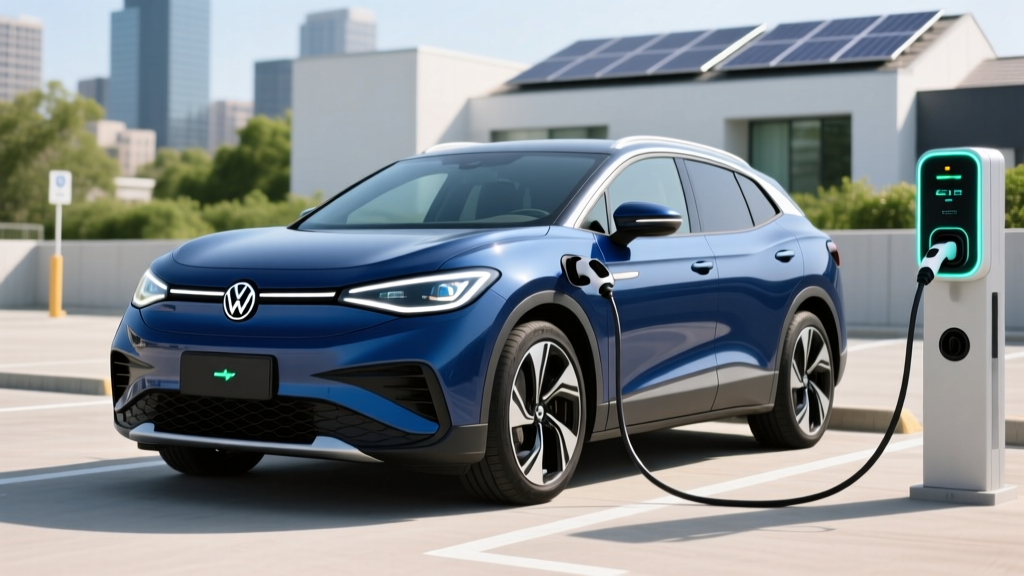
Quick Verdict: Is the 2026 VW ID.4 Pro Worth Leasing?
The 2026 Volkswagen ID.4 Pro sits in one of the most competitive segments in the EV market: the two-row electric crossover. With an EPA-estimated 291 miles of range (RWD, 82 kWh battery), a practical cabin, and Volkswagen's strong dealer network, it remains a compelling choice for families and commuters who want a mainstream EV without venturing into Tesla's ecosystem or Hyundai's aggressive pricing. The ID.4 Pro's lease cost typically lands between $299 and $449 per month depending on down payment, term length, regional incentives, and whether Volkswagen's manufacturer-to-dealer EV bonus cash is applied — which can sometimes be passed through to the lessee as a capitalized-cost reduction.
But leasing an EV involves more than the monthly payment. You need to understand real-world range, charging speed, tax-credit pass-through mechanics, and how the ID.4 Pro stacks up against the Hyundai Ioniq 5, Tesla Model Y, and Ford Mustang Mach-E. This review covers every number that matters.
2026 VW ID.4 Pro: Core Specifications
| Spec | 2026 ID.4 Pro (RWD) | 2026 ID.4 Pro S AWD |
|---|---|---|
| EPA Range | 291 miles | 263 miles |
| Battery (usable) | 82 kWh (NMC) | 82 kWh (NMC) |
| Drivetrain | Rear-wheel drive | Dual-motor AWD |
| Horsepower | 282 hp | 335 hp |
| 0–60 mph | ~7.3 sec | ~5.4 sec |
| Max DC Fast Charge | 175 kW | 175 kW |
| 10–80% DC Charge | ~28 min | ~28 min |
| Level 2 Charge Rate | 11 kW (AC onboard) | 11 kW (AC onboard) |
| MPGe (city/hwy/combined) | 115 / 98 / 107 | 104 / 90 / 97 |
| Efficiency | 31 kWh/100 mi | 35 kWh/100 mi |
| Cargo (rear seats up) | 30.3 cu ft | 30.3 cu ft |
| Cargo (rear seats folded) | 64.2 cu ft | 64.2 cu ft |
| Rear Legroom | 37.6 in | 37.6 in |
| Base MSRP (before dest.) | $44,995 | $49,495 |
| Destination Charge | $1,395 | $1,395 |
| Battery/Powertrain Warranty | 8 yr / 100,000 mi | 8 yr / 100,000 mi |
| Bumper-to-Bumper | 4 yr / 50,000 mi | 4 yr / 50,000 mi |
Sources: EPA fueleconomy.gov, Volkswagen USA.
Real-World Range: What the EPA Sticker Doesn't Tell You
Real-World Expectation:
- City/mixed driving (55–70°F): 270–290 miles — regenerative braking recovers energy in stop-and-go traffic, keeping you close to the sticker.
- Highway sustained (75 mph, 70°F): 235–260 miles. Aerodynamic drag at speed cuts efficiency roughly 10–15% below EPA combined.
- Cold weather (20°F, highway): 190–220 miles. The ID.4's NMC battery and heat pump (standard on Pro trims) mitigate some loss, but expect a 25–35% reduction from EPA in deep cold.
- Towing (if equipped): The AWD Pro S can tow up to 2,700 lbs; range drops dramatically — plan for 140–170 miles between charges under load.
The 82 kWh usable battery uses NMC (nickel manganese cobalt) chemistry, which offers higher energy density than LFP but is more sensitive to sustained 100% state of charge. Volkswagen recommends daily charging to 80% for routine use and 100% only before long trips — a practice that extends long-term battery health. The ID.4 Pro's thermal management system actively conditions the battery, which matters for both range preservation and fast-charging speed.
Charging Speed: DC Fast, Level 2, and Level 1
Charging speed is where the ID.4 Pro shows its age relative to newer competitors. The 175 kW peak DC fast-charge rate is serviceable but not class-leading — the Hyundai Ioniq 5 peaks at 240 kW on an 800V architecture, and the Tesla Model Y can sustain around 250 kW at V3 Superchargers.
| Charging Level | Power (kW) | Speed (miles of range per hour) | Notes |
|---|---|---|---|
| Level 1 (120V household) | ~1.4 kW | ~4–5 mi/hr | Emergency/trickle only; 60+ hours for a full charge |
| Level 2 (240V, 48A home charger) | 11 kW (onboard max) | ~33–36 mi/hr | Full charge in ~7.5 hours; ideal for overnight |
| DC Fast Charge (peak) | 175 kW | ~200+ mi in 30 min (10–80%) | 10–80% in ~28 min; tapers significantly above 80% |
Understanding the charge curve: The 175 kW peak only holds roughly between 10% and 30% state of charge. By 50% SoC, the rate drops to approximately 120–130 kW. By 80%, it falls to around 50–60 kW. This is why Volkswagen quotes 10–80% in ~28 minutes rather than 0–100% — charging above 80% on DC is painfully slow and not recommended for road-trip strategy. Plan your stops around 10–80% windows.
Level 2 home charging: The ID.4 Pro's 11 kW onboard charger is a strong point. With a 48-amp Level 2 home charger (like the ChargePoint Home Flex or Emporia Vue), you'll add roughly 33–36 miles of range per hour. An overnight charge from 20% to 80% takes about 4.5 hours — more than enough for daily driving recovery. Home charger installation typically costs $800–$2,000 depending on your electrical panel; a 200-amp panel upgrade can add $1,500–$3,000 if needed.
2026 VW ID.4 Pro Lease Cost: What You'll Actually Pay
Lease pricing fluctuates by region, dealer, and Volkswagen's monthly incentive programs, but here's a realistic framework based on current market conditions:
| Scenario | Monthly Payment | Due at Signing | Term / Miles |
|---|---|---|---|
| Base ID.4 Pro RWD — no incentives | $449–$529 | $3,500–$4,500 | 36 mo / 10K mi/yr |
| ID.4 Pro RWD — VW dealer cash applied | $349–$419 | $2,500–$3,500 | 36 mo / 10K mi/yr |
| ID.4 Pro RWD — aggressive regional promo | $279–$329 | $2,000–$3,000 | 36 mo / 10K mi/yr |
| ID.4 Pro S AWD — typical lease | $479–$569 | $3,500–$5,000 | 36 mo / 10K mi/yr |
Critical leasing detail — the $7,500 federal tax credit: Under IRS §30D, when you purchase an eligible EV, you claim the credit on your tax return (or apply it at point of sale as a down-payment reduction). But when you lease, the tax credit goes to the leasing company (the legal owner), not to you. However, under the "commercial clean vehicle credit" (IRC §45W), leasing companies can claim the credit and may pass the savings to you as a lower capitalized cost or monthly payment. Volkswagen Credit, Inc. has historically passed through some or all of this credit on ID.4 leases, but this is not guaranteed — always ask the dealer for the lease disclosure showing whether the credit is applied to the cap cost.
Federal Tax Credit Eligibility (Purchase, Not Lease)
If you choose to buy instead of lease, here's what determines §30D eligibility for the 2026 ID.4 Pro:
- MSRP cap: SUVs/crossovers must be under $80,000. The ID.4 Pro ($46,390 with destination) qualifies easily.
- Buyer income cap: AGI must not exceed $150,000 (single), $225,000 (head of household), or $300,000 (joint). Check IRS §30D rules.
- Battery sourcing: A percentage of critical minerals and battery components must be sourced from the U.S. or FTA partners. The ID.4 is assembled in Chattanooga, Tennessee, and Volkswagen has been progressively localizing battery supply. Verify current-year sourcing compliance at purchase — rules tighten annually.
- Point-of-sale transfer: You can transfer the credit to the dealer at purchase, reducing your out-of-pocket cost by up to $7,500 at signing.
Note: Tax credit rules change frequently. Consult a tax professional and verify at irs.gov before committing.
Interior, Tech, and Daily Practicality
The ID.4 Pro's cabin prioritizes space and simplicity over flash. The 12.9-inch infotainment touchscreen (upgraded from earlier model years) runs Volkswagen's ID. Software 4.x, which has resolved many of the lag and menu-logic complaints from the 2021–2023 launch era. Wireless Apple CarPlay and Android Auto are standard. The digital instrument cluster is a compact 5.3-inch display behind the steering wheel, supplemented by an available augmented-reality head-up display on Pro S trims.
Cargo and passenger space is genuinely competitive: 30.3 cubic feet behind the second row beats the Tesla Model Y's rear cargo area (though the Model Y compensates with a front trunk). Fold the 60/40 rear seats and you get 64.2 cubic feet — enough for a week's camping gear or a large furniture-store haul. Rear legroom at 37.6 inches is generous for two adults; three across is tight but doable for short trips.
Driver assistance: The ID.4 Pro comes standard with Travel Assist, which combines adaptive cruise control and lane-centering into a SAE Level 2 driver-assist system. This is not autonomous driving — you must keep your hands on the wheel and eyes on the road. It works well on highways but lacks the hands-free capability of Ford's BlueCruise or GM's Super Cruise on mapped roads. Volkswagen's Park Assist Plus with memory parking is a genuinely useful feature for tight garages.
How the ID.4 Pro Compares to Key Rivals
The two-row electric crossover segment is crowded. Here's how the ID.4 Pro measures up:
| Metric | VW ID.4 Pro (RWD) | Hyundai Ioniq 5 (SEL RWD LR) | Tesla Model Y (Long Range RWD) | Ford Mach-E (Select RWD ER) |
|---|---|---|---|---|
| EPA Range | 291 mi | 303 mi | 320 mi | 320 mi |
| Battery | 82 kWh NMC | 84 kWh NMC | ~78 kWh NMC | 91 kWh NMC |
| Peak DC Charge | 175 kW | 240 kW (800V) | 250 kW | 150 kW |
| 10–80% Time | ~28 min | ~18 min | ~22 min | ~38 min |
| 0–60 mph | 7.3 sec | 7.0 sec | 6.5 sec | 6.1 sec |
| Cargo (rear up) | 30.3 cu ft | 27.2 cu ft | 30.2 cu ft (+ frunk) | 29.7 cu ft (+ frunk) |
| Base MSRP | ~$46,390 | ~$47,600 | ~$46,630 | ~$44,990 |
| Frunk | No | Small (0.85 cu ft) | Yes (4.1 cu ft) | Yes (4.7 cu ft) |
Where the ID.4 Pro wins: Ride comfort, cabin quietness, and dealer-service accessibility. Volkswagen's suspension tuning absorbs rough pavement better than the firmer Ioniq 5 and Mach-E. The VW dealer network also provides easier service access in rural and suburban areas compared to Tesla's more urban-concentrated service centers.
Where it falls behind: DC charging speed (175 kW vs. 240–250 kW for Hyundai and Tesla), infotainment responsiveness (improved but still not Tesla-class), and the lack of a front trunk. On road trips, the Ioniq 5's 18-minute 10–80% charge saves real time compared to the ID.4's 28 minutes — over a 1,000-mile trip, that's 30–40 minutes less time at chargers.
Pros and Cons
Pros
- Comfortable, quiet ride quality — best-in-class for refinement
- Generous rear-seat legroom (37.6 in) and cargo space (30.3 cu ft)
- Strong Level 2 home charging (11 kW onboard) — full overnight recovery
- Assembled in Chattanooga, TN — strong §30D credit eligibility for purchase
- Heat pump standard — better cold-weather range preservation than competitors without one
- Competitive MSRP under $47K; well within the $80K SUV cap for tax credit
- 8-year/100,000-mile battery warranty with 70% capacity retention guarantee
Cons
- 175 kW DC fast-charge peak is below Hyundai/Tesla — adds time on road trips
- No front trunk (frunk) — lost storage opportunity
- Infotainment, while improved, still lags behind Tesla and Hyundai in responsiveness
- Capacitive touch sliders for volume and climate are frustrating vs. physical controls
- RWD 0–60 of 7.3 seconds feels leisurely in a segment where 5–6 seconds is common
- Lease tax-credit pass-through depends on Volkswagen Credit — not guaranteed
- Travel Assist is competent but not hands-free like BlueCruise or Super Cruise
Who Should Lease the 2026 VW ID.4 Pro?
Choose the ID.4 Pro if:
- You prioritize ride comfort and cabin quietness over sporty handling or quick acceleration.
- You charge primarily at home overnight and take road trips 3–5 times per year (not weekly).
- You want a mainstream dealer experience with local service, not a direct-to-consumer model.
- You need strong rear-seat space for children or frequent adult passengers.
- You want to lease and potentially benefit from the commercial credit pass-through.
Look elsewhere if:
- You road-trip frequently and want the fastest possible DC charging (consider Ioniq 5 or Model Y).
- You want hands-free highway driving (Ford Mach-E with BlueCruise, or GM EVs with Super Cruise).
- You need a front trunk for charging cables, groceries, or a small pet carrier.
- Performance and sub-6-second 0–60 times are a priority (look at Mach-E GT or Model Y Performance).
Frequently Asked Questions
What is the real-world range of the 2026 VW ID.4 Pro?
The EPA rates the ID.4 Pro RWD at 291 miles combined. In real-world driving, expect 270–290 miles in mild city/mixed conditions, 235–260 miles on sustained highway trips at 75 mph, and 190–220 miles in cold weather (below 30°F) with highway driving. The standard heat pump helps, but cold always reduces lithium-ion battery efficiency.
How fast does the ID.4 Pro charge at home and on DC fast chargers?
At home on a 240V Level 2 charger, the ID.4 Pro accepts up to 11 kW, adding roughly 33–36 miles of range per hour — a full overnight charge is easily achievable. On a DC fast charger, it peaks at 175 kW and charges from 10% to 80% in approximately 28 minutes. Above 80%, the charge rate tapers significantly, so plan road-trip stops around the 10–80% window.
How much does the ID.4 Pro cost after federal tax credits?
If you purchase the ID.4 Pro RWD at ~$46,390 (with destination) and qualify for the full $7,500 §30D credit (subject to income caps, battery sourcing rules, and AGI limits), your effective cost drops to approximately $38,890 before state incentives. If you lease, the credit goes to the leasing company under IRC §45W, and Volkswagen Credit may pass some or all of it through as a cap-cost reduction — ask the dealer for written confirmation.
Does the 2026 ID.4 Pro qualify for the $7,500 federal EV tax credit?
The ID.4 Pro qualifies on MSRP ($46,390 — well under the $80,000 SUV cap) and is assembled in the United States (Chattanooga, TN). Eligibility depends on your adjusted gross income (under $150K single / $300K joint), battery critical-mineral and component sourcing requirements (which tighten each year), and the vehicle's final certification status at time of purchase. Always verify current eligibility on irs.gov or with a tax professional.
Is leasing the ID.4 Pro better than buying?
Leasing makes sense if you want lower monthly payments, plan to upgrade in 3 years, and are comfortable with mileage restrictions (typically 10,000–15,000 miles/year). Buying makes more sense if you drive high annual miles, want to claim the §30D credit directly at point of sale, and plan to keep the vehicle 5+ years to ride out the depreciation curve. EV depreciation has been steep in recent years — leasing shifts that risk to the leasing company.
How does the ID.4 Pro's battery warranty work?
Volkswagen covers the ID.4's high-voltage battery for 8 years or 100,000 miles, whichever comes first. The warranty guarantees the battery will retain at least 70% of its original usable capacity during that period. If capacity drops below 70% under normal use, Volkswagen will repair or replace the battery. This is in line with industry standards (Hyundai, Ford, and most others offer similar 8/100K coverage).
Does the ID.4 Pro have one-pedal driving?
Partially. The ID.4 Pro offers a "B" (brake) drive mode that increases regenerative braking significantly, but it does not bring the vehicle to a complete stop and hold it — you still need to use the brake pedal at standstills. This is a deliberate Volkswagen engineering choice, unlike Nissan or Chevrolet's full one-pedal implementations.