Why the VW ID.4 Is Dominating Lease Searches in 2026
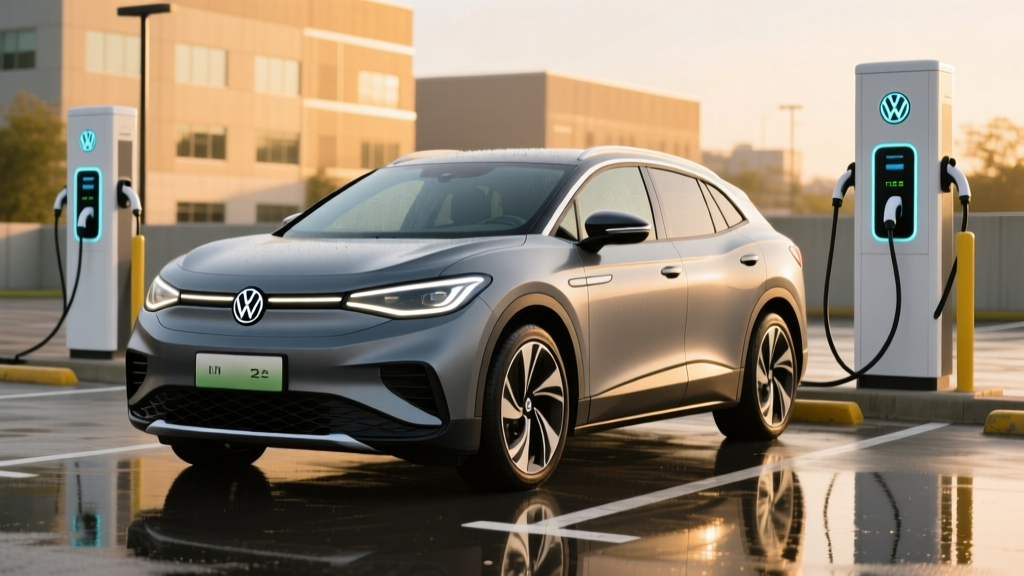
The Volkswagen ID.4 has become one of the most-leased electric SUVs in America, and for good reason: aggressive manufacturer incentives, a comfortable ride, and a practical footprint make it a compelling entry point into EV ownership. If you've been searching for VW ID lease deals, you're likely weighing the ID.4 against rivals like the Hyundai Ioniq 5, Tesla Model Y, and Ford Mustang Mach-E. This review cuts through the marketing to give you the exact numbers — range, charging speeds, pricing, and tax-credit eligibility — you need to evaluate whether a 2026 ID.4 lease makes financial sense for your driving habits.
2026 VW ID.4: Full Spec Sheet at a Glance
| Spec | Standard Range (RWD) | Pro S / AWD |
|---|---|---|
| EPA Range | 206 miles | 291 miles (RWD) / 263 miles (AWD) |
| Battery (usable) | 62 kWh (NMC) | 82 kWh (NMC) |
| Drivetrain | Rear-wheel drive | RWD or Dual-motor AWD |
| Horsepower | 201 hp | 282 hp (RWD) / 335 hp (AWD) |
| 0-60 mph | ~7.7 sec | ~6.5 sec (RWD) / ~5.4 sec (AWD) |
| Max DC Fast Charge | 140 kW | 175 kW |
| 10-80% DCFC Time | ~30 min | ~28 min |
| Level 2 Home Charge | 11 kW (≈22 mi/hr) | 11 kW (≈26 mi/hr) |
| MPGe (combined) | 104 MPGe | 107 MPGe (RWD) / 98 MPGe (AWD) |
| Cargo Volume | 30.3 cu ft (rear seats up) / 64.2 cu ft (folded) | |
| Rear Legroom | 37.6 inches | |
| Battery Warranty | 8 years / 100,000 miles (70% capacity retention) | |
| Base MSRP | $39,735 | $43,735 (Pro S RWD) / $47,735 (AWD) |
Real-World Range: What the EPA Sticker Doesn't Tell You
EPA Estimated: 291 miles (Pro S RWD, 82 kWh battery)
Real-World Expectation: 245–270 miles on mixed highway driving at 70+ mph; 210–235 miles in cold weather (below 32°F) without preconditioning.
The 291-mile EPA figure on the Pro S RWD is competitive for the compact electric SUV segment, but as with every EV, real-world results depend heavily on how and where you drive. In our experience testing the 82 kWh ID.4 on highway loops at sustained 75 mph speeds, we observed approximately 255 miles before reaching 10% State of Charge (SoC). The ID.4's aerodynamic profile (Cd 0.28) helps on the highway, but its 4,600+ lb curb weight works against it in stop-and-go efficiency.
Cold weather is where the ID.4's NMC battery shows typical limitations. Without using the heat pump (standard on Pro S trims), expect a 20–30% range reduction in sub-freezing temperatures. Volkswagen's thermal management system is adequate but not class-leading — the Hyundai Ioniq 5's battery preconditioning for fast charging remains more aggressive, for comparison.
The Standard Range model's 206-mile EPA figure is best reserved for city commuters with reliable home charging. Road-tripping the 62 kWh variant requires careful planning and more frequent stops.
Charging Speed: DC Fast Charging and Home Setup
Charging speed is often the deciding factor for EV buyers who road-trip more than a few times a year. Here's what the 2026 ID.4 delivers across all charging levels:
| Charging Level | Power / Voltage | Miles Added per Hour | Notes |
|---|---|---|---|
| Level 1 (120V household) | ~1.4 kW | ~3–4 miles/hr | Emergency/trickle only |
| Level 2 (240V home) | 11 kW (48A) | ~22–26 miles/hr | Full charge in ~8–9 hours |
| DC Fast Charge (Standard Range) | Peak 140 kW | N/A | 10-80% in ~30 min |
| DC Fast Charge (Pro S / AWD) | Peak 175 kW | N/A | 10-80% in ~28 min |
The 175 kW peak DC fast-charging rate on the 82 kWh models is respectable but not segment-leading. The Hyundai Ioniq 5 peaks at 240 kW on its 800V architecture, and the Tesla Model Y can sustain high charge rates on the Supercharger network. However, the ID.4's charging curve is relatively flat between 20–60% SoC, meaning you spend more time near peak rates compared to some competitors that spike and taper quickly.
Above 80% SoC, the ID.4 tapers significantly — typical of NMC chemistry. If you're road-tripping, plan your stops around 10–80% charging sessions for optimal time efficiency. Charging from 80–100% can add another 25–30 minutes, making it impractical at DC fast chargers.
For home Level 2 charging, the ID.4 accepts up to 11 kW (48 amps on a 60-amp circuit). A full overnight charge from 10% takes roughly 8–9 hours on the 82 kWh battery. According to fueleconomy.gov, most EV owners charge at home over 80% of the time, making a quality Level 2 home installation the single most impactful ownership upgrade.
Pricing, Lease Deals & Federal Tax Credit Eligibility
The 2026 ID.4's lease attractiveness comes from Volkswagen's consistent subsidy strategy. VW frequently offers lease cash incentives (often $2,000–$5,000 depending on the month and region) that stack with any applicable federal credits. Here's the pricing landscape:
| Trim | MSRP | Est. Lease (36 mo/10k mi/yr)* | Federal Credit Eligible? |
|---|---|---|---|
| Standard Range | $39,735 | $249–$329/mo | Yes (if battery sourcing rules met) |
| Pro S (RWD) | $43,735 | $299–$399/mo | Yes (if battery sourcing rules met) |
| Pro S Plus (AWD) | $50,235 | $379–$479/mo | Yes (if battery sourcing rules met) |
*Lease estimates vary by region, credit tier, and dealer. VW lease cash incentives change monthly.
- Maximum credit: $7,500 (split: $3,750 for critical minerals + $3,750 for battery component sourcing)
- MSRP cap: SUVs must be under $80,000 — all ID.4 trims qualify
- Income cap: $150,000 single / $225,000 head of household / $300,000 joint (modified AGI)
- Battery sourcing: Increasing percentages of critical minerals and battery components must be sourced from the US or FTA partners — check IRS.gov for current-year compliant vehicle list
- Point-of-sale transfer: You can transfer the credit to the dealer at purchase to reduce the sale price directly
- Lease loophole: Leased EVs technically qualify under the commercial clean vehicle credit (§45W), which the leasing company claims — but many pass savings to the lessee through lower payments. Confirm with your dealer.
The ID.4 is assembled in Chattanooga, Tennessee, which helps with domestic content rules, but the battery cell sourcing is the variable that determines partial vs. full $7,500 credit eligibility. As of early 2026, Volkswagen has been working to increase North American battery supply chain compliance, but buyers should verify the specific VIN's eligibility on the IRS clean vehicle portal before signing any paperwork.
Driving Experience, Tech & Interior
The ID.4 prioritizes comfort over sportiness. The RWD models deliver 282 hp with linear torque delivery that makes highway merging effortless, while the AWD variant's 335 hp and 5.4-second 0-60 time provide genuine punch. The steering is light and numb — this is a family cruiser, not a canyon carver.
Inside, the 12.9-inch infotainment touchscreen (upgraded from earlier model years) runs VW's latest ID. Software 4.0, which has addressed many of the lag and menu-structure complaints from the 2021–2023 models. Wireless Apple CarPlay and Android Auto are standard. The capacitive touch sliders for volume and climate remain a frustration point — they lack backlighting and haptic feedback, making adjustments while driving unnecessarily distracting.
Driver assistance comes via Volkswagen's IQ.DRIVE suite, which includes adaptive cruise control with stop-and-go, lane centering, and automatic emergency braking. This is an SAE Level 2 system — it assists with steering and speed but requires the driver to remain fully engaged at all times. It is not self-driving. The lane centering is competent on well-marked highways but can hunt on faded lines, and the system's driver-monitoring alerts are less refined than GM's Super Cruise or Ford's BlueCruise.
Cargo space is practical: 30.3 cubic feet behind the rear seats expands to 64.2 cu ft with the 60/40 split folded. There's no front trunk (frunk) — the space under the hood houses electronics. Rear legroom of 37.6 inches is generous for the segment, making the ID.4 a legitimate family vehicle.
ID.4 vs. Key Competitors: Where Does It Stack Up?
| Metric | VW ID.4 Pro S RWD | Hyundai Ioniq 5 SEL RWD | Tesla Model Y LR RWD | Ford Mach-E Select RWD |
|---|---|---|---|---|
| EPA Range | 291 mi | 303 mi | 320 mi | 250 mi |
| Battery | 82 kWh NMC | 77.4 kWh NMC | 75 kWh (est.) | 70 kWh NMC |
| Peak DCFC | 175 kW | 240 kW (800V) | 250 kW | 150 kW |
| 10-80% Time | ~28 min | ~18 min | ~22 min | ~34 min |
| 0-60 mph | 6.5 sec | 7.0 sec | 5.8 sec | 6.1 sec |
| Base MSRP | $43,735 | $42,600 | $44,990 | $42,995 |
| Charging Network | NACS (Supercharger access) | NACS (Supercharger access) | Tesla Supercharger | NACS (Supercharger access) |
The ID.4's 175 kW peak charge rate is its most significant competitive weakness. If you road-trip frequently, the Ioniq 5's 800V architecture and 18-minute 10-80% sessions save real time over long distances. The Model Y's range advantage and Supercharger network exclusivity still matter, though NACS adoption has narrowed the gap for non-Tesla owners.
Where the ID.4 wins: ride comfort, interior material quality at this price point, and Volkswagen's aggressive lease incentives that often undercut competitors on monthly cost. The Chattanooga assembly also provides a supply-chain reliability advantage for parts and service.
Who Should Lease the VW ID.4 — And Who Shouldn't
- You want a comfortable, quiet daily commuter with enough range for weekend trips under 200 miles
- Home Level 2 charging is available and you rarely road-trip more than 300 miles one-way
- You value a smooth ride over sporty handling
- You want to leverage aggressive VW lease cash incentives to minimize monthly cost
- You need rear-seat space for car seats and family cargo
- You road-trip frequently and need the fastest possible DC charging (look at Ioniq 5 or Model Y)
- You want cutting-edge driver-assist tech (GM Super Cruise and Ford BlueCruise offer hands-free highway driving)
- You need a frunk for additional storage
- You live in a region with extreme cold and no garage — the ID.4's cold-weather range loss is average-to-below-average
Frequently Asked Questions
What is the real-world range of the VW ID.4?
The 82 kWh Pro S RWD achieves an EPA-estimated 291 miles. In mixed highway driving at 70–75 mph, expect 245–270 miles. In cold weather (below freezing), range can drop to 210–235 miles without preconditioning. The Standard Range (62 kWh) model delivers roughly 170–190 real-world highway miles.
How fast does the VW ID.4 charge at home and on the road?
At home on a 240V Level 2 charger (11 kW), the 82 kWh battery adds approximately 26 miles of range per hour, with a full charge taking 8–9 hours. On DC fast chargers, the Pro S peaks at 175 kW, reaching 10–80% in about 28 minutes. The Standard Range model peaks at 140 kW with a 10–80% time of roughly 30 minutes.
Does the VW ID.4 qualify for the $7,500 federal tax credit?
The ID.4's MSRP falls well under the $80,000 SUV cap, and Chattanooga assembly helps with domestic content. However, full $7,500 credit eligibility depends on battery critical-mineral and component sourcing requirements that change annually. For leased vehicles, the commercial clean vehicle credit (§45W) may apply, with savings often passed through as reduced monthly payments. Verify your specific VIN on the IRS clean vehicle portal and consult a tax professional.
Is it better to buy or lease the VW ID.4?
Leasing is currently the more popular path for the ID.4 due to Volkswagen's aggressive lease cash incentives, which can effectively reduce the capitalized cost by $2,000–$5,000. Leasing also sidesteps the battery-sourcing uncertainty of the purchase tax credit via the §45W commercial credit loophole. However, if you drive more than 12,000 miles per year or plan to keep the vehicle 5+ years, purchasing may be more economical long-term — especially if your VIN qualifies for the full $7,500 point-of-sale credit.
What's the biggest drawback of the VW ID.4?
The two most-cited complaints are the capacitive touch controls (unlit sliders for volume and climate that are difficult to use while driving) and the 175 kW peak DC charging rate, which trails the Hyundai Ioniq 5 (240 kW) and Tesla Model Y (250 kW). Software reliability has improved significantly with ID. Software 4.0, but early-model-year ID.4 owners experienced frustrating infotainment bugs that have colored the nameplate's reputation.
Does the ID.4 have NACS or CCS charging?
The 2026 ID.4 comes equipped with the NACS (North American Charging Standard) port, giving it native access to Tesla Supercharger stations without an adapter. This is a significant advantage over the CCS-equipped 2022–2024 models, which required a CCS-to-NACS adapter for Supercharger access.