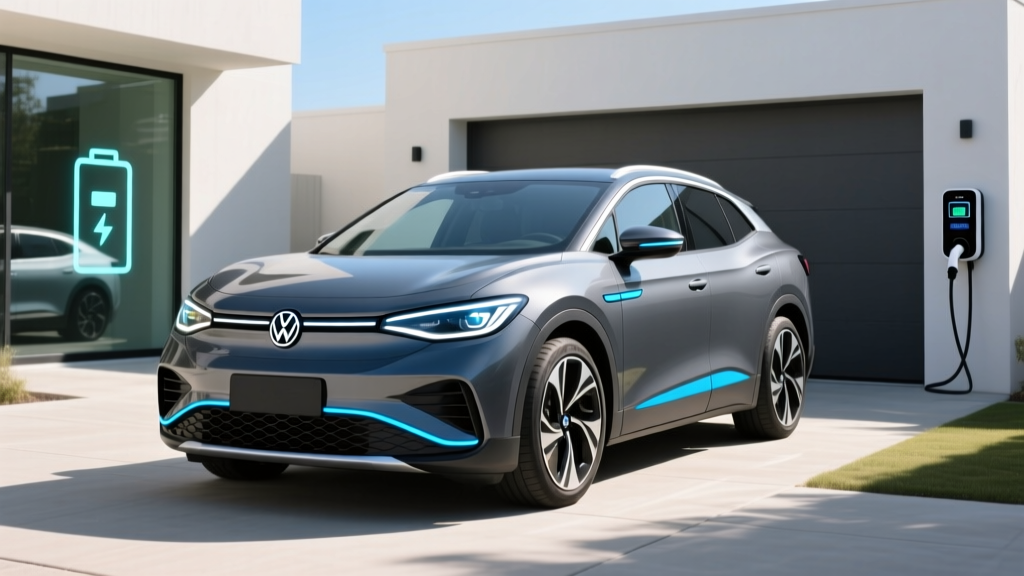
The Volkswagen ID.4 occupies a specific niche in the electric SUV market: it's the mainstream, no-drama family hauler that prioritizes comfort and space over cutting-edge performance or headline-grabbing range. For 2026, VW continues to refine the formula with improved infotainment software, a slightly larger usable battery on Pro trims, and competitive pricing that makes it a frequent target for attractive lease deals. If you've been searching for VW ID.4 lease deals, this profile breaks down every number you need — from real-world range and charging speeds to tax credit eligibility and total monthly cost — so you can negotiate from a position of knowledge.
2026 VW ID.4 at a Glance: Core Specifications
| Spec | Standard Range (S) | Pro / Pro S (RWD) | Pro S Plus (AWD) |
|---|---|---|---|
| EPA Range | 206 mi | 291 mi | 263 mi |
| Battery (Usable) | 62 kWh (NMC) | 82 kWh (NMC) | 82 kWh (NMC) |
| Horsepower | 201 hp | 282 hp | 335 hp (dual-motor) |
| 0–60 mph | 7.7 sec | 6.7 sec | 5.4 sec |
| Drivetrain | RWD | RWD | AWD |
| Max DC Fast Charge | 135 kW | 175 kW | 175 kW |
| 10–80% DC Time | ~30 min | ~28 min | ~28 min |
| Level 2 Home Charge | 11 kW (~33 mi/hr) | 11 kW (~33 mi/hr) | 11 kW (~33 mi/hr) |
| MPGe (Combined) | 107 MPGe | 107 MPGe | 101 MPGe |
| kWh/100 mi | 31 | 31 | 33 |
| Base MSRP | $37,730 | $41,995 | $51,495 |
Source: EPA fueleconomy.gov and Volkswagen USA. Prices exclude $1,495 destination charge. Specs reflect 2026 model year.
Range Reality: What the EPA Sticker Doesn't Tell You
EPA Rating: 291 miles (Pro/Pro S RWD, 82 kWh)
Expect in practice: 245–265 mi on highway road trips at 70+ mph; 200–230 mi in sustained sub-freezing winter conditions; 275–290 mi in mixed city/suburban driving in mild weather.
The 291-mile EPA figure on the Pro and Pro S RWD trims is legitimate for mixed driving in moderate temperatures. The ID.4's efficiency of 31 kWh/100 miles is average for the compact electric SUV class — the Hyundai Ioniq 5 achieves slightly better at 30 kWh/100 mi, while the Ford Mustang Mach-E Extended Range sits at 32.
Where the ID.4 loses ground is sustained highway driving. Its aerodynamic profile is more upright wagon than teardrop, and at 75 mph on the interstate, expect consumption to climb to roughly 36–38 kWh/100 mi, dropping effective range to around 240–250 miles. In cold weather (below 32°F), the resistive cabin heater and battery thermal management draw significant energy. Owners in northern climates consistently report 25–35% range reduction in deep winter — meaning that 291-mile sticker can shrink to roughly 190–220 miles on a frigid January commute. The available heat pump (standard on Pro S and above in 2026) mitigates this somewhat, typically limiting cold-weather loss to 20–25%.
The Standard Range (S) trim with its 62 kWh battery is best understood as a dedicated commuter or second-car option. Its 206-mile EPA range is adequate for daily driving under 60 miles round-trip but requires planning for any road trip over 150 miles.
Charging Speed: DC Fast, Level 2, and the Curve That Matters
| Charging Level | Power | Speed (Approx.) | Typical Use Case |
|---|---|---|---|
| Level 1 (120V household) | 1.4 kW | ~4 mi/hr | Overnight top-off, emergencies |
| Level 2 (240V home/public) | 11 kW | ~33 mi/hr | Daily home charging (7–8 hr for full) |
| DC Fast (Pro/Pro S) | Peak 175 kW | 10–80% in ~28 min | Road trips, Electrify America network |
| DC Fast (Std Range) | Peak 135 kW | 10–80% in ~30 min | Public fast charging |
The ID.4's 175 kW peak DC fast-charge rate (on 82 kWh trims) is competitive but not class-leading. The Hyundai Ioniq 5 and Kia EV6, with their 800-volt architectures, can peak at 240 kW and complete a 10–80% charge in roughly 18 minutes — a meaningful advantage on long road trips where every charging stop adds up.
The critical detail that spec sheets bury is the charge curve taper. The ID.4 hits 175 kW only between approximately 10–30% state of charge (SoC). By 60% SoC, power drops to roughly 100–110 kW. Above 80%, it falls to around 40–50 kW. This means the advertised 28-minute 10–80% time is accurate, but pushing from 80–100% adds another 25–30 minutes. On road trips, the optimal strategy is to charge to 80% and move on — planning stops every 180–200 miles rather than waiting for a full battery.
At home on a Level 2 charger (a 48-amp, 11.5 kW wallbox is ideal), the 82 kWh battery fills from empty in roughly 7.5 hours — perfectly suited to overnight charging. VW includes two years of complimentary 30-minute charging sessions on the Electrify America network, which remains one of the most extensive DC fast-charging networks in the U.S. outside of Tesla's Supercharger system.
Performance, Ride, and Daily Drivability
The 2026 ID.4 is tuned for comfort, not corner-carving. The RWD Pro models deliver 282 horsepower from a single rear-mounted permanent-magnet motor — adequate for confident highway merging and passing. The 6.7-second 0–60 time is respectable; you won't win stoplight sprints against a Tesla Model Y Performance (3.5 sec) or even the Ioniq 5 (5.0 sec), but the instant electric torque makes the ID.4 feel quicker in city driving than the numbers suggest.
The dual-motor AWD Pro S Plus bumps output to 335 hp and cuts the 0–60 time to 5.4 seconds, with the front induction motor providing confident traction in rain and light snow. The trade-off is 28 fewer miles of EPA range and a $9,500 price premium over the Pro S RWD.
Ride quality is where the ID.4 earns its reputation. The MEB platform delivers a planted, composed feel over rough pavement, with more suspension compliance than the firmer-riding Ioniq 5 or the sport-tuned Mach-E. The steering is light and numb — a deliberate choice for easy parking-lot maneuvering — and the turning circle is remarkably tight at 31.5 feet, making the ID.4 feel smaller than its 180.5-inch length suggests.
Regenerative braking is adjustable via steering-wheel paddles (on 2026 models with updated software), offering four levels from coasting to moderate one-pedal-like deceleration. Unlike some competitors, the ID.4 does not come to a full stop in its strongest regen mode — you still need the brake pedal for the final few mph. This is a deliberate engineering choice that frustrates one-pedal driving enthusiasts but feels natural to drivers transitioning from a gas car.
Interior Space, Cargo, and Tech
The ID.4's cabin is roomy and practical, with passenger volume that punches above its compact-SUV classification:
- Front headroom: 41.1 in | Front legroom: 41.1 in
- Rear headroom: 38.4 in | Rear legroom: 37.6 in
- Cargo behind rear seats: 30.3 cu ft
- Cargo with rear seats folded: 64.2 cu ft
- Frunk (front trunk): Not available — the MEB platform's HVAC components occupy the space under the hood
That rear legroom figure is a genuine strength — it comfortably fits two adults on long trips, and rear-facing child seats install without pushing the front passenger uncomfortably forward. The 30.3 cu ft of cargo space is on par with the Mach-E (29.7 cu ft) and trails the Ioniq 5 (27.2 cu ft behind the rear row, though the Ioniq's boxier shape yields more usable volume in practice).
The 2026 ID.4 benefits from VW's latest ID.Software 4.0, which addresses many of the infotainment complaints that plagued earlier model years. The 12.9-inch touchscreen is responsive, supports wireless Apple CarPlay and Android Auto, and now includes a traditional volume knob (finally replacing the touch-sensitive slider that frustrated owners). The digital instrument cluster is compact but legible, and the available head-up display with augmented-reality navigation arrows is genuinely useful.
On the driver-assistance front, the ID.4 comes standard with VW's IQ.DRIVE suite: adaptive cruise control with stop-and-go, lane-keeping assist, automatic emergency braking, and blind-spot monitoring. The available Travel Assist combines adaptive cruise and lane centering into a competent SAE Level 2 highway assist system — it handles lane keeping and speed management well on divided highways but requires hands-on-wheel supervision and does not perform automatic lane changes. It is not self-driving; it is a driver-assist system that reduces fatigue on long trips.
Pricing, Lease Deals, and Federal Tax Credit Eligibility
| Trim | MSRP (incl. dest.) | Est. Monthly Lease (36 mo, $3,999 down)* | Federal §30D Credit Eligible? |
|---|---|---|---|
| Standard Range (S) | $39,225 | $249–$299 | Yes — up to $7,500 |
| Pro | $43,490 | $299–$369 | Yes — up to $7,500 |
| Pro S | $47,990 | $349–$419 | Yes — up to $7,500 |
| Pro S Plus AWD | $52,990 | $419–$499 | Yes — up to $7,500 |
*Lease estimates are illustrative ranges based on typical VW Credit money factors and residual values observed in early 2026. Actual lease terms vary by dealer, region, credit tier, and available incentives. Always request a full lease breakdown (capitalized cost, money factor, residual, fees) before signing.
The ID.4 has been one of the most aggressively leased EVs in the U.S. market, and 2026 is no exception. VW frequently subsidizes leases through VW Credit with below-market money factors and competitive residual values, particularly on the Pro and Pro S trims. The most commonly advertised lease deals hover around $299–$369/month on the Pro with $3,999 due at signing on a 36-month term — making the ID.4 one of the most affordable ways to get into a 290-mile electric SUV with modern tech.
A critical nuance for leasing: under the IRS §30D rules, the $7,500 federal tax credit is technically assigned to the lessor (the finance company), not the lessee. However, most manufacturers — VW included — typically pass this benefit through as a capitalized cost reduction, effectively lowering your monthly payment. As of 2026, the ID.4 qualifies for the full $7,500 credit when purchased, provided you meet all eligibility criteria:
- MSRP cap: SUVs must be ≤ $80,000 — all ID.4 trims qualify ✓
- Buyer income cap: AGI ≤ $150,000 (single) / $225,000 (head of household) / $300,000 (joint) ✓ — verify your modified AGI
- Battery sourcing: Battery components must meet increasing domestic-content thresholds; critical minerals must meet sourcing requirements — the ID.4's Chattanooga, TN-built battery pack has consistently met these thresholds for 2025–2026 ✓
- Point-of-sale transfer: You may elect to transfer the credit to the dealer as an upfront price reduction rather than claiming it on your tax return — this is available for the ID.4 ✓
- Assembly: Final assembly must be in North America — the ID.4 is built in Chattanooga, Tennessee ✓
Source: IRS.gov — Clean Vehicle Credits. Tax rules change; consult a tax professional for your specific situation.
How the ID.4 Stacks Up Against Key Competitors
| Spec | VW ID.4 Pro S | Hyundai Ioniq 5 SEL | Ford Mach-E Premium ER | Tesla Model Y LR |
|---|---|---|---|---|
| EPA Range | 291 mi | 303 mi | 290 mi | 330 mi |
| Battery | 82 kWh (NMC) | 77.4 kWh (NMC) | 91 kWh (NMC) | 82 kWh (NMC) |
| Peak DC Charge | 175 kW | 240 kW | 150 kW | 250 kW |
| 10–80% Time | ~28 min | ~18 min | ~37 min | ~22 min |
| 0–60 mph | 6.7 sec | 5.0 sec (RWD) | 5.5 sec (RWD) | 4.8 sec (AWD) |
| Cargo (rear seats up) | 30.3 cu ft | 27.2 cu ft | 29.7 cu ft | 30.2 cu ft |
| Base MSRP | $41,995 | $43,500 | $44,995 | $46,630 |
| Heat Pump | Std (Pro S+) | Std | Optional | Std |
The ID.4's competitive advantages are clear: it's the least expensive 290-mile-class electric SUV in this comparison, and its ride comfort and rear-seat space are best-in-class. Where it falls behind is charging speed — the Ioniq 5's 800V architecture delivers meaningfully faster road-trip charging — and range, where the Model Y's 330-mile EPA rating gives it a tangible buffer advantage.
The Mach-E is the sportiest to drive but has the slowest DC charging in this group. The Ioniq 5 is the most well-rounded competitor, with faster charging and a more distinctive design, though its ride is firmer and its rear seat slightly tighter. The Model Y leads in range, charging speed, and Supercharger network access, but its minimalist interior, firm ride, and higher base price push it into a different buyer profile.
Warranty, Ownership Costs, and Long-Term Outlook
VW backs the ID.4 with competitive warranty coverage:
- Battery warranty: 8 years / 100,000 miles (retains ≥ 70% of original capacity)
- Powertrain warranty: 8 years / 100,000 miles
- Bumper-to-bumper: 4 years / 50,000 miles
- Complimentary maintenance: 2 years / 20,000 miles
- Electrify America charging: 2 years of complimentary 30-minute sessions
The 70% capacity retention threshold is industry-standard (matching Tesla, Hyundai, and Ford). Real-world degradation data from 2021–2024 ID.4 owners suggests the NMC cells hold up well — most high-mileage examples show 5–8% degradation after 60,000–80,000 miles, well within the warranty buffer. VW does not use LFP chemistry in the ID.4, so the pack is optimized for energy density over cycle life — a reasonable trade-off for a vehicle in this range class.
Insurance costs for the ID.4 run roughly 15–25% higher than a comparably priced gas SUV like the Tiguan, reflecting the higher repair costs associated with EV battery packs and specialized body structures. Expect annual premiums of $1,800–$2,400 depending on your state, driving record, and coverage level.
On the cost-to-fuel side, the ID.4's 31 kWh/100 mi efficiency translates to roughly $0.045–$0.06 per mile when charging at home on a national-average electricity rate of $0.16/kWh. Compare that to a 25 MPG gas SUV at $3.40/gallon ($0.136/mi) — the ID.4 saves roughly $900–$1,100 per year in fuel costs for a driver covering 12,000 miles annually. Over a typical 3-year lease, that's $2,700–$3,300 in fuel savings that partially offsets the higher monthly payment versus a gas alternative.
Pros, Cons, and the Verdict
- Comfortable, compliant ride — best in class for daily comfort
- Spacious rear seat and generous cargo area
- Competitive pricing with aggressive lease deals
- Full $7,500 federal tax credit eligibility (when purchased)
- Tight turning circle makes it easy in urban environments
- Improved infotainment with physical volume knob (2026)
- Built in the USA (Chattanooga, TN)
- DC charging slower than Ioniq 5, Model Y, and EV6
- No front trunk (frunk) — under-hood space wasted
- Real-world highway range drops noticeably vs. EPA
- Regenerative braking doesn't enable true one-pedal driving
- AWD only available on top trim (Pro S Plus)
- Steering feels numb and disconnected at highway speeds
The verdict: The 2026 VW ID.4 is the pragmatic choice for buyers who prioritize ride comfort, interior space, and value over maximum range or the fastest charging. It's not the most exciting EV in the segment, but it's arguably the easiest to live with daily — and when lease deals dip below $350/month on the Pro trim, it becomes one of the most compelling values in the electric SUV market.
Frequently Asked Questions
What is the real-world range of the 2026 VW ID.4?
The EPA rates the ID.4 Pro/Pro S (82 kWh, RWD) at 291 miles. In real-world highway driving at 70+ mph, expect 245–265 miles. In cold weather below freezing, range drops to approximately 200–230 miles. The Standard Range trim's 206-mile EPA rating yields roughly 160–175 miles in highway or cold-weather use.
How fast does the ID.4 charge at home and on the road?
On a Level 2 home charger (240V, 48A), the 82 kWh battery charges at 11 kW, adding roughly 33 miles per hour and filling from empty in about 7.5 hours. On DC fast chargers, the Pro/Pro S peaks at 175 kW and charges from 10–80% in approximately 28 minutes. The Standard Range model peaks at 135 kW with a similar 10–80% time of about 30 minutes.
Does the VW ID.4 qualify for the $7,500 federal tax credit?
Yes — the 2026 ID.4 qualifies for the full $7,500 federal EV tax credit under IRS §30D, provided you meet the income caps (≤$150K single / ≤$300K joint), the MSRP is under $80,000 (all trims qualify), and the vehicle meets battery-sourcing requirements (the Chattanooga-built pack has consistently met these thresholds). You can also elect to transfer the credit to the dealer at point of sale for an upfront price reduction. Consult a tax professional to confirm your personal eligibility.
Is it better to lease or buy the VW ID.4?
For most buyers in 2026, leasing the ID.4 is the financially stronger option. VW Credit frequently offers subsidized money factors that produce monthly payments in the $299–$399 range with $3,999 due at signing. The lessor captures the $7,500 tax credit and passes it through as a cap-cost reduction. Leasing also shields you from long-term battery degradation risk and EV depreciation uncertainty. Buying makes sense if you drive under 10,000 miles/year, plan to keep the vehicle 6+ years, and want to claim the credit directly.
How does the ID.4 compare to the Tesla Model Y and Hyundai Ioniq 5?
The ID.4 offers the most comfortable ride and lowest entry price in this trio. The Model Y leads in range (330 mi EPA), charging speed (250 kW peak), and Supercharger network access but costs more and has a polarizing interior. The Ioniq 5 is the fastest-charging (18-minute 10–80%) and most distinctive in design, with a slightly firmer ride. If ride comfort and value are your top priorities, the ID.4 wins. If charging speed and range matter most, look to the Ioniq 5 or Model Y.
What are the biggest drawbacks of the VW ID.4?
The most common owner complaints center on slower DC fast-charging speeds compared to 800V competitors, the lack of a front trunk, and regenerative braking that doesn't support full one-pedal driving. Highway range falls noticeably below the EPA sticker, and the steering lacks feedback. These are trade-offs for the ID.4's comfort-oriented tuning and competitive pricing — not deal-breakers for most buyers, but worth test-driving to confirm they don't bother you.