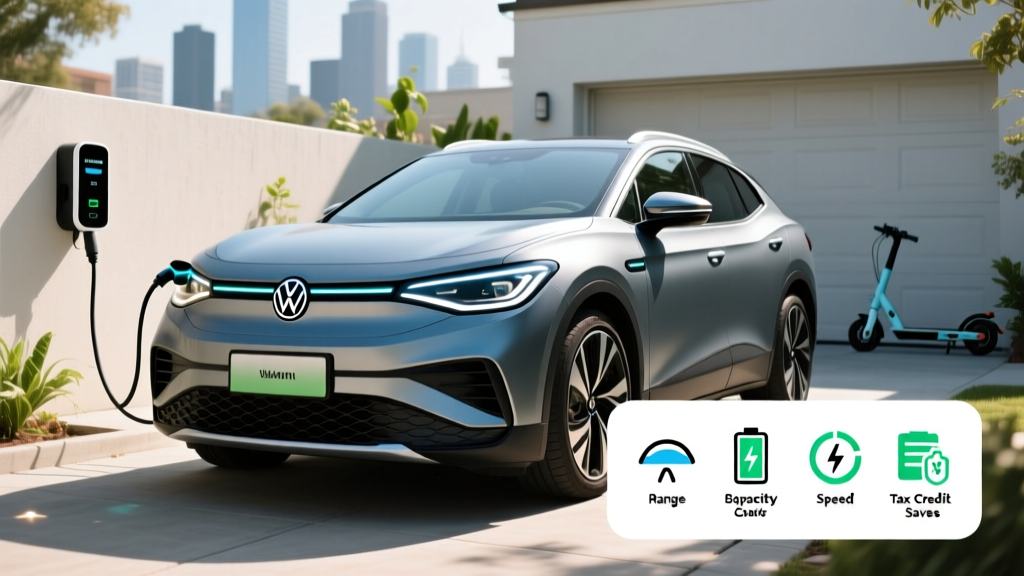
The Volkswagen ID.4 remains one of the most accessible electric SUVs in the U.S. market, combining practical cargo space, competitive range, and a starting price that undercuts many rivals. For buyers researching VW ID.4 financing, the numbers tell a nuanced story: a base MSRP that qualifies for federal incentives, DC fast charging that is adequate but not class-leading, and real-world range that requires some expectation management in cold climates and at highway speeds.
This review uses 2026 model-year specifications, current IRS §30D tax credit rules, and real-world driving data to help you determine whether the ID.4 fits your budget and your daily driving profile.
2026 VW ID.4 Core Specifications at a Glance
| Specification | ID.4 Standard (RWD) | ID.4 AWD Pro S |
|---|---|---|
| EPA Range | 275 miles | 263 miles |
| Battery (usable / gross) | 82 kWh / 91 kWh (NMC) | 82 kWh / 91 kWh (NMC) |
| Max DC Fast Charge | 170 kW | 170 kW |
| 10–80% DC Charge Time | ~28 minutes | ~28 minutes |
| Level 2 Home Charge Rate | 11 kW (~37 mi/hr) | 11 kW (~37 mi/hr) |
| Horsepower | 282 hp | 335 hp |
| 0–60 mph | 7.7 seconds | 5.4 seconds |
| Drivetrain | Rear-wheel drive | Dual-motor AWD |
| EPA Efficiency (combined) | 107 MPGe (31 kWh/100 mi) | 98 MPGe (34 kWh/100 mi) |
| Cargo Volume (behind rear seats) | 30.3 cu ft | 30.3 cu ft |
| Cargo Volume (seats folded) | 64.2 cu ft | 64.2 cu ft |
| Rear Legroom | 37.6 inches | 37.6 inches |
| Base MSRP | $40,790 | $48,790 |
Real-World Range: What to Actually Expect
The ID.4 uses an NMC (nickel manganese cobalt) lithium-ion battery with 91 kWh gross capacity and approximately 82 kWh usable. Volkswagen maintains a buffer at the top and bottom of the pack to protect long-term health — you'll never see the full 91 kWh on the dash, and that's intentional.
For a 40-mile round-trip commute with home charging, the ID.4's real-world range is more than sufficient even in winter. Road-trippers should plan charging stops every 200–220 miles to stay in the battery's optimal charging zone (below 80% state of charge), where DC fast charging is fastest.
Charging Speed: DC Fast Charging and Home Setup
The ID.4's charging profile is competent but not class-leading. Here's what to expect at each level:
| Charging Level | Power / Rate | Miles Added Per Hour | Notes |
|---|---|---|---|
| Level 1 (120V household) | ~1.4 kW | ~4–5 miles/hr | Emergency/trickle only |
| Level 2 (240V home) | 11 kW | ~37 miles/hr | Full charge in ~8.5 hours |
| DC Fast Charge | Peak 170 kW | ~220 miles/hr (peak) | 10–80% in ~28 min; tapers above 80% |
The 170 kW peak DC fast-charge rate means the ID.4 adds roughly 70% of its battery in about 28 minutes at a compatible 175 kW+ station (such as Electrify America, which VW includes three years of complimentary charging with new ID.4 purchases). However, the charge curve tapers significantly above 80% state of charge — a 10–90% session will take closer to 45 minutes. This is typical for NMC chemistry but slower than competitors like the Hyundai Ioniq 5, which peaks at 240 kW on its 800V architecture.
For home charging, an 11 kW onboard charger means a Level 2 wall connector on a 48-amp circuit will replenish the battery from empty in roughly 8.5 hours — easily overnight. If your home electrical panel supports a 60-amp dedicated circuit, installation typically runs $800–$2,000 depending on panel proximity and local permitting. Always consult a licensed electrician for final specifications.
Pricing, Trims, and VW ID.4 Financing With Tax Credits
The 2026 VW ID.4 is offered in several trims. Here's how pricing breaks down before and after the federal EV tax credit:
| Trim | Drivetrain | MSRP | After §30D Credit (if eligible) |
|---|---|---|---|
| Standard | RWD | $40,790 | $33,290 |
| Pro | RWD | $43,790 | $36,290 |
| Pro S | RWD | $46,290 | $38,790 |
| Pro S Plus | AWD | $51,290 | $43,790 |
| AWD Pro S | AWD | $48,790 | $41,290 |
Federal tax credit eligibility under IRS §30D is subject to several requirements that change periodically. As of 2026, key rules include:
- MSRP cap: SUVs must have a base MSRP at or below $80,000. All ID.4 trims qualify.
- Buyer income cap: Modified adjusted gross income must not exceed $150,000 (single), $225,000 (head of household), or $300,000 (joint filers).
- Battery sourcing: A percentage of critical minerals and battery components must be sourced from the U.S. or free-trade-agreement countries. Volkswagen has worked to localize ID.4 battery production at its Chattanooga, TN assembly plant, but the exact credit amount (up to $7,500) depends on current-year sourcing thresholds. Some buyers may qualify for $3,750 rather than the full $7,500.
- Point-of-sale transfer: Eligible buyers can transfer the credit to the dealer at purchase, reducing the upfront cost rather than waiting for a tax refund.
The ID.4's MSRP cap compliance makes it one of the more credit-friendly EVs on the market. However, always verify current eligibility on IRS.gov or consult a tax professional before finalizing your financing, as battery-sourcing rules tighten annually.
For VW ID.4 financing specifically, Volkswagen Financial Services frequently offers promotional APR rates (sometimes as low as 1.9–3.9% for well-qualified buyers) and lease deals that can further reduce monthly cost. Compare these against third-party lender rates and factor in the point-of-sale credit transfer when calculating your effective down payment.
Performance, Efficiency, and Daily Driving
The rear-wheel-drive ID.4 delivers 282 horsepower and a 7.7-second 0–60 mph time — adequate for merging and passing but not sporty. The dual-motor AWD variant bumps output to 335 hp and drops the sprint to 5.4 seconds, making it genuinely quick off the line.
Ride quality is composed and comfortable, tuned more for compliance than corner-carving. The turning radius is tight for an SUV, and the ID.4 offers a comfortable, upright seating position with excellent outward visibility.
Efficiency-wise, the RWD model achieves 107 MPGe combined (31 kWh per 100 miles), which is average for the compact electric SUV segment. The AWD drops to 98 MPGe. For context, the Tesla Model Y RWD achieves roughly 120 MPGe combined, while the Ford Mustang Mach-E Extended Range RWD lands around 105 MPGe. (Source: fueleconomy.gov)
Interior, Tech, and Driver Assistance
The ID.4 cabin is minimalist and spacious, with a 12.9-inch central touchscreen running VW's latest ID. Software interface. Wireless Apple CarPlay and Android Auto are standard. The digital instrument cluster is compact but legible, supplemented by an available augmented-reality head-up display on Pro S and above trims.
Standout tech features:
- IQ.DRIVE suite: adaptive cruise control, lane-keeping assist, travel assist (SAE Level 2 — driver must remain engaged)
- Park Assist Plus with memory parking
- Heat pump (standard on most trims) for improved cold-weather efficiency
- 30.3 cu ft cargo space (64.2 cu ft with rear seats folded) — competitive with the RAV4 Hybrid
Notable drawbacks:
- Infotainment touch-capacitive sliders for volume and climate can be imprecise
- Rear drum brakes (unusual at this price point, though they aid regenerative efficiency)
- No front trunk (frunk) — the space is occupied by HVAC components
- DC fast-charge speed trails Hyundai/Kia 800V competitors
- All trims under the $80K MSRP cap for §30D credit
- Spacious cargo area and comfortable rear seat
- 3 years of Electrify America charging included
- Heat pump standard for cold-climate efficiency
- Competitive base price for the segment
- 170 kW peak charge rate trails 800V rivals
- Infotainment interface draws criticism for touch sliders
- No frunk for additional storage
- Real-world highway range drops noticeably below EPA
- Rear drum brakes feel dated at this price
Warranty Coverage and Battery Longevity
Volkswagen provides a competitive warranty package for the ID.4:
- Limited vehicle warranty: 4 years / 50,000 miles
- Battery and powertrain warranty: 8 years / 100,000 miles (covers battery capacity retention below 70% of original)
- Roadside assistance: 4 years / 50,000 miles
The 70% capacity retention threshold over 8 years is industry-standard. NMC chemistry in the ID.4 has demonstrated moderate degradation in real-world fleet data — most owners report 5–8% capacity loss over the first 60,000 miles when following recommended charging practices (avoiding sustained 100% state of charge, using DC fast charging moderately). Volkswagen's Chattanooga-built battery packs have not been subject to major recall campaigns as of early 2026.
Who Should Buy the VW ID.4?
- Daily commuters with home Level 2 charging and round trips under 80 miles — the ID.4 handles this effortlessly with range to spare
- Small families needing SUV cargo space (stroller, groceries, car seats) without stepping up to a three-row vehicle
- Tax-credit-maximizing buyers whose income falls within §30D caps and who want an SUV priced well under the $80K threshold
- Cold-climate owners who benefit from the standard heat pump
- You regularly take 400+ mile road trips and want the fastest possible DC charging (consider the Ioniq 5 or Tesla Model Y)
- You need a frunk for charging cable storage or additional cargo
- You prioritize sporty driving dynamics over comfort
VW ID.4 vs. Key Competitors
| Model | EPA Range | DC Fast Charge | 10–80% | Base MSRP |
|---|---|---|---|---|
| VW ID.4 (RWD) | 275 mi | 170 kW | ~28 min | $40,790 |
| Hyundai Ioniq 5 (RWD) | 303 mi | 240 kW | ~18 min | $43,200 |
| Tesla Model Y (RWD) | 320 mi | 250 kW | ~20 min | $44,990 |
| Ford Mustang Mach-E (RWD) | 250 mi | 150 kW | ~33 min | $42,995 |
The ID.4 occupies a value position: it's the least expensive in this group and qualifies for the full tax credit on every trim, but it gives up range and charging speed to the Ioniq 5 and Model Y. If your priority is the lowest effective price after incentives, the ID.4 Standard is difficult to beat. If road-trip charging speed matters most, the Ioniq 5's 800V architecture is the clear winner.
Frequently Asked Questions
What is the real-world range of the 2026 VW ID.4?
The EPA rates it at 275 miles (RWD). Real-world highway driving in mild weather yields approximately 230–250 miles. In sub-freezing temperatures, expect 190–210 miles. City driving with regenerative braking can approach the EPA figure.
How fast does the ID.4 charge?
On a DC fast charger, it peaks at 170 kW, reaching 10–80% in about 28 minutes. At home on a Level 2 (240V) charger at 11 kW, a full charge takes approximately 8.5 hours.
Does the VW ID.4 qualify for the $7,500 federal EV tax credit?
All ID.4 trims fall under the $80,000 MSRP cap. Eligibility for the full $7,500 depends on your income (below $150K single / $300K joint), and current battery-sourcing requirements under §30D. Some buyers may qualify for $3,750 depending on critical-mineral sourcing thresholds. Verify at IRS.gov and consult a tax professional.
Is the VW ID.4 worth buying over the Tesla Model Y or Hyundai Ioniq 5?
The ID.4 is worth buying if your priority is a lower entry price, tax-credit eligibility across all trims, comfortable ride quality, and included Electrify America charging. Choose the Model Y for maximum range and Supercharger network access, or the Ioniq 5 for the fastest DC charging speeds.
What is the battery warranty on the ID.4?
Volkswagen covers the battery and powertrain for 8 years or 100,000 miles, whichever comes first. The warranty covers capacity retention below 70% of original capacity.
Does the ID.4 have a front trunk (frunk)?
No. The space under the hood houses HVAC and power electronics. All cargo goes in the rear hatch area (30.3 cu ft behind rear seats, 64.2 cu ft with seats folded).