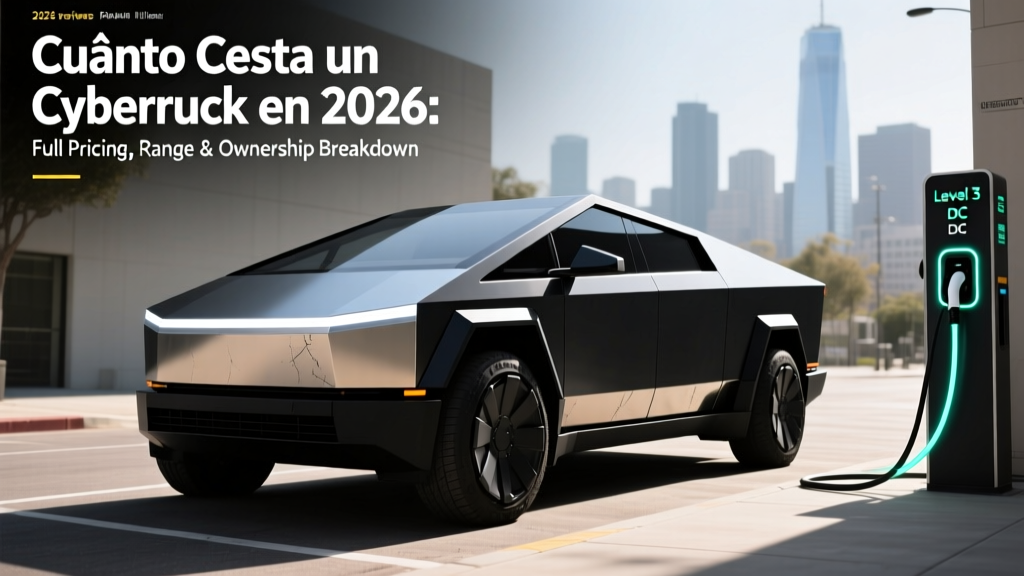
Searches for "cuánto cuesta un Cybertruck" have surged as Tesla's stainless-steel pickup moves from viral curiosity to real driveways across North America. But between the headline-grabbing Cyberbeast and the newly available Long Range AWD, the actual out-of-pocket cost varies by more than $40,000 depending on trim, options, and whether you qualify for federal incentives.
This guide cuts through the hype. We'll walk you through every 2026 Cybertruck trim's MSRP, real-world range versus the EPA sticker, DC fast-charging behavior (including the brutal taper above 80%), and the fine print on the IRS §30D tax credit. If you're weighing a Cybertruck against the Ford F-150 Lightning, Rivian R1T, or Chevrolet Silverado EV, you'll have the numbers to decide by the end.
2026 Tesla Cybertruck Pricing by Trim
Tesla restructured the Cybertruck lineup for the 2026 model year, dropping the originally promised $40,000 RWD base model and adding a Long Range AWD variant. Here's what each trim costs before destination, options, or incentives:
| Trim | Drivetrain | Base MSRP | As-Tested (Typical) |
|---|---|---|---|
| Long Range AWD | Dual-Motor AWD | $60,990 | $62,490 (w/ destination) |
| All-Wheel Drive | Dual-Motor AWD | $79,990 | $81,490 (w/ destination) |
| Cyberbeast | Tri-Motor AWD | $99,990 | $101,490 (w/ destination) |
The $1,500 destination fee applies across all trims. Tesla occasionally adjusts pricing without notice, so always verify on the configurator before ordering. The Full Self-Driving (Supervised) package adds $8,000 if purchased outright, or $99/month as a subscription — a significant variable in your total cost.
Estimated Price After Federal Tax Credit (§30D)
| Trim | MSRP + Dest. | Max §30D Credit | Est. Net Price |
|---|---|---|---|
| Long Range AWD | $62,490 | $7,500* | ~$54,990 |
| All-Wheel Drive | $81,490 | $7,500* | ~$73,990 |
| Cyberbeast | $101,490 | $0 (over MSRP cap) | $101,490 |
*Eligibility depends on buyer income, battery-sourcing compliance, and point-of-sale transfer rules. See the tax credit section below for full details. Source: IRS §30D.
Real-World Range vs. EPA Estimates
Tesla's EPA-rated range figures for the Cybertruck are competitive for a full-size electric pickup, but the angular stainless-steel exoskeleton creates aerodynamic drag that punishes highway efficiency. Here's what the stickers say — and what you'll actually see.
| Trim | EPA Range | Battery (Usable) | Real-World Highway | Cold-Weather Est. |
|---|---|---|---|---|
| Long Range AWD | 340+ mi (est.) | ~123 kWh (NMC) | ~270–290 mi | ~230–260 mi |
| All-Wheel Drive | 340 mi | ~123 kWh (NMC) | ~270–290 mi | ~230–260 mi |
| Cyberbeast | 320 mi | ~123 kWh (NMC) | ~250–270 mi | ~210–240 mi |
Why the gap? The Cybertruck's flat, angular body has a higher drag coefficient than a curved sedan. At 75+ mph, aerodynamic losses eat range faster than in a Model Y. In freezing temperatures (below 32°F / 0°C), expect 20–30% range reduction due to battery heating demands and reduced regenerative braking efficiency. Source: fueleconomy.gov.
The Cybertruck uses a ~123 kWh usable NMC (nickel manganese cobalt) battery pack. Tesla has not published exact chemistry breakdowns, but supply-chain reporting and energy-density calculations point to an NMC variant rather than LFP — which makes sense given the pack's energy demands and the vehicle's weight (~6,600–6,800 lbs curb).
Charging Speeds: DC Fast Charge and Home Level 2
Charging a 123 kWh battery is where the Cybertruck's size works against it. While peak DC fast-charge rates are strong, the total energy required means even a "fast" session takes meaningful time.
| Charging Level | Power / Rate | Time / Miles Added |
|---|---|---|
| Level 1 (120V household) | ~1.4 kW | ~3–4 mi/hr (12+ hrs for 10–80%) |
| Level 2 (240V home, 48A) | 11.5 kW | ~29 mi/hr (~9–10 hrs for 10–80%) |
| DC Fast Charge (Tesla Supercharger V4) | Peak 250 kW | 10–80% in ~28–32 min |
| DC Fast Charge (CCS adapter, 350 kW station) | Peak ~250 kW (vehicle-limited) | 10–80% in ~28–32 min |
The charging-curve reality: The Cybertruck peaks near 250 kW only between roughly 10–35% state of charge. By 50% SoC, it tapers to ~150 kW, and above 80% it drops sharply to protect the battery — often below 50 kW. This means a 10–90% session takes closer to 45–50 minutes, not the 28 minutes Tesla advertises for 10–80%. Plan road trips around the 10–80% window for efficiency.
At home, a 48-amp Level 2 wall connector on a 240V/60A circuit adds roughly 29 miles of range per hour — enough to fully replenish overnight for most daily driving. Budget $500–$2,000 for professional installation depending on whether your electrical panel needs an upgrade to 200A service.
Performance, Efficiency, and Capability
The Cybertruck's performance figures are extraordinary for a 6,800-pound vehicle. Here's the spec breakdown across trims:
| Spec | Long Range AWD | All-Wheel Drive | Cyberbeast |
|---|---|---|---|
| Horsepower | ~600 hp | ~600 hp | 845 hp |
| 0–60 mph | ~4.1 sec | ~3.9 sec | 2.6 sec |
| Top Speed | 112 mph | 130 mph | 130 mph |
| Drivetrain | Dual-Motor AWD | Dual-Motor AWD | Tri-Motor AWD |
| Max Towing | 11,000 lbs | 11,000 lbs | 11,000 lbs |
| Payload | ~2,500 lbs | ~2,500 lbs | ~2,500 lbs |
| MPGe (Combined) | ~68 MPGe (est.) | ~67 MPGe | ~64 MPGe |
| kWh/100 mi | ~49 (est.) | ~50 | ~52 |
The Cyberbeast's 2.6-second 0–60 time makes it one of the quickest production vehicles ever sold, regardless of powertrain. But efficiency suffers on the tri-motor variant — the extra front motor and aggressive tuning cost you roughly 20 miles of EPA range and 3–4 MPGe compared to the dual-motor trims.
Towing at the 11,000-pound max capacity will cut range by roughly 40–50%, putting real-world towing range around 130–170 miles depending on terrain and speed. This is competitive with the F-150 Lightning but a genuine limitation for long-haul towing without careful route planning around Superchargers.
Cargo Space, Interior, and Daily Practicality
The Cybertruck is a crew-cab pickup with a 6-foot composite bed (called the "vault") and a front trunk (frunk). Here are the key dimensions:
- Bed volume: 67 cu ft (vault, with tonneau closed)
- Frunk volume: ~7 cu ft (lockable, drainable)
- Total cargo: ~74 cu ft combined
- Bed length: 72 inches (6 ft)
- Front legroom: 41.5 inches
- Rear legroom: 38.2 inches
- Seating: 5 passengers (3-across rear bench)
The motorized tonneau cover is a standout feature — it's lockable, supports up to 300 lbs on top, and integrates with the vehicle's air suspension for load-leveling. However, the bed is shorter than a traditional F-150's 6.5-foot bed, and the sloped vault sides limit the width of flat items like plywood (a 4×8 sheet does not fit flat).
Inside, the 18.5-inch center touchscreen dominates the minimalist dashboard. Rear passengers get a 9.4-inch touchscreen for climate and media. The yoke-style steering wheel is standard; a conventional round wheel is available as a no-cost option. Build quality on 2026 models has improved significantly over early 2024 production units, with tighter panel gaps and fewer reported fitment issues.
Tax Credit Eligibility: Does the Cybertruck Qualify for §30D?
This is where many Cybertruck buyers face a rude surprise. The IRS §30D Clean Vehicle Credit offers up to $7,500 for qualifying new EVs, but several rules limit Cybertruck eligibility:
- MSRP Cap: Trucks must have an MSRP at or below $80,000. The Cyberbeast ($99,990) exceeds this cap and is ineligible. The All-Wheel Drive ($79,990) sits right at the limit and qualifies. The Long Range AWD ($60,990) comfortably qualifies.
- Buyer Income Cap: Modified adjusted gross income must not exceed $150,000 (single), $225,000 (head of household), or $300,000 (joint filing).
- Battery Sourcing: To receive the full $7,500, the battery must meet critical-mineral and battery-component sourcing requirements that tighten annually. Tesla's supply chain has largely complied for 2025–2026, but verify current status at fueleconomy.gov before purchasing.
- Point-of-Sale Transfer: You can transfer the credit to the dealer at purchase for an immediate price reduction — you don't have to wait until tax filing. This effectively lowers your out-of-pocket cost at delivery.
- One Credit Per VIN: The credit applies once per vehicle, and you're limited to one §30D credit per year.
Bottom line: The Long Range AWD and All-Wheel Drive trims are strong candidates for the full $7,500 credit (assuming your income qualifies and sourcing rules are met). The Cyberbeast gets nothing from §30D. Always consult a tax professional and check the latest IRS guidance at irs.gov before relying on credit estimates.
Cybertruck vs. Key Competitors: Is It Worth Buying?
The electric pickup segment is crowded in 2026. Here's how the Cybertruck stacks up against the F-150 Lightning, Rivian R1T, and Chevrolet Silverado EV on the specs that matter most:
| Spec | Cybertruck AWD | F-150 Lightning Lariat | Rivian R1T Dual | Silverado EV 4WT |
|---|---|---|---|---|
| Base MSRP | $79,990 | ~$69,995 | ~$79,900 | ~$74,900 |
| EPA Range | 340 mi | 320 mi (Ext. Range) | 352 mi (Max Pack) | 380 mi |
| Battery | ~123 kWh NMC | 131 kWh NMC | 149 kWh NMC | ~200 kWh NMC |
| Peak DC Charge | 250 kW | 150 kW | 220 kW | 350 kW |
| 0–60 mph | 3.9 sec | ~4.0 sec | ~3.5 sec | ~4.5 sec |
| Max Towing | 11,000 lbs | 10,000 lbs | 11,000 lbs | 12,500 lbs |
| §30D Credit | Up to $7,500 | Up to $7,500 | Up to $7,500 | Up to $7,500 |
Choose the Cybertruck if: You want the fastest charging in the segment alongside Supercharger network access, need tri-motor performance (Cyberbeast), value the stainless-steel body's dent resistance, or prioritize Tesla's software and Autopilot integration.
Choose the F-150 Lightning if: You need a traditional truck bed that fits 4×8 plywood flat, want a lower starting price, prefer Ford dealer service infrastructure, or need Pro Power Onboard for job-site use.
Choose the Rivian R1T if: You want the longest available range (Max Pack), need a front-trunk with more usable space, prefer a more refined interior, or want the Gear Tunnel for enclosed storage.
Choose the Silverado EV if: Maximum range (380+ mi) and towing (12,500 lbs) are your top priorities, or you need a mid-gate pass-through for long cargo.
Warranty, Ownership Costs, and Long-Term Outlook
Tesla provides the following warranty coverage for the 2026 Cybertruck:
- Basic Vehicle: 4 years / 50,000 miles
- Battery & Drive Units: 8 years / 120,000 miles (whichever comes first), with a minimum 70% capacity retention guarantee
- Rust-Through (body): Not explicitly covered — stainless steel doesn't rust traditionally, but surface corrosion can occur
The 8-year/120,000-mile battery warranty is slightly better than the industry-standard 8/100,000 seen on many competitors. The 70% retention threshold is typical — if your pack degrades below 70% of original capacity within the warranty period, Tesla will repair or replace it.
Insurance: Cybertruck insurance premiums run 20–40% higher than comparable F-150 Lightning policies, driven by repair costs for the stainless-steel body panels and limited third-party body-shop expertise. Expect $2,500–$3,800/year depending on your state, driving record, and coverage level.
Charging cost vs. gas: At the U.S. average electricity rate of $0.16/kWh and the Cybertruck's ~50 kWh/100 mi consumption, home charging costs roughly $8.00 per 100 miles. A gas F-150 at 20 MPG and $3.50/gallon costs $17.50 per 100 miles — more than double. DC fast charging at $0.35–$0.48/kWh narrows the gap to ~$17.50–$24.00 per 100 miles, making public charging comparable to gas on a per-mile basis.
Pros, Cons, and the Final Verdict
✅ Pros
- Tesla Supercharger network — the most reliable DC fast-charging infrastructure in North America
- Cyberbeast performance: 845 hp, 2.6-sec 0–60 in a pickup
- 250 kW peak DC charging, 10–80% in ~28–32 min
- Stainless-steel exoskeleton is dent- and scratch-resistant
- Lockable motorized tonneau + frunk for secure cargo
- Over-the-air updates continuously add features
- 11,000-lb towing capacity with integrated trailer brake controller
❌ Cons
- Cyberbeast ineligible for §30D tax credit (MSRP over $80K cap)
- Real-world highway range 15–20% below EPA due to aerodynamics
- Bed cannot fit a 4×8 sheet of plywood flat
- Insurance premiums significantly above segment average
- Visibility compromised by thick A-pillars and angular rear design
- Yoke steering controversial; learning curve for low-speed maneuvers
- No Apple CarPlay or Android Auto — Tesla's proprietary system only
- Build quality improving but still inconsistent vs. legacy automakers
Verdict: The 2026 Cybertruck is a compelling but polarizing electric pickup. The Long Range AWD at $60,990 (potentially ~$53,490 after the §30D credit) is the value play — strong range, dual-motor capability, and full credit eligibility. The Cyberbeast is a performance halo that trades tax incentives and efficiency for supercar acceleration. If you need a traditional truck bed or lower insurance costs, the F-150 Lightning or Rivian R1T may serve you better. But if Supercharger access, stainless-steel durability, and Tesla's tech ecosystem matter to you, the Cybertruck earns its place in the driveway.
Frequently Asked Questions
What is the real-world range of the Tesla Cybertruck?
The EPA rates the dual-motor AWD Cybertruck at 340 miles and the Cyberbeast at 320 miles. In real-world highway driving at 70–75 mph, expect 270–290 miles (AWD) or 250–270 miles (Cyberbeast). In cold weather below freezing, those numbers drop to roughly 230–260 miles and 210–240 miles respectively. Towing at max capacity cuts range by 40–50%.
How fast does the Cybertruck charge at home and on the road?
At home on a 240V Level 2 charger (48A / 11.5 kW), the Cybertruck adds about 29 miles of range per hour — a full overnight charge covers most needs. On a Tesla V4 Supercharger, it peaks at 250 kW and charges from 10–80% in approximately 28–32 minutes. Expect a 10–90% session to take 45–50 minutes due to charge-curve taper above 80%.
How much does the Cybertruck cost after tax credits?
The Long Range AWD starts at $62,490 (with destination) and may qualify for the full $7,500 §30D credit, bringing the net price to roughly $54,990. The All-Wheel Drive at $81,490 also qualifies, netting ~$73,990. The Cyberbeast at $101,490 exceeds the $80,000 MSRP cap and receives no federal credit. Eligibility depends on buyer income and battery-sourcing compliance — verify at irs.gov.
Does the Cybertruck qualify for the federal EV tax credit?
The Long Range AWD and All-Wheel Drive trims qualify for up to $7,500 under IRS §30D, provided the buyer's income is within limits ($150K single / $300K joint) and battery-sourcing requirements are met. The Cyberbeast does not qualify because its $99,990 MSRP exceeds the $80,000 truck cap. The credit can be transferred to the dealer at point of sale for an immediate price reduction.
Is the Cybertruck worth buying over the F-150 Lightning or Rivian R1T?
It depends on your priorities. The Cybertruck wins on DC fast-charging speed (250 kW), Supercharger network access, and Cyberbeast performance. The F-150 Lightning wins on bed practicality (fits 4×8 plywood), dealer service network, and lower starting price. The Rivian R1T wins on maximum range (352 mi with Max Pack), interior refinement, and adventure-oriented features like the Gear Tunnel. Test-drive all three before committing.
What is the Cybertruck's battery warranty?
Tesla covers the Cybertruck's battery and drive units for 8 years or 120,000 miles, whichever comes first. The warranty guarantees a minimum of 70% capacity retention during that period. If degradation exceeds 30%, Tesla will repair or replace the pack at no cost.
Can the Cybertruck tow a camper or boat?
Yes — the Cybertruck is rated for up to 11,000 pounds of towing across all trims. However, towing at or near max capacity will reduce range by roughly 40–50%, putting real-world towing range around 130–170 miles. Plan routes around Supercharger stops and consider a weight-distribution hitch for trailers over 5,000 pounds.