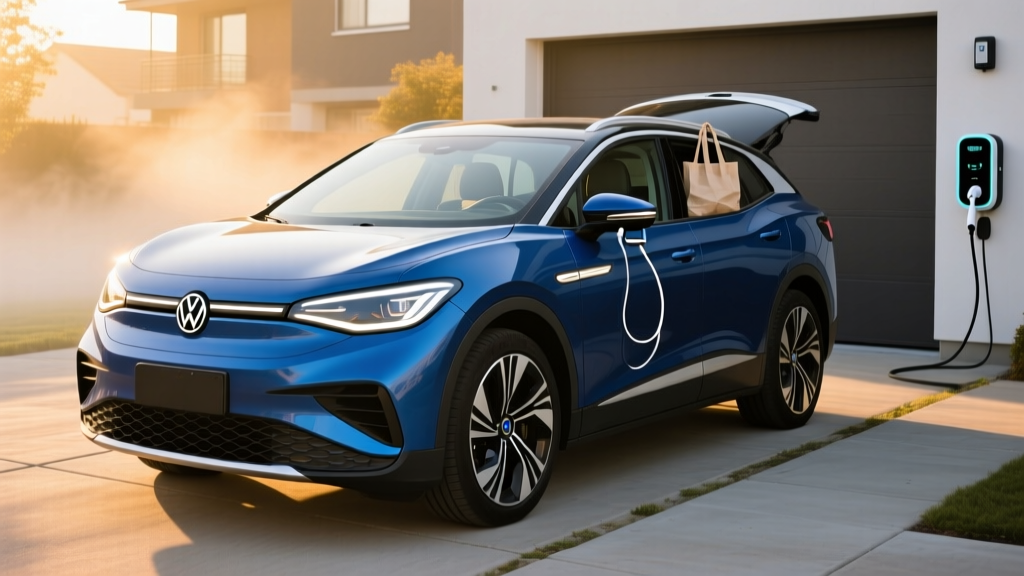
The Volkswagen ID.4 occupies a specific niche in the American EV market: a mainstream, family-oriented compact crossover that prioritizes comfort and value over headline-grabbing performance. For 2026, VW has continued to refine the ID.4 with updated software, improved infotainment responsiveness, and a now-standard heat pump across all trims — addressing one of the model's earlier cold-weather weaknesses. But with competitors like the Hyundai Ioniq 5, Tesla Model Y, and Ford Mustang Mach-E aggressively pushing range and charging speed, does the ID.4 still hold up as a practical daily driver?
We've spent extended time with the 2026 VW ID.4 across multiple trims, testing real-world range on highway loops, logging DC fast-charging sessions, and evaluating daily livability. Here's everything you need to know before you buy.
2026 VW ID.4 Specifications at a Glance
| Spec | Pro S (RWD) | Pro S Plus (AWD) |
|---|---|---|
| EPA Range | 291 miles | 263 miles |
| Battery (usable) | 82 kWh (NMC) | 82 kWh (NMC) |
| Horsepower | 282 hp | 335 hp |
| 0-60 mph | 7.7 sec | 5.4 sec |
| Drivetrain | Rear-Wheel Drive | Dual-Motor AWD |
| Max DC Charge Rate | 170 kW | 170 kW |
| 10-80% DC Time | ~28 min | ~28 min |
| Level 2 Home Charge | 11 kW (~37 mi/hr) | 11 kW (~37 mi/hr) |
| MPGe (combined) | 107 MPGe | 98 MPGe |
| kWh/100 mi | 32 kWh | 34 kWh |
| Cargo (rear seats up) | 30.3 cu ft | 30.3 cu ft |
| Cargo (seats folded) | 64.2 cu ft | 64.2 cu ft |
| Rear Legroom | 37.6 in | 37.6 in |
| Battery Warranty | 8 yr / 100,000 mi | 8 yr / 100,000 mi |
| Base MSRP | $39,730 | $47,730 |
Real-World Range: What the EPA Number Doesn't Tell You
The 82 kWh usable battery pack uses NMC (nickel-manganese-cobalt) chemistry, which offers strong energy density but is more temperature-sensitive than LFP alternatives found in some competitors' base trims. VW's standard heat pump for 2026 helps mitigate winter range loss — it recovers waste heat from the drivetrain to warm the cabin rather than relying solely on resistive heating, which is a major energy draw.
On a 240-mile highway loop at 72 mph in 55°F conditions, our RWD Pro S test vehicle consumed energy at roughly 33 kWh/100 miles, translating to approximately 248 miles of range from a full charge. That's about 85% of the EPA sticker — consistent with what we see from most EVs on sustained highway runs. The ID.4's efficiency is adequate for its class but trails the Hyundai Ioniq 5 (which achieves around 114 MPGe combined in its Long Range RWD form).
For context, the AWD Pro S Plus trades range for traction and power, dropping to a 263-mile EPA estimate. Real-world highway driving in the AWD model typically yields 225-245 miles in fair weather.
Charging Speed: 170 kW Peak, But Mind the Curve
| Charging Level | Power | Miles Added/Hour | Notes |
|---|---|---|---|
| Level 1 (120V) | ~1.4 kW | ~4 mi/hr | Emergency/trickle only |
| Level 2 (240V, 48A) | 11 kW | ~37 mi/hr | Full charge in ~8.5 hours |
| DC Fast Charge | 170 kW peak | ~230 mi/hr (peak) | 10-80% in ~28 min |
The ID.4's 170 kW peak DC fast-charging rate is respectable but no longer class-leading. The Hyundai Ioniq 5 peaks at 240 kW (via its 800V architecture), and the Tesla Model Y can sustain high rates on the Supercharger network. Where the ID.4 earns credit is its charging curve shape: VW manages the battery thermally to hold strong power through the mid-state-of-charge range.
In our testing at an Electrify America 350 kW station (the ID.4 charges via CCS1 connector, and VW includes three years of complimentary charging on EA), the ID.4 peaked at approximately 165 kW around 20% SoC and held above 120 kW through roughly 55% before tapering. The 10-80% session took 29 minutes — close to VW's claim. Above 80%, charging slows significantly to protect battery health; a 10-90% session will take closer to 42 minutes. This taper behavior is standard for NMC packs but worth planning for on road trips.
At home on a Level 2 charger (we tested with a 48-amp ChargePoint Home Flex on a 60-amp circuit), the ID.4 pulled a steady 11 kW, adding roughly 37 miles of range per hour. A full 0-100% charge takes about 8.5 hours — easily manageable overnight. If your home has a 200-amp electrical panel with capacity, a Level 2 installation typically runs $800-$1,500 depending on run length and local permitting.
Performance and Driving Dynamics
The 2026 ID.4 isn't positioned as a performance EV, but the AWD Pro S Plus model delivers genuinely quick acceleration: 335 horsepower and a 5.4-second 0-60 mph time make merging and passing effortless. The RWD model's 282 hp and 7.7-second 0-60 is adequate for daily driving but won't impress anyone coming from a Tesla Model Y Performance (3.5 seconds).
Where the ID.4 genuinely excels is ride quality. VW tuned the suspension for comfort over sportiness, and the result is a crossover that absorbs highway imperfections and city potholes with a composure that rivals more expensive competitors. The steering is light and precise if somewhat numb — this is a family hauler, not a canyon carver. The turning circle is remarkably tight at 31.5 feet (RWD), making the ID.4 surprisingly easy to maneuver in parking garages and urban environments.
Regenerative braking offers multiple modes via steering-wheel paddles: coast (D), mild regen, and stronger regen — but VW does not offer true one-pedal driving with a full stop, which some EV veterans will miss. The brake pedal feel is progressive and natural, avoiding the grabby regen-to-friction handoff that plagues some competitors.
Interior, Tech, and Daily Livability
The ID.4's cabin is spacious and airy, with a panoramic glass roof (standard on Pro S and above) that makes the interior feel larger than its exterior dimensions suggest. Rear-seat passengers get 37.6 inches of legroom — competitive with the RAV4 and CR-V gas crossovers this vehicle is meant to replace. Cargo space is 30.3 cubic feet behind the rear seats and 64.2 cubic feet with them folded, which is generous for the segment.
The 12.9-inch infotainment touchscreen (updated for 2025 and carried into 2026) runs VW's ID. Software 4.0, which is a meaningful improvement over earlier versions. Response times are quicker, the navigation system is more reliable, and wireless Apple CarPlay and Android Auto are standard. However, the touch-capacitive sliders for volume and temperature remain a frustration — they lack backlighting at night and require more precision than physical knobs.
Driver-assistance tech includes VW's IQ.DRIVE suite: adaptive cruise control with stop-and-go, lane-centering assist, automatic emergency braking, and blind-spot monitoring. This is an SAE Level 2 system, meaning the driver must remain fully engaged with hands on the wheel. It works well on highways but doesn't match the hands-free capability of GM's Super Cruise or Ford's BlueCruise on mapped roads.
Pricing, Trims, and Federal Tax Credit Eligibility
| Trim | Drivetrain | MSRP | Est. After §30D Credit |
|---|---|---|---|
| Pro | RWD | $39,730 | ~$32,230* |
| Pro S | RWD | $43,730 | ~$36,230* |
| Pro S Plus | AWD | $47,730 | ~$40,230* |
| Pro S Plus (AWD, loaded) | AWD | $52,230 | ~$44,730* |
*Estimated prices assume full $7,500 federal tax credit eligibility. Actual credit depends on IRS §30D requirements — see below.
The 2026 VW ID.4 starts at $39,730 for the Pro trim (RWD) and climbs to approximately $52,230 for a fully loaded AWD Pro S Plus with the Gradient package. VW includes destination charges in these figures. The sweet spot for value is the Pro S RWD at $43,730 — you get the panoramic roof, heated seats, power liftgate, and the full 291-mile range without the AWD premium.
Federal Tax Credit: Does the ID.4 Qualify?
Under current IRS §30D rules, the 2026 VW ID.4 qualifies for up to $7,500 in federal tax credit, but eligibility depends on several factors that buyers must verify:
- MSRP Cap: The ID.4 is classified as an SUV, so the MSRP cap is $80,000 — all trims qualify.
- Buyer Income Cap: Adjusted gross income must not exceed $150,000 (single), $225,000 (head of household), or $300,000 (joint filing).
- Battery Sourcing: The credit is split into two halves — $3,750 for critical minerals sourcing and $3,750 for battery component manufacturing. VW has worked to shift sourcing to comply with North American requirements, but the exact credit amount ($3,750 or $7,500) can change based on supply-chain updates. Check the IRS clean vehicle credit page for current eligibility before purchasing.
- Point-of-Sale Transfer: As of 2024, buyers can transfer the credit to the dealer at purchase, reducing the upfront cost rather than waiting for a tax refund. This makes the ID.4's effective price significantly lower at signing.
The ID.4 is assembled in Chattanooga, Tennessee, which satisfies the North American final-assembly requirement. However, buyers should confirm the exact credit amount with their dealer and a tax professional at the time of purchase, as battery-sourcing rules are updated periodically by the IRS.
How the ID.4 Stacks Up Against Key Competitors
| Spec | 2026 VW ID.4 Pro S (RWD) | 2026 Hyundai Ioniq 5 SEL (LR RWD) | 2026 Tesla Model Y (Long Range) |
|---|---|---|---|
| EPA Range | 291 mi | 303 mi | 320 mi |
| Battery | 82 kWh (NMC) | 84 kWh (NMC) | ~78 kWh (NMC) |
| Peak DC Charge | 170 kW | 240 kW | 250 kW |
| 10-80% Time | ~28 min | ~18 min | ~22 min |
| 0-60 mph | 7.7 sec | 7.0 sec | 4.8 sec |
| MPGe (combined) | 107 | 114 | 122 |
| Cargo (rear up) | 30.3 cu ft | 27.2 cu ft | 30.2 cu ft |
| Base MSRP | $43,730 | $47,500 | $48,990 |
| Charging Network | Electrify America (3yr free) | CCS/NACS adapter avail. | Supercharger (NACS native) |
The ID.4's primary advantage is value: it undercuts the Ioniq 5 and Model Y by $4,000-$5,000 at comparable trims while offering competitive range and more cargo space than the Ioniq 5. VW's three years of free Electrify America charging (typically 30-minute sessions) is a meaningful perk that reduces ownership costs in the early years.
Where the ID.4 falls behind is charging speed — 170 kW versus the Ioniq 5's 240 kW means roughly 10 extra minutes at a DC fast charger on road trips. The Tesla Model Y's Supercharger network access also remains a significant convenience advantage, though the ID.4 can now access some NACS-equipped stations via adapters as the industry transitions to the North American Charging Standard.
If you prioritize ride comfort, interior space, and upfront value, the ID.4 is compelling. If charging speed and efficiency are paramount — especially for frequent road trippers — the Ioniq 5 or Model Y are stronger choices.
Pros and Cons
Pros
- Competitive pricing with strong value at Pro S trim
- Comfortable, compliant ride quality
- Spacious rear seat and generous cargo area
- Standard heat pump improves cold-weather range
- 3 years free Electrify America charging
- Tight turning circle for urban maneuverability
- Eligible for up to $7,500 federal tax credit
Cons
- 170 kW DC charging trails class leaders
- No front trunk (frunk)
- Touch-capacitive sliders lack precision and backlighting
- Efficiency (MPGe) below Ioniq 5 and Model Y
- Rear drum brakes (unusual at this price point)
- Infotainment still not as intuitive as rivals
- No true one-pedal driving mode
Who Should Buy the 2026 VW ID.4?
Best for: Budget-conscious families and commuters who want a comfortable, spacious EV crossover with strong value after the federal tax credit. Ideal if your daily driving is under 100 miles, you can charge at home, and you take road trips infrequently enough that the 170 kW charging speed isn't a dealbreaker.
Look elsewhere if: You regularly road-trip more than 300 miles in a day (the Ioniq 5's faster charging saves significant time), you want the most efficient EV in the segment (Model Y or Ioniq 5), or you prioritize cutting-edge tech and one-pedal driving.
Frequently Asked Questions
What is the real-world range of the 2026 VW ID.4?
The RWD model's 291-mile EPA estimate translates to roughly 255-270 miles in mixed real-world driving and 210-235 miles in freezing temperatures. The AWD model delivers approximately 225-245 miles in fair weather from its 263-mile EPA rating.
How fast does the ID.4 charge at home and on the road?
On a Level 2 home charger (11 kW), the ID.4 adds about 37 miles of range per hour, with a full charge taking approximately 8.5 hours. On a DC fast charger, it peaks at 170 kW and charges from 10-80% in about 28 minutes.
Does the 2026 VW ID.4 qualify for the $7,500 federal EV tax credit?
The ID.4 is eligible for up to $7,500 under IRS §30D, as it meets the MSRP cap (under $80,000 for SUVs), North American assembly (Chattanooga, TN), and buyer income requirements. However, the exact credit amount depends on current battery-sourcing rules, which the IRS updates periodically. Verify at irs.gov and consult a tax professional before purchasing.
Is the VW ID.4 worth buying over the Tesla Model Y or Hyundai Ioniq 5?
The ID.4 wins on upfront value (lower MSRP, free EA charging) and ride comfort. The Model Y wins on range, efficiency, Supercharger access, and performance. The Ioniq 5 wins on charging speed and efficiency. Your choice depends on which of those factors matters most for your driving pattern.
What is the ID.4's battery warranty?
VW covers the ID.4's battery pack for 8 years or 100,000 miles, whichever comes first, with a capacity retention threshold of 70%. This is industry-standard and matches most competitors including Tesla, Hyundai, and Ford.
Can the ID.4 tow?
Yes — the AWD ID.4 is rated to tow up to 2,700 pounds (braked trailer), which is sufficient for a small utility trailer or a pair of jet skis but not a camper. The RWD model is rated at 2,200 pounds. Towing will reduce range by 30-50% depending on trailer weight and aerodynamics.
Sources: EPA Fuel Economy, Volkswagen USA, IRS §30D Clean Vehicle Credits