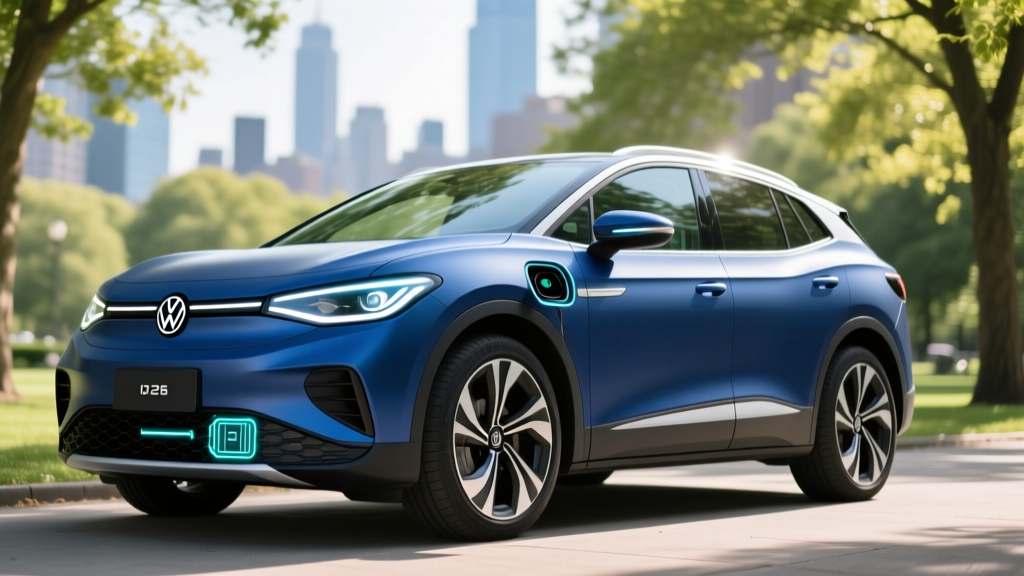
Is the VW ID.4 electric car worth buying in 2026? The ID.4 is a practical, roomy compact electric SUV with up to 291 miles of EPA range (RWD Standard trim), a usable 77 kWh NMC battery, and DC fast charging that peaks at 170 kW (10–80% in roughly 28 minutes). Starting around $42,195 before destination, it qualifies for partial or full federal tax credit depending on your income, sourcing, and the current IRS §30D rules. Real-world highway range lands closer to 240–260 miles, dropping further in cold climates. If you have Level 2 home charging and mostly drive under 200 miles daily, the ID.4 is one of the most sensible electric crossovers on the market. If you regularly road-trip in winter or lack home charging, read our cost and charging breakdown below before committing.
What the 2026 VW ID.4 Actually Delivers
Volkswagen has iterated the ID.4 steadily since its US launch, and the current model year benefits from software improvements, a slightly larger usable battery buffer, and the transition to the NACS charging port for native Tesla Supercharger access. Here is the spec snapshot that matters for purchase decisions:
| Spec | Value |
|---|---|
| EPA Range | 291 miles (RWD); 263 miles (AWD Pro S) |
| Battery (Usable) | 77 kWh, NMC chemistry |
| Peak DC Fast Charge | 170 kW (10–80% in ~28 min) |
| Level 2 AC Charge | 11 kW (~7.5 hours 0–100%) |
| Charging Port | NACS (native Supercharger access) |
| Motor Output | 282 hp (RWD) / 335 hp (AWD) |
| 0–60 mph | ~7.3 sec (RWD) / ~5.4 sec (AWD) |
| MPGe (Combined) | 104 MPGe (RWD) |
| Cargo Volume | 30.3 cu ft (rear seats up) / 64.2 cu ft (folded) |
| Base MSRP | ~$42,195 (Standard) to ~$52,000 (AWD Pro S Plus) |
| Battery/Powertrain Warranty | 8 years / 100,000 miles (70% capacity retention) |
Source: fueleconomy.gov and Volkswagen of America specifications.
Real-world range reality check: The EPA sticker says 291 miles for the RWD Standard trim. In our experience and aggregated owner data, expect 240–260 miles at sustained 70–75 mph highway speeds in mild weather. In freezing temperatures (below 30°F), cabin heating and battery resistance can drop range by 20–30%, putting real winter highway range around 190–220 miles. Plan road trips accordingly and precondition the battery via the VW app before DC fast charging in cold weather.
ID.4 vs Gas Compact SUV: A Cost Comparison
The most common cross-shop for the ID.4 is a gas compact SUV like the Toyota RAV4 or Honda CR-V. Let's run the numbers over 5 years and 75,000 miles, assuming a national average gas price of $3.40/gallon and residential electricity at $0.16/kWh.
| Cost Factor | VW ID.4 (RWD) | Toyota RAV4 AWD (30 MPG) |
|---|---|---|
| Purchase Price (base) | $42,195 | $32,500 |
| Federal Tax Credit (est.) | Up to $7,500* | $0 |
| Effective Purchase | ~$34,695 | $32,500 |
| Energy/Fuel Cost (75k mi) | ~$2,880** | ~$8,500 |
| Maintenance (est. 5yr) | ~$1,200 | ~$3,200 |
| 5-Year Total (purchase + energy + maint.) | ~$38,775 | ~$44,200 |
* Federal §30D credit eligibility depends on MSRP caps, buyer income limits, battery component and critical mineral sourcing. Confirm at irs.gov or with a tax professional. Point-of-sale transfer available at participating dealers.
** Based on 3.0 miles/kWh efficiency and 100% home Level 2 charging at $0.16/kWh. Public DC fast charging at $0.40–$0.55/kWh would increase this figure substantially.
The ID.4 closes the upfront price gap with the tax credit and pulls ahead on operating costs by year two or three. If you cannot access the credit, the breakeven extends to roughly year four. The key variable is your electricity rate — homeowners with solar or time-of-use plans paying under $0.12/kWh see even larger savings, while apartment dwellers relying entirely on public fast charging at $0.50/kWh may see minimal fuel savings over a hybrid.
Real Charging Costs and What You'll Actually Spend
Understanding the difference between kW (power — how fast energy flows) and kWh (energy — how much the battery holds) is critical. The ID.4's battery holds 77 kWh of usable energy. Here's what filling it costs in different scenarios:
| Charging Method | Rate | Cost per Full Charge | Cost per Mile |
|---|---|---|---|
| Home Level 2 (national avg.) | $0.16/kWh | $12.32 | $0.042 |
| Home Level 2 (off-peak TOU) | $0.09/kWh | $6.93 | $0.024 |
| Public Level 2 (ChargePoint, etc.) | $0.25/kWh | $19.25 | $0.066 |
| DC Fast Charging (Electrify America) | $0.48/kWh | $36.96 | $0.127 |
| Tesla Supercharger (NACS) | $0.35/kWh | $26.95 | $0.092 |
At home on Level 2, the ID.4 costs roughly 4 cents per mile to drive — about one-third the per-mile fuel cost of a 30 MPG gas SUV at $3.40/gallon. But if you rely exclusively on public DC fast charging, your cost per mile climbs to 9–13 cents, which narrows the advantage significantly. This is why home charging access is the single biggest determinant of EV ownership satisfaction.
Home Level 2 Installation: What to Budget
Most ID.4 owners will want a Level 2 home charger (240V, 32–48 amps) for overnight charging. Here's a realistic installation cost breakdown:
| Component | Typical Cost Range |
|---|---|
| Level 2 Charger (ChargePoint, Emporia, Wallbox) | $350–$700 |
| Electrician labor (240V/50A circuit run) | $600–$2,000 |
| Permit & inspection | $100–$300 |
| Electrical panel upgrade (if needed, 100A→200A) | $1,500–$3,500 |
| Total (no panel upgrade) | $1,050–$3,000 |
| Total (with panel upgrade) | $2,550–$6,500 |
The 11 kW onboard charger in the ID.4 means you'll add roughly 35–40 miles of range per hour of Level 2 charging — more than enough to fully replenish overnight for any daily commute under 200 miles. Always have a licensed electrician assess your panel capacity before purchase; older homes with 100-amp service may need an upgrade.
Tax Credit Eligibility: What the ID.4 Actually Qualifies For
The federal §30D clean vehicle credit can deliver up to $7,500, but it is not a guaranteed flat amount. Eligibility hinges on several moving targets:
- MSRP cap: SUVs must be under $80,000 — all ID.4 trims qualify.
- Buyer income cap: AGI must not exceed $150,000 (single), $225,000 (head of household), or $300,000 (joint). Check your modified AGI against IRS thresholds.
- Battery component sourcing: A percentage of battery components must be manufactured or assembled in North America. This threshold increases yearly — check current-year rules at irs.gov.
- Critical mineral sourcing: A percentage of critical minerals must be sourced from the US or free-trade-agreement partners.
- Point-of-sale transfer: You can transfer the credit to the dealer at purchase to reduce your out-of-pocket cost immediately, rather than waiting to claim it on your tax return.
The ID.4 is assembled in Chattanooga, Tennessee, which helps with domestic content rules, but critical mineral sourcing requirements tighten each year. Always verify eligibility with your dealer and a tax professional before relying on the full $7,500 in your budget. Some states offer additional rebates — check your state energy office or AFDC for local incentives.
Common ID.4 Misconceptions, Corrected
| Myth | Fact |
|---|---|
| "The ID.4 charges too slowly compared to Hyundai/Kia." | The ID.4 peaks at 170 kW, which is slower than the Ioniq 5's 240 kW. However, 10–80% in ~28 minutes is adequate for most road trips, and the charging curve is relatively flat through 60% SoC before tapering. |
| "I'll never be able to use Tesla Superchargers." | Current ID.4 models use the NACS port natively, granting access to Tesla's Supercharger network — the most reliable DC fast charging infrastructure in the US. |
| "The battery will need expensive replacement in a few years." | VW warranties the battery for 8 years/100,000 miles at 70% capacity retention. NMC degradation data across the industry shows most batteries retain 85–90% capacity after 100,000 miles. Full replacement (rare) costs roughly $8,000–$15,000 out of warranty. |
| "EV insurance is prohibitively expensive." | ID.4 insurance averages 5–15% higher than a comparable gas SUV, depending on your state and driving record. Shop quotes from GEICO, State Farm, and Progressive — the gap has narrowed significantly as insurers have more EV claims data. |
| "I can't drive it in winter." | You can, but plan for 20–30% range loss below 30°F. The ID.4's available heat pump (standard on higher trims) reduces heating-related range loss. Preconditioning while plugged in preserves range. |
Ownership Considerations Before You Buy
Beyond the sticker price and EPA range, these real-world factors determine whether the ID.4 fits your life:
Home charging access. If you own a home or have a dedicated parking spot with 240V outlet access, the ID.4 is effortless — plug in at night, wake up to 250+ miles. If you live in an apartment without charging, you'll depend on public infrastructure. Map the Level 2 and DC fast chargers within 2 miles of your home using PlugShare or the VW app before buying.
Climate and driving patterns. Owners in the Sun Belt will see range closest to the EPA sticker year-round. Those in the Upper Midwest or Northeast should budget for 200 real-world winter miles and plan road-trip charging stops accordingly. The ID.4's AWD variant adds traction but sacrifices 28 miles of EPA range.
Software and infotainment. VW's ID. software has improved substantially since the buggy 2021–2022 launch, with faster response times and more reliable over-the-air updates. However, the touch-capacitive steering wheel controls and climate slider bars remain divisive — test-drive and interact with these controls before purchasing.
Depreciation. EVs, including the ID.4, have experienced steeper depreciation than gas counterparts in recent years, partly due to aggressive price cuts and incentive shifts. Expect 45–55% value retention at 3 years — better than some EVs, worse than a RAV4 Hybrid. If you plan to keep the car 7+ years, this matters less.
Decision Framework: Is the ID.4 Right for You?
Choose the VW ID.4 if:
- You have Level 2 home charging (or can install it)
- Your daily driving is under 150 miles round-trip
- You want a mainstream-brand compact EV SUV with strong cargo space (30.3 cu ft)
- You value NACS Supercharger access for road trips
- You qualify for at least a partial federal tax credit
- You prefer a comfortable, quiet ride over sporty handling
Look elsewhere if:
- You need 300+ real-world highway miles — consider the Hyundai Ioniq 5 (Long Range) or Tesla Model Y
- You want the fastest DC charging — the Ioniq 5 (240 kW) or Lucid Gravity (300+ kW) charge considerably faster
- You lack any home or workplace charging and your area has sparse public infrastructure
- You regularly tow — the ID.4's 2,700-lb tow rating trails the Model Y (3,500 lb) and F-150 Lightning (7,700 lb)
- You want cutting-edge ADAS — VW's Travel Assist is competent Level 2, but Ford BlueCruise and GM Super Cruise offer hands-free highway driving on mapped roads
Frequently Asked Questions
What is the real-world range of the VW ID.4 electric car?
The EPA rates the RWD ID.4 at 291 miles. Real-world highway driving in mild weather yields 240–260 miles. In sub-freezing temperatures, expect 190–220 miles due to battery resistance and cabin heating demand. AWD trims start at 263 miles EPA and lose a similar percentage in real-world conditions.
How long does it take to charge the ID.4 at home?
On a Level 2 home charger (240V, 48A), the ID.4's 11 kW onboard charger replenishes the 77 kWh battery from empty to full in roughly 7.5 hours. For a typical daily commute using 50–80 miles, you'll need only 2–3 hours of charging overnight.
Does the ID.4 qualify for the $7,500 federal tax credit?
The ID.4 may qualify for up to $7,500 under IRS §30D rules, but eligibility depends on your income (AGI caps apply), the vehicle's battery component and critical mineral sourcing percentages for the current year, and MSRP limits (all ID.4 trims are under the $80,000 SUV cap). Verify current eligibility at irs.gov and with your tax professional. The credit can be transferred to the dealer at point of sale.
Can the VW ID.4 use Tesla Superchargers?
Yes. The current ID.4 is equipped with the NACS (North American Charging Standard) port, providing native access to Tesla's Supercharger network without an adapter. This is one of the ID.4's strongest practical advantages for road-trip charging reliability.
How does the ID.4 compare to a hybrid like the RAV4 Hybrid?
The RAV4 Hybrid delivers about 40 MPG combined with no charging requirement and a lower starting price (~$32,000). The ID.4 costs more upfront but saves $4,000–$6,000 in fuel and maintenance over 5 years (with home charging and tax credit). The hybrid is better for buyers without home charging, frequent long-distance winter drivers, or those who want zero behavior change. The ID.4 is better for daily commuters with home charging who want lower operating costs and zero tailpipe emissions.
What does ID.4 maintenance cost compared to a gas car?
The ID.4 has no engine oil, spark plugs, transmission fluid, or exhaust system to maintain. Scheduled service is limited to cabin air filter replacement, brake fluid checks (regenerative braking extends pad life significantly — many owners exceed 80,000 miles on original pads), tire rotation, and wiper fluid. Expect roughly $200–$300 per year in maintenance versus $500–$800 for a gas compact SUV.
What happens if the ID.4 battery degrades?
VW covers the battery for 8 years or 100,000 miles against capacity loss below 70%. Industry-wide NMC degradation data suggests most EV batteries retain 85–90% of original capacity at 100,000 miles with normal use. To maximize longevity, avoid frequently charging to 100% or draining to 0% — set your daily charge limit to 80% and only charge to 100% before long trips. Full out-of-warranty battery replacement, while rare, costs approximately $8,000–$15,000.