The Mercedes EQS: A Luxury EV Flagship Under Pressure
The Mercedes-Benz EQS sedan has served as the automaker's electric flagship since its 2022 debut, but the luxury EV landscape has shifted dramatically. With rivals like the Lucid Air, BMW i7, and Tesla Model S continually updating, buyers researching the EQS inside and out need precise data on range, charging behavior, interior execution, and ownership costs — not marketing gloss. This review dissects the 2026 EQS lineup (EQS 450+ and EQS 580 4MATIC) with the exact figures that matter for a six-figure EV purchase.
We'll cover the cabin experience, real-world range reconciliation against EPA estimates, DC fast-charging curves, federal tax credit eligibility under current IRS §30D rules, and whether the EQS still justifies its premium positioning.
EQS Specifications at a Glance
| Spec | EQS 450+ Sedan | EQS 580 4MATIC Sedan |
|---|---|---|
| EPA Range | 390 miles | 371 miles |
| Battery (usable) | 118 kWh (NMC) | 118 kWh (NMC) |
| Drivetrain | RWD, single motor | AWD, dual motor |
| Horsepower | 355 hp | 536 hp |
| 0-60 mph | 5.9 sec | 4.1 sec |
| Peak DC Fast Charge | 200 kW | 200 kW |
| 10-80% DCFC Time | ~31 min | ~31 min |
| Level 2 Charge Rate | 9.6 kW (~31 mi/hr) | 9.6 kW (~31 mi/hr) |
| MPGe (combined) | 97 MPGe | 91 MPGe |
| Efficiency | 35 kWh/100 mi | 37 kWh/100 mi |
| Cargo Volume | 22.0 cu ft (trunk) | 22.0 cu ft (trunk) |
| Rear Legroom | 41.7 in | 41.7 in |
| Base MSRP | $104,400 | $125,950 |
| Battery Warranty | 10 yr / 155,000 mi | 10 yr / 155,000 mi |
Sources: fueleconomy.gov, Mercedes-Benz USA.
Inside the EQS: Cabin, Hyperscreen, and Space
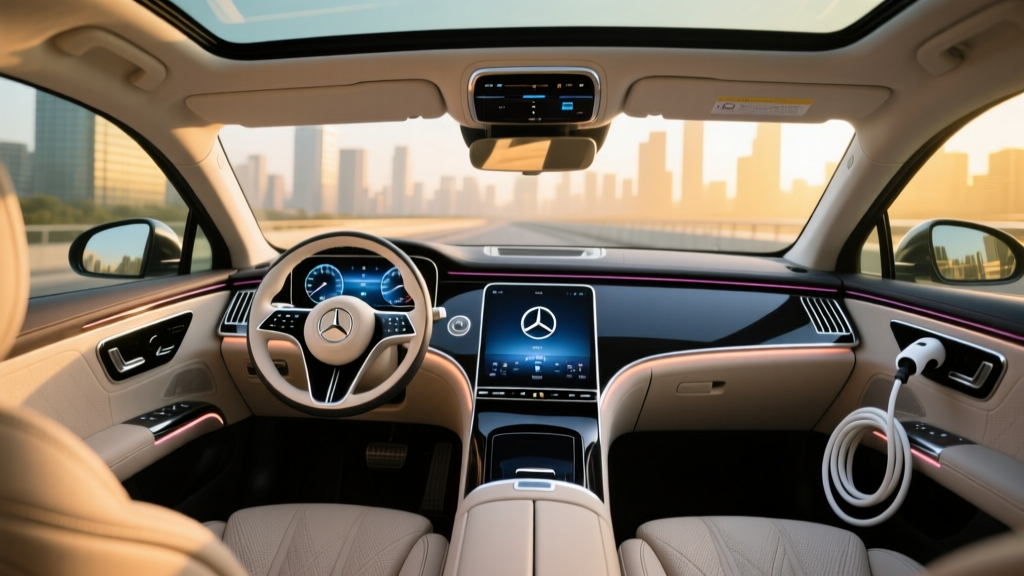
Stepping inside the EQS, the first thing that commands attention is the MBUX Hyperscreen — a 56-inch curved glass panel spanning the full dashboard width, integrating a 17.7-inch central OLED display, a 12.3-inch driver cluster, and a 12.3-inch passenger screen. It's visually stunning, but real-world usability is mixed. The screen's sheer size means some climate and vehicle controls are buried in submenus, and the passenger display can distract the driver in peripheral vision. Mercedes has improved responsiveness in the 2026 model year, reducing the latency that plagued earlier versions.
Material quality is flagship-appropriate: open-pore wood, Nappa leather (standard on 580, optional on 450+), aluminum trim, and ambient lighting with 64 colors. The cabin is exceptionally quiet — Mercedes uses acoustic-laminated glass all around, and at 70 mph the EQS is one of the quietest production sedans available, rivaling the BMW i7.
Space is generous but with a caveat. Rear legroom measures 41.7 inches, which is excellent, and the rear seats recline with available massage and heating. However, the sloping roofline (designed for aerodynamic efficiency — the EQS achieves a Cd of 0.20) reduces rear headroom compared to boxier sedans. Taller passengers (6'2"+) will notice the compromise. The trunk offers 22.0 cubic feet, expandable to 63 cu ft with rear seats folded, accessed via a practical liftback design. There is no front trunk (frunk) — the space is occupied by HVAC components and electronics.
Real-World Range vs. EPA Estimates
The 118 kWh usable battery (NMC chemistry, supplied by CATL/Farasis) is one of the largest in any production EV. NMC (nickel manganese cobalt) offers high energy density, which is why the EQS achieves its range figure, but it's more sensitive to sustained 100% state-of-charge storage than LFP chemistries. Mercedes recommends daily charging to 80-90% and only charging to 100% before long trips — the battery management system includes a buffer of approximately 7 kWh above and below the usable window to protect longevity.
Efficiency on the EQS 450+ is rated at 97 MPGe combined (35 kWh per 100 miles). That's respectable for a 5,600-pound luxury sedan but trails the Lucid Air Grand Touring (131 MPGe) and Tesla Model S Long Range (120 MPGe). The aerodynamic efficiency helps, but mass is the EQS's enemy in energy consumption.
Charging Speed: DC Fast and Home Level 2
The EQS peaks at 200 kW on DC fast charging (CCS1 connector). In optimal conditions — battery preconditioned to ~85°F, starting at 10% SoC — the EQS sustains roughly 180-200 kW up to about 40% SoC, then tapers progressively. The 10-80% charge takes approximately 31 minutes. From 80-100%, charging slows dramatically to under 50 kW, adding another 20+ minutes. This taper behavior is typical of NMC batteries managed conservatively for longevity, but it means the EQS is not a class leader in charging speed. The Lucid Air peaks at 300+ kW, and the Porsche Taycan at 320 kW on 800V architectures.
For home Level 2 charging, the EQS accepts up to 9.6 kW on a 240V/40A circuit, adding approximately 31 miles of range per hour. A full 0-100% charge at home takes roughly 12-13 hours. Most owners will charge from 20-80% overnight, which takes about 7-8 hours — easily within a single overnight window.
| Charging Level | Power (kW) | Speed / Time | Notes |
|---|---|---|---|
| Level 1 (120V) | ~1.4 kW | ~4 mi/hr | Emergency only; full charge ~85 hrs |
| Level 2 (240V, 40A) | 9.6 kW | ~31 mi/hr; 20-80% in ~7.5 hrs | Home standard; requires NEMA 14-50 or hardwired |
| DC Fast (CCS1) | 200 kW peak | 10-80% in ~31 min | Tapers above 80%; precondition battery via nav |
Preconditioning tip: When you enter a DC fast-charger destination into the MBUX navigation, the EQS automatically begins warming the battery to optimal temperature. Without preconditioning — especially in cold weather — peak charge rates may drop to 100-130 kW, significantly extending charge time.
Performance and Driving Dynamics
The EQS 450+ delivers 355 horsepower through a single rear motor, reaching 0-60 mph in 5.9 seconds. That's adequate for merging and passing but leisurely by luxury EV standards. The EQS 580 4MATIC (dual-motor AWD, 536 hp) cuts that to 4.1 seconds, which feels appropriately rapid. Both variants are electronically limited to 130 mph.
Ride quality is where the EQS shines. Standard AIRMATIC air suspension absorbs road imperfections with genuine authority, and the cabin isolation is exceptional. Steering is light and accurate but offers minimal feedback — this is a grand tourer, not a sports sedan. The available rear-axle steering (up to 10 degrees) dramatically improves low-speed maneuverability, shrinking the turning circle to 35.8 feet — remarkable for a 207-inch-long sedan.
Regenerative braking offers three levels (D+, D, D-) selected via steering-wheel paddles, plus D-Auto, which uses radar and camera data to modulate regen based on traffic ahead. One-pedal driving is achievable in D- mode, but the brake-pedal feel is somewhat artificial — a common complaint in Mercedes EVs.
Pricing, Trims, and Federal Tax Credit Eligibility
The 2026 EQS lineup starts at $104,400 for the EQS 450+ Sedan and $125,950 for the EQS 580 4MATIC. A fully optioned EQS 580 with the AMG Line package, Rear Seat Comfort package, and Executive Rear Seat Plus can exceed $145,000. The EQS SUV variant is priced separately (starting ~$105,550 for 450+, ~$127,100 for 580).
| Trim | Base MSRP | As-Tested (typical options) |
|---|---|---|
| EQS 450+ Sedan | $104,400 | $112,000-$118,000 |
| EQS 580 4MATIC Sedan | $125,950 | $135,000-$145,000 |
| EQS 450+ SUV | $105,550 | $115,000-$122,000 |
| EQS 580 4MATIC SUV | $127,100 | $138,000-$148,000 |
Some buyers may qualify for state-level incentives (California's CVRP, Colorado's innovative motor vehicle credit, etc.), but these vary by jurisdiction and often have their own income and price caps. Check your state's energy office for current programs.
ADAS and Driver-Assistance Technology
The EQS comes equipped with Mercedes-Benz Driver Assistance Package, which includes adaptive cruise control, lane-keeping assist, automatic lane changes (with turn-signal confirmation), and Active Emergency Stop Assist. This is a SAE Level 2 system — the driver must remain engaged, with hands on the wheel and eyes on the road. It is not autonomous driving.
Mercedes does offer its DRIVE PILOT system (SAE Level 3) in limited markets, which allows hands-off, eyes-off driving under 40 mph on approved divided highways. However, as of 2026, DRIVE PILOT availability in the US remains limited to specific highway segments in Nevada and California, with significant geographic and speed restrictions. It is an expensive option (~$2,500) and requires specific road and weather conditions to engage.
EQS vs. the Competition
| Spec | Mercedes EQS 450+ | Lucid Air Grand Touring | BMW i7 xDrive60 | Tesla Model S LR |
|---|---|---|---|---|
| EPA Range | 390 mi | 516 mi | 318 mi | 402 mi |
| Battery | 118 kWh (NMC) | 112 kWh (NMC) | 101.7 kWh (NMC) | 100 kWh (est.) |
| Peak DCFC | 200 kW | 300+ kW | 195 kW | 250 kW |
| 0-60 mph | 5.9 sec | 3.0 sec | 4.5 sec | 3.1 sec |
| Base MSRP | $104,400 | $125,600 | $119,300 | $74,990 |
| Tax Credit | No (over cap) | No (over cap) | No (over cap) | No (over cap) |
| MPGe (comb.) | 97 | 131 | 86 | 120 |
The Lucid Air Grand Touring is the efficiency and range king, offering 516 EPA miles and faster charging — but at a higher base price and with a less established service network. The BMW i7 offers a more traditional luxury sedan experience with comparable interior quality but less range. The Tesla Model S Long Range is the performance and value pick, but its interior quality and ride comfort don't match the Mercedes.
Choose the EQS if:
- Ride comfort and cabin silence are your top priorities
- You value the Hyperscreen and MBUX ecosystem
- You prefer a traditional luxury dealer experience
- You need a liftback trunk with 63 cu ft of cargo space
Look elsewhere if:
- Maximum range is critical (Lucid Air)
- You want faster DC charging (Lucid, Porsche Taycan)
- Performance per dollar matters (Tesla Model S)
- You want a more engaging driving experience (BMW i7, Porsche)
Warranty, Ownership, and Longevity
Mercedes provides a competitive warranty package for the EQS:
- Basic vehicle: 4 years / 50,000 miles
- Battery: 10 years / 155,000 miles (capacity retention guaranteed above 70% of original)
- Powertrain: 4 years / 50,000 miles
- Corrosion: 4 years / 50,000 miles
The 10-year / 155,000-mile battery warranty is strong and aligns with industry norms for premium EVs (BMW, Audi offer similar). The 70% capacity retention threshold is standard — if the battery degrades below 70% of its original 118 kWh capacity within the warranty period, Mercedes will repair or replace it. Based on current NMC degradation data from fleet operators, most owners should expect 85-90% capacity retention at 100,000 miles with proper charging habits (avoiding frequent 100% charges and DC fast charging in extreme temperatures).
Insurance costs for the EQS are elevated — expect annual premiums 25-40% higher than a comparable ICE S-Class, driven by repair costs for the Hyperscreen, sensor suite, and battery. Get quotes before purchasing.
Pros
- Class-leading cabin silence and ride comfort
- 390-mile EPA range (450+)
- Generous rear seat space and liftback utility
- Hyperscreen is visually impressive
- 10-yr/155,000-mi battery warranty
- Rear-axle steering improves maneuverability
Cons
- No federal tax credit eligibility (MSRP cap)
- DC charging peaks at 200 kW (slower than rivals)
- Heavy — 5,600+ lbs affects efficiency
- Hyperscreen menus can be distracting
- No front trunk (frunk)
- Steep depreciation (luxury EV norm)
- Sloping roofline cuts rear headroom for tall passengers
Who Should Buy the Mercedes EQS?
The EQS is best suited for luxury sedan buyers who prioritize comfort, quiet, and technology over outright performance or efficiency. It excels as a daily commuter and long-distance cruiser, particularly for owners with home Level 2 charging who can wake up to a full battery every morning. The 390-mile range eliminates range anxiety for most use cases, and the liftback trunk adds practicality that traditional sedans lack.
It is less ideal for buyers who frequently road-trip in cold climates (range drops significantly), those who want the fastest possible DC charging, or anyone sensitive to the lack of a federal tax credit on a $100,000+ vehicle. If your priority is efficiency, the Lucid Air is the clear winner. If it's performance, the Tesla Model S Plaid or Porsche Taycan. If it's traditional luxury with electric power, the EQS and BMW i7 are the top contenders — and the EQS wins on range while the i7 wins on driving engagement.
Frequently Asked Questions
What is the real-world range of the Mercedes EQS?
The EQS 450+ is EPA-rated at 390 miles. In real-world highway driving at 70-75 mph in moderate temperatures, expect 330-350 miles. In cold weather below 30°F, range drops to approximately 270-300 miles. City driving with regenerative braking can exceed 400 miles.
How fast does the EQS charge at home and on DC fast chargers?
On DC fast charging, the EQS peaks at 200 kW and charges from 10-80% in approximately 31 minutes with a preconditioned battery. At home on a Level 2 (240V/40A) charger, it charges at 9.6 kW, adding about 31 miles per hour — a typical 20-80% charge takes about 7.5 hours overnight.
Does the Mercedes EQS qualify for the federal EV tax credit?
No. The IRS §30D credit caps eligible sedans at $55,000 MSRP and SUVs at $80,000 MSRP. The EQS Sedan starts at $104,400 and the SUV at $105,550, exceeding both caps. No EQS variant qualifies for the $7,500 federal credit regardless of buyer income. See IRS.gov for current rules.
Is the EQS worth buying over the Lucid Air or BMW i7?
It depends on priorities. The EQS offers the best ride comfort and cabin quietness, strong range (390 mi), and practical liftback cargo space. The Lucid Air delivers far superior efficiency (131 MPGe) and range (516 mi) with faster charging, but at a higher price. The BMW i7 offers a more engaging driving experience but with less range (318 mi). Test-drive all three before deciding.
What battery chemistry does the EQS use, and how long will it last?
The EQS uses an NMC (nickel manganese cobalt) battery with 118 kWh usable capacity. NMC offers high energy density but requires careful charging habits for longevity — avoid frequent 100% charges and prolonged storage at full SoC. Mercedes warrants the battery for 10 years / 155,000 miles with a 70% capacity retention guarantee. Real-world data suggests 85-90% capacity at 100,000 miles with proper care.
Does the EQS have a frunk (front trunk)?
No. The space under the hood is occupied by HVAC components, power electronics, and the washer-fluid reservoir. All cargo goes in the 22.0 cu ft rear liftback trunk (63 cu ft with seats folded).
For the latest EQS pricing and specifications, visit Mercedes-Benz USA. Safety ratings available at NHTSA.gov and IIHS.org.