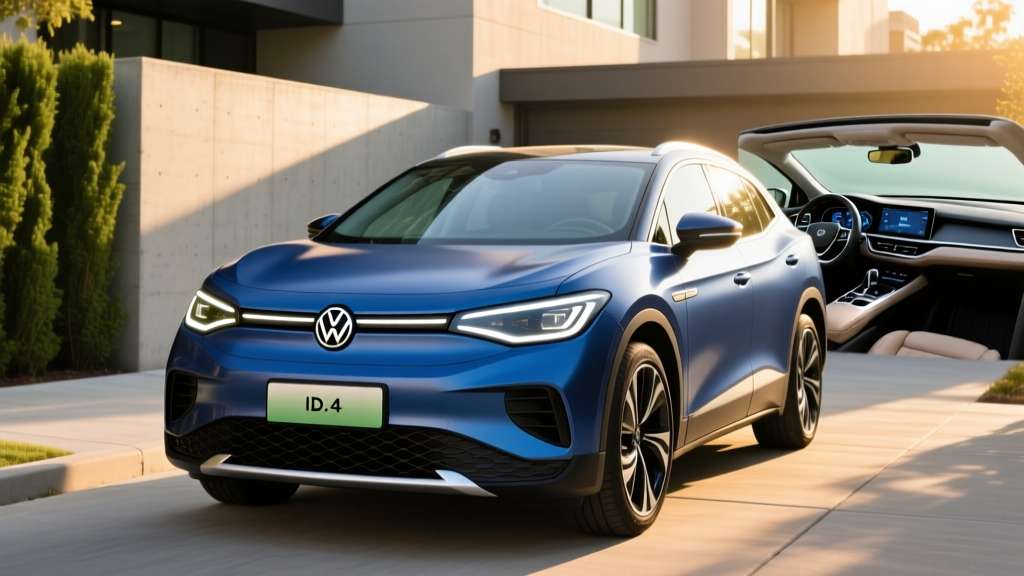
Volkswagen's ID.4 has always been a sensible electric crossover — roomy, comfortable, and priced to compete. But since its launch, owners and reviewers alike have flagged a consistent set of complaints: laggy infotainment, frustrating capacitive touch controls, awkward window-switch layouts, and software glitches that undermine an otherwise solid EV platform. In late 2024 and into 2025, Volkswagen acknowledged design and usability issues in the ID.3 and ID.4 publicly, committing to sweeping interior and software overhauls for the next generation.
For 2026, the ID.4 arrives with meaningful mid-cycle updates that address many of those pain points — a revised infotainment system with physical volume controls, faster processor speeds, and an updated software stack. But has VW gone far enough? Below, we break down the 2026 ID.4 with the data-driven scrutiny EV buyers deserve: real range, real charging speeds, real pricing after federal incentives, and an honest assessment of whether the fixes make this a compelling buy in a crowded compact electric SUV segment.
2026 Volkswagen ID.4: Core Specifications at a Glance
| Spec | ID.4 Standard (RWD) | ID.4 AWD Pro S |
|---|---|---|
| EPA Range | 275 miles | 263 miles |
| Battery (usable) | 82 kWh (NMC) | 82 kWh (NMC) |
| Horsepower | 282 hp | 335 hp |
| 0–60 mph | 7.3 sec | 5.4 sec |
| Drivetrain | Rear-wheel drive | Dual-motor AWD |
| Max DC Fast Charge | 170 kW | 170 kW |
| 10–80% DC Charge Time | ~28 min | ~28 min |
| Level 2 Home Charge Rate | 11 kW (~37 mi/hr) | 11 kW (~37 mi/hr) |
| MPGe (combined) | 107 MPGe | 101 MPGe |
| Efficiency | 31 kWh/100 mi | 33 kWh/100 mi |
| Cargo (behind rear seats) | 30.3 cu ft | 30.3 cu ft |
| Cargo (seats folded) | 64.2 cu ft | 64.2 cu ft |
| Rear Legroom | 37.6 in | 37.6 in |
| Base MSRP | $39,995 | $48,495 |
| Battery Warranty | 8 yr / 100,000 mi | 8 yr / 100,000 mi |
What Volkswagen Acknowledged — and What the 2026 ID.4 Actually Fixes
When Volkswagen acknowledged design and usability issues in the ID.3 and ID.4, the company specifically cited three problem areas: the capacitive-touch steering wheel controls that registered accidental inputs, the two-window-switch layout for four windows that confused drivers, and the previous-generation infotainment system that suffered from slow response times and occasional freezes.
For 2026, the ID.4 receives:
- Revised steering wheel: Physical buttons replace the problematic capacitive-touch pads, eliminating unintended inputs during turns.
- Four-window switches restored: The rear windows now have dedicated switches rather than the prior toggle-and-hold arrangement.
- Infotainment overhaul: VW's latest software platform runs on a faster processor with improved voice recognition, a larger 12.9-inch touchscreen, and — critically — a physical volume knob/slider, a direct response to owner feedback.
- Improved OTA capability: Over-the-air updates are now more reliable, addressing the failed or stalled updates that plagued early ID.4 models.
What hasn't changed: the ID.4's fundamental architecture, battery pack, and exterior design remain the same. If you disliked the ID.4's exterior proportions or its somewhat upright driving position, those persist. The fixes are targeted, not transformative.
Real-World Range: Beyond the EPA Sticker
EPA Estimate: 275 miles
Highway (70 mph, moderate weather): ~235–250 miles
City / mixed driving: ~260–275 miles
Cold weather (below 32°F, highway): ~195–220 miles
Towing (if equipped): ~160–180 miles
The 82 kWh usable battery (gross capacity is approximately 86 kWh, with a software-locked buffer to protect long-term health) uses NMC (nickel-manganese-cobalt) chemistry. This is important context: NMC offers higher energy density than LFP (lithium iron phosphate), which is why the ID.4 achieves 275 miles from a moderately sized pack. The trade-off is that NMC batteries are more sensitive to sustained high states of charge and extreme temperatures.
In real-world highway testing at sustained 70–75 mph speeds, the ID.4 RWD typically returns 3.5–3.8 miles per kWh, translating to roughly 235–250 miles before reaching a 10% state of charge. Cold weather compounds this — below freezing, expect a 20–30% reduction due to cabin heating demands and increased battery internal resistance. The ID.4's standard heat pump (now included on all 2026 trims) mitigates this somewhat compared to resistance-heating EVs, but physics is physics.
For context against the segment: the Hyundai Ioniq 5 (Long Range RWD) achieves an EPA 303 miles from a 77.4 kWh battery, while the Tesla Model Y Long Range AWD hits 308 miles. The ID.4 trails both by roughly 30 miles on the sticker — a meaningful gap on road trips.
Charging Performance: DC Fast and Home Level 2
| Charging Method | Power (kW) | Speed (miles/hr added) | Notes |
|---|---|---|---|
| Level 1 (120V household) | 1.4 kW | ~4 mi/hr | Emergency/top-up only |
| Level 2 (240V, 48A home) | 11 kW | ~37 mi/hr | Full charge in ~8.5 hours |
| DC Fast (peak) | 170 kW | ~520 mi/hr (peak) | 10–80% in ~28 minutes |
| DC Fast (sustained avg) | ~115 kW | ~350 mi/hr (avg) | Real-world average 10–80% |
The ID.4's 170 kW peak DC fast-charging rate is adequate but no longer class-leading. Competitors like the Hyundai Ioniq 5 and Kia EV6 peak at 240 kW on 800V architectures, achieving 10–80% in roughly 18 minutes. The ID.4's 400V architecture limits its peak, and as with all EVs, the charge curve tapers significantly above 80% state of charge.
In practice, on a 150 kW Electrify America or ChargePoint stall, the ID.4 will sustain roughly 130–150 kW between 10–50% SoC, then progressively taper to 60–80 kW through the 50–80% window. The ~28-minute 10–80% figure assumes optimal battery preconditioning (navigating to a charger via the built-in nav triggers thermal prep). Without preconditioning, add 5–8 minutes in cold weather.
For home charging, the 11 kW onboard charger is a strong point — it's faster than the Tesla Model Y's 11.5 kW and significantly faster than some competitors limited to 7.2 or 9.6 kW. A full overnight charge from 20% to 100% takes roughly 8.5 hours on a 48-amp Level 2 home station. Note: achieving the full 11 kW requires a hardwired 60-amp circuit; a NEMA 14-50 outlet on a 50-amp breaker limits you to 9.6 kW (~32 mi/hr).
Performance and Driving Dynamics
The 2026 ID.4 Standard produces 282 horsepower from its rear-mounted permanent-magnet synchronous motor — a 30 hp bump over the original 2021 launch spec, achieved through software tuning refinements. The 0–60 mph time of 7.3 seconds is unhurried by modern EV standards but entirely adequate for merging and passing. The AWD Pro S variant's dual-motor setup delivers 335 hp and a 5.4-second 0–60, which feels properly quick in daily driving.
The ID.4's MEB platform gives it a low center of gravity and competent handling, though the steering is deliberately light and numb — this is a comfort-tuned family crossover, not a sportscar. Ride quality over rough pavement is a genuine strength, with well-damped suspension that absorbs impacts better than the stiffer Ioniq 5 or Model Y. Road noise insulation is above average for the segment.
The ID.4's regenerative braking system deserves specific mention: unlike many competitors, VW does not offer true one-pedal driving. The strongest regen setting (B mode) still requires brake-pedal use for complete stops. Some EV veterans find this frustrating; others appreciate the more natural, coasting-friendly feel.
Pricing, Trims, and Federal Tax Credit Eligibility
| Trim | Base MSRP | Est. After §30D Credit | Key Features |
|---|---|---|---|
| ID.4 Standard (RWD) | $39,995 | ~$32,495* | 12.9" screen, heat pump, 19" wheels |
| ID.4 Pro (RWD) | $43,995 | ~$36,495* | Added ADAS, panoramic roof, heated seats |
| ID.4 Pro S (RWD) | $46,495 | ~$38,995* | Premium interior, 20" wheels, power liftgate |
| ID.4 AWD Pro S | $48,495 | ~$40,995* | Dual-motor, 263-mi range, all above |
| ID.4 AWD Pro S Plus | $53,495 | ~$45,995* | Head-up display, ventilated seats, premium audio |
*Tax credit estimates assume full $7,500 §30D eligibility. Actual credit depends on buyer income, battery sourcing, and MSRP caps. Consult a tax professional and review current IRS §30D guidance.
The 2026 ID.4 qualifies for the federal EV tax credit under §30D, but eligibility is not automatic. Current rules require:
- MSRP cap: SUVs must be priced at or below $80,000 (all ID.4 trims qualify).
- Buyer income cap: Modified AGI must not exceed $150,000 (single), $225,000 (head of household), or $300,000 (joint).
- Battery sourcing: A percentage of critical minerals and battery components must be sourced from the U.S. or free-trade-agreement partners. VW sources ID.4 batteries for the U.S. market from SK On's Georgia plant, which currently meets component requirements, but critical-mineral thresholds tighten annually. Verify current-year compliance on the fueleconomy.gov tax credit page.
- Point-of-sale transfer: As of 2024, eligible buyers can transfer the credit to the dealer at purchase, receiving the $7,500 as an immediate price reduction rather than waiting for a tax refund.
Interior, Tech, and the Usability Fixes in Practice
The 2026 ID.4's cabin materials are a mixed bag that reflects VW's positioning between mainstream and premium. Soft-touch materials on the dash and upper door panels feel upscale, but the lower door pockets, center console, and rear seatbacks use hard, scratchy plastics that don't match the $40,000+ price tag. Compared to the Hyundai Ioniq 5's more cohesive interior design or the Tesla Model Y's minimalist (if spartan) approach, the ID.4 lands in an awkward middle ground.
The updated 12.9-inch infotainment screen is a clear improvement. Response times are noticeably faster than the 2021–2024 models, and the new software layout groups functions more logically. The return of a physical volume control is a small detail that matters enormously in daily use — no more stabbing at a touchscreen slider while driving.
Driver assistance comes via Volkswagen's IQ.DRIVE suite, which includes adaptive cruise control with stop-and-go, lane-keeping assist, and front/rear automatic emergency braking. This is an SAE Level 2 system — it assists with steering and speed but requires the driver to remain fully engaged at all times. It is not self-driving. The system is competent but not class-leading; Ford's BlueCruise and GM's Super Cruise offer hands-free highway driving on mapped roads, which VW does not yet match.
Pros and Cons: An Honest Assessment
- Comfortable ride quality — best in segment over rough pavement
- Spacious rear seat (37.6" legroom) and cargo area (30.3 cu ft)
- 11 kW Level 2 charging — faster than many competitors
- Heat pump standard on all trims (cold-weather efficiency)
- Physical controls restored for 2026 (steering wheel, volume)
- Competitive base price after tax credit (~$32,500)
- 8-year / 100,000-mile battery warranty
- EPA range (275 mi) trails Ioniq 5, Model Y, and EV6
- 170 kW DC charging is slower than 800V competitors (240+ kW)
- No one-pedal driving / limited regen braking
- Interior plastics below expectations for price point
- IQ.DRIVE lags behind BlueCruise/Super Cruise in capability
- Software, while improved, still not as polished as Tesla or Hyundai
- Resale value historically weaker than Tesla or Korean EVs
Who Should Buy the 2026 Volkswagen ID.4?
Choose the ID.4 if: You prioritize ride comfort and cabin quietness over maximum range; you need generous rear-seat space for child seats or adult passengers; you primarily drive in mixed city/suburban conditions where the 275-mile range is sufficient; and the post-credit price of ~$32,500–$39,000 fits your budget.
Look elsewhere if: You regularly take 300+ mile road trips (the Ioniq 5 or Model Y offer 30+ more EPA miles and faster DC charging); you want hands-free highway driving (Ford BlueCruise or GM Super Cruise); you demand one-pedal driving; or resale value is a top priority.
Frequently Asked Questions
What is the real-world range of the 2026 VW ID.4?
The EPA rates the ID.4 Standard RWD at 275 miles. In real-world highway driving at 70 mph, expect approximately 235–250 miles. In cold weather (below freezing), highway range can drop to 195–220 miles. City and suburban driving with regenerative braking recovers more energy, often matching or slightly exceeding the EPA figure.
How fast does the ID.4 charge at home and on the road?
On a 48-amp Level 2 home charger, the ID.4 charges at 11 kW, adding roughly 37 miles of range per hour and achieving a full charge from near-empty in about 8.5 hours. On DC fast chargers, it peaks at 170 kW and charges from 10–80% in approximately 28 minutes with battery preconditioning active. This is slower than 800V competitors like the Ioniq 5 (~18 minutes) but adequate for most road-trip charging stops.
Does the 2026 ID.4 qualify for the $7,500 federal EV tax credit?
The ID.4 is eligible for the full §30D credit, but buyer eligibility depends on income caps ($150K single / $300K joint modified AGI), the vehicle's MSRP (must be under $80K for SUVs — all trims qualify), and battery-sourcing requirements that tighten annually. VW assembles the U.S.-market ID.4 in Chattanooga, Tennessee, with batteries from SK On's Georgia facility, which currently satisfies component requirements. Always verify current-year eligibility at fueleconomy.gov and consult a tax professional.
Is the 2026 ID.4 worth buying over the Tesla Model Y or Hyundai Ioniq 5?
It depends on your priorities. The Model Y Long Range AWD offers 308 miles of range, access to the Supercharger network, and the most polished software — but at a higher starting price and with a firmer ride. The Ioniq 5 delivers 303 miles, 240 kW DC charging, and a more distinctive design. The ID.4 wins on ride comfort, cabin quietness, and post-credit value at the base trim. If comfort and price matter more than maximum range and charging speed, the ID.4 makes a strong case.
Did Volkswagen fix the infotainment and usability problems?
Partially. The 2026 model's 12.9-inch screen with faster processing, physical volume control, and restored steering-wheel buttons address the most-cited complaints. The software is more stable and responsive than prior model years. However, some reviewers note that the menu hierarchy still requires more taps than ideal for certain functions, and the digital instrument cluster remains small (5.3 inches) compared to competitors. The fixes are meaningful improvements, not a complete reinvention.
What is the battery warranty on the ID.4?
Volkswagen covers the ID.4's high-voltage battery for 8 years or 100,000 miles (whichever comes first), with a capacity-retention threshold of 70%. If the battery degrades below 70% of its original capacity within that period, VW will repair or replace it. This matches the industry standard set by most automakers and is consistent with NHTSA-referenced battery warranty norms. The vehicle's basic warranty is 4 years / 50,000 miles.