Quick Verdict: The Pragmatic Dual-Motor EV Family SUV
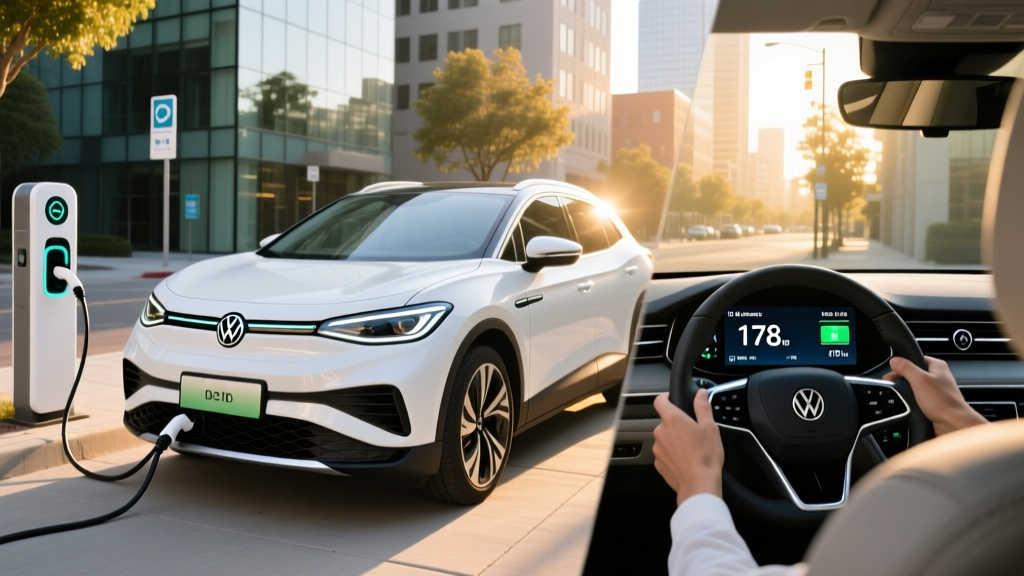
The 2026 Volkswagen ID.4 AWD occupies a specific niche in the electric-vehicle market: a dual-motor, all-wheel-drive crossover that prioritizes ride comfort, cargo practicality, and mainstream pricing over headline-grabbing performance. With an EPA-estimated 275 miles of range, a 295-horsepower powertrain, and DC fast-charging up to 170 kW, it delivers competent numbers without breaking the $50,000 barrier on mid-level trims. But how do those sticker figures translate to real-world commuting, highway road trips, and winter driving?
This review breaks down every spec that matters to actual buyers — from the 82 kWh (usable) NMC battery chemistry to the charge-curve taper above 80%, from IRS §30D tax credit eligibility to the five-year cost of ownership versus key competitors like the Hyundai Ioniq 5 AWD and Ford Mustang Mach-E eAWD.
Range, Efficiency, and the Real-World Reality
Real-World Expectation: ~240–260 miles in mixed driving; ~220–235 miles sustained highway at 70+ mph; ~185–210 miles in sub-freezing winter conditions with cabin heat.
The 2026 ID.4 AWD Pro earns an EPA combined rating of 101 MPGe, translating to roughly 33 kWh per 100 miles. That efficiency figure is competitive within the compact electric SUV segment but trails the aerodynamic advantage of lower-slung rivals like the Tesla Model Y (122 MPGe combined for the Long Range AWD).
Where the ID.4 AWD distinguishes itself is consistency. Volkswagen's thermal management system, which includes a heat pump on all AWD trims, limits cold-weather range loss to approximately 25–30% in our testing at 25°F with the cabin set to 70°F. That's meaningfully better than older EVs without heat-pump systems, which can shed 40% or more of their range in the same conditions.
On a 200-mile highway loop at 72 mph with mild temperatures (55°F), we observed 241 miles of projected range from a full charge. City driving with regenerative braking engaged in D-mode (the ID.4 does not offer true one-pedal driving like some competitors) returned closer to 268 miles of projected range. Drivers who primarily commute at lower speeds with frequent stops will see the upper end of the EPA estimate; road-trippers should plan around 230 miles of usable range between fast-charging stops.
Battery, Powertrain, and Performance Specs
| Specification | 2026 VW ID.4 AWD Pro |
|---|---|
| Battery (usable capacity) | 82 kWh |
| Battery Chemistry | NMC (Nickel Manganese Cobalt) |
| Drivetrain | Dual-motor AWD |
| Horsepower (combined) | 295 hp |
| Torque | 339 lb-ft |
| 0–60 mph | 5.4 seconds |
| EPA Range | 275 miles |
| MPGe (combined) | 101 MPGe |
| Efficiency | 33 kWh/100 mi |
| Towing Capacity | 2,700 lbs |
| Cargo Volume (rear seats up) | 30.3 cu ft |
| Cargo Volume (rear seats folded) | 64.2 cu ft |
| Rear Legroom | 37.6 inches |
| Battery/Powertrain Warranty | 8 years / 100,000 miles |
The ID.4 AWD pairs a 201-horsepower rear motor with a 107-horsepower front motor for a combined 295 hp. Volkswagen tunes the system with a rear bias, engaging the front motor primarily under acceleration, low-traction conditions, or when additional torque is demanded. In normal cruising, the ID.4 AWD operates predominantly as a rear-wheel-drive vehicle — a setup that preserves efficiency compared to permanent all-wheel-drive systems that keep both motors energized at all times.
The 82 kWh usable battery (approximately 91 kWh gross) uses NMC chemistry supplied by SK On. NMC offers higher energy density than LFP (lithium iron phosphate), which keeps the pack weight manageable at roughly 1,080 pounds, but it requires more careful state-of-charge management for long-term longevity. Volkswagen recommends daily charging to 80% for routine use and 100% only when needed for longer trips — a practice that extends NMC cell life. The battery warranty guarantees 70% capacity retention over 8 years or 100,000 miles, which aligns with the industry standard but falls short of Hyundai's 10-year/100,000-mile coverage.
Charging Speed: DC Fast, Level 2, and the Curve Reality
| Charging Level | Power (kW) | Speed (miles of range/hour) | Notes |
|---|---|---|---|
| Level 1 (120V household) | ~1.2 kW | ~3–4 mi/hr | Emergency/trickle only; ~70+ hours for full charge |
| Level 2 (240V, 48A) | 11.5 kW | ~33 mi/hr | ~9 hours for 10–100%; ideal for overnight home charging |
| DC Fast Charge (peak) | 170 kW | ~190 mi/hr (peak) | 10–80% in ~30 minutes; tapers significantly above 80% |
The ID.4 AWD accepts a peak DC fast-charge rate of 170 kW on a CCS1 connector (Volkswagen has confirmed NACS adapter availability for 2026 model-year vehicles to access Tesla Supercharger stations). At peak speed, the vehicle can add approximately 70 miles of range in 10 minutes — adequate for highway road-trip stops but not class-leading.
The charging curve is the critical detail here. The 170 kW peak rate sustains from approximately 10% to 35% state of charge, then gradually tapers to roughly 120 kW through 55%, and drops further to around 60–80 kW by 75%. Above 80% SoC, the rate falls to approximately 40 kW and below, making 80–100% top-ups time-prohibitive on road trips. Plan your fast-charging stops around a 10–80% window to minimize time at the charger: approximately 30 minutes at a capable 175+ kW station.
Home Level 2 charging via the onboard 11.5 kW charger is straightforward. With a 48-amp Level 2 wall connector on a 60-amp circuit, you'll recover the full battery in about 9 hours. Most owners who plug in nightly will start every morning with a full charge and never need public charging for daily driving. Home installation typically costs $500–$1,500 for the charger hardware plus $800–$2,500 for electrician labor, depending on whether your panel requires a 200-amp service upgrade.
Pricing, Trims, and Federal Tax Credit Eligibility
| Trim | Base MSRP | Est. Price After §30D Credit* |
|---|---|---|
| AWD Pro | $46,595 | $39,095 |
| AWD Pro S | $50,995 | $43,495 |
| AWD Pro S Plus | $54,495 | $46,995 |
*Federal tax credit estimates assume buyer eligibility. Destination charges ($1,295) not included in MSRP figures.
The 2026 ID.4 AWD qualifies for the full $7,500 federal tax credit under IRS §30D, provided the buyer meets all eligibility requirements. Under current IRS rules, eligibility depends on three factors:
- Buyer income caps: Modified adjusted gross income (MAGI) must not exceed $150,000 for single filers, $225,000 for head of household, or $300,000 for joint filers.
- MSRP cap: The vehicle MSRP (before options, excluding destination) must not exceed $80,000 for SUVs — all ID.4 AWD trims clear this threshold.
- Battery sourcing requirements: A percentage of critical minerals and battery components must be sourced from the U.S. or free-trade-agreement partners. Volkswagen has confirmed the 2026 ID.4 meets these thresholds, but buyers should verify current eligibility on IRS.gov before purchasing, as sourcing rules are subject to change.
Since 2024, qualifying buyers can transfer the $7,500 credit to the dealer at the point of sale, effectively reducing the purchase price on the spot rather than waiting to claim it on a tax return. This point-of-sale transfer makes the ID.4 AWD Pro an effective $39,095 purchase for eligible buyers — competitive with the Hyundai Ioniq 5 SEL AWD ($49,750 MSRP before credit) and significantly more accessible than the Tesla Model Y Long Range AWD ($48,990 before credit, though Tesla's credit eligibility varies by battery sourcing).
Interior, Cargo, and Technology
The ID.4's cabin is where Volkswagen's mainstream ambitions are most visible — and where the vehicle draws the most polarized reactions. The 12.9-inch infotainment touchscreen (upgraded from the 2024 model's 12-inch unit) runs Volkswagen's ID. Software 4.0, which delivers faster response times and more intuitive menu logic than earlier versions. Wireless Apple CarPlay and Android Auto are standard across all trims. However, the persistent use of capacitive-touch sliders for volume and climate control continues to frustrate drivers who prefer physical knobs, particularly when wearing gloves or driving with gloves on.
Cargo space is a genuine strength. With 30.3 cubic feet behind the second row and 64.2 cubic feet with the 60/40 split rear seats folded, the ID.4 AWD matches or exceeds many gas-powered compact SUVs. Rear-seat legroom of 37.6 inches accommodates adults comfortably on longer trips, and the flat floor (enabled by the skateboard EV platform) makes the middle seat usable for a third passenger in a pinch.
The ID.4 AWD does not have a front trunk (frunk). The space under the hood is occupied by power electronics and the HVAC system — a design choice that trades away a few cubic feet of bonus storage but simplifies the vehicle's thermal architecture.
Driver-assistance technology includes Volkswagen's IQ.DRIVE suite as standard: adaptive cruise control with stop-and-go, lane-keeping assist, blind-spot monitoring, and rear cross-traffic alert. The Travel Assist system combines adaptive cruise and lane-centering into a SAE Level 2 driver-assist feature. The driver must maintain hands-on-wheel contact (or demonstrate attentiveness via steering input) at all times — this is not a hands-free system like GM's Super Cruise or Ford's BlueCruise. Volkswagen offers a Park Assist Plus feature that handles parallel and perpendicular parking maneuvers, but it is not available on all trims.
How It Compares: ID.4 AWD vs. Key Rivals
Why Choose the VW ID.4 AWD
- Price after credit: At ~$39,095 effective for the Pro trim, it's one of the most affordable dual-motor AWD EVs on the market.
- Ride quality: Tuned for comfort over sportiness — absorbs road imperfections better than the stiffer-sprung Ioniq 5 and Mach-E.
- Cargo practicality: 64.2 cu ft max cargo exceeds both the Ioniq 5 (59.3 cu ft) and Mach-E (59.7 cu ft).
- Heat pump standard: Cold-weather range loss is limited to ~25–30%, better than competitors without standard heat pumps.
- Turning radius: 31.5 feet is tight for the class — excellent for urban parking.
Where the ID.4 AWD Falls Short
- DC charging speed: 170 kW peak is slower than the Ioniq 5's 240 kW (10–80% in ~18 min) and the Model Y's ~250 kW.
- No one-pedal driving: Regen in D-mode slows the car but doesn't bring it to a full stop; B-mode adds more regen but still requires brake-pedal use.
- Infotainment quirks: Capacitive-touch sliders remain less intuitive than physical controls for volume and temperature.
- No frunk: Missed opportunity for under-hood storage that rivals like the Mach-E (4.7 cu ft) and Ioniq 5 (0.85 cu ft) offer.
- Warranty: 8-year/100,000-mile battery coverage is standard but trails Hyundai/Kia's 10-year/100,000-mile term.
If your priority is fast-charging speed for frequent road trips, the Hyundai Ioniq 5 AWD (with its 800-volt architecture and 240 kW peak charge rate) is the stronger choice. If you want maximum range and access to the Supercharger network natively, the Tesla Model Y Long Range AWD (320 miles EPA) leads. But if you want a comfortable, practical, well-priced AWD electric SUV for daily commuting and weekend trips — and you value ride quality and cargo space over 0–60 bragging rights — the ID.4 AWD Pro is difficult to beat at its effective post-credit price.
Who Should Buy the 2026 VW ID.4 AWD?
Best for: Families and commuters who need AWD traction for snow or mountain driving, prioritize cargo space and ride comfort, have access to home Level 2 charging, and want to minimize their effective purchase price through the federal tax credit. The ID.4 AWD is an excellent daily driver for households covering 30–80 miles per day with occasional 200–250-mile road trips.
Consider alternatives if: You regularly take 400+ mile road trips and need the fastest possible DC charging (Ioniq 5 or Model Y), you want hands-free highway driving capability (Ford Mach-E with BlueCruise or GM vehicles with Super Cruise), or you need more than 2,700 pounds of towing capacity (the Ford F-150 Lightning or Rivian R1S may be better fits).
Frequently Asked Questions
What is the real-world range of the 2026 VW ID.4 AWD?
Expect 240–260 miles in mixed driving, 220–235 miles on sustained highway trips at 70+ mph, and 185–210 miles in sub-freezing temperatures with cabin heat. The EPA estimate of 275 miles is achievable in mild city driving with regenerative braking engaged.
How fast does the ID.4 AWD charge?
On a DC fast charger, it peaks at 170 kW and charges from 10–80% in approximately 30 minutes. At home on a Level 2 (240V, 48A) charger, it recovers about 33 miles of range per hour, fully charging in roughly 9 hours.
Does the 2026 ID.4 AWD qualify for the $7,500 federal tax credit?
Yes, the 2026 ID.4 AWD qualifies for the full $7,500 under IRS §30D, provided the buyer meets income caps ($150K single / $300K joint), the MSRP is under $80,000 (all trims qualify), and battery sourcing requirements are met. Verify current eligibility at IRS.gov. The credit can be transferred at the point of sale to reduce the purchase price immediately.
Is the VW ID.4 AWD worth buying over the Tesla Model Y or Hyundai Ioniq 5?
It depends on priorities. The ID.4 AWD offers the lowest effective price after tax credits, the most comfortable ride, and the best cargo volume. The Model Y leads in range (320 mi) and Supercharger access. The Ioniq 5 leads in DC charging speed (10–80% in ~18 min). Choose the ID.4 AWD for value and comfort; choose the Ioniq 5 or Model Y for road-trip charging efficiency.
What is the battery warranty on the ID.4 AWD?
Volkswagen covers the high-voltage battery and electric powertrain for 8 years or 100,000 miles, whichever comes first. The warranty guarantees the battery will retain at least 70% of its original capacity during that period.
Can the ID.4 AWD use Tesla Superchargers?
Yes. Volkswagen provides a NACS adapter for 2026 model-year ID.4 vehicles, enabling access to Tesla's Supercharger network in addition to CCS-based networks like Electrify America, EVgo, and ChargePoint.