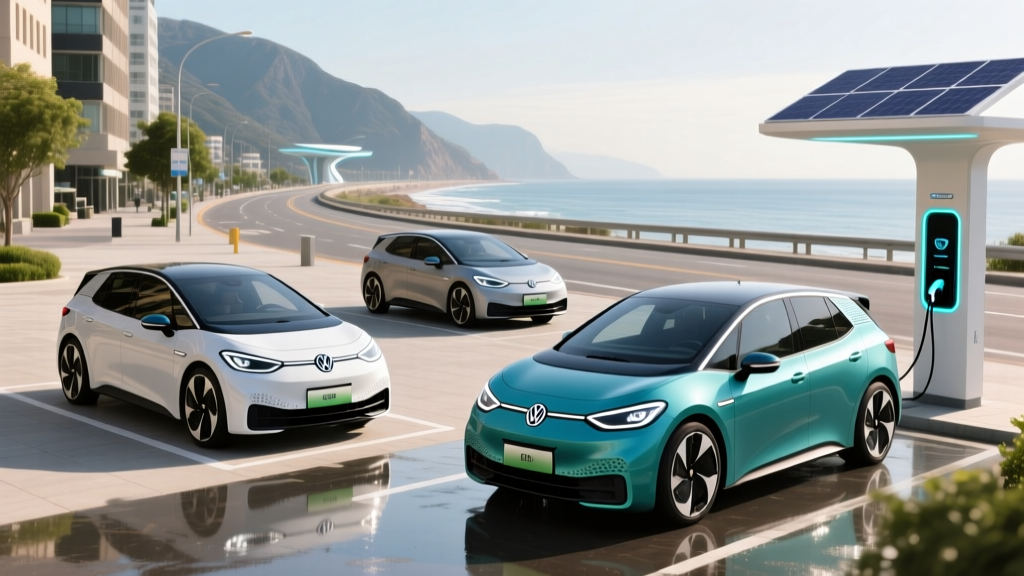
Volkswagen's ID. family started as a parade of futuristic concepts at auto shows. By 2026, several of those concepts have become real, buyable EVs on U.S. soil — while others remain vaporware or Europe-only exclusives. If you've been searching VW ID concepts wondering which ones you can actually drive home, this guide separates the production reality from the auto-show fantasy, with exact EPA range figures, charging speeds, and current federal tax-credit eligibility for each model.
From Concept to Curb: The VW ID. Lineup in 2026
Volkswagen committed to the ID. sub-brand in 2016, unveiling concept after concept on its MEB (Modularer E-Antriebs-Baukasten) platform. The strategy was ambitious: electrify everything from compact hatchbacks to three-row buses. The U.S. market, however, received a curated subset. Here's the current production status:
- ID.4 — Compact SUV (on sale since 2021, refreshed for 2025/2026)
- ID.7 — Midsize sedan/fastback (U.S. launch confirmed for late 2025/early 2026)
- ID.Buzz — Retro electric minivan (U.S. long-wheelbase version on sale 2025+)
- ID.2all / ID.3 — Compact hatchbacks (Europe only, no U.S. plans)
- ID.GTI Concept — Hot hatch concept (announced, no production date)
Below, we profile each U.S.-available model with the exact numbers buyers need.
2026 VW ID.4: The Volume Seller
| Spec | Standard Range (RWD) | Pro AWD |
|---|---|---|
| EPA Range | 206 mi | 263 mi |
| Battery (usable) | 62 kWh (NMC) | 77 kWh (NMC) |
| Max DC Fast Charge | 135 kW | 175 kW |
| 10–80% DC Time | ~30 min | ~28 min |
| Level 2 Home Rate | 11 kW (~37 mi/hr) | 11 kW (~37 mi/hr) |
| 0–60 mph | 7.7 sec | 5.4 sec |
| Horsepower | 201 hp | 295 hp |
| Drivetrain | RWD | Dual-motor AWD |
| EPA Efficiency | 104 MPGe (29 kWh/100mi) | 98 MPGe (34 kWh/100mi) |
| Cargo (behind 2nd row) | 30.3 cu ft (64.2 cu ft folded) | |
| Rear Legroom | 37.6 in | |
| Base MSRP | $39,735 | $46,880 |
Charging Curve Reality
The ID.4's 175 kW peak (AWD) sounds competitive, but peak rate only holds between roughly 10–35% State of Charge. The curve tapers significantly above 60%, and charging from 80–100% can add another 25 minutes. For road-trip planning, budget 28 minutes for 10–80%, but always precondition the battery via the navigation system's charge-stop routing for best results.
2026 VW ID.7: The Tesla Model 3 Fighter
| Spec | ID.7 Pro (RWD) | ID.7 GTX (AWD) |
|---|---|---|
| EPA Range | ~340 mi (est.) | ~300 mi (est.) |
| Battery (usable) | 77 kWh (NMC) | 77 kWh (NMC) |
| Max DC Fast Charge | 200 kW | 200 kW |
| 10–80% DC Time | ~26 min | ~26 min |
| Level 2 Home Rate | 11 kW (~42 mi/hr) | 11 kW (~42 mi/hr) |
| 0–60 mph | 6.5 sec (est.) | 5.2 sec (est.) |
| Horsepower | 282 hp | 335 hp |
| Drivetrain | RWD | Dual-motor AWD |
| EPA Efficiency | ~120 MPGe (est.) | ~105 MPGe (est.) |
| Cargo (trunk) | 19.8 cu ft (hatchback: 42.4 cu ft Touring) | |
| Rear Legroom | 38.2 in | |
| Base MSRP (est.) | ~$48,000 | ~$55,000 |
Standout Tech & Drawbacks
The ID.7 introduces VW's latest 4.0 infotainment software with a 15-inch display, improved capacitive touch sliders (a sore point in early ID.4 models), and an available augmented-reality head-up display. The optional "Touring" wagon variant offers exceptional cargo versatility. However, VW's software has historically lagged rivals in responsiveness, and the ID.7 lacks a frunk — a missed opportunity in a segment where the Hyundai Ioniq 6 and Tesla Model 3 both offer front storage.
2026 VW ID.Buzz: The Electric Bus Returns
| Spec | ID.Buzz LWB AWD |
|---|---|
| EPA Range | 231 mi |
| Battery (usable) | 86 kWh (NMC) |
| Max DC Fast Charge | 200 kW |
| 10–80% DC Time | ~26 min |
| Level 2 Home Rate | 11 kW (~36 mi/hr) |
| 0–60 mph | 7.9 sec |
| Horsepower | 330 hp |
| Drivetrain | Dual-motor AWD |
| EPA Efficiency | 81 MPGe (41 kWh/100mi) |
| Cargo (behind 3rd row) | 18.3 cu ft |
| Cargo (2nd row folded) | 80.2 cu ft |
| Passenger Capacity | 7 |
| Base MSRP | $59,995 |
Federal Tax Credit Eligibility (§30D Rules for 2026)
The IRS §30D clean vehicle credit remains complex. Eligibility depends on MSRP caps, buyer income limits, battery-component sourcing, and critical-mineral requirements. Here's where VW's ID. lineup stands:
| Model | Base MSRP | MSRP Cap Met? | Est. Credit | Effective Price |
|---|---|---|---|---|
| ID.4 Standard Range | $39,735 | Yes (SUV cap: $80K) | $3,750–$7,500* | $32,235–$35,985 |
| ID.4 Pro AWD | $46,880 | Yes | $3,750–$7,500* | $39,380–$43,130 |
| ID.7 Pro (est.) | ~$48,000 | Yes (Sedan cap: $55K) | $3,750–$7,500* | ~$40,500–$44,250 |
| ID.Buzz LWB AWD | $59,995 | Yes (Minivan/SUV cap: $80K) | $3,750–$7,500* | $52,495–$56,245 |
*Credit amount depends on battery-sourcing compliance (critical minerals + battery components). VW has been working to localize battery supply, but the full $7,500 requires both thresholds met. Buyer income caps also apply: $300K joint / $225K head-of-household / $150K individual MAGI. Point-of-sale transfer is available at participating dealers. Always verify current eligibility on fueleconomy.gov before purchasing.
Warranty Coverage
All 2026 VW ID. models carry:
- Basic warranty: 4 years / 50,000 miles
- Battery & powertrain: 8 years / 100,000 miles (capacity retention threshold: 70%)
- Corrosion perforation: 7 years / 100,000 miles
- Roadside assistance: 4 years / 50,000 miles
The 70% battery-capacity threshold is standard for the industry but less generous than Hyundai/Kia's 65% guarantee over the same period. VW does not currently offer a free scheduled-maintenance plan for ID. models.
How VW ID. Models Compare to Key Competitors
| Spec | VW ID.4 AWD | Hyundai Ioniq 5 AWD | Tesla Model Y LR AWD |
|---|---|---|---|
| EPA Range | 263 mi | 260 mi | 303 mi |
| Battery | 77 kWh NMC | 77.4 kWh NMC | ~75 kWh NMC |
| Max DC Charge | 175 kW | 233 kW | 250 kW |
| 10–80% Time | ~28 min | ~18 min | ~20 min |
| 0–60 mph | 5.4 sec | 5.0 sec | 4.8 sec |
| Base MSRP (AWD) | $46,880 | $49,750 | $48,990 |
| Cargo | 30.3 cu ft | 27.2 cu ft | 30.2 cu ft |
The ID.4 trails the Ioniq 5 and Model Y in DC charging speed — a meaningful gap on road trips where the Hyundai adds 100 miles in roughly 12 minutes versus 18 minutes for the VW. The ID.4 compensates with a slightly more traditional interior layout, a more compliant ride, and competitive cargo volume. The Model Y still wins on range and Supercharger network access, though VW's Electrify America partnership has improved public charging reliability.
Pros
- Comfortable, car-like driving dynamics with compliant suspension
- Generous rear-seat legroom across all ID. models
- ID.Buzz offers unmatched 7-passenger electric versatility
- ID.4 is one of the most affordable AWD electric SUVs
- Improved 4.0 infotainment in 2025/2026 models
Cons
- DC charging speeds trail Hyundai/Kia and Tesla rivals
- Software still occasionally sluggish vs. competitors
- No frunk on any ID. model
- ID.Buzz range is limited for road trips
- ID.7 U.S. availability delayed; pricing still preliminary
Who Should Buy a VW ID. Vehicle?
Choose the ID.4 if: You want a practical, comfortable compact electric SUV for daily commuting and moderate road trips, and you value ride quality and interior space over maximum charging speed. The AWD Pro at ~$47K is the sweet spot.
Choose the ID.7 if: You're a sedan buyer who wants 300+ miles of range, a spacious rear seat, and European driving refinement — and you're willing to wait for U.S. deliveries to stabilize.
Choose the ID.Buzz if: You need 7-passenger electric seating, love the retro design, and your driving is primarily local/suburban. Accept that road trips will require 30-minute charge stops every 180 miles.
Look elsewhere if: Maximum DC fast-charging speed is your priority (see Ioniq 5), you need 320+ miles of range (see Tesla Model Y or Hyundai Ioniq 6), or you want the most proven software stack (Tesla).
Frequently Asked Questions
What is the real-world range of VW ID. models?
Real-world range depends on speed, temperature, and terrain. The ID.4 AWD delivers ~230–240 highway miles in mild weather, dropping to ~175–195 in freezing cold. The ID.Buzz manages ~185–200 highway miles. The ID.7 (est. ~340 EPA) should deliver ~290–310 highway miles in ideal conditions.
How fast do VW ID. vehicles charge?
At a DC fast charger, the ID.4 AWD peaks at 175 kW (10–80% in ~28 minutes), while the ID.7 and ID.Buzz peak at 200 kW (~26 minutes). At home on Level 2 (240V, 48A), all models accept 11 kW, adding roughly 36–42 miles of range per hour — enough for a full overnight charge.
How much does a VW ID. cost after tax credits?
After the federal §30D credit (up to $7,500, depending on battery-sourcing compliance and buyer income), the ID.4 AWD can drop from $46,880 to roughly $39,380–$43,130. The ID.Buzz falls to approximately $52,495–$56,245. Check fueleconomy.gov for current sourcing-compliance status before purchasing.
Do VW ID. models qualify for the federal EV tax credit?
All current U.S. ID. models meet the MSRP caps. Full $7,500 credit eligibility depends on battery-component and critical-mineral sourcing thresholds, which VW has been progressively localizing. Buyer MAGI limits apply ($300K joint / $150K individual). The credit can be transferred at point of sale as an instant rebate at participating dealerships.
Is the VW ID.4 worth buying vs. the Hyundai Ioniq 5 or Tesla Model Y?
The ID.4 wins on ride comfort and value (lowest AWD starting price). The Ioniq 5 wins on charging speed (233 kW vs. 175 kW) and 800V architecture. The Model Y wins on range (303 mi) and Supercharger network access. Your priority — comfort, charging speed, or range — determines the best pick.
Which VW ID. concepts are still not available?
The ID.2all (affordable compact hatch), ID.GTI concept (performance hatch), and ID.Cross Turismo concepts remain either Europe-only or without confirmed U.S. production dates as of 2026. The ID.Life concept (small urban SUV) has not been confirmed for any market.