A salvaged Tesla can look like the deal of a lifetime on auction sites — a 2024 Model 3 Long Range with a branded title selling for $18,000 when the clean-title equivalent commands $35,000+. But the gap between a smart bargain and a financial nightmare in the salvage EV world is measured in kilowatt-hours, not miles. This guide dissects exactly what you're getting when you buy a salvaged Tesla in 2026, with hard data on battery integrity, real-world range expectations, charging performance, warranty implications, and the total cost equation that most sellers won't show you.
What "Salvage Title" Actually Means for a Tesla
A salvage title is issued when an insurance company declares a vehicle a total loss — meaning repair costs exceed a threshold percentage of the vehicle's pre-damage value (typically 70-100%, varying by state). For Teslas, the most common causes are collision damage, flood submersion, and — increasingly — battery pack damage from curb strikes or road debris.
Here's the critical distinction for EV buyers: a salvage title on a Tesla doesn't just affect cosmetics and resale value the way it might on a gas car. It directly impacts the most expensive component — the high-voltage traction battery — and can void remaining factory warranty coverage. Tesla's New Vehicle Limited Warranty explicitly states that vehicles with salvage or rebuilt titles are not covered under the Battery and Drive Unit Limited Warranty.
Once a Tesla receives a salvage title, it must pass a state inspection to receive a "rebuilt" title before it can be legally driven and registered. The rigor of these inspections varies enormously by state — some require detailed structural and electrical checks, while others are largely administrative.
Real-World Range: What to Expect from a Salvaged Tesla Battery
EPA Estimated: 341 miles (75 kWh usable, NMC chemistry)
Real-World Highway (70 mph, 72°F): ~285-305 miles
Real-World Highway (32°F, no heat pump preconditioning): ~225-260 miles
Real-World City with Regen: ~310-330 miles
Salvaged Battery Caveat: Expect 5-15% additional range loss if the pack sustained partial cell damage or has degraded beyond normal calendar aging. Always request a battery health scan showing individual module voltage deltas before purchase.
For the most popular salvaged Tesla models, here's what the EPA numbers and real-world expectations look like:
| Model / Trim | Battery (kWh Usable) | Chemistry | EPA Range | Real-World Expectation | Salvaged Risk Range |
|---|---|---|---|---|---|
| Model 3 RWD (2024-25) | 57.5 | LFP | 272 mi | 230-255 mi | 200-240 mi |
| Model 3 LR AWD (2024-25) | 75 | NMC | 341 mi | 285-310 mi | 250-295 mi |
| Model Y LR AWD (2024-25) | 75 | NMC | 308 mi | 260-285 mi | 230-270 mi |
| Model S LR (2024-25) | 95 | NMC | 402 mi | 340-370 mi | 300-350 mi |
LFP (lithium iron phosphate) batteries in the base Model 3 RWD are more resilient to partial damage scenarios because their cell chemistry is inherently more stable and less prone to thermal runaway. However, LFP packs have lower energy density, meaning fewer miles to begin with. NMC (nickel manganese cobalt) packs in Long Range and Performance trims offer more range but are more sensitive to thermal events and physical damage to individual cells.
Charging Specs: What Changes (and What Doesn't) After Salvage
If the battery pack itself wasn't structurally compromised and the vehicle's onboard charger and high-voltage architecture are intact, a rebuilt Tesla should charge at factory-spec speeds. But "if" is doing enormous work in that sentence. Here are the baseline specs you should expect:
| Charging Level | Model 3 / Y | Model S / X | Miles Added per Hour |
|---|---|---|---|
| Level 1 (120V, 12A) | 1.4 kW | 1.4 kW | 3-5 mi/hr |
| Level 2 (240V, 48A) | 11.5 kW | 11.5 kW | 30-44 mi/hr |
| DC Fast Charge (V3 Supercharger) | 250 kW peak | 250 kW peak | ~175 mi in 15 min |
| 10-80% DC Fast Charge Time | ~25-28 min | ~30-35 min | — |
Salvaged battery charging reality: If individual modules were replaced during the rebuild using non-matched cells, the Battery Management System (BMS) may limit charge rates to protect weaker modules. Expect the charge curve to taper earlier — instead of sustaining peak kW until ~55% State of Charge (SoC), a repaired pack may begin tapering at 40-45%. This can add 5-10 minutes to a 10-80% session. Always test-charge at a Supercharger before finalizing a purchase and monitor the charge curve on the vehicle's display.
Teslas use the NACS (North American Charging Standard) connector natively. In 2026, this is the dominant DC fast-charging standard in the US, with Ford, GM, Rivian, and most other automakers having adopted it. You'll have the widest access to public charging infrastructure of any EV brand — a genuine advantage when buying used.
Performance, Tech, and What Survives a Rebuild
| Specification | Value |
|---|---|
| 0-60 mph | 4.2 seconds |
| Horsepower | 346 hp (dual motor) |
| Drivetrain | AWD (dual motor, permanent magnet rear + induction front) |
| Efficiency (EPA) | 132 MPGe combined / 25 kWh per 100 mi |
| Cargo Volume | 23 cu ft (rear trunk) + 3 cu ft (frunk) |
| Rear Legroom | 35.2 inches |
| Curb Weight | 4,034 lbs |
Performance specs remain factory-accurate if the drive units, inverter, and battery are undamaged. Tesla's dual-motor powertrain is remarkably robust — the permanent magnet synchronous rear motor and induction front motor have few wear components. Where salvaged Teslas often show weakness is in ADAS calibration.
Tech and Driver Assistance: All 2024-2025 Teslas feature Tesla Vision (camera-only, no radar or ultrasonic sensors), a 15.4-inch center touchscreen, over-the-air updates, and the option to subscribe to FSD (Supervised). However, FSD (Supervised) is an SAE Level 2 driver-assistance system — not self-driving. The driver must remain fully engaged, hands on or near the wheel, and eyes on the road at all times.
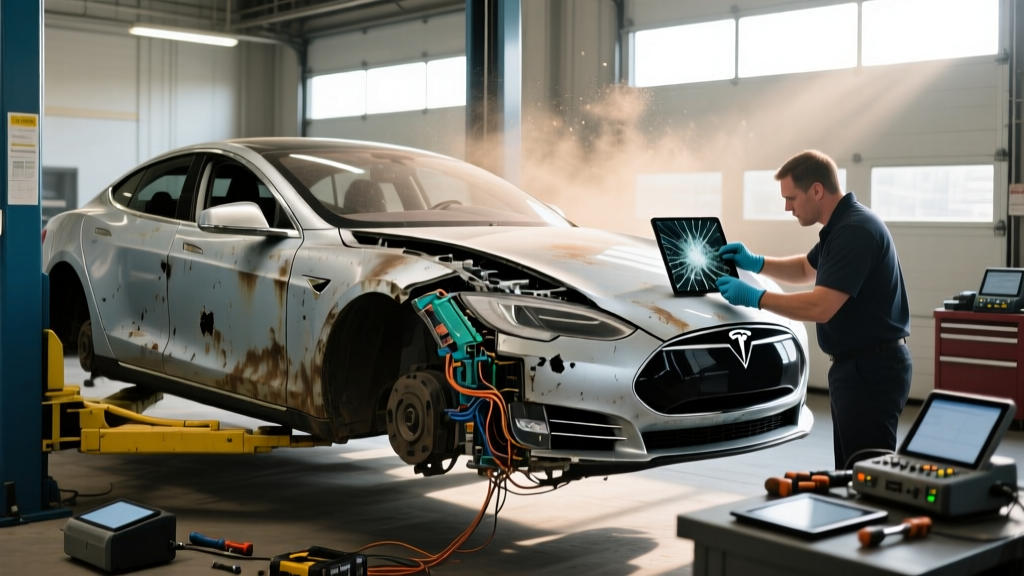
After any structural repair — especially windshield replacement, front bumper work, or suspension changes — Tesla's camera-based Autopilot and FSD systems require precise recalibration. If the body shop that rebuilt the vehicle did not perform camera alignment using Tesla's proprietary tools, you may experience phantom braking, lane-centering drift, or degraded emergency braking performance. Budget $300-$600 for a Tesla Service Center calibration visit post-purchase, and verify all cameras are recognized in the service menu before driving.
The Price Equation: Salvaged Tesla Cost Breakdown
| Cost Factor | Clean Title (Used) | Salvaged / Rebuilt Title |
|---|---|---|
| Purchase Price | $32,000-$37,000 | $17,000-$24,000 |
| Federal §30D Tax Credit (Used EV) | Up to $4,000* | $0 (not eligible) |
| Insurance (Annual, Full Coverage) | $2,200-$3,000 | $2,800-$4,500 (or declined) |
| Pre-Purchase Battery Inspection | N/A | $200-$500 |
| ADAS Camera Recalibration | N/A | $300-$600 |
| Resale Value (3 years later) | $20,000-$25,000 | $8,000-$14,000 |
*The IRS §30D used EV credit allows up to $4,000 or 30% of the sale price (whichever is lower) for qualified previously-owned clean vehicles. The vehicle must be purchased from a licensed dealer, have an MSRP under $25,000 (for the used credit — note this is significantly lower than the new-vehicle caps), and the buyer must meet income thresholds ($75,000 single / $150,000 joint). Salvaged-title vehicles are generally ineligible because dealers typically will not retail them, and the credit requires a dealer sale with a valid VIN report showing clean history. Consult a tax professional before relying on this credit.
The raw purchase-price savings of $10,000-$18,000 are real. But the total-cost picture narrows that gap substantially when you factor in lost tax credit eligibility, higher insurance premiums (or outright coverage denials), accelerated depreciation, and potential out-of-warranty battery repair costs.
Warranty: What Tesla Will and Won't Cover
This is where salvaged Tesla ownership gets painful. Tesla's warranty policy is unambiguous:
- New Vehicle Limited Warranty (4 yr / 50,000 mi): Voided entirely by a salvage or rebuilt title.
- Battery and Drive Unit Warranty (8 yr / 100,000 mi for Model 3/Y LR; 8 yr / 120,000 mi for Model S/X): Voided by salvage title. This is the warranty that covers battery capacity falling below 70% of original — the single most valuable protection an EV buyer has.
- Goodwill / Out-of-Warranty Repairs: Tesla Service Centers may refuse to work on salvaged vehicles entirely, or may limit service to non-high-voltage systems. Third-party EV repair shops are your fallback, but the network is thin outside major metro areas.
- Over-the-Air Updates: These generally continue to function on rebuilt-title Teslas. However, Tesla has been known to restrict certain features (like FSD transfer or subscription eligibility) on vehicles with branded titles.
A replacement Tesla battery pack in 2026 costs between $12,000 and $22,000 depending on model and capacity, installed. Without warranty coverage, that cost falls entirely on the owner if the pack degrades prematurely or sustains damage.
Pros and Cons: The Honest Scorecard
Pros
- Purchase price 40-55% below clean-title equivalent
- Access to Tesla Supercharger network (NACS native)
- OTA software updates still typically function
- Strong performance if powertrain is undamaged
- LFP battery models (Model 3 RWD) offer more damage resilience
- Low running costs (electricity vs. gas) remain unchanged
Cons
- All factory warranties voided — including 8-yr battery coverage
- Federal used-EV tax credit (§30D) generally unavailable
- Insurance premiums 25-60% higher; some carriers refuse coverage
- Resale value 50-65% lower than clean-title equivalent
- Tesla Service Centers may refuse high-voltage work
- Hidden battery damage risk (cell imbalance, coolant intrusion)
- ADAS calibration may be compromised post-repair
- Flood-damaged packs carry latent thermal runaway risk
Who Should (and Shouldn't) Buy a Salvaged Tesla
Choose a Salvaged Tesla If:
- You're a DIY-capable owner who can perform basic diagnostics and has access to third-party EV repair
- You plan to drive the car into the ground (5+ years) where resale value is irrelevant
- The damage was cosmetic only (verified by pre-purchase inspection with battery scan data)
- You have access to affordable insurance that will write a full-coverage policy on a rebuilt title
- You're buying a Model 3 RWD with an LFP pack (more resilient chemistry, lower pack replacement cost)
Choose a Clean-Title Used Tesla (or a Competitor) If:
- You need warranty protection for the battery — this is non-negotiable for most buyers
- You want to qualify for the $4,000 used EV tax credit
- You plan to resell within 3-4 years and need predictable depreciation
- You live in an area without third-party EV repair options
- The vehicle was flood-damaged or has documented battery pack intrusion
- You rely on FSD (Supervised) and can't risk ADAS calibration issues
Key Competitors: Clean-Title Alternatives at Similar Net Cost
When you add up the true cost of a salvaged Tesla (purchase + lost credit + insurance premium + depreciation risk), you're often within $3,000-$6,000 of a clean-title competitor with full warranty:
- 2023-2024 Hyundai Ioniq 6 SE (clean used, ~$27,000-$31,000): EPA 361 miles, 800V architecture for 10-80% in ~18 min at 350 kW chargers, full warranty intact, §30D eligible from a dealer.
- 2023-2024 Chevrolet Equinox EV 2LT (clean used, ~$28,000-$33,000): EPA 319 miles, qualifies for used-EV credit from a dealer, GM warranty transferable.
- 2024 Tesla Model 3 RWD (clean used, ~$29,000-$33,000): EPA 272 miles, LFP battery, remaining factory warranty, eligible for $4,000 used credit from a licensed dealer.
Frequently Asked Questions
What is the real-world range of a salvaged Tesla Model 3 Long Range?
Expect 250-295 miles depending on battery condition, temperature, and driving style. The EPA sticker reads 341 miles, but real-world highway driving at 70 mph yields ~285-305 miles even in a clean-title car. A salvaged pack with module-level damage or above-normal degradation will lose an additional 5-15% from those real-world numbers. Cold weather (below freezing) compounds the loss further, dropping range to 225-260 miles on a healthy pack.
How fast does a salvaged Tesla charge?
If the battery and high-voltage system are intact, factory-spec: 250 kW peak DC fast charging, 10-80% in approximately 25-28 minutes, and 11.5 kW on Level 2 home charging (about 30-44 miles per hour). However, a repaired pack with mismatched modules may see the BMS taper charge rates earlier in the session, adding 5-10 minutes to a 10-80% charge. Always test at a Supercharger before purchasing.
Does a salvaged Tesla qualify for the federal EV tax credit?
Almost certainly not. The IRS §30D used-EV credit (up to $4,000) requires purchase from a licensed dealer, and most dealers will not retail salvage-title vehicles. Additionally, the vehicle must have a sale price under $25,000 and the buyer must meet income caps ($75,000 single / $150,000 joint). Even if you find a dealer willing to sell a rebuilt-title Tesla, the vehicle history report will flag the branded title, and the IRS requires the dealer to report the VIN and sale details. Consult a tax professional before assuming eligibility.
Is a salvaged Tesla worth buying vs. a clean-title competitor?
It depends on your risk tolerance, repair access, and ownership timeline. The upfront savings of $10,000-$18,000 are real, but the total cost gap narrows to $3,000-$8,000 when you account for lost tax credits, higher insurance, steeper depreciation, and zero warranty protection. For a mechanically savvy owner planning to keep the car 5+ years with verified cosmetic-only damage, a salvaged Tesla can be a rational purchase. For everyone else, a clean-title used EV with remaining warranty and tax credit eligibility is the safer financial choice.
What are the biggest risks of buying a salvaged Tesla?
The three biggest risks are: (1) undetected battery pack damage — coolant intrusion or cell-level damage that doesn't manifest until months later, with replacement costs of $12,000-$22,000; (2) compromised ADAS calibration from structural repairs done without Tesla's proprietary alignment tools, potentially affecting automatic emergency braking and lane-keeping; (3) insurance coverage denial or premiums so high they erase the purchase-price savings within 3-4 years.
Can Tesla Service Centers work on a salvaged Tesla?
Tesla's official policy is to decline high-voltage system work on vehicles with salvage or rebuilt titles. This includes battery diagnostics, drive unit replacement, and high-voltage cable repairs. You may still receive service for 12V systems, infotainment, suspension, and cosmetic items — but policies vary by service center. Third-party EV specialists are an option, but the network is limited and not all have access to Tesla-specific diagnostic software.
Sources: EPA fuel economy data from fueleconomy.gov; Tesla warranty terms from tesla.com/support; IRS §30D used vehicle credit rules from irs.gov.