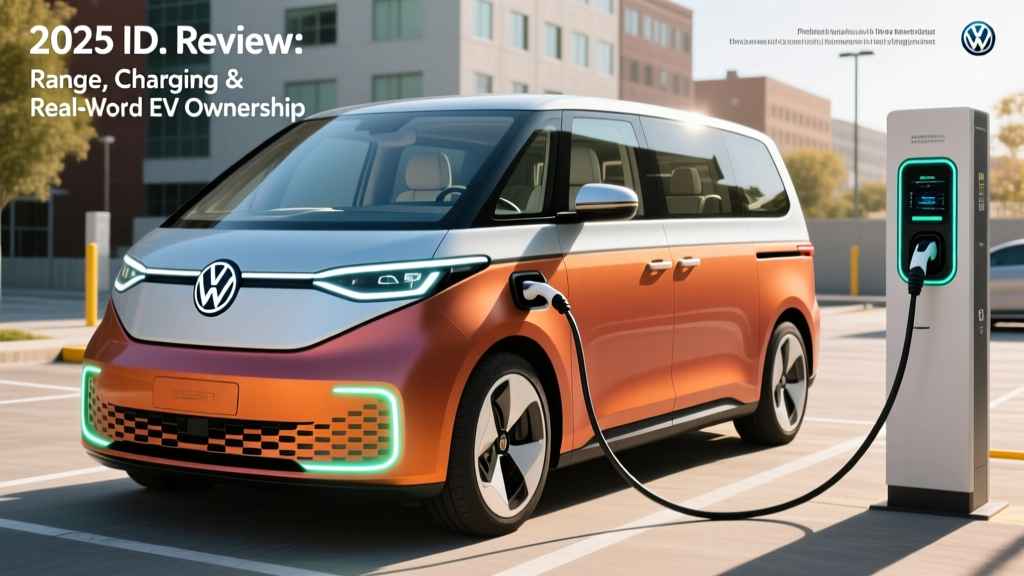
The 2025 Volkswagen ID. Buzz arrived in the United States carrying decades of Microbus nostalgia and a thoroughly modern electric powertrain. But retro charm doesn't charge your battery or fit your family's gear. After examining EPA data, real-world driving variables, and Volkswagen's published specifications, here's what prospective buyers actually need to know about the VW ID. Buzz van before signing a purchase agreement.
Range, Battery, and Efficiency: What the Numbers Actually Mean
The US-spec ID. Buzz is equipped with a 91 kWh gross battery pack (approximately 86 kWh usable) using NMC (nickel manganese cobalt) lithium-ion chemistry. This is a larger pack than the European-market short-wheelbase version, necessary to move the longer, heavier American model.
| Specification | 2025 VW ID. Buzz (RWD) | 2025 VW ID. Buzz (AWD) |
|---|---|---|
| EPA Estimated Range | 234 miles | 231 miles |
| Battery (Gross / Usable) | 91 kWh / ~86 kWh | 91 kWh / ~86 kWh |
| Battery Chemistry | NMC | NMC |
| Combined MPGe | 87 MPGe | 84 MPGe |
| Efficiency (kWh/100 mi) | 39 kWh/100 mi | 40 kWh/100 mi |
| Drivetrain | Rear-Wheel Drive | Dual-Motor AWD |
According to fueleconomy.gov, the RWD ID. Buzz achieves 87 MPGe combined. That's respectable for a vehicle of this size but noticeably lower than a Tesla Model Y (approximately 117 MPGe combined) or a Hyundai Ioniq 5 (114 MPGe combined). If efficiency is your top priority, the ID. Buzz is not the segment leader. If space and character are, it has few rivals.
Charging Speed and Infrastructure: DC Fast and Home Level 2
Charging capability is where three-row EV buyers need to pay close attention. The ID. Buzz supports a peak DC fast-charge rate of 170 kW on a CCS1 connector — adequate, but not class-leading in 2025.
| Charging Level | Power | Speed / Time |
|---|---|---|
| Level 1 (120V household) | ~1.4 kW | ~3–4 miles per hour |
| Level 2 (240V home/public) | 11 kW (max onboard) | ~25–28 miles per hour; full charge in ~9 hours |
| DC Fast Charge (CCS1) | 170 kW peak | 10–80% in approximately 26 minutes |
The 10–80% DC fast-charge time of roughly 26 minutes is competitive with vehicles like the Kia EV9 (which peaks higher at 236 kW but has a similar-size battery). However, the ID. Buzz uses the CCS1 connector standard. Volkswagen has confirmed that future models will adopt the NACS (Tesla-style) connector, but the 2025 ID. Buzz ships with CCS1. This means access to Tesla Supercharger stations requires a CCS-to-NACS adapter — functional, but an added friction point on road trips.
At home on a Level 2 charger, the 11 kW onboard charger replenishes the pack from empty in about 9 hours. For most owners plugging in overnight, this is perfectly adequate — you'll wake up to a full battery every morning. Budget $500–$1,500 for a quality Level 2 home charger installation (equipment plus electrician labor), depending on your panel capacity and run length.
Performance and Drivetrain
The ID. Buzz is not a performance vehicle, and Volkswagen isn't pretending otherwise. Here's what the powertrain delivers:
- RWD model: 282 horsepower, single rear motor, 0–60 mph in approximately 7.9 seconds
- AWD (4Motion) model: 335 horsepower combined, dual-motor, 0–60 mph in approximately 6.5 seconds
Acceleration is perfectly adequate for merging and passing, and the instant torque of the electric motors makes the van feel surprisingly responsive around town. The AWD model adds genuine all-weather capability, which matters for buyers in snow-belt states. However, the AWD variant costs roughly $4,000 more and sacrifices a small amount of range (231 vs. 234 miles EPA).
Ride quality is a genuine strength. The long wheelbase and low center of gravity (battery pack under the floor) deliver a composed, comfortable ride that absorbs road imperfections well. This is a family cruiser, not a canyon carver — and that's exactly right for the use case.
Pricing, Trims, and Federal Tax Credit Eligibility
The ID. Buzz is positioned as a premium electric van, and its pricing reflects that. Here's the 2025 MSRP breakdown:
| Trim | Drivetrain | Base MSRP |
|---|---|---|
| Pro S | RWD | $59,995 |
| Pro S | AWD (4Motion) | $63,995 |
| Pro S Plus | RWD | $64,995 |
| Pro S Plus | AWD (4Motion) | $68,995 |
| 1st Edition (launch year) | AWD | $69,995 |
Destination charges add approximately $1,495. A well-equipped Pro S Plus AWD can land near $72,000 before incentives.
Does the VW ID. Buzz Qualify for the Federal EV Tax Credit?
Under current IRS §30D rules, the ID. Buzz faces significant hurdles for the full $7,500 federal tax credit:
- MSRP cap: Vans fall under the $80,000 MSRP cap for SUVs/vans — the ID. Buzz clears this threshold on all trims.
- Buyer income cap: Modified adjusted gross income must not exceed $150,000 (single) / $300,000 (joint filing).
- Battery sourcing requirements: Critical minerals and battery component sourcing rules tightened significantly through 2025. Volkswagen's supply chain for the ID. Buzz battery has not consistently met the full critical-minerals and battery-component thresholds required for the complete $7,500 credit.
- Point-of-sale transfer: If eligible, the credit can be applied at purchase rather than waiting for tax filing.
Bottom line: Consult a tax professional and check the latest fueleconomy.gov tax credit database for the current eligibility status of the specific trim you're considering. Partial credit ($3,750) may apply depending on which sourcing requirement is met. Do not assume the full $7,500 is available without verifying current-year rules.
Cargo Space, Passenger Room, and Practicality
This is the ID. Buzz's strongest argument. The US-market long-wheelbase version offers genuine three-row utility:
- Cargo behind third row: ~18.0 cubic feet (enough for several suitcases or a week of groceries for a large family)
- Cargo behind second row (third row folded): ~75.5 cubic feet
- Maximum cargo (all rear seats folded): ~132.0 cubic feet
- Second-row legroom: ~39.6 inches
- Third-row legroom: ~36.3 inches
- Seating: 7-passenger standard (2+3+2 configuration on most trims)
The second-row bench slides fore and aft, allowing you to prioritize legroom or cargo depending on the trip. The third row is genuinely usable for adults on shorter trips — a meaningful advantage over compact three-row crossovers where the way-back seats are punishment. The low, flat load floor (thanks to the skateboard-style EV platform) makes loading bulky items straightforward.
One practicality note: the ID. Buzz does not offer a front trunk (frunk). The space under the hood houses HVAC and power electronics. All cargo goes in the rear.
Technology, Driver Assistance, and Interior
The ID. Buzz runs Volkswagen's ID. Software 4.0 infotainment platform on a 12.9-inch touchscreen. The system is a meaningful improvement over earlier ID.4 software, with faster response times, better voice recognition, and a more logical menu structure. Wireless Apple CarPlay and Android Auto are standard.
Standard driver-assistance features under the IQ.DRIVE suite include:
- Adaptive cruise control with stop-and-go
- Lane-keeping assist and lane-centering
- Automatic emergency braking with pedestrian detection
- Blind-spot monitoring with rear cross-traffic alert
- Travel Assist (semi-automated lane-centering at highway speeds)
Available upgrades on higher trims include a head-up display with augmented-reality navigation overlays, a panoramic fixed glass roof with electrochromic dimming (Pro S Plus and above), Harman Kardon premium audio, and heated/ventilated front seats with massage function.
Notable drawbacks: The capacitive-touch steering wheel controls on early-production models drew widespread criticism for accidental inputs. Volkswagen has acknowledged this issue; verify whether your specific build includes the revised physical-button steering wheel. Additionally, the turning circle is larger than you might expect given the van's heritage — the long wheelbase means tighter parking maneuvers require patience.
Warranty and Long-Term Ownership
| Coverage | Term |
|---|---|
| Limited Vehicle Warranty | 4 years / 50,000 miles |
| Powertrain Warranty | 4 years / 50,000 miles |
| High-Voltage Battery Warranty | 8 years / 100,000 miles (minimum 70% capacity retention) |
| Roadside Assistance | 4 years / 50,000 miles |
The 8-year/100,000-mile battery warranty with a 70% capacity retention threshold is industry-standard and aligns with competitors like the Kia EV9 and Hyundai Ioniq 5. NMC chemistry in the ID. Buzz typically sees 8–12% degradation over the first 100,000 miles based on industry-wide data from similar packs — meaning most owners will retain 88–92% of original capacity well within the warranty window. Volkswagen covers the battery if it falls below 70% within the warranty period.
Pros, Cons, and Verdict: Who Should Buy the VW ID. Buzz Van?
Pros
- Genuine three-row, 7-passenger space with usable adult third row
- Massive cargo volume (132 cu ft max) with flat load floor
- Comfortable, composed ride quality for a large van
- Distinctive retro-modern design — nothing else looks like it
- Standard AWD availability for all-weather confidence
- Improved ID. Software 4.0 infotainment
Cons
- Starting price near $60,000 is steep for the segment
- Real-world highway range drops significantly (160–175 mi in cold weather)
- CCS1 connector — requires adapter for Tesla Superchargers
- 170 kW peak DC charge rate is average, not class-leading
- Federal tax credit eligibility uncertain due to battery sourcing rules
- No frunk; capacitive-touch controls may frustrate
Is the VW ID. Buzz Worth Buying?
Choose the ID. Buzz if: You need genuine three-row passenger space plus cargo volume, value ride comfort and distinctive design, charge primarily at home, and don't regularly drive more than 200 miles in a single day.
Look elsewhere if: Maximum range and charging speed are your top priorities (consider the Kia EV9 or Tesla Model X), you need the lowest possible price point, or you rely heavily on the Tesla Supercharger network without wanting to manage adapters.
Frequently Asked Questions
What is the real-world range of the VW ID. Buzz?
The EPA rates the RWD model at 234 miles combined. In real-world highway driving at 70–75 mph in mild weather, expect 200–215 miles. In freezing temperatures, range can drop to 160–175 miles. The boxy shape creates aerodynamic drag that disproportionately affects highway efficiency.
How fast does the ID. Buzz charge?
On a DC fast charger, the ID. Buzz peaks at 170 kW and charges from 10–80% in approximately 26 minutes. At home on a Level 2 (240V) charger at 11 kW, a full charge takes about 9 hours, adding roughly 25–28 miles of range per hour of charging.
Does the VW ID. Buzz qualify for the $7,500 federal EV tax credit?
Eligibility under IRS §30D depends on current-year battery sourcing requirements, your income level, and the MSRP cap (which the ID. Buzz clears as a van under $80,000). As of 2025, full credit eligibility is uncertain due to critical-minerals and battery-component sourcing thresholds. Verify at fueleconomy.gov and consult a tax professional before relying on the credit in your purchase decision.
How does the ID. Buzz compare to the Kia EV9?
The Kia EV9 offers a longer EPA range (up to 304 miles on the Light RWD trim), faster 236 kW DC charging, NACS connector compatibility, and a lower starting price (~$54,900). However, the EV9's third row is tighter for adults, and its cargo volume behind the third row is smaller. The ID. Buzz wins on interior space and ride comfort; the EV9 wins on range, charging speed, and value.
Is the VW ID. Buzz good for road trips?
It's capable but requires planning. With real-world highway range around 200 miles, you'll need a DC fast-charge stop roughly every 2.5–3 hours. The 26-minute 10–80% charge time is acceptable for a meal break. The main friction point is CCS1 connector availability — while Electrify America, EVgo, and ChargePoint networks support CCS, Tesla Superchargers require an adapter.
Can the ID. Buzz tow?
Volkswagen rates the US-spec ID. Buzz at a maximum towing capacity of 2,500 pounds (braked trailer). This is sufficient for a small utility trailer or a pair of jet skis, but not for a mid-size camper or boat. If towing is a priority, the Rivian R1S or Tesla Model X offer significantly higher ratings.